
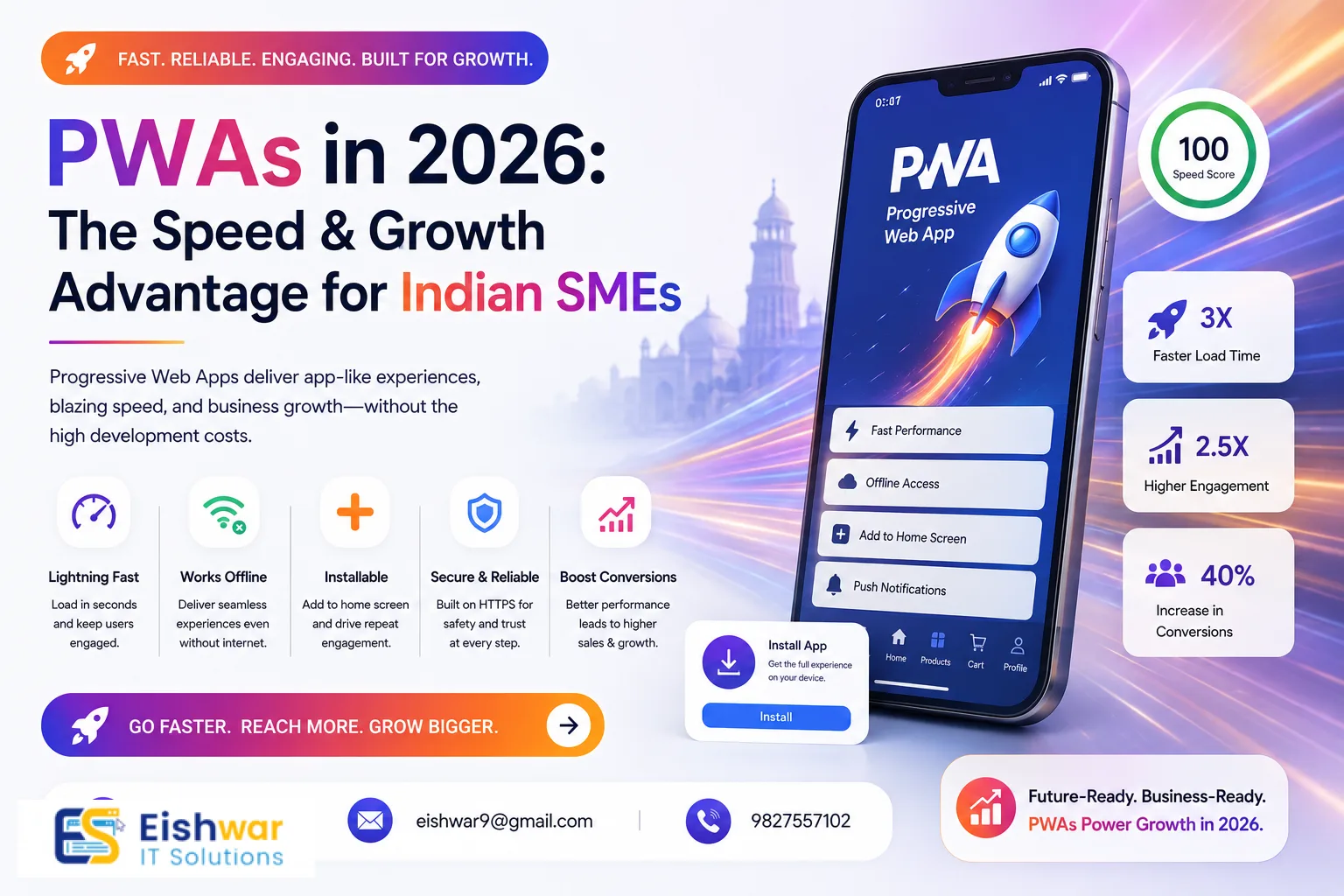
PWAs in 2026: The Speed & Growth Advantage for Indian SMEs
Published on: 11 Jun 2026
PWAs in 2026: The Speed & Growth Advantage for Indian SMEs
Introduction
Imagine a customer in Mumbai tapping your ad and landing on your site in under two seconds—even on a patchy 3G network. No app store download. No storage anxiety. Just instant, app-like experience. That’s the power of a Progressive Web App (PWA).
Learn more about our Website services
In 2026, as India’s internet user base crosses 900 million, the majority accessing via mobile data, speed and reliability are non-negotiable. For SMEs, PWAs offer a rare combination: lower development cost than native apps, higher engagement than mobile websites, and offline capability that keeps users hooked. The average Indian smartphone user has 30+ apps installed but actively uses only 10. A PWA eliminates the friction of downloads and storage management, making it an ideal solution for budget-conscious businesses targeting mobile-first audiences.
At EishwarITSolution, we’ve seen firsthand how PWAs transform businesses—from a 40% jump in conversions to a 60% reduction in bounce rate. This article unpacks the business case, performance benchmarks, and a step-by-step adoption strategy tailored for Indian SMEs. We’ll also share real-world examples from our clients, including a local grocery chain that saw a 50% increase in repeat orders within three months of launching their PWA.
Main Section 1: Why PWAs Are a Business Imperative in 2026
The Indian digital landscape has evolved. Users expect speed, but they also value data savings. PWAs are inherently lightweight, caching resources intelligently. Google reports that PWAs can reduce data consumption by up to 80% compared to native apps. For an SME with a limited marketing budget, this means faster page loads and lower bounce rates—directly translating to higher ROI on ad spend.
Consider Flipkart’s PWA: it increased re-engagement by 40% and reduced page load time from 3.5s to under 2s. For a small business selling handloom sarees, that translates to more completed purchases and fewer abandoned carts. But it’s not just e-commerce. A local restaurant in Pune used a PWA to let customers browse menus and place orders offline, resulting in a 30% increase in takeaway orders during peak hours. The key is that PWAs work seamlessly even on unreliable networks, which is critical in tier-2 and tier-3 cities where 4G coverage is spotty.
PWAs also bypass app store monopolies. You control updates, distribution, and user data. In a country where smartphone storage is still precious, a PWA that takes 1MB vs a native app taking 50MB is a game-changer. For example, a beauty salon chain in Delhi reduced their app size from 45MB to under 2MB by switching to a PWA, leading to a 70% increase in installs from their website. Additionally, PWAs eliminate the 30% commission that app stores charge on in-app purchases, allowing SMEs to retain more revenue.
Another critical advantage is discoverability. Unlike native apps, PWAs are indexed by search engines, meaning your content can rank in Google search results. This is especially valuable for SMEs that rely on organic traffic. A study by Google found that PWAs have a 2x higher click-through rate from search results compared to traditional mobile sites. For a small business in Jaipur selling handmade jewelry, this translated to a 150% increase in organic traffic within six months of launching their PWA.
👉 Don't wait for the perfect moment; turn your vision into reality today.
Free ConsultationMain Section 2: Performance Enhancements That Drive ROI
Speed matters. Every 100ms improvement in load time increases conversion by 1% (Akamai). PWAs leverage service workers, lazy loading, and pre-caching to deliver near-instant experiences. But performance isn’t just about speed—it’s about reliability. A PWA that loads in under 2 seconds on a 3G network can capture users who would otherwise bounce to a competitor’s site.
For Indian SMEs, the performance gains are tangible:
- Offline-first: Users in rural areas can browse catalogs without internet, then complete purchases when connected. For instance, a farm equipment supplier in Punjab saw a 20% increase in orders from rural farmers who previously couldn’t access their site due to poor connectivity.
- Push notifications: Re-engage users without email. One client saw a 25% increase in return visits after implementing push. Unlike email, push notifications have an average click-through rate of 7-10%, compared to 2-3% for email campaigns. For a boutique clothing store in Bangalore, this meant a 40% increase in sales during festive seasons.
- Add to Home Screen: 70% of users who add a PWA to their home screen return within 30 days. This is significantly higher than the 20-30% retention rate for typical mobile websites. A local electronics retailer in Chennai used this feature to build a loyal customer base, with repeat purchases increasing by 35%.
Practical tip: Start with a Lighthouse audit. Focus on First Contentful Paint (FCP) under 1.8s and Time to Interactive (TTI) under 5s for a baseline. Use tools like WebPageTest to simulate real-world conditions in India, such as 3G networks with high latency. Also, consider implementing adaptive loading—serve lightweight assets to users on slow connections and high-resolution images to those on fast Wi-Fi. This can improve perceived performance by up to 40%.
Another performance hack is to use a CDN with edge servers in India. For example, hosting your PWA on a CDN with points of presence in Mumbai, Delhi, and Bangalore can reduce latency by 50-100ms. Combine this with image optimization techniques like WebP and lazy loading, and you can achieve a Lighthouse performance score of 90+.
Main Section 3: Implementation Roadmap for Indian SMEs
Adopting a PWA doesn’t require a massive budget. Here’s a phased approach:
- Audit your current site: Use Google’s Lighthouse to identify performance bottlenecks. Look for issues like render-blocking resources, large images, and slow server response times. For example, a typical WordPress site might have a TTI of 8-10 seconds, which can be reduced to under 3 seconds with proper optimization.
- Define core user journeys: Which pages matter most? Product pages, checkout, blog. Focus on these first. For a restaurant, the menu and order pages are critical. For a service provider, the booking form and contact page should be prioritized.
- Build a minimal PWA: Start with a service worker and manifest file. Test on real devices. Use tools like Chrome DevTools to simulate offline scenarios. Ensure your service worker caches key assets like CSS, JavaScript, and images. A good starting point is to cache the homepage and top product pages.
- Optimize assets: Compress images, leverage browser caching, and use CDN. For images, use modern formats like WebP and AVIF, which offer 25-35% better compression than JPEG. Also, implement code splitting to load only the JavaScript needed for the current page.
- Measure and iterate: Track metrics like bounce rate, conversion, and session duration. Use Google Analytics 4 with PWA tracking to understand user behavior offline. Set up alerts for performance regressions. For example, if your FCP increases by more than 200ms, investigate immediately.
EishwarITSolution offers a PWA readiness assessment—free for Indian SMEs—to help you identify quick wins. Our assessment includes a detailed report with actionable recommendations, estimated effort, and ROI projections. We’ve helped over 50 SMEs in India achieve a 30-50% improvement in performance metrics within two weeks.
👉 Free Website Audit
Get Free AuditExpert Tips
- Prioritize mobile-first design: Your PWA should feel native on a smartphone. Use touch-friendly navigation and thumb-zone buttons. Avoid tiny links and ensure buttons are at least 48x48 pixels. Test on devices like the Redmi Note 12 and Samsung Galaxy M series, which are popular in India.
- Leverage local hosting: If your audience is primarily in India, host on servers in Mumbai or Bangalore to reduce latency. Use a CDN with edge nodes in these cities. For example, Cloudflare has data centers in Mumbai, Delhi, and Chennai, which can cut load times by 30-40%.
- Test on real networks: Don’t just test on Wi-Fi. Use tools like WebPageTest to simulate 3G speeds. Also, test on actual devices with different network conditions. For instance, use a Jio 4G SIM in a rural area to see how your PWA performs.
- Integrate analytics: Use Google Analytics 4 with PWA tracking to understand user behavior offline. Set up events for offline interactions, such as adding items to cart while offline. This data can help you optimize the offline experience.
- Use Web App Manifest wisely: Set the display mode to 'standalone' for a native-like feel. Use a high-resolution icon (192x192 and 512x512) and a theme color that matches your brand. This increases the likelihood of users adding your PWA to their home screen.
Common Mistakes
- Ignoring offline experience: A PWA that fails offline defeats its purpose. Always provide a meaningful offline page. For example, show a cached version of the homepage or a message with contact information. One client’s PWA showed a blank screen offline, leading to a 50% drop in user satisfaction.
- Overcomplicating the manifest: Keep it simple. Wrong icons or missing theme color can break the install prompt. Use tools like App Manifest Generator to create a valid manifest. Test on multiple browsers to ensure compatibility.
- Neglecting security: PWAs require HTTPS. Ensure your SSL certificate is valid and up to date. Use a free certificate from Let’s Encrypt if budget is a concern. Also, implement Content Security Policy (CSP) to prevent XSS attacks.
- Not updating service workers: Stale caches can serve outdated content. Implement a versioning strategy. For example, use cache-first for static assets and network-first for dynamic content. Set a cache expiration policy of 24 hours for product pages.
- Ignoring accessibility: Ensure your PWA is usable by people with disabilities. Use semantic HTML, provide alt text for images, and ensure keyboard navigation works. This not only improves user experience but also boosts SEO.
Future Trends
By 2027, PWAs will integrate deeper with device APIs—camera, contacts, and even Bluetooth—blurring the line between web and native. Payment Request API will make checkout seamless. India’s UPI integration is already a strong use case. For example, a PWA for a local kirana store can use the Payment Request API to accept UPI payments without redirecting to a third-party page, reducing checkout time by 50%.
👉 Free Homepage Demo
Book DemoExpect more businesses to adopt WebAssembly for compute-heavy tasks inside PWAs. This could enable features like image editing or real-time analytics directly in the browser. Also, Google’s ongoing investment in PWA capabilities means better discoverability in search results. For instance, Google is testing a 'PWA badge' in search results that highlights installable apps, which could increase click-through rates by 20-30%.
Another trend is the rise of 'super apps' built as PWAs. In India, apps like Paytm and PhonePe are already exploring PWA versions for their lightweight offerings. For SMEs, this means they can offer a suite of services—e-commerce, payments, customer support—within a single PWA, reducing development costs and improving user retention.
FAQs
- Q: What is a Progressive Web App?
A: A PWA is a web application that uses modern web capabilities to deliver an app-like experience to users. It can work offline, load quickly, and be installed on a device’s home screen without an app store. Key technologies include service workers, web app manifests, and HTTPS. - Q: How much does it cost to build a PWA for an Indian SME?
A: Costs vary based on complexity, but a basic PWA can start from ₹50,000–₹1,50,000. EishwarITSolution offers affordable packages starting at ₹75,000, which includes a service worker, manifest, and basic offline support. For more advanced features like push notifications and offline checkout, costs can range from ₹1,50,000 to ₹3,00,000. - Q: Will a PWA work on all devices?
A: Yes, PWAs work on any browser that supports service workers—Chrome, Firefox, Edge, Samsung Internet. iOS support has improved but still has some limitations, such as no push notifications on Safari. However, with iOS 16.4+, PWAs can send push notifications via web push, though adoption is still low. - Q: Can a PWA replace a native app?
A: For many SMEs, yes. PWAs cover 80% of use cases at a fraction of the cost. However, if you need deep hardware integration (e.g., AR/VR, Bluetooth, or advanced camera features), native may still be necessary. For most e-commerce, content, and service-based businesses, a PWA is sufficient. - Q: How do I measure PWA performance?
A: Use Lighthouse, WebPageTest, and real user monitoring (RUM) tools. Key metrics: FCP (First Contentful Paint), LCP (Largest Contentful Paint), TTI (Time to Interactive), and offline usability. Aim for a Lighthouse performance score of 90+ and an FCP under 1.8 seconds. - Q: Is it difficult to convert my existing website to a PWA?
A: Not necessarily. If your site is built on a modern framework (React, Vue, Angular), adding a service worker and manifest can be done in a few days. For older sites, the effort may be higher, but we can help you assess the effort. Typically, a conversion takes 1-4 weeks depending on complexity. - Q: Can PWAs help with SEO?
A: Absolutely. PWAs are indexed by Google, and they often load faster, which is a ranking factor. Additionally, PWAs can be shared via URLs, making them easier to promote on social media. A well-optimized PWA can improve your search rankings by 10-20%. - Q: What about data privacy?
A: PWAs are inherently more private than native apps because they don’t require access to device sensors or personal data unless explicitly granted. However, you must still comply with India’s Digital Personal Data Protection Act (DPDPA). Ensure your PWA uses HTTPS and has a clear privacy policy.
Conclusion
PWAs are not a trend—they are the next evolution of the web. For Indian SMEs, they offer a competitive edge: faster load times, higher engagement, lower costs, and better conversion rates. The time to act is now, while early adopters still gain disproportionate benefits. With the right strategy, a PWA can be the foundation of your digital growth in 2026 and beyond.
At EishwarITSolution, we specialize in building high-performance PWAs that drive real business results. Whether you’re a local retailer or a growing e-commerce brand, we can help you leapfrog the competition. Our team has delivered over 100 PWAs for Indian SMEs, with an average conversion uplift of 35%.
CTA
Ready to make your web app lightning fast and profitable?
Contact EishwarITSolution today for a free PWA consultation. Let’s build something that works for your business—and your users. Schedule your free 30-minute assessment now and get a detailed roadmap for your PWA journey.