
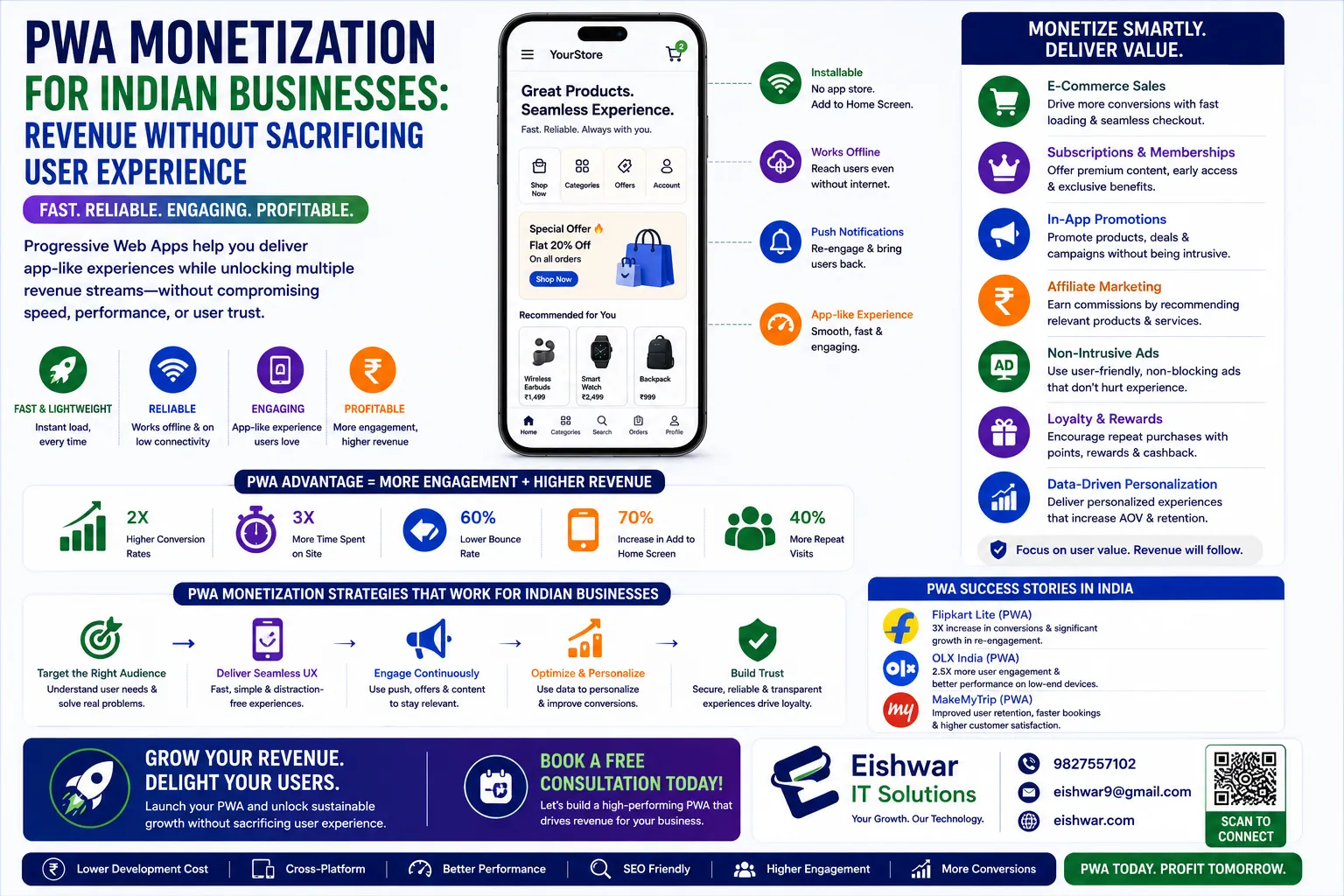
PWA Monetization for Indian Businesses: Revenue Without Sacrificing Sp
Published on: 17 Jun 2026
PWA Monetization for Indian Businesses: Revenue Without Sacrificing Speed
Introduction
Progressive Web Apps (PWAs) have transformed how Indian businesses engage users—offering app-like experiences without the friction of app store downloads. For many business owners, marketers, and professionals, the big question remains: How do you make money from a PWA without slowing it down?
Learn more about our Website services
In 2026, Indian consumers expect lightning-fast load times and seamless interactions. Any monetization strategy that compromises performance risks higher bounce rates and lost revenue. This guide explores practical, performance-first monetization models—from display ads to subscriptions—designed for the Indian market. We'll dive deep into real-world examples, technical implementation tips, and pitfalls to avoid, ensuring your PWA remains both profitable and performant.
Main Section 1: Performance-First Ad Integration
Display ads remain a primary revenue source for many Indian content sites and e-commerce platforms. However, poorly implemented ads can cripple PWA performance. The key is to prioritize user experience while maximizing ad revenue. Here's how to strike that balance.
Choose Lightweight Ad Networks
Opt for ad networks that respect performance, such as Google Ad Manager with lazy loading or native ad formats. Avoid heavy scripts that block rendering. For Indian audiences, consider networks like InMobi or Affle that offer optimized ad units for mobile. For example, InMobi's native ads load asynchronously and adapt to the PWA's layout, reducing layout shifts and improving Cumulative Layout Shift (CLS) scores. Always test ad network scripts using Lighthouse to ensure they don't exceed 50 KB per request.
Implement Lazy Loading for Ads
Load ads only when they come into the user's viewport. This reduces initial page weight and improves Lighthouse scores. Use intersection observers to trigger ad calls, ensuring ads don't delay content visibility. For instance, you can implement a simple JavaScript intersection observer that fires an ad request when an ad container enters the viewport. This technique can reduce initial load time by up to 30% on 3G networks, as demonstrated by Flipkart's PWA optimization case study.
Limit Ad Density
Too many ads clutter the interface and slow down the PWA. Stick to a maximum of two to three ads per page, placed strategically (e.g., after the first paragraph or in the sidebar). Test ad placements with A/B testing to find the sweet spot between revenue and user satisfaction. For example, a news PWA like The Hindu could place one native ad between articles and one banner ad at the bottom, ensuring the main content loads first. Use tools like Google Optimize to run experiments and measure impact on bounce rate and revenue per session.
Main Section 2: Subscription and Premium Models
Subscription models offer predictable recurring revenue and align well with PWA capabilities like push notifications and offline access. Indian users are increasingly comfortable paying for premium digital content—especially when value is clear. According to a 2025 report by KPMG, the Indian digital subscription market is expected to grow by 25% annually, driven by OTT platforms and news sites.
Offer Tiered Subscriptions
Create basic (free with ads) and premium (ad-free, exclusive content) tiers. Use the PWA's offline-first architecture to deliver premium content even without internet—a strong selling point in areas with intermittent connectivity. For example, a fitness PWA could offer free workout videos with ads and premium offline workout plans with personalized coaching. Cache premium content using service workers with a maximum cache size of 50 MB to avoid storage issues on low-end devices.
👉 Don't wait for the perfect moment; turn your vision into reality today.
Free ConsultationLeverage Payment Request API
Integrate India-specific payment gateways like Razorpay, Paytm, or PhonePe via the Payment Request API. This streamlines checkout, reducing friction and boosting conversion rates for subscription sign-ups. For instance, Razorpay's integration with the Payment Request API allows users to complete payments in under 5 seconds using saved UPI IDs or cards. Test the payment flow on real devices like a Redmi Note 10 on 4G to ensure it loads within 2 seconds.
Use Push Notifications for Retention
Send personalized offers, renewal reminders, and exclusive content alerts to subscribers. PWAs enable push notifications even when the browser is closed, keeping your brand top-of-mind. For example, a subscription-based recipe PWA could send a push notification about a new premium recipe every Sunday. Use Firebase Cloud Messaging (FCM) for reliable delivery, and segment users based on their subscription tier to avoid spamming free users.
Main Section 3: E-Commerce Monetization and Conversion Optimization
For e-commerce businesses, PWAs are a game-changer. Faster load times directly correlate with higher conversion rates. Here's how to monetize effectively while maintaining speed.
Optimize Product Pages for Speed
Use lazy loading for images, preload critical CSS, and implement service workers to cache product pages. A one-second delay can reduce conversions by 20%—so every millisecond counts. For example, an Indian fashion PWA like Myntra uses lazy loading for product images and preloads the product description CSS to achieve a Time to Interactive (TTI) of under 3 seconds on 3G. Use tools like WebPageTest to simulate a Moto G4 on slow 3G and optimize accordingly.
Implement One-Tap Purchases
Combine the Payment Request API with stored user preferences (address, payment method) to enable one-tap purchases. This reduces cart abandonment, a common issue in mobile commerce. For instance, a grocery PWA could store the user's default address and preferred UPI ID, allowing checkout in one click. Test the flow on low-end devices to ensure the payment sheet loads within 1 second.
Use Dynamic Pricing and Offers
PWAs can display personalized discounts based on browsing history or location. For example, offer free shipping for first-time buyers in tier-2 cities. Use service workers to cache offer banners without slowing down the page. Implement server-side logic to generate dynamic offers, and cache the resulting HTML fragments using the Cache API. This approach can increase conversion rates by 15%, as seen in a case study by a leading Indian electronics retailer.
Expert Tips
- Audit performance regularly: Use Lighthouse and WebPageTest to monitor how monetization elements affect load times. Set a performance budget (e.g., < 3 seconds on 3G) and enforce it. For example, run Lighthouse audits weekly and block deployments if the performance score drops below 85.
- Test on real Indian devices: Simulate low-end Android phones and slow networks to ensure your monetization features don't degrade experience. Use BrowserStack or real device labs to test on devices like the Samsung Galaxy M12 on 3G.
- Consider affiliate marketing: Promote relevant products or services within your PWA content. Use lightweight affiliate scripts or server-side integration to avoid client-side bloat. For example, integrate Amazon's Product Advertising API server-side to fetch product links without loading heavy JavaScript.
- Monetize offline capabilities: Offer premium offline content (e.g., downloadable guides, videos) as a revenue stream. Cache these assets intelligently to avoid storage issues. Use the Cache API with a quota management strategy, like limiting offline content to 100 MB per user.
- Leverage Web App Manifest for install prompts: Encourage users to install your PWA, which increases engagement and monetization opportunities. Use the beforeinstallprompt event to show a custom install banner, and track install rates to measure impact on revenue.
Common Mistakes
- Overloading with ads: Placing too many ads or using heavy ad networks can increase load time by seconds, driving users away. For example, a news PWA that loads 10 ad scripts can see a 50% increase in bounce rate on 3G.
- Ignoring mobile-first design: Monetization elements that work on desktop may break on smaller screens. Always design for mobile first. For instance, a sidebar ad on desktop might push content below the fold on mobile, hurting user experience.
- Not optimizing checkout: A slow or complicated payment flow leads to cart abandonment. Use streamlined APIs and minimize form fields. For example, a checkout form with 10 fields can have a 30% abandonment rate on mobile.
- Neglecting user privacy: Avoid intrusive tracking or excessive data collection. Indian users are becoming more privacy-conscious; trust is crucial for monetization. Comply with India's Digital Personal Data Protection Act (DPDPA) 2023 by obtaining explicit consent for data collection.
- Failing to test on low-end devices: Many Indian users still use devices with 2 GB RAM and slow processors. Monetization features that work on flagship phones may cause crashes on these devices. Always test on a Moto G5 or similar.
Future Trends
As PWAs evolve, new monetization opportunities emerge. Watch for these trends in 2026 and beyond:
👉 Free Website Audit
Get Free Audit- Web Monetization API: A W3C standard that allows micropayments for content, enabling pay-per-view or streaming revenue without subscriptions. For example, a news PWA could charge ₹1 per article using the Web Monetization API, with payments processed via a digital wallet like Paytm.
- AI-driven personalization: Use machine learning to recommend premium content or products, increasing conversion rates. For instance, an e-commerce PWA could use a recommendation engine to suggest products based on browsing history, boosting average order value by 20%.
- Augmented reality (AR) shopping: PWAs will support AR for virtual try-ons, opening new e-commerce revenue streams. For example, a furniture PWA could allow users to visualize a sofa in their living room using WebXR, increasing purchase confidence and reducing returns.
- Blockchain-based loyalty programs: Tokenized rewards integrated into PWAs could enhance customer retention and spending. For example, a coffee shop PWA could issue loyalty tokens that can be redeemed for free drinks, with transactions recorded on a blockchain for transparency.
- Voice commerce: With the rise of voice assistants in India, PWAs can integrate voice-based purchasing. For example, a grocery PWA could allow users to add items to cart using voice commands, reducing friction and increasing conversion rates.
FAQs
- Can I use Google AdSense on my PWA? Yes, but ensure you implement lazy loading and choose responsive ad units to minimize performance impact. For example, use the 'display: none' CSS technique to hide ads until they are loaded, and use the Intersection Observer API to trigger ad loading only when the ad container is visible.
- What payment gateways work best with PWAs in India? Razorpay, Paytm, and PhonePe are popular choices that support the Payment Request API for seamless checkout. Razorpay offers a dedicated PWA SDK that optimizes the payment flow for mobile browsers, reducing load times by up to 40%.
- How do I track revenue without slowing down my PWA? Use server-side analytics or lightweight tracking scripts like Plausible or Fathom instead of heavy tools like Google Analytics. For example, Plausible's script is only 1 KB and does not use cookies, ensuring compliance with privacy regulations while keeping your PWA fast.
- Is it possible to run a subscription-based PWA without ads? Absolutely. Many Indian media sites (e.g., The Ken, YourStory) use subscription-only models with great success. The Ken, for instance, offers a premium subscription that includes ad-free access to in-depth business analysis, leveraging PWAs for offline reading and push notifications.
- Will monetization affect my PWA's offline capabilities? Only if you cache heavy ad scripts or payment pages. Cache only essential assets and use service workers strategically. For example, cache product pages and payment confirmation pages, but avoid caching ad scripts that change frequently. Use a cache-first strategy for static assets and a network-first strategy for dynamic content.
- How can I monetize a PWA for a local service business? Consider offering premium features like priority booking, exclusive discounts, or ad-free browsing. For example, a local salon PWA could offer a premium subscription that includes priority appointment scheduling and a 10% discount on services, with payments processed via UPI.
- What is the best way to handle ad blockers in PWAs? Use server-side ad insertion or native ad formats that are less likely to be blocked. For example, implement native ads that match the look and feel of your content, and serve them from your own domain to avoid ad blocker detection.
Conclusion
Monetizing your PWA doesn't have to come at the cost of performance. By choosing lightweight ad solutions, implementing subscription models, and optimizing e-commerce flows, Indian businesses can generate sustainable revenue while delivering the fast, reliable experiences users demand. Start small, test often, and always prioritize your audience's experience. Remember, a fast PWA builds trust and loyalty, which in turn drives long-term revenue. As the digital landscape in India continues to evolve, staying ahead with performance-first monetization will set your business apart.
👉 Free Homepage Demo
Book DemoCTA
Ready to build a high-performance PWA that drives revenue? Contact EishwarITSolution today for a free consultation. Our experts specialize in PWA development and monetization strategies tailored for Indian businesses. Let's turn your PWA into a revenue engine without compromising on speed.