
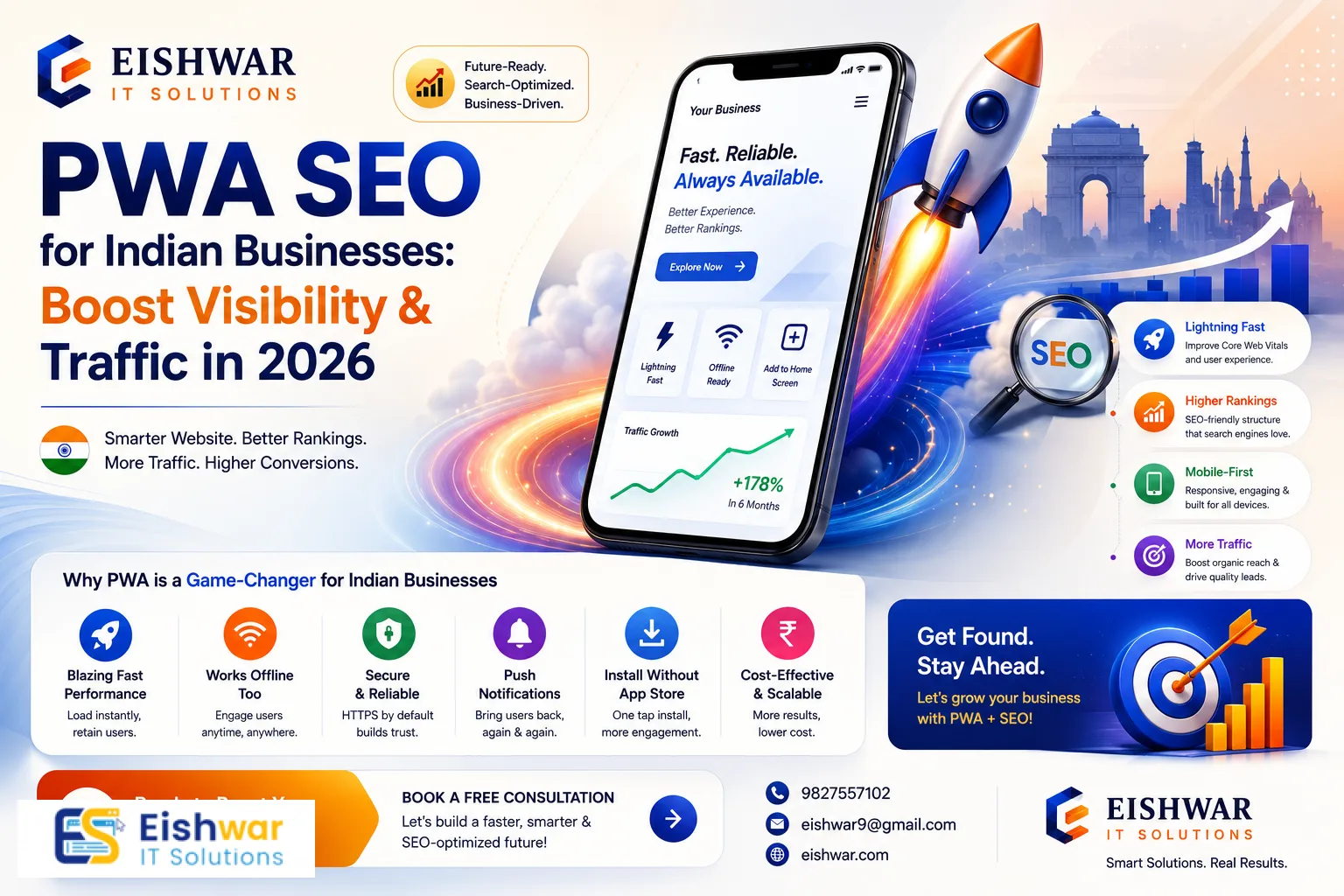
PWA SEO for Indian Businesses: Boost Visibility & Traffic in 2026
Published on: 22 Jun 2026
PWA SEO for Indian Businesses: Boost Visibility & Traffic in 2026
Introduction
India's digital landscape is booming. With over 800 million internet users and a mobile-first audience, businesses are racing to provide fast, engaging experiences. Progressive Web Apps (PWAs) have emerged as a game-changer, combining the best of web and mobile apps. But here's the catch: even the fastest PWA won't drive business if it's not found. That's where PWA SEO comes in.
Learn more about our Website services
In 2026, search engines are smarter than ever. They prioritize user experience, speed, and mobile-friendliness. PWAs naturally excel in these areas, but they also pose unique SEO challenges—like dynamic rendering, deep linking, and indexing. For Indian businesses targeting local customers, mastering PWA SEO is not optional; it's essential.
In this guide, you'll learn practical strategies to optimize your PWA for search engines, boost organic traffic, and dominate local search results. Whether you run an e-commerce store, a service platform, or a content site, these insights will help you turn your PWA into a traffic magnet. We'll cover everything from technical foundations to content strategies, with real-world examples tailored to the Indian market. By the end, you'll have a clear roadmap to make your PWA both fast and findable.
Main Section 1: Why PWA SEO Matters for Indian Businesses
India is a mobile-first country. Over 70% of web traffic comes from smartphones. Users expect pages to load in under three seconds. If your site is slow, they bounce. PWAs solve this with near-instant loading, offline support, and app-like interactions. But without proper SEO, even the best PWA remains invisible.
Search engines like Google now use Core Web Vitals as ranking signals. PWAs typically score well on Largest Contentful Paint (LCP), First Input Delay (FID), and Cumulative Layout Shift (CLS). This gives them a natural SEO advantage. However, PWAs often rely on JavaScript frameworks (React, Angular, Vue) that can be tricky for crawlers. For example, a React-based PWA without server-side rendering might show a blank page to Googlebot, leading to zero indexing. This is a critical pitfall that Indian businesses must avoid.
For Indian businesses, local SEO is critical. A PWA that loads quickly on 2G/3G networks in tier-2 cities can capture local search traffic. Think about a user searching for 'best chai in Jaipur' or 'repair shop near me.' If your PWA is optimized for local keywords and structured data, you'll appear in the coveted local pack. Consider a small business in Lucknow: by adding LocalBusiness schema with address, phone, and hours, and creating a city-specific landing page, they can outrank larger competitors who ignore local optimization.
Moreover, PWAs can be installed on the home screen, increasing repeat visits and engagement. This signals to Google that your site is valuable, further boosting rankings. In short, PWA SEO aligns perfectly with Google's user-first philosophy. As we move into 2026, the businesses that invest in this synergy will dominate search results, especially in high-growth Indian markets.
Main Section 2: Technical SEO Best Practices for PWAs
To make your PWA search-engine-friendly, you need to address technical aspects. Here are the key areas, with practical tips for implementation:
👉 Don't wait for the perfect moment; turn your vision into reality today.
Free Consultation1. Server-Side Rendering (SSR) or Pre-Rendering
Most PWAs use client-side JavaScript to render content. Search bots may not execute all JS, leading to blank pages. Implement SSR (e.g., Next.js, Nuxt.js) or pre-rendering to serve static HTML to crawlers. This ensures your content is indexed correctly. For example, an e-commerce PWA built with Next.js can pre-render product pages at build time, making them instantly indexable. If you're using a framework like Create React App, consider tools like react-snap for pre-rendering.
2. Dynamic Rendering
If SSR is not feasible, use dynamic rendering. Detect crawlers (by user agent) and serve them a static version of your page while real users get the full PWA experience. Google recommends this approach for JavaScript-heavy sites. Tools like Rendertron or Prerender.io can automate this. However, be careful: dynamic rendering adds complexity, so test thoroughly to ensure crawlers see the same content as users.
3. Proper Service Worker Caching
Service workers can cache pages for offline access, but they can also accidentally block crawlers. Ensure your service worker does not interfere with robots.txt or cache dynamic content in a way that serves stale versions to search engines. A common mistake is caching the entire site with a 'network-first' strategy that delays crawler access. Instead, use a 'stale-while-revalidate' pattern for critical pages, and always serve fresh HTML to Googlebot. For example, in your service worker, check the user agent and bypass caching for crawlers.
4. Structured Data (Schema Markup)
Add structured data for your business type (LocalBusiness, Product, Article, etc.). This helps search engines understand your content and enables rich snippets. For Indian businesses, include location-specific markup with address, phone, and operating hours. Use JSON-LD format for easy implementation. For instance, a restaurant PWA in Delhi can use Restaurant schema with menu items, reviews, and location data to appear in rich results. Test your markup with Google's Rich Results Test to avoid errors.
5. Canonical URLs and Deep Linking
PWAs often use hash-based routing (#/page). This can create duplicate content issues. Use canonical tags to point to the original URL. Also, implement deep linking so that each page has a unique, shareable URL. For example, instead of 'example.com/#/product/123', use 'example.com/product/123' with proper history API routing. This ensures that when users share a link, it points to the correct page, and crawlers can index it without confusion.
6. Optimize for Core Web Vitals
Even though PWAs are fast, monitor LCP, FID, and CLS. Compress images, lazy-load non-critical resources, and minimize JavaScript. Use tools like Google PageSpeed Insights and Lighthouse to audit regularly. For Indian users on slow networks, consider serving smaller images via responsive srcset attributes. For example, a news PWA can serve 480px-wide images to mobile users and 1200px to desktop, reducing LCP by up to 40%. Also, preload critical fonts and above-the-fold content to improve perceived performance.
Main Section 3: Content & Local SEO Strategies for PWA
Technical SEO is the foundation, but content is what drives traffic. Here's how to create a content strategy that works with your PWA:
👉 Free Website Audit
Get Free Audit1. Mobile-First Content
Write short paragraphs, use bullet points, and include clear headings. Your PWA's fast load time will keep users engaged, but the content must be scannable. For Indian audiences, use local examples and references (e.g., festivals, cities, regional languages where appropriate). For instance, a travel PWA can create a blog post titled 'Top 10 Destinations for Diwali 2026' with local tips and images optimized for mobile. This resonates with users and improves dwell time.
2. Local Landing Pages
Create dedicated pages for each city or region you serve. For example, 'Digital Marketing Services in Pune' or 'Best Salon in Bangalore.' Ensure these pages include local keywords, testimonials, and location-specific schema. A practical tip: use Google My Business data to inform your content. If you see that 'salon in Indiranagar' is a high-volume query, create a page specifically for that area. Include embedded Google Maps and local reviews to boost relevance.
3. Blogging for Organic Reach
Regularly publish blog posts related to your industry. For a PWA-focused business, write about 'How to Improve Website Speed for Indian Users' or 'Why Your Business Needs a PWA in 2026.' These posts can attract backlinks and social shares. Use keyword research tools like Google Keyword Planner to find long-tail queries with low competition. For example, 'PWA benefits for small businesses in India' might have decent search volume and fewer competing pages.
4. User-Generated Content (Reviews & Ratings)
Encourage customers to leave reviews on your PWA. Display them with structured data to earn star ratings in search results. Positive reviews also build trust, which is crucial for local SEO. For example, a restaurant PWA can send a push notification after a meal, asking for a review. Display these reviews on the homepage and product pages, marked up with Review schema. This can increase click-through rates by up to 30% in search results.
5. Internal Linking Structure
Use descriptive anchor text to link between your pages. For instance, from a blog post about PWA performance, link to your 'PWA Development Services' page. This distributes link equity and helps crawlers discover all pages. Create a logical hierarchy: your homepage links to category pages, which link to individual product or service pages. Use breadcrumb navigation to show users and crawlers where they are. For example, Home > Services > PWA Development > Case Studies.
Expert Tips
- Use Google Search Console: Monitor how Google crawls your PWA. Check for coverage errors, submit sitemaps, and test URLs with the URL Inspection tool. Set up email alerts for critical issues like 'Indexed, but not submitted in sitemap.'
- Leverage WebP Images: Convert images to WebP format for faster loading. This improves LCP and reduces bandwidth costs—critical for users on limited data plans. For example, a fashion e-commerce PWA can save up to 30% on image file sizes without quality loss.
- Implement Breadcrumb Schema: Help users and search engines navigate your site hierarchy. Breadcrumbs can appear in search results, improving click-through rates. Use the BreadcrumbList schema in JSON-LD format.
- Optimize for Voice Search: With the rise of voice assistants in India, use natural language long-tail keywords. For example, 'where to buy organic spices in Mumbai' instead of 'organic spices Mumbai.' Create FAQ pages that answer common voice queries, as these often appear in featured snippets.
- Test on Real Devices: Use tools like BrowserStack to test your PWA on various Indian smartphones and network speeds. Ensure a seamless experience across devices. Pay special attention to budget Android phones, which are common in tier-2 cities.
Common Mistakes
- Ignoring robots.txt: Blocking crawlers from accessing CSS/JS files can break rendering. Allow all necessary resources. Use 'Disallow: /' only for staging sites, not production.
- Using only client-side rendering: Relying solely on JavaScript can lead to incomplete indexing. Always have a fallback for crawlers. Even with Google's improved JS handling, SSR is safer.
- Neglecting meta tags: Every page must have unique title tags and meta descriptions. Duplicate tags hurt rankings. Use tools like Screaming Frog to audit your meta data.
- Forgetting about offline pages: If your PWA shows a generic offline page, make sure it's not indexed. Use noindex meta tag or disallow in robots.txt. Otherwise, users might see it in search results.
- Over-optimizing for speed: While speed is important, don't sacrifice content quality. Thin content won't rank, no matter how fast the page loads. Balance performance with substance.
Future Trends
In 2026, we expect even tighter integration between PWAs and search engines. Google's AI (like Bard) may prioritize PWAs for their speed and engagement signals. The rise of 5G in India will enable richer experiences, but optimization for low-end devices will remain crucial. For example, PWAs that use adaptive loading (serving lighter content to slower connections) will have an edge.
👉 Free Homepage Demo
Book DemoWebAssembly (Wasm) could allow PWAs to run complex applications (e.g., video editing, games) directly in the browser, opening new SEO opportunities. Also, voice search and visual search will become more prominent, requiring PWAs to support structured data for images and audio. Indian businesses that invest in PWA SEO now will be well-positioned to capture the next wave of search traffic, especially as Google continues to reward user experience.
FAQs
1. What is PWA SEO and why is it different from traditional SEO?
PWA SEO focuses on optimizing Progressive Web Apps for search engines. It differs because PWAs heavily rely on JavaScript, requiring techniques like server-side rendering or dynamic rendering to ensure crawlers can index content. Traditional SEO for static HTML sites is simpler, as content is immediately visible to crawlers without additional processing.
2. Can Google index my PWA without SSR?
Yes, but it's risky. Google's crawler can execute some JavaScript, but it may not render all content, especially if your app uses complex frameworks or lazy-loading. Using SSR or pre-rendering guarantees your content is indexed completely. For critical pages like product or service pages, SSR is highly recommended.
3. How does PWA speed affect SEO rankings?
Speed is a direct ranking factor through Core Web Vitals. A fast PWA improves user experience, reduces bounce rates, and signals quality to search engines, leading to higher rankings. For example, a PWA that loads in under 2 seconds on 3G networks will outperform a slower competitor in search results.
4. What are the best tools to audit PWA SEO?
Use Google Search Console, Lighthouse, PageSpeed Insights, and the Mobile-Friendly Test. For structured data, use Google's Rich Results Test. For crawling, Screaming Frog SEO Spider can help identify issues like missing meta tags or broken links. For JavaScript rendering, use the URL Inspection tool in Search Console.
5. How can I optimize my PWA for local search in India?
Create location-specific pages, use LocalBusiness schema, collect Google reviews, and ensure your NAP (Name, Address, Phone) is consistent across directories. Also, target local keywords in your content, such as 'best [service] in [city].' For example, a plumber PWA in Mumbai should have a page for 'emergency plumber in Andheri' with relevant schema.
6. Does installing a PWA on the home screen affect SEO?
Indirectly, yes. Increased engagement (repeat visits, longer sessions) signals to Google that your site is valuable, which can positively impact rankings. However, the installation itself is not a direct ranking factor. Focus on providing a great user experience to encourage installations.
7. What is the role of service workers in PWA SEO?
Service workers enable offline access and faster loading. However, they must be configured to not block crawlers or serve stale content. Properly cached service workers can improve performance metrics that affect SEO, such as LCP and FID. For example, caching your CSS and JS files can reduce load times for returning visitors.
8. How do I handle dynamic content in a PWA for SEO?
For dynamic content like user-generated reviews or real-time inventory, use a combination of SSR for initial load and client-side updates. Ensure that crawlers see a complete version of the page, either through pre-rendering or dynamic rendering. For example, an e-commerce PWA can pre-render product pages with static inventory data and update it via JavaScript for users.
9. What is the impact of AMP on PWA SEO?
AMP (Accelerated Mobile Pages) is a separate technology, but it can complement PWAs. Some businesses use AMP for instant loading of content pages, while using PWA for the full app experience. However, Google no longer requires AMP for Top Stories, so focus on PWA performance instead. If you already have AMP, ensure it redirects to your PWA for a seamless experience.
Conclusion
PWA SEO is not a one-time setup; it's an ongoing process. For Indian businesses, the combination of a fast, installable PWA and a solid SEO strategy can unlock massive organic traffic. By focusing on technical foundations, content quality, and local optimization, you can outpace competitors and capture valuable search real estate. Remember, the goal is to provide the best user experience while making it easy for search engines to find and understand your content. Start implementing these strategies today, and watch your visibility grow.
CTA
Ready to transform your PWA into an SEO powerhouse? Contact EishwarITSolution today for a free audit and personalized roadmap. Let's make your business the top result in 2026!