
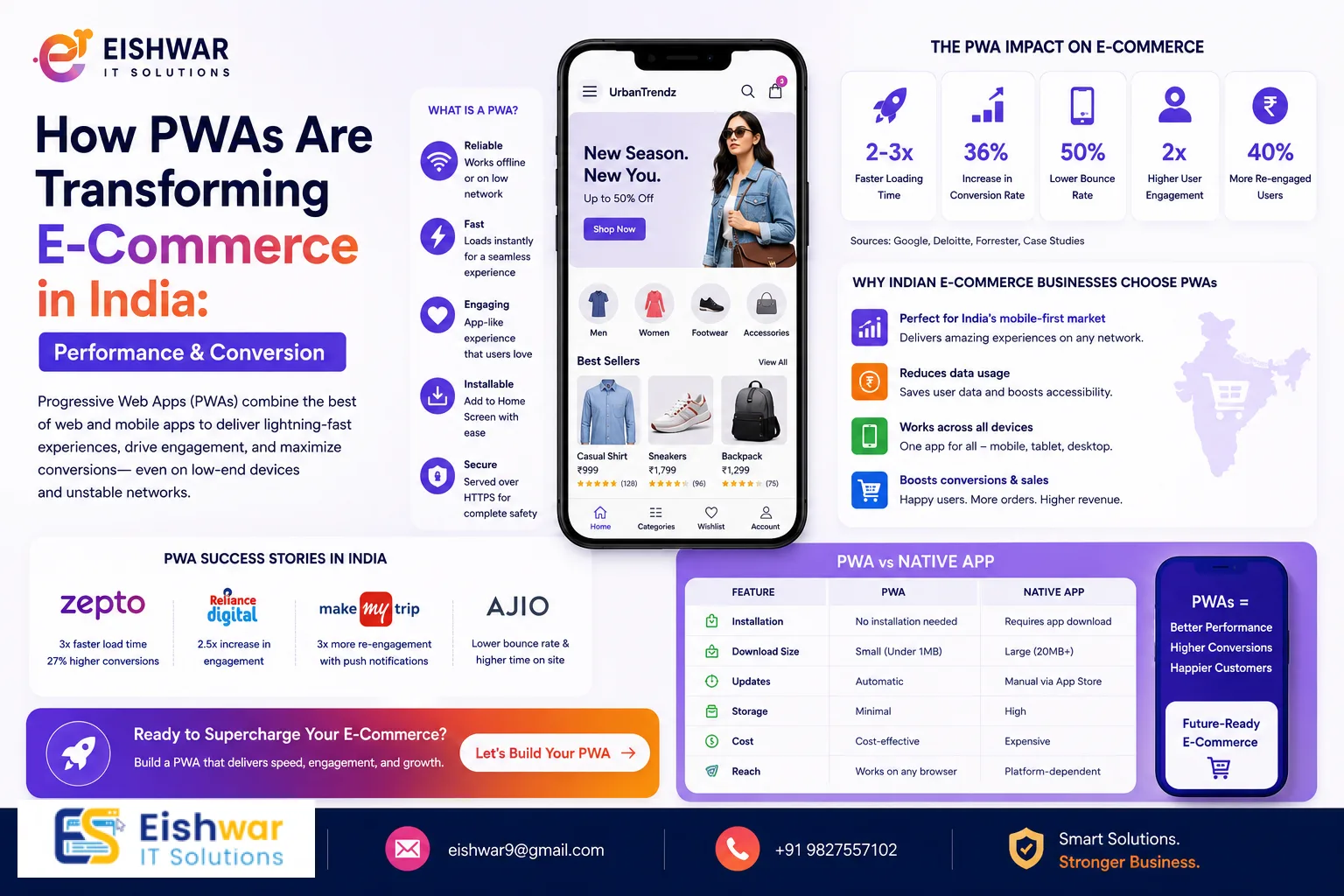
How PWAs Are Transforming E-Commerce in India: Performance & Conversio
Published on: 10 Jun 2026
How PWAs Are Transforming E-Commerce in India: Performance & Conversion Optimization
Introduction
India's e-commerce market is booming, with millions of users accessing online stores via smartphones. But slow load times, high bounce rates, and poor user experience still plague many websites. Enter Progressive Web Apps (PWAs) — a game-changing technology that combines the best of web and mobile apps. At EishwarITSolution, we've seen firsthand how PWAs can transform e-commerce performance and conversion rates, especially in India's diverse digital landscape.
Learn more about our Website services
In this guide, we'll explore how PWAs are reshaping online shopping in India, why performance matters more than ever, and actionable steps you can take to optimize your own PWA for higher conversions. Whether you're a business owner, marketer, or professional, these insights will help you stay ahead.
Main Section 1: Why PWAs Are a Perfect Fit for Indian E-Commerce
India's internet users are predominantly mobile-first. According to recent reports, over 70% of online traffic comes from mobile devices. Yet, many e-commerce sites still struggle with heavy pages, slow loading, and data constraints. PWAs solve these challenges natively.
Key advantages for India:
- Lightweight & Fast: PWAs are typically 10-100x smaller than native apps, loading instantly even on 2G/3G networks. For example, a typical e-commerce PWA might be under 1 MB, compared to a native app that can exceed 50 MB.
- Offline Capabilities: With service workers, users can browse products, view past orders, and add items to cart without an internet connection. This is a game-changer in rural areas where connectivity drops frequently.
- No App Store Dependency: Users can install PWAs directly from the browser, bypassing app stores — crucial in regions with low app store engagement. This also eliminates the 30% commission that app stores often charge on in-app purchases.
- Lower Data Usage: PWAs consume less data, a critical factor for cost-conscious Indian users. A PWA can reduce data consumption by up to 80% compared to a native app, as it loads only necessary resources.
- Higher Engagement: Push notifications and home screen installation boost repeat visits and retention. Studies show that PWAs can increase user retention by 2x compared to traditional mobile websites.
Real-world example: Flipkart Lite (a PWA) saw a 70% increase in conversions and 3x higher time on site. Similarly, Myntra reported a 50% rise in mobile conversions after switching to a PWA. These numbers aren't just impressive—they're proof that PWAs address the specific pain points of Indian e-commerce users.
Main Section 2: Performance Optimization Strategies for PWA E-Commerce
Performance is the backbone of any successful PWA. Here are proven strategies to supercharge your e-commerce PWA:
1. Optimize Core Web Vitals
Google's Core Web Vitals (LCP, FID, CLS) directly impact search rankings and user experience. For e-commerce, aim for LCP under 2.5 seconds, FID under 100ms, and CLS under 0.1. Use tools like Lighthouse and PageSpeed Insights to monitor. For example, if your product images are large, consider using a CDN to serve optimized versions. A practical tip: compress images to under 100 KB for thumbnails and under 500 KB for full-size images.
2. Implement Smart Caching
Cache product images, CSS, and JavaScript using a service worker. Use a cache-first strategy for static assets and network-first for dynamic content like pricing or stock status. This ensures speed while keeping data fresh. For instance, you can set a cache expiration of 24 hours for product images but only 5 minutes for inventory data. This balance prevents users from seeing outdated information.
👉 Don't wait for the perfect moment; turn your vision into reality today.
Free Consultation3. Lazy Load Images & Videos
Product pages often have many high-res images. Implement lazy loading so that only visible content loads initially. Use modern formats like WebP and AVIF to reduce file sizes by 30-50%. For example, a product page with 20 images can load only the first 5 initially, then load the rest as the user scrolls. This can cut initial load time by 40%.
4. Minimize JavaScript & CSS
Bloat is a killer. Remove unused code, minify files, and use code splitting. For e-commerce, prioritize critical CSS for above-the-fold content. A common mistake is loading third-party scripts (like analytics or chatbots) that block rendering. Instead, load them asynchronously. For example, defer non-essential JavaScript until after the page has loaded.
5. Use a CDN with Edge Caching
India's vast geography means latency varies. A CDN with edge caching brings content closer to users, reducing load times significantly. Consider providers like Cloudflare or Akamai with Indian PoPs. For instance, a user in Mumbai will get content from a local server rather than one in Delhi or abroad, cutting load time by 50-100 ms.
6. Optimize the Checkout Flow
PWAs allow seamless checkout even offline. Store cart data locally and sync when online. Use autofill and one-click payment options (UPI, wallets) to reduce friction. For example, integrate with UPI apps like Google Pay or PhonePe to allow users to pay without entering card details. This can reduce cart abandonment by 20%.
Main Section 3: Conversion Optimization with PWA Features
Beyond speed, PWAs offer unique features that directly boost conversion rates:
Add to Home Screen (A2HS)
Prompt users to install your PWA after they show interest (e.g., after adding an item to cart). This increases retention and repeat purchases. Example: OLX saw a 30% increase in daily active users after implementing A2HS. To maximize effectiveness, show the prompt only after the user has visited at least two pages or spent 30 seconds on the site.
Push Notifications
Send personalized alerts for abandoned carts, price drops, or order updates. PWAs support push notifications on both Android and desktop. Use segmentation to avoid spam and improve CTR. For instance, send a notification for a cart abandonment within 1 hour, but only if the user has opted in. A good practice is to A/B test notification copy and timing.
Offline Browsing & Cart
Allow users to browse products and add items to cart even without internet. This is especially powerful in areas with intermittent connectivity. Sync automatically when online. For example, a user in a metro can add items while commuting through a tunnel, and the cart syncs once they're back online. This feature alone can increase conversions by 15% in regions with poor connectivity.
App-Like UI/UX
PWAs can mimic native app gestures like swipe, pull-to-refresh, and smooth transitions. Use a standalone display mode for an immersive experience. For example, implement a bottom navigation bar for easy access to categories, cart, and profile. This reduces the number of taps needed to complete a purchase.
👉 Free Website Audit
Get Free AuditTrust Signals
Include SSL, secure payment badges, and clear return policies. PWAs run on HTTPS by default, which builds trust. Additionally, display customer reviews and ratings prominently. For instance, show a 'Secure Checkout' badge near the payment button to reassure users.
Expert Tips
- Start with a PWA audit: Use Lighthouse to identify performance bottlenecks specific to your e-commerce site. Focus on areas like render-blocking resources and image optimization.
- Test on real devices in India: Simulate slow networks (2G/3G) and low-end devices to ensure your PWA works for your target audience. Use tools like Chrome DevTools' network throttling.
- Leverage Web App Manifest: Customize the splash screen, theme color, and icons to match your brand. This creates a cohesive experience when users install the PWA.
- Monitor analytics: Track PWA-specific metrics like install rate, offline usage, and notification opt-in rate. Use Google Analytics with custom events to measure these.
- Iterate with A/B testing: Test different caching strategies, UI flows, and notification timings to optimize conversions. For example, test a 'Install App' prompt at different stages of the user journey.
Common Mistakes
- Over-caching dynamic content: Avoid caching pricing or stock info for too long — stale data leads to poor user experience. Set short cache durations for such data.
- Ignoring accessibility: Ensure your PWA is keyboard-navigable and screen-reader friendly. Accessibility impacts SEO and user trust. Use ARIA labels for interactive elements.
- Too many notifications: Aggressive push notifications can lead to high opt-out rates. Be judicious and provide value. Limit to 2-3 notifications per week per user.
- Not optimizing for all browsers: While PWAs work on Chrome, test on Firefox, Edge, and Samsung Internet (popular in India). Each browser may handle service workers differently.
- Neglecting security: Always use HTTPS. Any mixed content warnings can break service workers. Use tools like SSL Labs to check your certificate.
Future Trends
PWAs are evolving rapidly. Here's what to watch:
- Web Push for iOS: With iOS 16.4+, PWAs can now send push notifications on iPhones — a huge opportunity for Indian e-commerce where iOS usage is growing. This opens up a new channel for engagement.
- Payment Request API & Digital Wallets: Integration with UPI, Paytm, and Google Pay will make checkout seamless. This can reduce checkout time from 30 seconds to under 5 seconds.
- AI-Powered Personalization: PWAs can leverage on-device AI to recommend products without sending data to servers. This enhances privacy and speed.
- Bluetooth & NFC APIs: Future PWAs may interact with physical store beacons for in-store experiences, like offering discounts when a user is near a product.
- Better Offline Support: IndexedDB and background sync will enable full offline order placement. This means users can complete purchases entirely offline, with sync happening later.
FAQs
- What is a PWA in simple terms?
A Progressive Web App is a website that behaves like a mobile app — it can be installed on your home screen, work offline, and send push notifications. It uses modern web technologies to deliver a native app-like experience. - How does a PWA improve e-commerce conversion rates?
By loading faster, working offline, and offering app-like features (push notifications, A2HS), PWAs reduce friction and increase user engagement, leading to higher conversions. For example, faster load times alone can reduce bounce rates by 30%. - Is a PWA cheaper than building a native app?
Yes! Developing a PWA typically costs 3-5x less than a native app, and you only need one codebase for all platforms. This also reduces maintenance costs. - Can a PWA replace a native app for e-commerce?
For most e-commerce needs, yes. PWAs cover 90%+ of native app features. However, if you need advanced hardware access (e.g., AR for virtual try-ons), a native app may still be needed. - How long does it take to convert a website to a PWA?
Basic PWA implementation can take 2-4 weeks. Full optimization with caching and offline support may take 1-3 months depending on complexity. This includes testing and iteration. - Does Google rank PWAs better?
Yes, because PWAs typically have better performance (Core Web Vitals) and user engagement signals, which are ranking factors. This can lead to higher organic traffic. - What are the key metrics to track for a PWA?
Track install rate, offline usage, notification opt-in rate, page load time, and conversion rate. Use tools like Google Analytics and Lighthouse to monitor these. - Can PWAs work on all devices in India?
Yes, PWAs work on all modern browsers, including Chrome, Firefox, and Samsung Internet. However, ensure you test on low-end devices and slow networks for optimal performance.
Conclusion
Progressive Web Apps are not just a trend — they are a strategic advantage for e-commerce businesses in India. By combining lightning-fast performance with app-like features, PWAs help you capture more conversions, retain customers, and stand out in a crowded market. At EishwarITSolution, we specialize in building high-performance PWAs tailored for Indian audiences. The time to act is now.
👉 Free Homepage Demo
Book DemoCTA
Ready to transform your e-commerce store with a PWA? Contact EishwarITSolution today for a free consultation. Let's build a faster, smarter, and more profitable online experience for your customers in India.