The Hidden Costs of Legacy Systems: Why Indian SMEs Are Losing Million
Published on: 11 Jun 2026
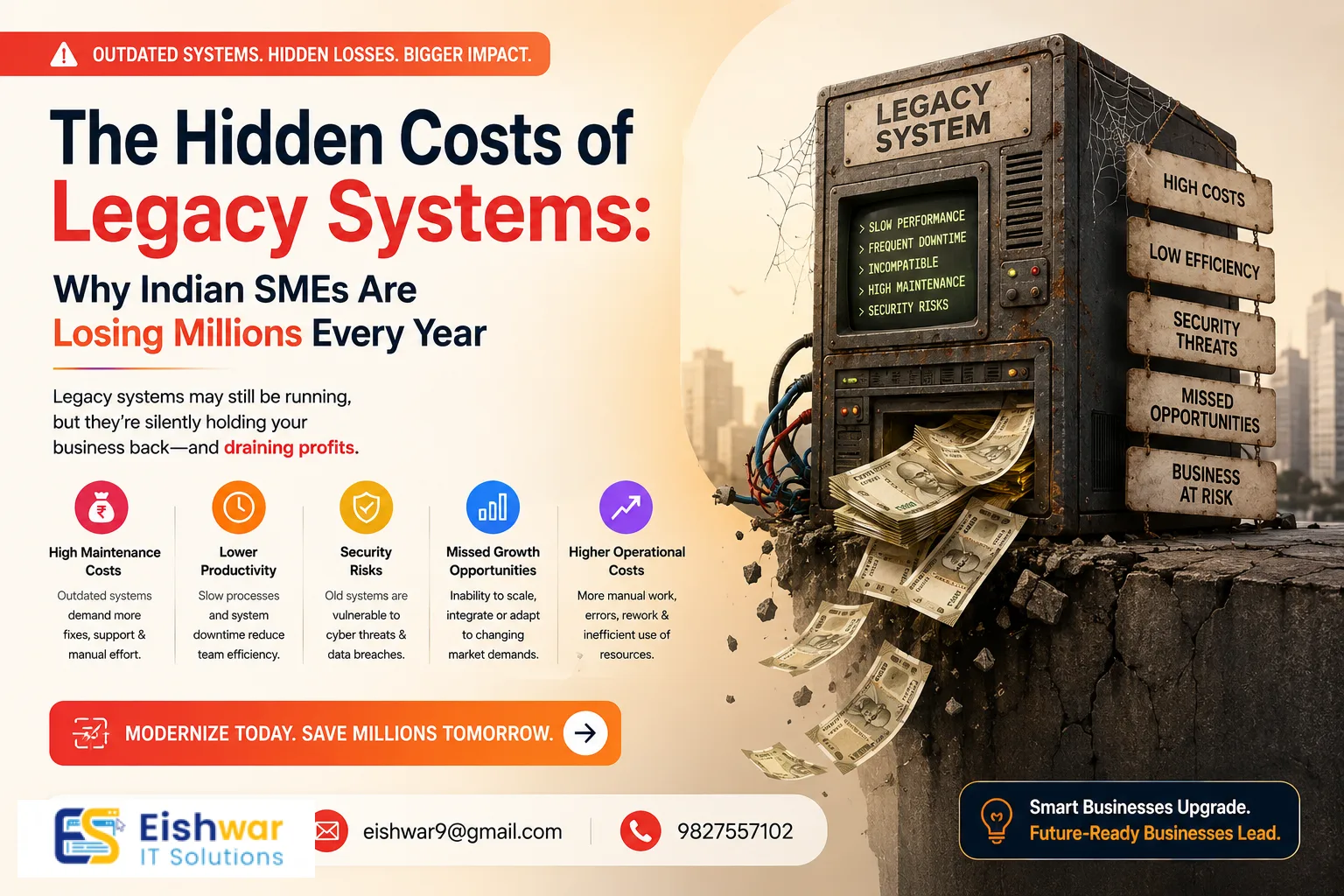
The Hidden Costs of Legacy Systems: Why Indian SMEs Are Losing Millions and How to Break Free
Every day, Indian SMEs pour thousands of rupees into systems that were built a decade ago. But what if those systems are actually costing you more than you think? Legacy systems—old software, outdated hardware, and obsolete processes—are like silent leeches on your business finances. In this article, we'll uncover the hidden costs that are bleeding your bottom line and show you how EishwarITSolution can help you modernize without disruption.
Learn more about our Website services
Introduction
Imagine a manufacturing unit in Pune still running Windows XP. Or a retail chain in Delhi using a DOS-based inventory system. Shocking? It's more common than you'd think. Many Indian SMEs cling to legacy systems because they 'work'—but that comfort comes at a steep price. According to a 2023 study by Gartner, the average cost of maintaining legacy systems can eat up to 70% of IT budgets. For a mid-sized Indian business, that could mean losing ₹50 lakh annually. But the costs go beyond money: lost productivity, security risks, and missed opportunities. This article will help you identify these hidden drains and take action.
Consider the story of a Surat textile manufacturer who relied on a 15-year-old ERP system. The system worked fine for basic accounting, but when the company tried to expand into e-commerce, the legacy software couldn't handle real-time inventory updates across multiple warehouses. The result? Overstocking in one location and stockouts in another, leading to ₹12 lakh in lost sales over six months. This is just one example of how legacy systems silently erode profitability.
Main Section 1: The Financial Drain—Direct and Indirect Costs
Direct Costs
- Maintenance Fees: Legacy systems often require specialized support, which is expensive and scarce. For example, a company using an old ERP might pay ₹2 lakh per month for vendor support. As the technology ages, finding experts who can maintain it becomes harder, driving up costs. Some SMEs report paying up to ₹5 lakh annually just for emergency fixes.
- Downtime Losses: Older systems crash more often. Each hour of downtime can cost a small e-commerce business ₹1 lakh in lost sales. For a B2B service provider, downtime might mean missed deadlines and penalty clauses. A Bangalore-based SaaS company lost a ₹50 lakh contract because their legacy server went down during a critical demo.
- Licensing and Compliance Costs: Many legacy systems require expensive per-user licenses that don't scale well. As your team grows, these costs multiply. Additionally, outdated systems may not comply with modern tax regulations, leading to fines. A Delhi-based logistics firm paid ₹3 lakh in GST penalties because their legacy system generated incorrect invoices.
Indirect Costs
- Lost Productivity: Employees waste hours waiting for slow systems. A 10-person team losing 30 minutes daily equals ₹6 lakh wasted per year. But it's not just time—it's morale. Employees frustrated with clunky systems are more likely to leave, increasing turnover costs. A Chennai-based IT services company found that their legacy CRM caused a 15% drop in employee satisfaction.
- Security Breaches: Unsupported systems are vulnerable. A ransomware attack on a legacy system could cost ₹20 lakh in ransom plus recovery. But the real cost is reputation damage. A Jaipur-based healthcare startup lost 200 patient records due to a breach in their legacy system, resulting in a ₹10 lakh fine and loss of trust.
- Opportunity Cost: Every rupee spent on maintaining legacy systems is a rupee not spent on innovation. A Mumbai-based e-commerce company calculated that they could have launched a mobile app with the ₹15 lakh they spent on legacy maintenance in one year.
Real-world example: A Mumbai-based logistics firm lost ₹15 lakh in a single quarter due to a legacy GPS system that failed to update routes, causing delivery delays. The delays led to customer churn and a 20% drop in repeat orders. After migrating to a modern GPS system, they recovered those losses within three months.
👉 Don't wait for the perfect moment; turn your vision into reality today.
Free ConsultationMain Section 2: Operational Inefficiencies—The Hidden Productivity Killer
Legacy systems don't just cost money; they kill efficiency. Here's how:
- Manual Workarounds: Employees often create Excel sheets to compensate for system limitations. This doubles work and increases error rates. A Pune-based manufacturing company found that their finance team spent 40% of their time manually reconciling data between their legacy ERP and modern bank portals. This led to a 5% error rate in financial reports, causing audit delays.
- Integration Nightmares: Old systems don't talk to modern tools. A CRM from 2010 can't sync with a 2024 marketing automation platform, forcing duplicate data entry. For a Delhi-based retail chain, this meant that customer data from their loyalty program was never integrated with their email marketing tool, resulting in missed cross-selling opportunities worth ₹8 lakh annually.
- Scalability Issues: As your business grows, legacy systems can't handle the load. A retail chain adding 50 stores might need to replace the entire POS system. A Bangalore-based restaurant chain tried to scale from 10 to 30 outlets using their legacy POS, but the system crashed during peak hours, leading to a 30% drop in revenue during the expansion phase.
- Data Silos: Legacy systems often store data in proprietary formats that are inaccessible to other tools. This means that sales data, inventory data, and customer data live in separate worlds. A Hyderabad-based logistics company spent ₹2 lakh annually on manual data consolidation just to generate basic reports.
Case study: A Bangalore startup wasted 200 developer hours per month just to keep their legacy payment gateway running—hours that could have built new features. The startup was planning to launch a subscription model, but the legacy system couldn't handle recurring billing. After migrating to a modern payment gateway, they reduced maintenance time by 90% and launched the subscription feature in just two weeks.
Main Section 3: Strategic Risks—Why You're Falling Behind Competitors
Innovation Gap: Competitors using modern systems launch features faster. While you're patching old code, they're releasing AI-driven chatbots. A Kolkata-based e-commerce company lost 15% market share to a competitor who implemented a recommendation engine using machine learning. The legacy system couldn't support the data processing required for such features.
Customer Experience: Slow websites and outdated interfaces frustrate users. A 2-second delay in page load can increase bounce rates by 103% (Google). For an Indian SME, this means losing potential customers who expect seamless digital experiences. A Jaipur-based travel agency saw a 25% drop in online bookings after their legacy booking system slowed down during the holiday season.
👉 Free Website Audit
Get Free AuditRegulatory Compliance: Indian regulations like GST and data localization require modern systems. Legacy systems often fail to generate proper reports, leading to penalties. A Surat-based diamond exporter faced a ₹5 lakh fine because their legacy system couldn't generate the required GST input credit reports. Additionally, the system didn't support e-invoicing, forcing manual compliance that took 10 hours per week.
Talent Acquisition: Top tech talent doesn't want to work with legacy systems. A Chennai-based IT company struggled to hire developers because their stack included COBOL and outdated databases. They had to offer 20% higher salaries to attract talent willing to work with legacy tech, adding ₹12 lakh to annual payroll costs.
Example: A Jaipur textile exporter lost a major European client because their legacy system couldn't generate the required sustainability reports. The client needed carbon footprint data across the supply chain, but the legacy system only tracked basic inventory. The exporter lost a ₹2 crore annual contract to a competitor with a modern ERP.
Expert Tips
Based on our experience at EishwarITSolution, here's how to start:
- Audit Your Systems: List all legacy systems and calculate total cost of ownership (TCO) including downtime, support, and lost productivity. Use a simple spreadsheet to track costs over the past 12 months. Include hidden costs like employee overtime and manual workarounds.
- Prioritize by Impact: Focus on systems that affect customer experience or revenue first. For example, if your e-commerce platform is legacy, prioritize it over internal HR systems. Use a scoring matrix that weighs factors like revenue impact, security risk, and integration complexity.
- Choose the Right Partner: Look for vendors with expertise in migration without downtime. EishwarITSolution offers zero-downtime migrations using a phased approach. We've helped over 200 Indian SMEs migrate without losing a single transaction.
- Train Your Team: Involve employees early to reduce resistance. Provide hands-on training and create a support channel for questions. A Pune-based company reduced migration resistance by 60% by running pilot sessions with key users.
- Plan for Data Migration: Ensure data integrity. Test with sample data before full cutover. Use automated tools to validate data accuracy. A Delhi-based retailer avoided a major data loss by running three rounds of test migrations before going live.
- Set Realistic Timelines: Don't rush. A typical migration takes 4-8 weeks with proper planning. Build in buffer time for unexpected issues. A Bangalore-based startup avoided a crisis by adding two weeks of contingency time to their migration plan.
Common Mistakes
Don't fall into these traps:
- Underestimating Costs: Many SMEs think migration is too expensive, but staying put costs more. A proper ROI analysis often favors migration. For example, a Mumbai-based company found that the cost of migration was recovered in 14 months through reduced maintenance and increased productivity.
- DIY Migration: Without expert help, you risk data loss or extended downtime. Always use professionals. A Chennai-based startup tried to migrate their database themselves and lost 3 years of customer data, costing them ₹8 lakh in recovery and lost business.
- Ignoring Security: Old systems are prime targets. Don't delay upgrades due to budget concerns—a breach can be fatal. A Hyderabad-based company ignored security patches for their legacy system and suffered a ransomware attack that cost ₹25 lakh in ransom and recovery.
- Skipping Testing: Always test thoroughly. A failed migration can hurt SEO and user trust. A Jaipur-based e-commerce site lost 40% of their organic traffic after a botched migration that broke their URL structure.
- Not Involving Stakeholders: Migration affects everyone from sales to finance. Get buy-in from all departments. A Delhi-based company faced a 3-month delay because the finance team wasn't consulted about new reporting requirements.
Future Trends
By 2026, we predict:
👉 Free Homepage Demo
Book Demo- AI-Powered Migration: Tools that automatically map and migrate data from legacy systems to cloud platforms. This will reduce migration time by 50% and minimize human error. Early adopters in India are already seeing benefits.
- Legacy System Retirement as a Service: Specialized firms offering end-to-end decommissioning, including data archiving and compliance documentation. This will make migration accessible to even the smallest SMEs.
- Zero-Downtime Migration Becoming Standard: No business will accept downtime during upgrades. Technologies like blue-green deployments and database replication will make this the norm.
- Integration-First Approach: New systems will be designed to integrate easily with existing tools via APIs and microservices. This will reduce the pain of future migrations.
- Regulatory-Driven Modernization: As Indian regulations evolve, legacy systems will become non-compliant faster. SMEs will need to modernize to avoid penalties, especially in sectors like finance and healthcare.
FAQs
- What is a legacy system? A legacy system is old technology, software, or hardware that is still in use but outdated. It may still function but lacks modern features, security updates, or support. Examples include Windows XP, DOS-based applications, or custom-built software from the early 2000s.
- How do I know if my business has a legacy system? Signs include frequent crashes, slow performance, lack of vendor support, inability to integrate with modern tools, and high maintenance costs. Also, if your IT team spends more time on maintenance than innovation, you likely have legacy systems.
- What are the risks of not upgrading? Security vulnerabilities, regulatory non-compliance, lost productivity, competitive disadvantage, and potential revenue loss from downtime. Additionally, you risk losing top talent who prefer working with modern tech.
- How long does a typical migration take? It varies from a few weeks to several months, depending on system complexity. With EishwarITSolution's zero-downtime approach, most migrations complete in 4-8 weeks. Complex systems like ERPs may take 12-16 weeks.
- Can I migrate without losing SEO? Yes! With proper planning—301 redirects, URL mapping, and content preservation—your SEO can remain intact. Our team ensures this by conducting a full SEO audit before and after migration. We've helped clients maintain or even improve their search rankings.
- What is the cost of modernizing legacy systems? Costs vary widely. A small business might spend ₹5-10 lakh, while larger enterprises could invest ₹50 lakh or more. However, ROI is usually positive within 12-18 months. For example, a client recovered their ₹8 lakh investment in 14 months through reduced maintenance and increased sales.
- How do I choose the right technology partner? Look for experience in your industry, proven migration methodologies, strong client testimonials, and post-migration support. EishwarITSolution has helped over 200 Indian SMEs across manufacturing, retail, logistics, and services. Ask for case studies and references.
Conclusion
The hidden costs of legacy systems are real and significant. From direct financial drains to lost opportunities, staying with old technology is a risky gamble. But the path forward is clear: assess, plan, and migrate with a trusted partner. At EishwarITSolution, we specialize in making your digital transformation smooth, secure, and profitable. Don't wait until a crisis forces your hand—start modernizing today.
CTA
Ready to uncover the true cost of your legacy systems? Contact EishwarITSolution for a free, no-obligation audit. Our experts will identify hidden costs and create a customized migration plan that fits your budget and timeline. Visit http://eishwar.com or call us at +91-XXXXXXXXXX to schedule your consultation. Transform your business, not your stress.