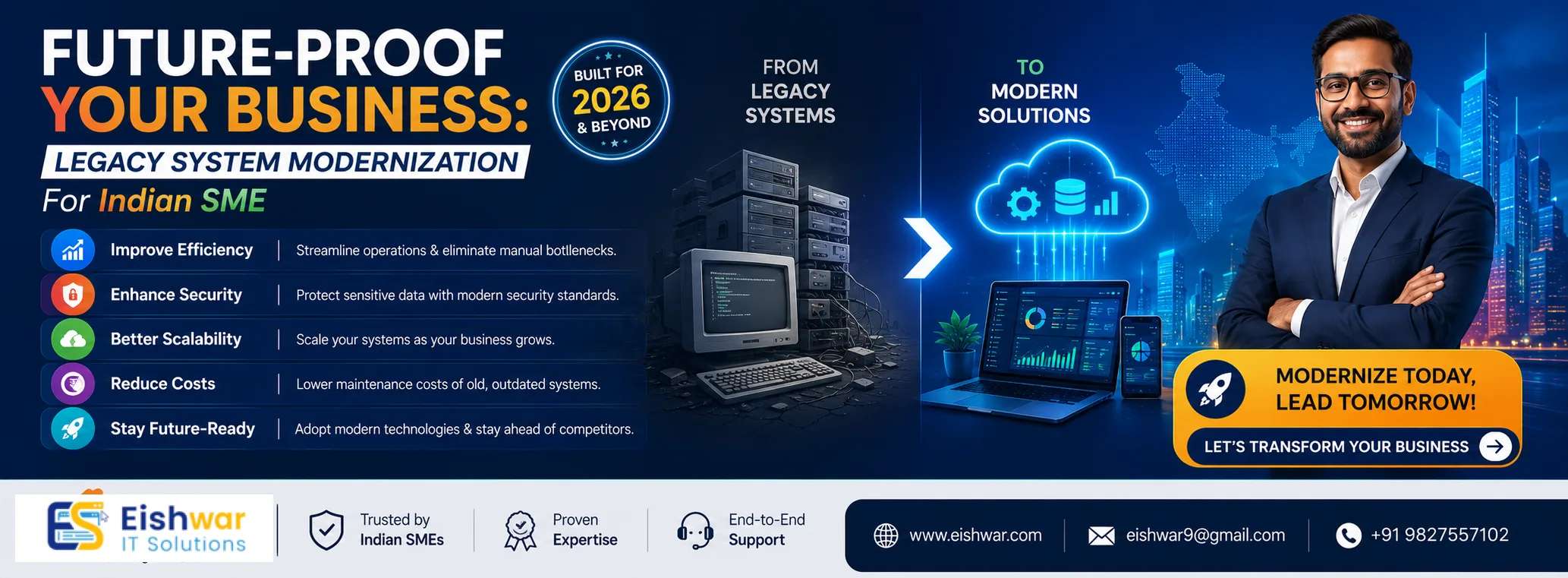
Future-Proof Your Business: Legacy System Modernization for Indian SME
Published on: 06 Jul 2026
Future-Proof Your Business: Legacy System Modernization for Indian SMEs
Introduction
In the fast-paced digital economy, Indian SMEs face a critical challenge: outdated legacy systems that hinder growth, increase costs, and expose businesses to security risks. Modernizing these systems isn't just an IT upgrade—it's a strategic move to future-proof your business. This guide provides a practical, step-by-step approach to legacy system modernization tailored for Indian SMEs. You'll learn how to assess your current systems, choose the right migration path, and implement changes with minimal disruption. Whether you run a retail chain, a manufacturing unit, or a service-based firm, these insights will help you transform your technology stack into a growth engine.
Learn more about our Website services
Main Section 1: Why Legacy Systems Are Holding Your Business Back
Legacy systems—aging software, outdated hardware, and manual processes—are often the invisible drag on SME performance. They lead to frequent downtime, high maintenance costs, and limited scalability. For example, a mid-sized Indian logistics company using a 15-year-old ERP might spend 30% of its IT budget on patching and workarounds. Moreover, these systems lack integration capabilities, making it hard to adopt modern tools like cloud analytics or AI-driven inventory management. The result? Slower decision-making, missed opportunities, and frustrated employees. Modernizing these systems can reduce operational costs by up to 40% and improve productivity by 50%, according to industry studies. It's time to break free from the past and build a foundation for future growth.
Main Section 2: A Step-by-Step Modernization Strategy for Indian SMEs
Here's a clear roadmap to modernize your legacy systems without disrupting daily operations. Start with a comprehensive audit: map all your current systems, identify pain points, and prioritize based on business impact. For instance, a Mumbai-based pharmaceutical distributor might discover that its inventory system is causing 15% stockouts due to manual updates. Next, choose a modernization approach—rehosting to the cloud, refactoring code, or replacing with a modern SaaS solution. For example, an Indian textile manufacturer could migrate its inventory management from an on-premise server to a cloud-based platform, gaining real-time visibility and reducing stockouts. Then, plan a phased rollout: begin with a non-critical module like payroll, test thoroughly for two weeks, and gradually expand to core operations. Allocate a budget for training your team—consider workshops and user manuals—to ensure smooth adoption. Finally, monitor performance metrics like uptime, response time, and user satisfaction to validate success. This structured approach minimizes risk and maximizes ROI.
Main Section 3: Real-World Examples and Actionable Tips
Consider the case of a Bangalore-based e-commerce startup that replaced its legacy order management system with a cloud-native solution. The result: order processing time dropped from 4 hours to 15 minutes, and customer complaints reduced by 60%. Another example: a Pune-based accounting firm automated its manual data entry using modern APIs, freeing up 20 hours per week for high-value advisory work. Actionable tips: start small, involve your team early, and partner with a reliable IT service provider like EishwarITSolution. Also, ensure data integrity during migration by running parallel tests—run both old and new systems for a week to catch discrepancies. Use agile methodologies to iterate quickly and gather feedback from users. Remember, modernization is a journey, not a one-time event. Keep learning and adapting to new technologies.
👉 Don't wait for the perfect moment; turn your vision into reality today.
Free ConsultationExpert Tips
- Assess Total Cost of Ownership: Don't just look at upfront costs. Factor in maintenance, training, and downtime over five years to compare legacy vs. modern systems. For example, a legacy server might cost ₹50,000 annually in electricity and cooling, while a cloud solution could be ₹30,000 with better reliability.
- Prioritize Security: Modern systems often come with built-in security features. Ensure your new platform complies with Indian data protection laws like the Digital Personal Data Protection Act. Consider encryption and multi-factor authentication.
- Leverage Government Incentives: Indian SMEs can benefit from schemes like the Digital India initiative or MSME technology upgrade programs to offset costs. For instance, the MSME Ministry offers subsidies up to 50% for technology adoption in manufacturing.
- Focus on User Experience: Involve end-users in the selection process. A system that's easy to use will drive adoption and ROI faster. Run pilot tests with a small group and gather feedback on interface and workflow.
- Plan for Scalability: Choose solutions that can grow with your business. Cloud-based systems offer flexible scaling without major capital expenditure. For example, a retail chain can add new store modules without upgrading hardware.
Common Mistakes
- Rushing the Audit: Skipping a thorough assessment leads to missed dependencies and integration failures. Always map all system interactions first, including third-party APIs and database connections.
- Ignoring Data Migration: Data loss or corruption during migration can cripple operations. Use automated tools like ETL (Extract, Transform, Load) and run multiple validation checks. For example, compare record counts before and after migration.
- Underestimating Change Management: Technology alone isn't enough. Train your team, communicate benefits, and address resistance early. Hold town hall meetings to explain how modernization will reduce manual work.
- Choosing a One-Size-Fits-All Solution: Off-the-shelf products may not fit your unique workflows. Customize or choose modular solutions when possible. For instance, a logistics firm might need custom route optimization features.
- Neglecting Post-Migration Support: Modern systems need ongoing updates and support. Partner with a provider that offers reliable maintenance, including 24/7 helpdesk and regular security patches.
Future Trends
The future of legacy system modernization is shaped by AI, edge computing, and low-code platforms. AI-driven automation can predict system failures and optimize performance. For example, a Chennai-based manufacturer used AI to predict machine breakdowns, reducing downtime by 30%. Edge computing reduces latency for real-time applications, ideal for manufacturing or retail. Low-code platforms empower non-technical staff to build custom solutions, accelerating digital transformation. For Indian SMEs, adopting these trends early can create a significant competitive edge. Additionally, hybrid cloud models will become more common, balancing cost and control. Stay informed and plan your roadmap to incorporate these innovations.
FAQs
What is legacy system modernization?
Legacy system modernization is the process of updating outdated software, hardware, or processes to improve performance, security, and scalability. For Indian SMEs, it often involves migrating to cloud-based platforms, refactoring code, or replacing old systems with modern SaaS solutions.
👉 Free Website Audit
Get Free AuditHow much does it cost to modernize legacy systems for an SME in India?
Costs vary based on system complexity, chosen approach, and vendor. For small to mid-sized Indian businesses, a basic cloud migration can start from ₹2-5 lakhs, while full modernization may range from ₹10-50 lakhs. Government subsidies and phased rollouts can help manage expenses. For example, a Delhi-based retailer spent ₹3 lakhs on cloud migration and saved ₹1.5 lakhs annually in maintenance.
What are the risks of not modernizing legacy systems?
Risks include security vulnerabilities, frequent downtime, high maintenance costs, inability to scale, and loss of competitive edge. In worst cases, data breaches or system failures can halt business operations entirely. For instance, a 2023 report found that 60% of Indian SMEs using legacy systems experienced at least one security incident in the past year.
How long does a legacy system modernization project take?
Timelines depend on scope. A simple cloud rehosting may take 2-4 weeks, while a full replacement or refactoring can take 3-6 months. A phased approach allows you to see early wins while continuing work on complex modules. For example, a Jaipur-based wholesaler completed a CRM migration in 3 weeks with minimal disruption.
Can I modernize legacy systems without disrupting daily operations?
Yes, with careful planning. Use a phased rollout, run parallel systems during testing, and schedule migrations during low-activity periods. Partnering with an experienced IT service provider like EishwarITSolution ensures minimal downtime. For instance, a Surat-based textile firm migrated its billing system over a weekend with zero downtime.
What is the best modernization approach for a small Indian business?
For most small businesses, rehosting to the cloud or adopting a SaaS solution is the quickest and most cost-effective path. It reduces maintenance overhead and provides instant scalability. Consult with experts to evaluate your specific needs. For example, a bakery chain in Bengaluru switched to a cloud-based POS system and saw a 20% increase in sales due to better inventory tracking.
How do I ensure data security during modernization?
Data security is critical. Use encrypted connections during migration, implement access controls, and conduct regular security audits. Ensure your new system complies with Indian data protection laws like the Digital Personal Data Protection Act. For instance, a healthcare SME in Hyderabad used end-to-end encryption and multi-factor authentication to protect patient data during migration.
Conclusion
Legacy system modernization is no longer optional for Indian SMEs—it's a necessity to stay competitive in a digital-first world. By following a structured strategy, avoiding common pitfalls, and leveraging expert guidance, you can transform your technology stack into a powerful asset. The journey may seem daunting, but the rewards—lower costs, faster operations, and happier customers—are well worth the effort. Start today with a simple audit and take the first step toward a future-proof business.
CTA
Ready to modernize your legacy systems? Contact EishwarITSolution for a free consultation and customized modernization plan. Our experts will help you assess your current systems, choose the right approach, and implement with zero downtime. Don't let outdated technology hold your business back—future-proof it today!
👉 Free Homepage Demo
Book Demo