Legacy System Migration to Cloud: Cut Costs & Scale Faster for Indian
Published on: 22 Jun 2026
Legacy System Migration to Cloud: Cut Costs & Scale Faster for Indian SMEs
Introduction
Indian SMEs are the backbone of the economy, yet many still rely on legacy systems—outdated on-premise servers, old ERPs, or custom-built software—that drain resources and limit growth. The cloud offers a lifeline: lower costs, elastic scalability, and access to modern tools. But migration can feel daunting. This guide provides a clear, actionable blueprint for migrating your legacy systems to the cloud, tailored for Indian SMEs. Whether you're a manufacturer in Pune or a retailer in Mumbai, these steps will help you cut costs and scale faster. We'll cover real-world examples, expert tips, common pitfalls, and future trends to ensure your migration is smooth and successful.
Learn more about our Website services
Main Section 1: Why Indian SMEs Must Migrate Legacy Systems to the Cloud
Legacy systems are expensive to maintain. Think of the hardware, electricity, cooling, and IT staff required to keep old servers running. For a typical Indian SME with 20-50 employees, annual on-premise IT costs can easily exceed ₹10-15 lakhs, including hardware refreshes, software licenses, and support contracts. Cloud providers like AWS, Azure, or Google Cloud offer pay-as-you-go models, eliminating upfront capital expenditure. For an Indian SME, this means converting fixed costs into variable ones—freeing up cash for growth, marketing, or hiring.
Scalability is another game-changer. During peak seasons (e.g., Diwali sales, festival promotions, or year-end financial closes), cloud resources can auto-scale to handle traffic spikes, then shrink when demand drops. Legacy systems force you to over-provision for peak loads or risk crashes during critical periods. For example, a small e-commerce store in Jaipur that used an on-premise server crashed during a flash sale, losing ₹2 lakhs in potential revenue. After migrating to cloud, they auto-scaled and handled 5x traffic without issues.
Plus, cloud platforms come with built-in security, compliance, and disaster recovery, which are often too expensive for SMEs to manage on-premise. Features like automated backups, encryption at rest and in transit, and multi-factor authentication are included at no extra cost. Many Indian SMEs also benefit from local data residency options (e.g., AWS Mumbai region) to comply with Indian data protection laws.
Consider a Chennai-based logistics company that migrated its legacy tracking system to AWS. They reduced IT costs by 40% (from ₹8 lakhs to ₹4.8 lakhs annually) and improved system uptime from 95% to 99.9%. That reliability directly impacted customer satisfaction and revenue—they retained two major clients who were considering switching due to frequent outages.
Main Section 2: Step-by-Step Blueprint for a Successful Cloud Migration
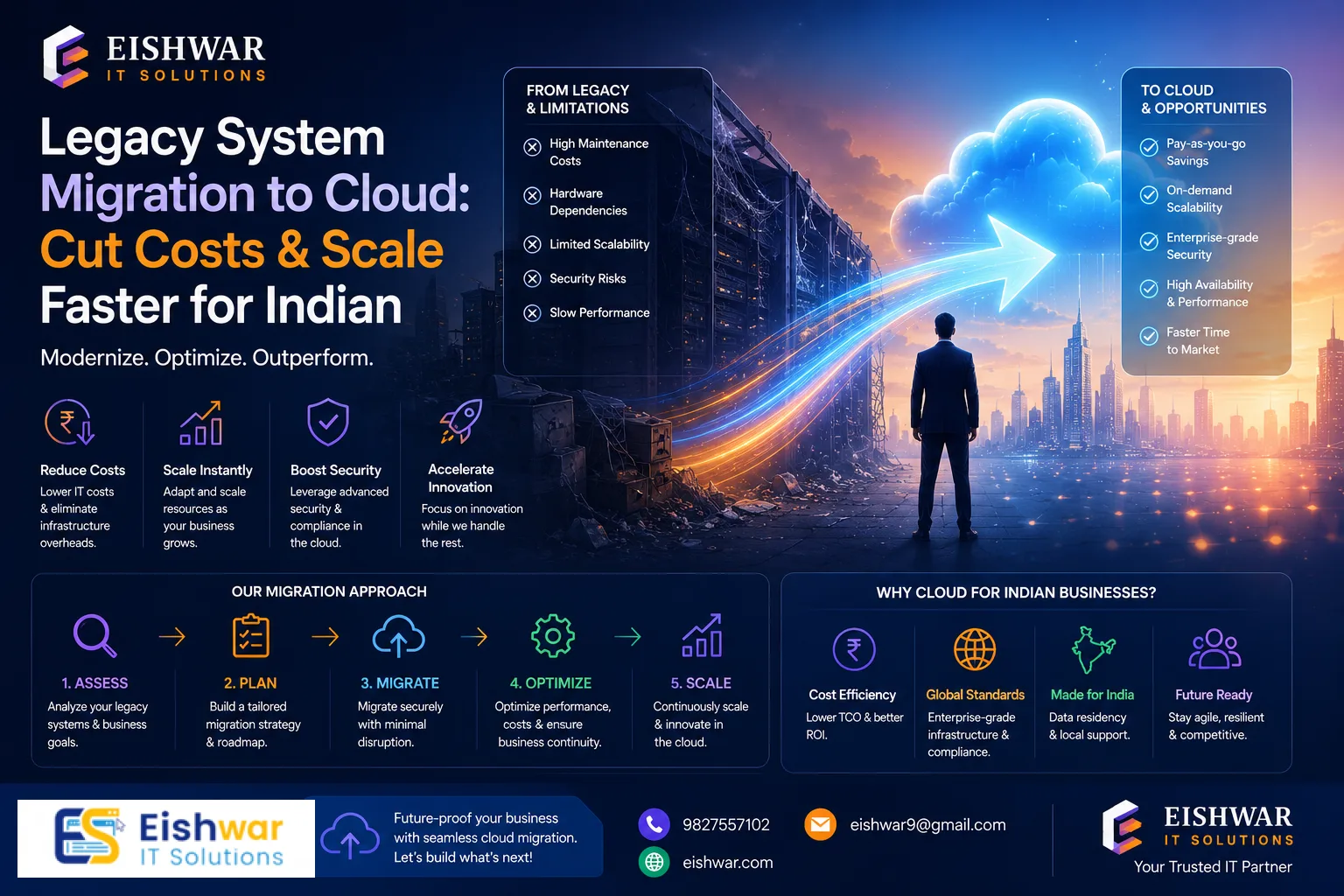
Migrating legacy systems isn't a lift-and-shift exercise. It requires planning. Here's a proven 5-step process for Indian SMEs:
Step 1: Audit and Prioritize
List all legacy systems and assess their dependencies, data volumes, and business criticality. Rank them by migration ease and impact. Start with non-critical apps to build confidence. For example, migrate your internal HR system first before touching your core ERP. Use tools like AWS Application Discovery Service or Azure Migrate to automate discovery. Create a dependency map to understand which apps talk to each other—this avoids surprises during migration.
👉 Don't wait for the perfect moment; turn your vision into reality today.
Free ConsultationStep 2: Choose the Right Cloud Model
Decide between public, private, or hybrid cloud. For most SMEs, public cloud (e.g., AWS, Azure) offers the best balance of cost and features. If you handle sensitive data (e.g., healthcare or financial records), a hybrid approach might be better, keeping critical data on-premise while moving less sensitive workloads to cloud. For example, a small clinic in Delhi might keep patient records on a private cloud for compliance, but move billing and scheduling to public cloud for cost savings.
Step 3: Pick a Migration Strategy (The 6 R's)
Common strategies include Rehost (lift-and-shift), Replatform (minor optimizations), or Refactor (re-architect for cloud-native). Rehost is fastest but may not fully leverage cloud benefits; refactor offers long-term gains but requires more effort. For Indian SMEs, a pragmatic approach is to rehost legacy apps that are stable and refactor only those that need performance improvements. For instance, a legacy inventory management system running on an old Windows server can be rehosted to AWS EC2 quickly, while a custom-built CRM might benefit from refactoring to use cloud-native databases like Amazon RDS.
Step 4: Execute with a Phased Approach
Migrate in waves. Test each wave thoroughly. Use tools like AWS Migration Hub or Azure Migrate to automate and monitor progress. Ensure rollback plans are in place. For example, migrate your email server first, test for a week, then move file storage, and finally the database. This phased approach minimizes business disruption and allows your team to learn gradually. A Pune-based manufacturing SME migrated their ERP in three waves over two months, with zero downtime during business hours.
Step 5: Optimize Post-Migration
Once live, continuously monitor costs, performance, and security. Use cloud cost management tools to right-size resources. Set up alerts to avoid bill shocks. For example, if you over-provisioned a virtual machine, you can downsize it after monitoring usage. Many SMEs save 20-30% in the first year by rightsizing. Also, implement tagging to track costs by department or project. Use AWS Cost Explorer or Azure Cost Management to get granular insights.
Main Section 3: Real-World Success Stories from Indian SMEs
Case Study 1: A Mumbai-based E-commerce Store
Migrated from a legacy on-premise server to AWS. Result: 50% reduction in infrastructure costs (from ₹6 lakhs to ₹3 lakhs annually), 99.9% uptime, and ability to handle 10x traffic during sales. They used auto-scaling groups and a content delivery network (CloudFront) to serve product images faster. The migration paid for itself within 8 months.
Case Study 2: A Bangalore IT Services Firm
Moved its legacy CRM to Azure. Result: 30% faster response times, seamless remote access for employees (critical during work-from-home), and integration with modern analytics tools like Power BI. They also reduced backup costs by using Azure Backup instead of tape drives. The firm now processes 50% more client requests without adding staff.
Case Study 3: A Surat Textile Manufacturer
Migrated legacy inventory and order management systems to Google Cloud. Result: 35% lower operational costs, real-time inventory visibility across three factories, and 20% faster order fulfillment. They used Cloud SQL for database migration and BigQuery for analytics. The owner now accesses dashboards from his phone, enabling quicker decisions.
👉 Free Website Audit
Get Free AuditThese examples show that cloud migration is not just for large enterprises. With proper planning, any SME can achieve tangible results.
Expert Tips
- Start small: Migrate a single application first to learn the process. A non-critical app like an internal wiki or expense tracker is ideal.
- Involve stakeholders: Get buy-in from IT, finance, and business heads early. Explain the ROI in terms they care about—cost savings for finance, agility for business, and security for IT.
- Budget for hidden costs: Include data transfer fees, training, and potential downtime. Data egress charges can add up—plan to minimize them by using cloud-native services.
- Invest in training: Upskill your team on cloud fundamentals—free courses are available from AWS Skill Builder, Microsoft Learn, and Google Cloud Skills Boost. Even basic certification (e.g., AWS Cloud Practitioner) can boost confidence.
- Use managed services: Reduce operational overhead by leveraging cloud-native services like RDS (managed databases), Lambda (serverless compute), or Cloud Storage. This frees your IT team to focus on innovation rather than patching servers.
- Negotiate with providers: Many cloud providers offer startup credits or discounts for SMEs. For example, AWS Activate provides up to $1,000 in credits for qualifying startups. Ask your cloud partner about such programs.
Common Mistakes
- Lifting and shifting everything: Not all apps benefit from a direct move; some need refactoring to take advantage of cloud-native features. For example, a monolithic legacy app might run poorly on cloud without re-architecting.
- Ignoring security: Cloud security is a shared responsibility—don't assume it's fully managed. You must configure firewalls, identity management, and encryption correctly. A common mistake is leaving storage buckets publicly accessible.
- Underestimating data migration: Data transfer can be slow and costly; plan bandwidth and timing. For large datasets (e.g., 1 TB+), consider using physical data transfer devices like AWS Snowball or Azure Data Box.
- No cost governance: Without monitoring, cloud costs can spiral. Set budgets and alerts. One SME in Pune forgot to turn off test instances and incurred ₹50,000 in extra charges in a month.
- Skipping testing: Test each migration wave thoroughly to avoid business disruption. Use staging environments that mirror production. A retail SME in Delhi skipped testing and lost two days of sales due to a misconfigured database.
- Not planning for downtime: Even with phased migration, some downtime may occur. Communicate with customers and schedule migrations during low-traffic periods (e.g., weekends or late nights).
Future Trends
Cloud migration is evolving. Expect more AI-driven migration tools that automate assessment and execution. For example, AWS Migration Hub now uses machine learning to predict migration costs and risks. Serverless architectures will reduce the need to manage servers entirely, allowing SMEs to focus on code. Edge computing will bring cloud capabilities closer to users, benefiting SMEs in remote areas (e.g., a logistics company in Nagpur using edge nodes for real-time tracking). Also, multi-cloud strategies will become common to avoid vendor lock-in—many SMEs are already using AWS for compute and Azure for analytics. Finally, sustainability is gaining traction: cloud providers are investing in renewable energy, and SMEs can reduce their carbon footprint by migrating from energy-hungry on-premise data centers.
👉 Free Homepage Demo
Book DemoFAQs
1. What is the average cost of cloud migration for an Indian SME?
Costs vary widely based on the number of systems and data volume. A simple migration (e.g., moving a single app with 50 GB data) can start at ₹2-5 lakhs, while complex projects (multiple apps, 1 TB+ data) may exceed ₹20 lakhs. Most SMEs see ROI within 12-18 months through reduced hardware, energy, and maintenance costs. Always get a detailed quote from a cloud consultant, as hidden costs like data transfer and training can add 10-20%.
2. How long does a typical cloud migration take?
Small migrations (1-2 apps) can take 1-3 months; larger ones (5+ apps, including databases) 6-12 months. Phased approaches help minimize disruption. For example, a Delhi-based SME migrated their entire IT stack (10 apps) in 8 months by moving one app per month. Plan for extra time if you need to refactor legacy code.
3. Will my data be safe in the cloud?
Yes, if you follow best practices. Cloud providers offer encryption at rest and in transit, access controls (IAM), and compliance certifications (e.g., ISO 27001, SOC 2). However, you must configure them correctly. For example, enable encryption for all storage buckets, use multi-factor authentication for admin accounts, and regularly audit access logs. Many Indian SMEs also use cloud-native backup services like AWS Backup to automate data protection.
4. Can I migrate legacy apps that are not cloud-ready?
Yes, but you may need to refactor or use emulation. Tools like AWS Mainframe Modernization or Azure Logic Apps can help. For example, a legacy COBOL-based inventory system can be migrated using AWS Mainframe Modernization with minimal code changes. Alternatively, you can containerize the app using Docker and run it on cloud Kubernetes services. Consult with a cloud expert to evaluate the best approach for your specific legacy app.
5. Do I need a cloud specialist on my team?
Not necessarily. Many Indian cloud consulting firms offer end-to-end migration services, from assessment to post-migration support. Alternatively, upskill existing staff through free online courses (e.g., AWS Cloud Practitioner, Azure Fundamentals). Many SMEs start with a consultant for the first migration and then train internal staff for subsequent projects. This hybrid approach balances cost and knowledge transfer.
6. What happens to my old hardware after migration?
You can repurpose, sell, or recycle it. Some SMEs keep legacy systems as backups during transition (e.g., for 3-6 months). After that, you can sell used servers on platforms like OLX or Quikr, or donate to educational institutions for tax benefits. For recycling, use certified e-waste recyclers to ensure compliance with Indian environmental regulations. Remember to securely wipe all data before disposal.
7. How do I handle compliance with Indian data laws (e.g., IT Act, upcoming DPDP Act)?
Cloud providers offer data residency options (e.g., AWS Mumbai region) to keep data within India. Use these to comply with local laws. Also, implement data classification and access controls. For sensitive data (e.g., customer PII), consider encryption with customer-managed keys. Many cloud providers also offer compliance documentation to help with audits. Consult a legal expert for specific compliance requirements.
Conclusion
Migrating legacy systems to the cloud is no longer optional for Indian SMEs that want to compete. It's a strategic move that cuts costs, boosts scalability, and unlocks innovation. By following the blueprint outlined here—audit, choose a strategy, execute in phases, and optimize—you can transform your IT infrastructure without breaking the bank. The cloud is not just for tech giants; it's for every business ready to grow. Start your journey today, and you'll soon see the benefits in your bottom line and customer satisfaction.
CTA
Ready to migrate your legacy systems to the cloud? Contact EishwarITSolution today for a free consultation. Our experts will help you design a cost-effective migration plan tailored to your SME. Don't let legacy systems hold you back—embrace the cloud and scale faster. Get in touch now and take the first step toward a more agile, cost-efficient future.