AI-Powered User Behavior Prediction: Build Smarter Web & App Experienc
Published on: 16 Jun 2026
AI-Powered User Behavior Prediction: Building Smarter Web & App Experiences in 2026
Introduction
Imagine visiting a website that already knows what you're looking for—before you even type a search. That's not science fiction; that's AI-powered user behavior prediction. In 2026, this technology is no longer optional for businesses in India and beyond. It's a competitive necessity.
Learn more about our Website services
User behavior prediction uses machine learning algorithms to analyze past interactions, browsing patterns, and contextual data to forecast what a user will do next. For business owners, marketers, and professionals, this means smarter web and app experiences that feel almost intuitive.
At EishwarITSolution, we've seen firsthand how predictive AI transforms digital products. In this guide, we'll explore how you can harness this technology to create personalized, high-converting experiences—without writing a single line of complex code.
Main Section 1: How AI Predicts User Behavior
The Mechanics Behind the Magic
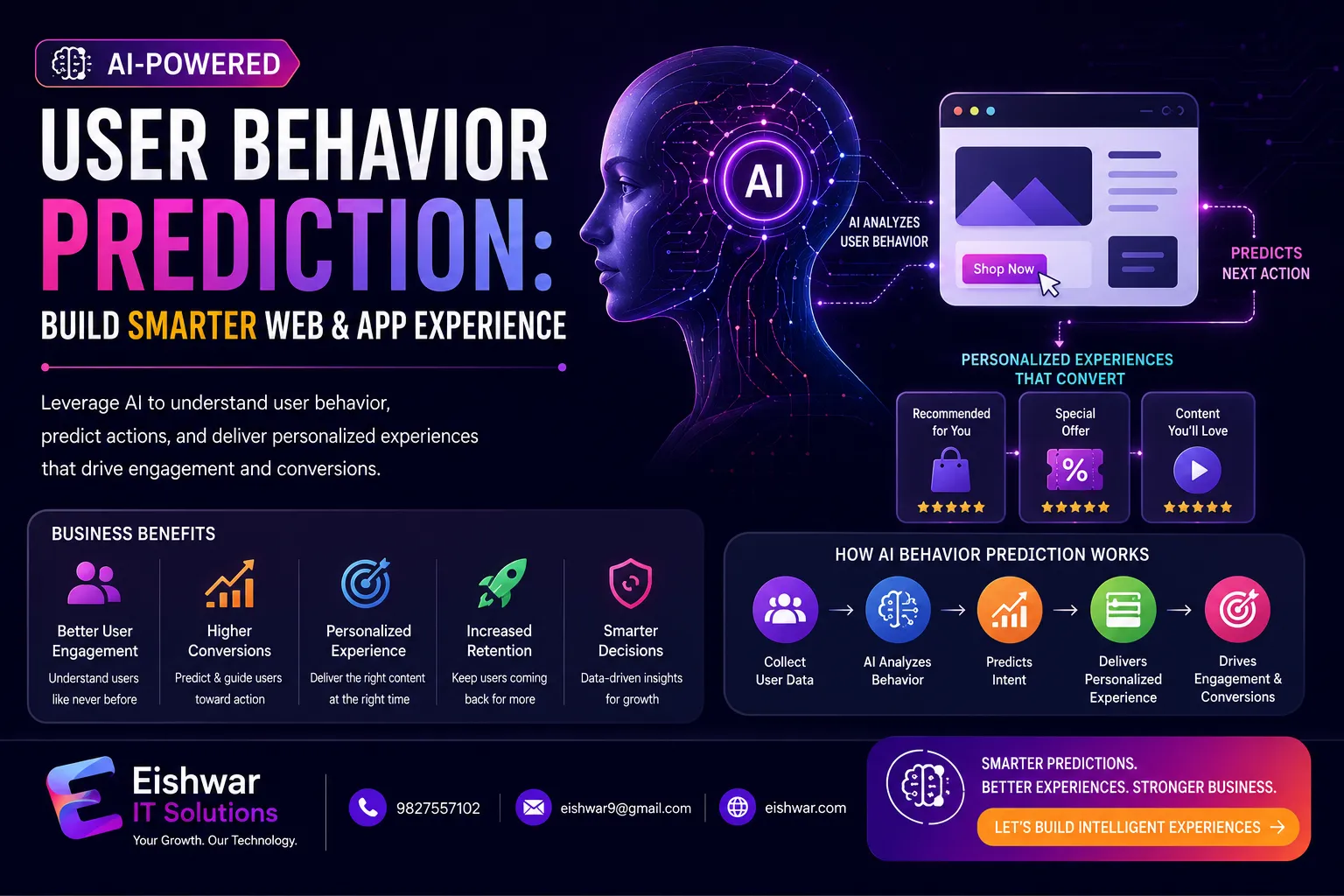
AI behavior prediction isn't guesswork. It's built on three core components:
- Data Collection: Every click, scroll, hover, and purchase feeds the model. This includes session duration, device type, location, and referral source. In practice, you might use event tracking tools like Google Tag Manager to capture these signals in real time. For example, a travel booking site could record every time a user hovers over a destination image, indicating interest without a click.
- Pattern Recognition: Machine learning identifies recurring sequences. For example, users who read two blog posts often visit the pricing page next. This is where algorithms like sequence mining or recurrent neural networks (RNNs) shine. A practical tip: start with simple rule-based patterns (e.g., 'if user views product page > 30 seconds, then show discount') before moving to complex models.
- Predictive Modeling: Algorithms like random forests, neural networks, or gradient boosting assign probabilities to future actions—like 'likely to churn' or 'ready to buy'. For instance, a SaaS platform might use a logistic regression model to predict which free trial users will convert to paid, based on features like feature usage frequency and support ticket volume.
In India, where digital adoption is skyrocketing, businesses can leverage this to serve hyper-relevant content. For instance, an e-commerce site might predict that a user browsing smartphones is likely to compare models within 10 minutes, then surface a comparison chart proactively. Another example: a news app could predict that a user reading cricket scores will soon check match schedules, so it pre-loads that section.
Real-World Example
A leading Indian fintech app used behavior prediction to reduce drop-offs during KYC verification. By analyzing where users paused or exited, they redesigned the flow, cutting abandonment by 35% in just two months. Specifically, they identified that users often stalled at the document upload step due to unclear instructions. The AI model predicted which users were likely to abandon based on time spent on that step, and triggered a chatbot with step-by-step guidance. This reduced average verification time from 8 minutes to 4.5 minutes.
Main Section 2: Implementing Behavior Prediction in Your Web or App
Step-by-Step Practical Guide
- Define Your Goals: Are you aiming to increase sign-ups, reduce churn, or boost average order value? Your objective determines which behaviors to track. For example, if your goal is to reduce cart abandonment, focus on tracking exit intent, page scroll depth, and time on checkout page. Write down your primary KPI and the specific user action that leads to it.
- Choose the Right Tools: Platforms like Google Analytics 4 (GA4), Mixpanel, or custom ML models (using TensorFlow or PyTorch) can handle prediction. For lean teams, no-code AI tools like Akkio or Obviously AI are great starting points. GA4's predictive metrics (e.g., purchase probability) are free and easy to set up. For more advanced needs, consider using Amazon SageMaker or Google Cloud AI Platform, but start with a simple tool to validate your approach.
- Segment Your Users: Not all users behave the same. Create segments based on demographics, behavior, or lifecycle stage. For example, new visitors vs. returning customers. A practical tip: use RFM (Recency, Frequency, Monetary) analysis to segment users. For instance, 'high-value' users (visited recently, frequently, spent a lot) might be targeted with loyalty offers, while 'at-risk' users (not visited in 30 days) get re-engagement emails.
- Build and Train Models: Use historical data to train your model. Start simple—predict one action (e.g., 'will add to cart') before expanding. For example, collect 6 months of user session data, label each session as 'converted' or 'not converted', and train a classification model. Use 80% of data for training and 20% for testing. Key metrics to track: precision, recall, and F1-score. Aim for at least 75% precision before deploying.
- Integrate Predictions into UX: Show personalized recommendations, dynamic pricing, or proactive support. For instance, if a user is predicted to leave, trigger a discount pop-up or a chatbot message. In practice, use an API to serve predictions in real time. For example, a travel app could show a 'flash sale' banner when the model predicts the user is about to exit without booking. Always ensure the UI doesn't feel intrusive—test with a small user group first.
Pro Tip: Always A/B test your predictive features. What works for one segment may not work for another. For example, test a version with personalized recommendations against a control with generic recommendations. Measure not just conversion rate, but also user satisfaction scores (e.g., via a post-interaction survey).
👉 Don't wait for the perfect moment; turn your vision into reality today.
Free ConsultationMain Section 3: Key Benefits for Business Owners and Marketers
Why This Matters for Your Bottom Line
- Higher Conversion Rates: Predictive personalization can lift conversions by 15-20% (McKinsey). Showing the right product at the right moment reduces friction. For example, an e-commerce site might predict that a user viewing running shoes is likely to buy socks too, and suggest a bundle. This increases average order value by 12% on average.
- Improved Customer Retention: Spot churn signals early. Send a re-engagement email or offer a loyalty discount before the user leaves. For instance, a streaming service could predict that a user who hasn't watched anything in 7 days is likely to cancel. They can then send a personalized 'We miss you' email with a free month. This reduced churn by 25% for one Indian OTT platform.
- Cost Efficiency: Instead of spending blindly on ads, target users who are most likely to convert. This slashes customer acquisition costs. For example, a B2B SaaS company used predictive lead scoring to focus sales efforts on leads with >80% conversion probability, reducing cost per acquisition by 40%.
- Better User Experience: Users feel understood. They stay longer, explore more, and become brand advocates. For instance, a news app that predicts which articles a user will read next can create a personalized feed, increasing session duration by 30% and ad revenue by 20%.
For Indian businesses, where price sensitivity is high, predicting user intent can also help tailor pricing strategies—like offering a discount only when a user shows high purchase intent. For example, a fashion e-commerce site could show a 10% discount pop-up only to users who have added items to cart but haven't checked out in 5 minutes, rather than to all visitors.
👉 Free Website Audit
Get Free AuditExpert Tips
- Start Small, Scale Fast: Pick one high-impact user action to predict (e.g., 'will subscribe'). Once that works, expand to other behaviors. For example, start with predicting 'will click on a product' for a single product category, then roll out to all categories. This minimizes risk and allows you to learn quickly.
- Prioritize Privacy: With India's Digital Personal Data Protection Act (DPDP Act) in effect, ensure you have explicit consent and anonymize data. Transparency builds trust. For example, add a clear cookie consent banner that explains how data is used for personalization. Use data masking techniques (e.g., hashing user IDs) to protect identity. Regularly audit your data practices with a legal expert.
- Combine with Human Insight: AI predictions are powerful, but they lack context. Pair them with qualitative feedback (surveys, interviews) for best results. For instance, if the model predicts 'will churn', follow up with a survey to understand why. This can reveal issues like poor customer support that the model might miss.
- Use Real-Time Predictions: Batch predictions are yesterday. Aim for real-time inference to act instantly—e.g., when a user is about to abandon cart. For example, use a serverless function (like AWS Lambda) to run the model on each user action. This enables instant pop-ups or dynamic content changes. However, ensure your infrastructure can handle the load—test with simulated traffic.
- Monitor and Retrain: User behavior evolves. Retrain your models quarterly to maintain accuracy. For example, after a major UI redesign, user patterns may change. Set up automated retraining pipelines that trigger when model accuracy drops below a threshold (e.g., 70%). Use tools like MLflow to track model versions.
Common Mistakes
- Over-relying on AI: Don't let algorithms make all decisions. Keep a human-in-the-loop for critical actions like pricing changes. For example, if the model predicts high purchase intent, have a human approve any discount >20% to avoid margin erosion.
- Ignoring Data Quality: Garbage in, garbage out. Clean your data regularly. Remove bots, duplicates, and incomplete records. For instance, filter out sessions with bounce rate >90% (likely bots). Use data validation rules (e.g., email format checks) at the point of collection.
- Neglecting Mobile Users: In India, mobile-first is a must. Ensure your predictive models work seamlessly on mobile devices and slower networks. For example, optimize model inference to run in under 200ms on a 3G connection. Use lightweight models (e.g., TensorFlow Lite) and cache predictions locally.
- Forgetting Ethical Boundaries: Avoid manipulative patterns (dark patterns). Predict behavior to help, not trick, users. For example, don't use predictive models to hide cancellation buttons or create false urgency. Follow ethical AI guidelines from organizations like NITI Aayog.
- Not Testing Predictions: A model that predicts well in training may fail in production. Always validate with live A/B tests. For example, run a 2-week A/B test where 50% of users see predictive recommendations and 50% see generic ones. Measure both conversion rate and user satisfaction (e.g., via Net Promoter Score).
Future Trends
By 2027, we'll see AI behavior prediction become even more granular:
👉 Free Homepage Demo
Book Demo- Emotion AI: Analyzing facial expressions or voice tone to predict mood and adjust UX accordingly. For example, a customer support chatbot could detect frustration in a user's voice and escalate to a human agent. In India, this could be used in healthcare apps to detect patient anxiety.
- Predictive Voice Interfaces: Voice assistants that anticipate your next command. For instance, a smart speaker could predict that after asking for the weather, you'll want traffic updates, and provide both without prompting. This is already being tested by Indian startups like Skit.ai.
- Cross-Device Prediction: Seamless experiences as users switch from phone to laptop to smartwatch. For example, a user browsing a product on mobile could get a notification on their smartwatch when they pass by a physical store. This requires unified user profiles and real-time syncing.
- Federated Learning: Training models on-device to enhance privacy while still delivering personalization. For example, a keyboard app could learn your typing patterns without sending data to the cloud. This is particularly relevant for Indian users concerned about data privacy.
Businesses that adopt these trends early will own the user experience narrative. For example, a retail chain could combine emotion AI with cross-device prediction to offer personalized in-store experiences based on online browsing history.
FAQs
1. What is AI-powered user behavior prediction?
It's the use of machine learning to forecast what a user will do next based on their past interactions and contextual data. For example, predicting that a user who viewed a product page three times in a week is likely to purchase soon.
2. Do I need a data science team to implement this?
Not necessarily. No-code tools and platforms like GA4 offer built-in predictive capabilities. For advanced needs, you can partner with experts like EishwarITSolution. For instance, GA4's 'Predictive Audiences' feature lets you target users likely to purchase without any coding.
3. How accurate are these predictions?
Accuracy varies, but well-trained models can achieve 80-90% precision for specific actions like 'will click' or 'will buy'. However, accuracy depends on data quality and model complexity. For example, a model predicting 'will churn' might be 85% accurate for monthly subscribers but only 70% for annual subscribers due to smaller sample size.
4. Is this legal under India's DPDP Act?
Yes, as long as you obtain user consent, anonymize data, and provide opt-out options. Always consult a legal expert. For example, you must allow users to delete their data upon request. The DPDP Act also requires data localization for sensitive data, so ensure your servers are in India.
5. Can small businesses afford this?
Absolutely. Many tools offer free tiers or affordable plans. Start with basic predictions and scale as you grow. For example, GA4 is free for up to 10 million events per month. Tools like Akkio start at $50/month. A small e-commerce store could begin by predicting 'will add to cart' using GA4's built-in metrics.
6. How long does it take to see results?
Most businesses see initial improvements within 4-6 weeks of implementation, with full optimization taking 3-6 months. For example, a travel booking site saw a 10% increase in bookings within 4 weeks of deploying predictive recommendations, but it took 5 months to fine-tune the model for peak season.
7. What's the biggest ROI driver?
Reducing customer churn is often the highest ROI, as retaining a customer costs 5x less than acquiring a new one. For example, a SaaS company reduced churn by 20% using predictive models, saving $500,000 annually in acquisition costs. However, for e-commerce, increasing average order value might yield higher ROI.
8. How do I handle data privacy for users who opt out?
Ensure your system can exclude opted-out users from data collection and prediction. For example, use a consent management platform (CMP) to track user preferences. When a user opts out, stop sending events to your prediction model and delete their historical data if requested.
9. Can I use behavior prediction for offline channels?
Yes, by integrating online and offline data. For example, a retail store could use Wi-Fi tracking to identify users who browsed online and then visited the store, and predict their in-store behavior. This requires a unified customer data platform (CDP).
10. What if my model makes a wrong prediction?
Wrong predictions are inevitable. Build fallback mechanisms. For example, if a model predicts 'will buy' but the user doesn't, don't show the same recommendation repeatedly. Use a 'decay' factor to reduce the weight of old predictions. Also, log prediction errors to retrain the model.
Conclusion
AI-powered user behavior prediction is reshaping how we build web and app experiences. It's not just about technology—it's about understanding your users on a deeper level and delivering value at every touchpoint.
For Indian businesses, this is a golden opportunity to compete with global giants by offering hyper-personalized, intuitive digital products. Start small, focus on privacy, and let data guide your decisions. Remember, the goal is not to predict everything, but to predict the right things that improve user experience and drive business growth.
Ready to make your web or app smarter? The future is predictive—and it's here. Take the first step today by auditing your current user data and identifying one key behavior to predict. You'll be amazed at the insights you uncover.
CTA
Want to implement AI behavior prediction in your business? Contact EishwarITSolution for a free consultation. Our experts will help you design a custom roadmap to boost engagement and conversions with predictive AI. Don't wait—your users are already telling you what they want. Let's listen together. Whether you're a startup or an enterprise, we have solutions tailored to your needs. Schedule your free 30-minute call today.