
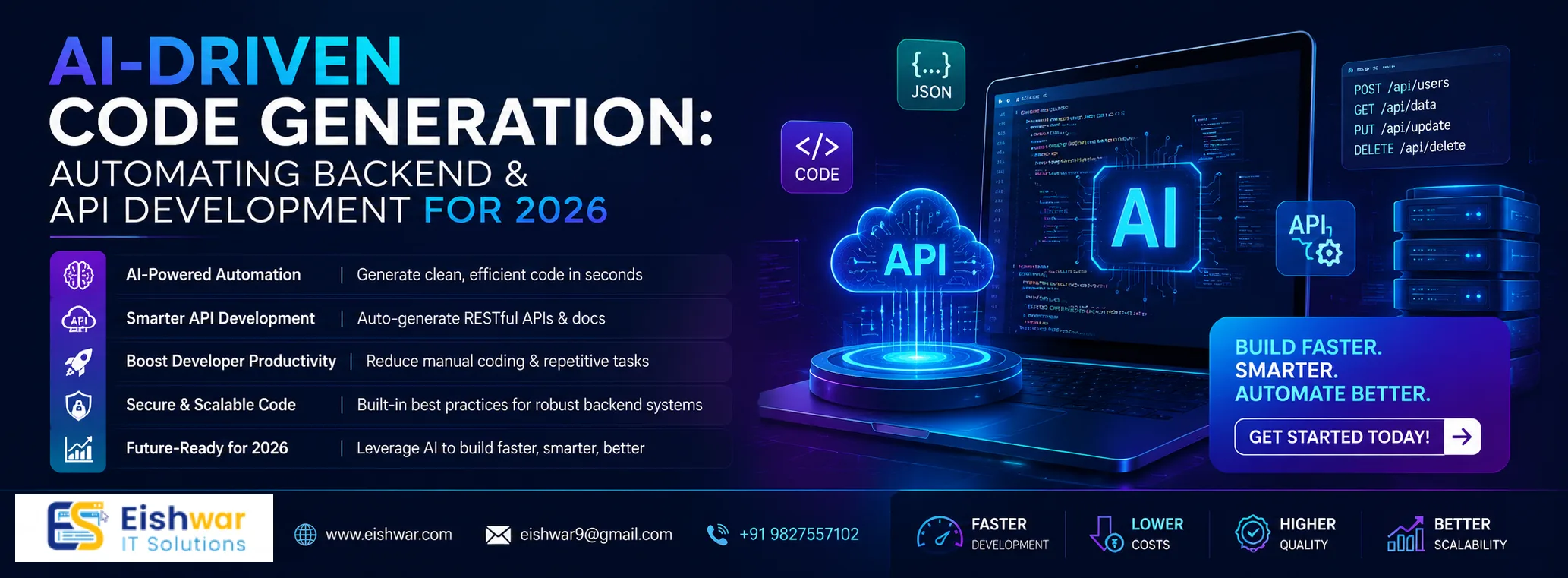
AI-Driven Code Generation: Automating Backend & API Development for 20
Published on: 06 Jul 2026
AI-Driven Code Generation: Automating Backend & API Development for 2026
Introduction
Backend and API development has long been the backbone of web and app projects—but it's also one of the most time-consuming, error-prone parts of the stack. In 2026, AI-driven code generation is changing the game. Tools like GitHub Copilot, Tabnine, and Amazon CodeWhisperer can now generate entire backend endpoints, database schemas, and API integrations in minutes. For Indian business owners and marketers, this means faster time-to-market, lower development costs, and fewer bugs.
Learn more about our Website services
At EishwarITSolution, we've seen firsthand how AI accelerates backend workflows while maintaining code quality. In this article, we'll explore the latest AI code generation tools, practical use cases, common mistakes to avoid, and what the future holds for backend automation in 2026. We'll also dive into specific examples and tips tailored for Indian SMEs, helping you leverage these tools effectively.
Main Section 1: How AI Code Generation Transforms Backend Development
AI code generation isn't just about autocompleting a few lines. Modern tools understand context, follow coding standards, and can generate complex logic. For example, you can describe an API endpoint in plain English—like "create a REST API for user registration with email verification"—and the AI produces the entire controller, model, and route files. This capability is powered by large language models trained on millions of code repositories, enabling them to predict and generate code that aligns with best practices.
Key Benefits for Indian Businesses:
- Speed: Reduce backend development time by up to 60%. For instance, a typical e-commerce API that takes two weeks can now be built in three to four days.
- Consistency: AI enforces coding patterns, reducing technical debt. This is crucial for teams with varying skill levels, as it ensures uniform code quality.
- Cost: Lower dependency on senior developers for repetitive tasks. Junior developers can use AI to generate boilerplate code, freeing seniors for architecture and review.
- Scalability: Generate scalable microservices architectures automatically. AI can suggest database indexing strategies, caching layers, and load balancing configurations.
For instance, a fintech startup in Bangalore used AI code generation to build their payment gateway integration in three days instead of three weeks. The AI handled the boilerplate, while developers focused on business logic. They reported a 70% reduction in initial development time and a 40% decrease in bug-related rework.
Main Section 2: Top AI Tools for Backend & API Automation in 2026
Here are the leading AI tools every developer should know, along with practical tips for each:
- GitHub Copilot X: Now supports multi-file generation, chat-based refactoring, and pull request summaries. Tip: Use the chat feature to ask for code reviews or explain complex functions. It's particularly useful for generating unit tests for new endpoints.
- Amazon CodeWhisperer: Best for AWS-native projects; generates secure, optimized code for Lambda, API Gateway, and DynamoDB. Tip: Integrate with AWS Cloud9 for seamless development. It also flags potential security issues like hardcoded credentials.
- Tabnine Enterprise: Offers on-premise deployment for data-sensitive industries like banking and healthcare. Tip: Customize the model with your codebase to improve accuracy. It's ideal for teams that require strict data privacy.
- Replit Ghostwriter: Ideal for rapid prototyping and collaborative coding. Tip: Use it in pair programming sessions to quickly iterate on API designs. It's great for hackathons and MVPs.
- OpenAI Codex (via API): Powers custom automation pipelines for large enterprises. Tip: Build a custom tool that generates code from your internal API documentation. This can standardize development across teams.
These tools integrate seamlessly with VS Code, JetBrains, and other popular IDEs. Pro tip: always review AI-generated code for security vulnerabilities—especially when handling user data. Use static analysis tools like SonarQube to catch issues early.
👉 Don't wait for the perfect moment; turn your vision into reality today.
Free ConsultationMain Section 3: Practical Use Cases for Indian Businesses
AI code generation isn't just for tech giants. Here's how Indian SMEs and startups can leverage it with specific examples:
- E-commerce: Automatically generate product catalog APIs, cart logic, and order processing endpoints. Example: A Mumbai-based fashion retailer used AI to build a recommendation engine API, which increased average order value by 15%.
- EdTech: Build quiz engines, user progress tracking, and payment integrations faster. Example: A Pune-based online learning platform generated a complete student assessment API in two days, including automated grading and feedback.
- Healthcare: Generate HIPAA-compliant APIs for patient records and appointment scheduling. Example: A Chennai clinic used AI to create a secure patient portal API, reducing manual data entry errors by 80%.
- Logistics: Create real-time tracking APIs and route optimization backends. Example: A Delhi-based logistics company used AI to generate their entire shipment tracking API in under 8 hours. The AI produced Node.js code with MongoDB schemas, authentication, and error handling—saving ₹2 lakhs in development costs.
For each use case, start with a clear API contract. For instance, define endpoints like /api/products with GET, POST, PUT, DELETE methods, and specify request/response formats. AI tools can then generate the corresponding code, including validation and error handling.
Expert Tips
- Start with a clear specification: AI works best when you provide detailed prompts. Write out your API contract (endpoints, request/response formats) before generating code. Use tools like Swagger or OpenAPI to define the contract, then feed it to the AI.
- Use AI for testing too: Tools like Diffblue Cover can automatically generate unit tests for your AI-generated backend code. This ensures that your code is reliable and reduces manual testing effort by up to 50%.
- Combine with CI/CD: Integrate AI code generation into your pipeline—trigger auto-generation when a new feature is defined. For example, use GitHub Actions to automatically generate code from a pull request description.
- Maintain human oversight: Always review generated code for logic errors, security flaws, and performance bottlenecks. Set up code review checklists that include AI-generated code validation.
- Leverage domain-specific models: Some AI tools now offer fine-tuned models for industries like fintech or healthcare—use them for better accuracy. For instance, a fintech model might generate code with built-in compliance checks for RBI regulations.
Common Mistakes
- Blindly trusting AI output: Never deploy AI-generated code without testing. One startup in Mumbai lost customer data due to an unvalidated SQL injection vulnerability. Always run penetration tests and use parameterized queries.
- Ignoring licensing: Some AI code generators may produce code with restrictive licenses. Always check the output's license compatibility. For example, code generated from open-source repositories might carry GPL obligations.
- Over-reliance on AI for architecture: AI can't replace a seasoned architect. Use it for implementation, not design decisions. For complex systems, involve a senior developer to define the overall structure.
- Neglecting documentation: AI-generated code often lacks comments. Add documentation to ensure maintainability. Use tools like JSDoc or Sphinx to auto-generate documentation from your code.
Future Trends
By 2027, AI code generation will evolve to:
👉 Free Website Audit
Get Free Audit- End-to-end backend generation: From database schema to deployment scripts, all from a single prompt. For example, you could say "Create a microservice for user management with PostgreSQL and deploy to AWS ECS" and get everything.
- Real-time collaboration: AI will act as a pair programmer, suggesting improvements as you type. This will be integrated into IDEs like VS Code, providing instant feedback on code quality.
- Self-healing code: AI will automatically fix bugs and update dependencies. Imagine an AI that monitors your production code and patches vulnerabilities without human intervention.
- Integration with low-code platforms: Combine AI code generation with drag-and-drop UI builders for true no-code backend development. This will empower business analysts to create simple APIs without coding.
Indian businesses that adopt these tools early will gain a significant competitive advantage. For instance, early adopters in the e-commerce sector have already seen a 30% reduction in time-to-market for new features.
FAQs
1. Is AI-generated code secure?
AI-generated code can be secure if you use reputable tools and review the output. Always run security scans and follow best practices like input validation and encryption. For example, use OWASP guidelines to check for common vulnerabilities.
2. Can AI replace backend developers?
No, AI is a productivity tool, not a replacement. Developers are still needed for architecture, complex logic, and quality assurance. Think of AI as a supercharged assistant that handles repetitive tasks, allowing developers to focus on innovation.
3. Which programming languages does AI code generation support?
Most tools support Python, JavaScript, TypeScript, Java, C#, Go, and Ruby. Some also support Rust, Kotlin, and Swift. For backend development, Python and JavaScript are the most popular due to their extensive frameworks like Django and Express.js.
4. How much does AI code generation cost?
Pricing varies: GitHub Copilot is around $10-39/month per user, while enterprise solutions like Tabnine can cost up to $150/user/month. Many offer free tiers for small teams. For Indian businesses, the cost is often offset by the time savings—typically a 5x return on investment.
5. Can AI generate APIs for mobile apps?
Absolutely. AI can create RESTful and GraphQL APIs that work seamlessly with iOS, Android, and cross-platform frameworks like Flutter and React Native. For example, you can generate a complete user authentication API that works with Firebase or custom backends.
6. How do I start using AI code generation in my team?
Start with a pilot project. Choose a small, well-defined feature like a user registration API. Install a tool like GitHub Copilot in your IDE, write a clear prompt, and review the output. Gradually expand to more complex tasks as your team gains confidence.
👉 Free Homepage Demo
Book Demo7. What are the risks of using AI-generated code?
Risks include security vulnerabilities, licensing issues, and code quality problems. Mitigate these by conducting thorough code reviews, using security scanners, and maintaining a human-in-the-loop approach. Always test in a staging environment before production.
Conclusion
AI-driven code generation is no longer a futuristic concept—it's a practical tool that Indian businesses can use today to build backend systems faster, cheaper, and with fewer errors. By combining AI with human expertise, you can accelerate your development cycles and focus on innovation. The key is to start small, review rigorously, and scale gradually. With the right approach, AI can be a game-changer for your backend development, helping you stay ahead in a competitive market.
CTA
Don't let manual coding slow you down. Get in touch with EishwarITSolution today and discover how AI-driven backend automation can transform your web and app projects in 2026. Our team of experts will help you integrate the right tools and processes to maximize your ROI.