AI Chatbots for Business: Automate Support & Leads in 2026
Published on: 14 Jun 2026
AI Chatbots for Business: Automate Support & Leads in 2026
Introduction
Imagine a tireless assistant that answers customer queries at 3 AM, qualifies leads while you sleep, and never takes a coffee break. That's the promise of AI chatbots in 2026. For Indian business owners, marketers, and professionals, chatbots are no longer a futuristic luxury—they're a competitive necessity. In this guide, we'll explore how you can leverage AI chatbots to automate customer support and supercharge lead generation, with practical examples tailored for the Indian market. Whether you run a small kirana store or a growing SaaS startup, chatbots can help you scale operations without proportionally increasing costs. By the end of this article, you'll have a clear roadmap to implement your first chatbot and start seeing tangible results.
Learn more about our Website services
Main Section 1: Why AI Chatbots Are Essential for Indian Businesses in 2026
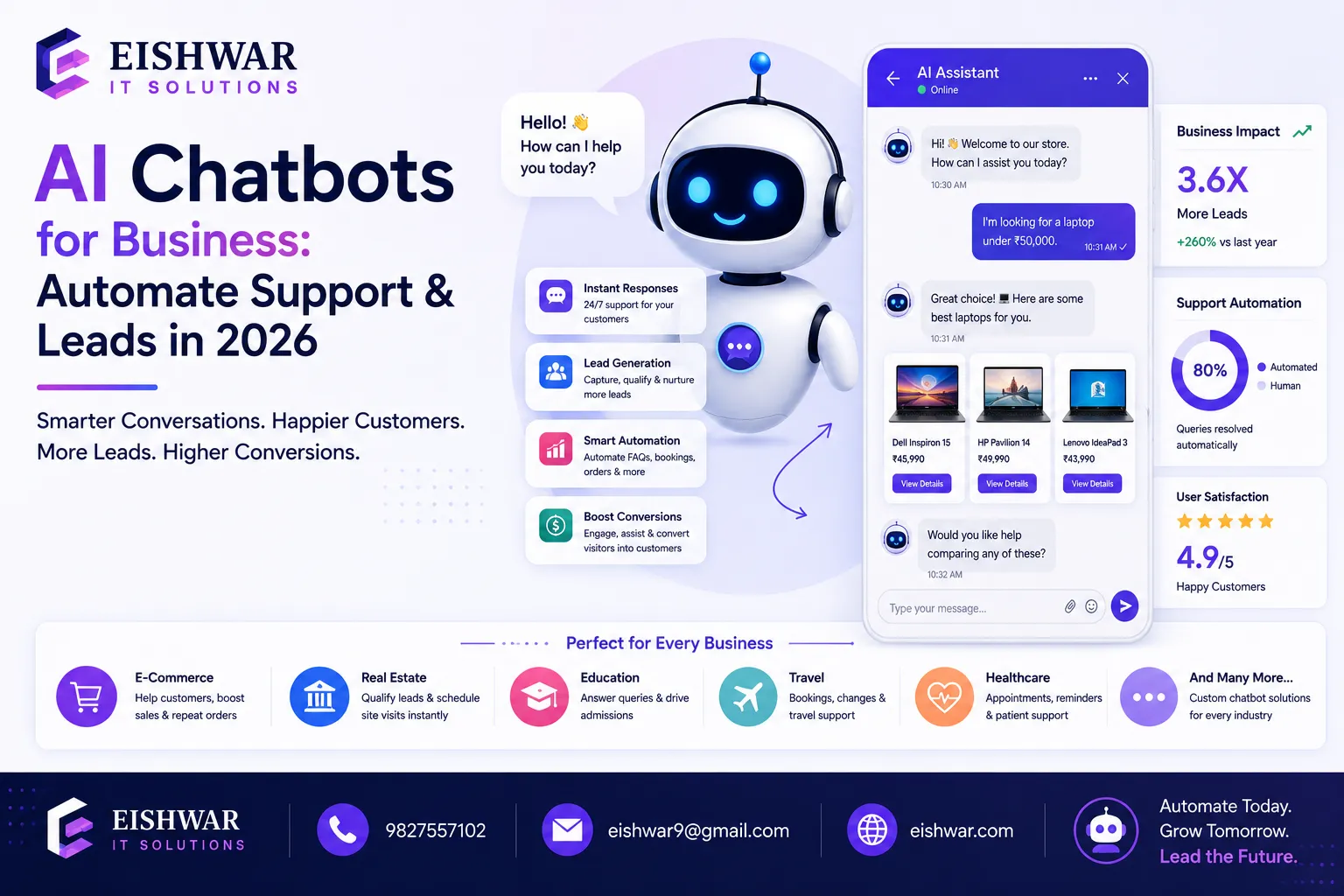
India's digital landscape is booming. With over 900 million internet users and a growing preference for instant messaging, customers expect quick, personalized responses. AI chatbots meet this demand by providing 24/7 support, reducing response times from hours to seconds. For example, a Delhi-based e-commerce store using a chatbot saw a 40% increase in customer satisfaction and a 30% reduction in support costs. Moreover, chatbots can handle multiple languages—critical for India's diverse market. They also integrate seamlessly with popular platforms like WhatsApp, Facebook Messenger, and your website. In 2026, the cost of chatbot development has dropped significantly, making it accessible even for micro-businesses. A chatbot can handle up to 80% of routine queries, freeing your team to focus on complex issues. For instance, a Jaipur-based travel agency deployed a chatbot on WhatsApp to answer common questions about packages, visa requirements, and booking status, resulting in a 50% reduction in phone call volume. The key is to choose a platform that supports Indian languages like Hindi, Tamil, and Marathi, ensuring no customer feels left out.
Main Section 2: How AI Chatbots Automate Customer Support
Modern AI chatbots use natural language processing (NLP) to understand and respond to customer inquiries. They can handle FAQs, track orders, process returns, and escalate complex issues to human agents. For instance, a Bengaluru-based SaaS company deployed a chatbot that resolved 70% of common queries without human intervention. To get started, identify your most frequent support requests and train your chatbot using those examples. Use a tool like Tidio or ManyChat to build your first bot without coding. Remember to monitor conversations regularly to improve accuracy. A practical tip: create a decision tree for your chatbot. For example, if a customer asks about order status, the bot can ask for the order ID, fetch the data from your backend, and provide real-time updates. If the issue is unresolved, the bot can transfer the conversation to a human agent with full context. In 2026, advanced chatbots also use sentiment analysis to detect frustrated customers and prioritize them for human intervention. For a Pune-based electronics retailer, this feature reduced complaint resolution time by 60%. Additionally, integrate your chatbot with your CRM to log all interactions, ensuring a seamless customer history. This not only improves support but also helps in personalizing future interactions.
👉 Don't wait for the perfect moment; turn your vision into reality today.
Free ConsultationMain Section 3: AI Chatbots for Lead Generation
Chatbots excel at capturing leads by engaging visitors with personalized messages. For example, a Mumbai real estate firm used a chatbot on their website to ask visitors about budget and location preferences, qualifying leads in real-time. The bot then scheduled site visits automatically, boosting conversions by 50%. To replicate this, design your chatbot to ask qualifying questions, offer valuable content (like an ebook), and integrate with your CRM. Use triggers based on user behavior, such as time spent on a page or exit intent, to initiate conversations. For instance, if a user spends more than 30 seconds on your pricing page, the chatbot can pop up with a message like, "Looking for the best plan? Let me help you choose." This proactive approach can increase lead capture by up to 40%. In 2026, chatbots also leverage predictive analytics to score leads based on their responses. A high-scoring lead can be instantly routed to your sales team, while low-scoring ones can be nurtured with automated follow-ups. For a Chennai-based edtech startup, this led to a 35% increase in demo bookings. Remember to A/B test your chatbot's opening messages—sometimes a simple "Hi! How can I help?" works better than a long introduction. Also, ensure your chatbot collects essential data like email and phone number (with consent) for future marketing campaigns.
Expert Tips
- Start Simple: Focus on one use case—support or lead gen—before expanding. Trying to do both at once can overwhelm your bot and confuse users.
- Human Handoff: Always provide an option to speak to a human for complex issues. A bot that traps users in endless loops is a recipe for frustration.
- Test & Iterate: A/B test your chatbot's responses and tweak based on user feedback. Use analytics to identify drop-off points in conversations.
- Localize: Use regional languages and cultural references to connect better with Indian audiences. For example, a bot that says "Namaste" or uses festive greetings during Diwali can build rapport.
- Set Clear Expectations: Let users know they're chatting with a bot upfront. Transparency builds trust and reduces disappointment.
Common Mistakes
- Overcomplicating: Trying to handle too many tasks at once leads to poor performance. Keep your bot's scope narrow initially.
- Ignoring Analytics: Not tracking chatbot metrics like resolution rate and user satisfaction means you're flying blind. Use tools like Google Analytics or built-in dashboards.
- Lack of Personality: A robotic tone drives customers away. Make your bot friendly and relatable—add a touch of humor where appropriate.
- Forgetting Privacy: Ensure compliance with India's Digital Personal Data Protection Act. Obtain explicit consent before storing user data and provide a clear privacy policy.
- Poor Integration: A chatbot that doesn't sync with your CRM or backend systems creates data silos. Invest in proper API integrations.
Future Trends
By 2027, AI chatbots will become even more sophisticated. Expect voice-enabled bots, deeper integration with AR/VR for product demos, and hyper-personalization using predictive analytics. Indian businesses that adopt these technologies early will gain a significant edge. Keep an eye on platforms like Google's Dialogflow and OpenAI's GPT models for cutting-edge capabilities. For example, a voice-enabled chatbot on WhatsApp could allow users to speak in Hindi and receive spoken responses, making it accessible for less tech-savvy users. Additionally, chatbots will increasingly use generative AI to create personalized marketing messages on the fly. Imagine a bot that analyzes a user's browsing history and sends a tailored discount code via chat. In the Indian context, chatbots will also integrate with UPI for seamless payments, enabling instant transactions within the chat interface. The key is to stay updated with these trends and experiment early—your competitors certainly will.
👉 Free Website Audit
Get Free AuditFAQs
- What is an AI chatbot? An AI chatbot is a software application that uses artificial intelligence to simulate human conversation, often used for customer support or lead generation. It can understand natural language and provide relevant responses without human intervention.
- How much does an AI chatbot cost for a small business? Costs vary from free tiers (e.g., ManyChat) to ₹50,000/month for advanced custom solutions. Start with a free plan and upgrade as needed. Many platforms offer pay-as-you-grow pricing, making it affordable for small businesses.
- Can AI chatbots handle multiple languages? Yes, many modern chatbots support Hindi, Tamil, Bengali, and other Indian languages through NLP. Some platforms even allow you to train the bot with your own language data for better accuracy.
- How do I measure chatbot success? Track metrics like response time, resolution rate, lead conversion rate, and customer satisfaction score (CSAT). Also monitor user engagement—how many users complete the conversation versus drop off.
- Is it difficult to set up a chatbot? No, no-code platforms allow you to build a basic chatbot in a few hours. Technical support from EishwarITSolution can help with advanced setups, including custom integrations and AI training.
- What industries benefit most from AI chatbots? E-commerce, real estate, healthcare, education, and travel are top beneficiaries. However, any business with frequent customer interactions can see significant improvements in efficiency and customer satisfaction.
- How do I ensure my chatbot complies with Indian data privacy laws? Use encrypted data storage, obtain user consent before collecting data, and provide an option to delete data. Regularly audit your chatbot's data handling practices to stay compliant with the Digital Personal Data Protection Act.
Conclusion
AI chatbots are transforming how Indian businesses interact with customers. By automating support and lead generation, you can save time, reduce costs, and grow your revenue. Start small, focus on value, and scale as you learn. The future is conversational—embrace it today. Remember, the best chatbot is one that your customers love to use. Test, iterate, and always keep the user experience at the center of your strategy.
CTA
Ready to deploy your own AI chatbot? Contact EishwarITSolution for a free consultation. Let's build a bot that works for your business 24/7. Our experts will help you choose the right platform, design conversational flows, and integrate with your existing systems. Don't let your competitors get ahead—start your chatbot journey today.
👉 Free Homepage Demo
Book Demo