
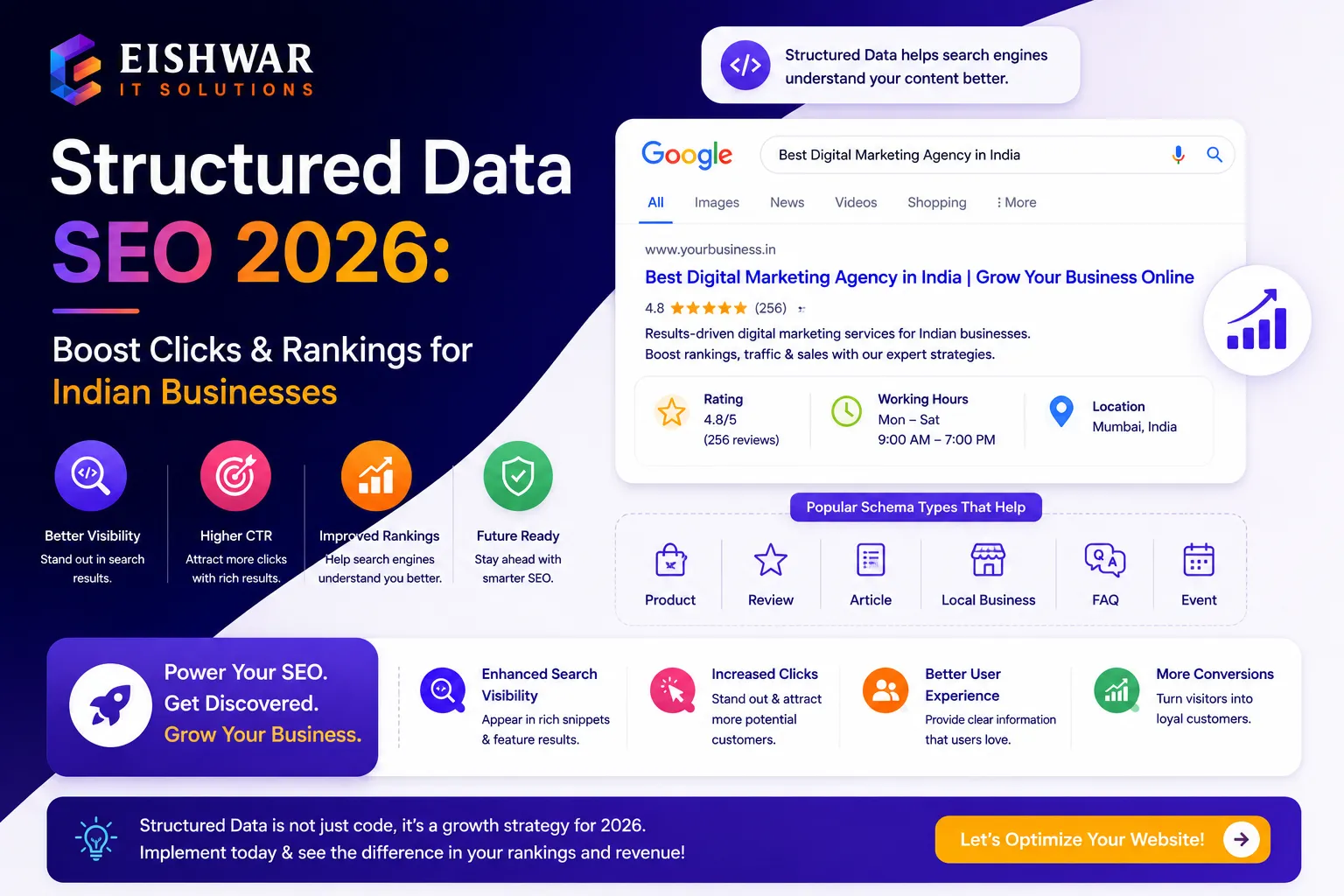
Structured Data SEO 2026: Boost Clicks & Rankings for Indian Businesse
Published on: 14 Jun 2026
Structured Data SEO 2026: Boost Clicks & Rankings for Indian Businesses
Introduction
In the fast-evolving world of SEO, structured data has become a non-negotiable element for businesses aiming to stand out in search results. For Indian businesses, where competition is fierce and user expectations are rising, implementing schema markup can be the difference between being ignored and earning a click. As we move into 2026, search engines like Google are increasingly relying on structured data to understand content context and deliver rich results. This guide will walk you through everything you need to know about structured data, from types to implementation, with practical examples tailored for the Indian market.
Learn more about our Website services
Consider this: a user in Mumbai searches for "best digital marketing agency near me." Without structured data, your result is a plain blue link. With it, you can display star ratings, review counts, service categories, and even a click-to-call button. This isn't just a nice visual—it's a proven way to increase click-through rates (CTR) by up to 30%, according to industry studies. In 2026, with voice search and AI-driven assistants becoming mainstream, structured data also helps your content get featured in voice answers and knowledge panels. For Indian businesses, this means capturing traffic from platforms like Google Assistant, Alexa, and Siri, which are increasingly used by tech-savvy consumers in cities like Delhi, Bengaluru, and Hyderabad.
Let's dive deeper into why structured data matters and how you can leverage it effectively.
Main Section 1: What is Structured Data and Why Does It Matter?
Structured data is a standardized format for providing information about a page and classifying its content. Think of it as a label that tells search engines exactly what your content means—whether it's a recipe, an event, a product, or a local business. By adding schema markup to your HTML, you help Google create rich snippets, which are enhanced search results that include star ratings, prices, images, and more.
For Indian businesses, the benefits are clear: rich snippets can increase click-through rates (CTR) by up to 30%. Imagine a user searching for "best digital marketing agency in Mumbai." A result with a star rating, review count, and service description will attract far more clicks than a plain blue link. In 2026, with voice search and AI-driven assistants becoming mainstream, structured data also helps your content get featured in voice answers and knowledge panels.
Consider a local restaurant in Delhi. By adding LocalBusiness schema with address, phone, and opening hours, you not only improve local SEO but also make it easier for Google to display your information in the Local Pack. This is crucial for businesses targeting Indian audiences who often rely on quick, actionable information. For example, a restaurant in Connaught Place can use schema to show its menu, reservation options, and customer reviews directly in search results, making it easier for hungry customers to choose.
Moreover, structured data helps search engines understand the context of your content. For instance, if you run a blog about Indian festivals, Article schema can help Google categorize your posts under relevant topics like "Diwali celebrations" or "Holi recipes." This improves your chances of appearing in Google News or Top Stories, which are highly visible sections of search results.
👉 Don't wait for the perfect moment; turn your vision into reality today.
Free ConsultationMain Section 2: Top Schema Types for Indian Businesses in 2026
Not all schema types are created equal. Depending on your industry, certain markups will deliver more value. Here are the most impactful ones for Indian businesses:
- LocalBusiness: Essential for any physical store, clinic, or service provider. Include name, address, phone, opening hours, and reviews. Example: A dental clinic in Bangalore can use this to appear in local searches with a map and contact button. Add properties like priceRange and image for a richer snippet.
- Product: E-commerce sites selling anything from sarees to smartphones should use Product schema with price, availability, and ratings. This enables price drop alerts and product carousels in search. For example, a Flipkart seller of Kanchipuram sarees can include brand, color, and size to attract specific buyers.
- Article: Bloggers and news sites can mark their articles to appear in Top Stories and Google News. For a digital marketing blog like EishwarITSolution, this increases visibility for trending topics. Use properties like datePublished and author to build authority.
- FAQ: Frequently asked questions marked with FAQ schema can appear directly in search results, giving users instant answers and reducing bounce rate. For instance, a travel agency in Goa can answer questions like "What are the best beaches in Goa?" directly in search.
- Event: For businesses hosting webinars, workshops, or local events, Event schema helps display date, time, and location in a rich card. A startup in Pune hosting a tech meetup can use this to attract attendees.
- Video: With video content booming, VideoObject schema helps your videos appear with thumbnails and duration in search results, boosting engagement. A YouTube channel focusing on Indian cooking can use this to highlight recipe videos.
- BreadcrumbList: This schema improves site navigation by showing breadcrumbs in search results, helping users understand your site structure. For an e-commerce site, this can reduce bounce rates by making it easier to browse categories.
For example, a digital marketing agency in Mumbai can use LocalBusiness, Article, and FAQ schemas together. This creates a comprehensive search presence that builds trust and authority. Additionally, consider using HowTo schema for tutorial pages—like "How to optimize your Google Business Profile"—to appear in step-by-step guides in search.
Main Section 3: How to Implement Structured Data (Step-by-Step)
Implementing structured data doesn't require a developer degree. Here's a simple process for Indian businesses:
- Identify your content type: Determine which schema type fits your page. For a service page, use Service schema; for a blog post, use Article. If you're unsure, check Schema.org for a full list.
- Generate the markup: Use Google's Structured Data Markup Helper or Schema.org's generator. Fill in the required fields like name, description, and URL. For example, for a local restaurant, you'd add name, address, phone, and cuisine type.
- Add to your site: Insert the generated JSON-LD code (preferred by Google) into the section of your HTML. If you're using WordPress, plugins like Yoast SEO or Schema Pro can automate this. For custom sites, you can add it manually via your CMS.
- Test and validate: Use Google's Rich Results Test to ensure your markup is correct. Fix any errors or warnings. For example, if you miss the price field in Product schema, the test will flag it.
- Monitor performance: Check Google Search Console for rich result reports. Track impressions and clicks for pages with structured data. Look for trends—if a page with FAQ schema gets more clicks, consider adding it to other pages.
For example, a small business owner in Pune can add LocalBusiness schema to their contact page in under 30 minutes. The result? Better local rankings and a higher chance of appearing in voice search results like "best plumber near me." To speed up the process, use tools like Merkle's Schema Markup Generator, which offers pre-built templates for common types.
👉 Free Website Audit
Get Free AuditPro tip: If you have multiple pages, create a template for each schema type. For instance, a product page template can include Product, Offer, and Review schemas, saving time during updates.
Expert Tips
- Use JSON-LD format: It's easier to implement and maintain than microdata or RDFa. Google recommends it for scalability. Most modern CMSs support JSON-LD natively.
- Keep data accurate: Outdated information (e.g., wrong phone number) can harm trust and SEO. Regularly update your schema. Set a quarterly reminder to review and refresh.
- Leverage nested schemas: Combine types like Product with Offer and Review for richer results. A product page can have price, availability, and rating all in one. For example, a smartphone listing can include brand, storage capacity, and color.
- Don't overdo it: Only add schema that matches your content. Incorrect markup can lead to manual penalties. For instance, don't add Review schema to a page without actual reviews.
- Think mobile-first: With mobile-first indexing, ensure your structured data works flawlessly on mobile devices. Test on both desktop and mobile using Google's Mobile-Friendly Test.
- Use schema for local languages: If your business targets Hindi, Tamil, or other regional audiences, add inLanguage property to your schema. This helps voice search in local languages.
Common Mistakes
- Using wrong schema type: For example, marking a service page as Product. This confuses search engines and may reduce eligibility for rich results. Always double-check Schema.org definitions.
- Missing required fields: Each schema has mandatory properties. Omitting them can cause validation errors. For LocalBusiness, name and address are required.
- Inconsistent NAP (Name, Address, Phone): LocalBusiness schema must match your Google Business Profile. Discrepancies hurt local SEO. For example, if your GMB lists "123 Main St" but schema says "123 Main Street," Google may penalize you.
- Ignoring testing: Deploying schema without testing can lead to errors that go unnoticed. Always use the Rich Results Test. Even a small typo can break the markup.
- Overloading with spammy data: Adding fake reviews or ratings violates Google's guidelines and can result in penalties. Stick to genuine user-generated content.
- Not updating after site changes: If you redesign your site or change URLs, update your schema accordingly. Broken links in schema can hurt user experience.
Future Trends
Looking ahead to 2026 and beyond, structured data will become even more integral to SEO. Here's what to watch:
👉 Free Homepage Demo
Book Demo- AI-generated schema: Tools like Google's natural language AI may auto-generate schema from content, but manual oversight will remain important for accuracy. Expect plugins to offer AI-assisted suggestions.
- Voice search dominance: Structured data will be key for voice assistants to pull concise answers. FAQ and HowTo schemas will be particularly valuable. For example, a user asking "How to make biryani?" will get a step-by-step answer from a page with HowTo schema.
- Visual search: ImageObject schema will help products and services appear in visual search results, especially on platforms like Google Lens. For an Indian fashion brand, this means showing sarees or lehengas in image searches with price and availability.
- Zero-click searches: As featured snippets and knowledge panels expand, structured data will be essential for capturing these prime real estate spots. For instance, a weather site can use schema to appear in a knowledge panel for "Mumbai weather."
- Privacy and data ethics: With tighter regulations like India's Digital Personal Data Protection Act, structured data must respect user privacy while providing value. Transparent data usage will build trust. Avoid collecting unnecessary personal data in schema.
- Integration with AI chatbots: As chatbots become more common, structured data can help them pull accurate information from your site. For example, a customer asking a chatbot about product availability can get real-time data from Product schema.
For Indian businesses, staying ahead means adopting structured data now. It's not just about rankings; it's about being visible in the moments that matter. Start experimenting with new schema types like LearningResource for educational content or MedicalWebPage for healthcare sites.
FAQs
What is structured data in SEO?
Does structured data directly improve rankings?
How can Indian small businesses implement structured data for free?
What are the most common structured data errors?
Will structured data help with voice search in India?
How often should I update my structured data?
Can structured data be used for multiple languages?
Conclusion
Structured data is no longer a nice-to-have—it's a must-have for any Indian business serious about SEO in 2026. From boosting CTR to enabling voice search, the benefits are tangible and measurable. Start by identifying your content types, generate accurate markup, and test rigorously. As search evolves, those who leverage structured data will enjoy a competitive edge. Don't let your business get lost in the noise; make your content stand out with rich results. Remember, the key is to start small, focus on accuracy, and scale as you see results. Whether you're a local shop in Chennai or an e-commerce giant in Gurgaon, structured data can transform your search presence.
CTA
Ready to supercharge your SEO with structured data? Contact EishwarITSolution today for a free consultation. Our experts will audit your site and implement schema markup that drives results. Let's make 2026 your best year yet! We'll help you identify the right schema types, fix common errors, and monitor performance to ensure you get the most out of your efforts.