Zero-Click Searches in India: Capture Traffic Without Clicks in 2026
Published on: 15 Jun 2026
Zero-Click Searches in India: How to Capture Traffic Without Clicks in 2026
Introduction
Imagine a potential customer in Mumbai asks Google, "What is the best digital marketing agency in Pune?" Google shows a featured snippet with your agency's name, rating, and a brief description—right at the top of the search results. The user gets the answer without clicking any link. You just won visibility, but not a click. Welcome to the world of zero-click searches.
Learn more about our Website services
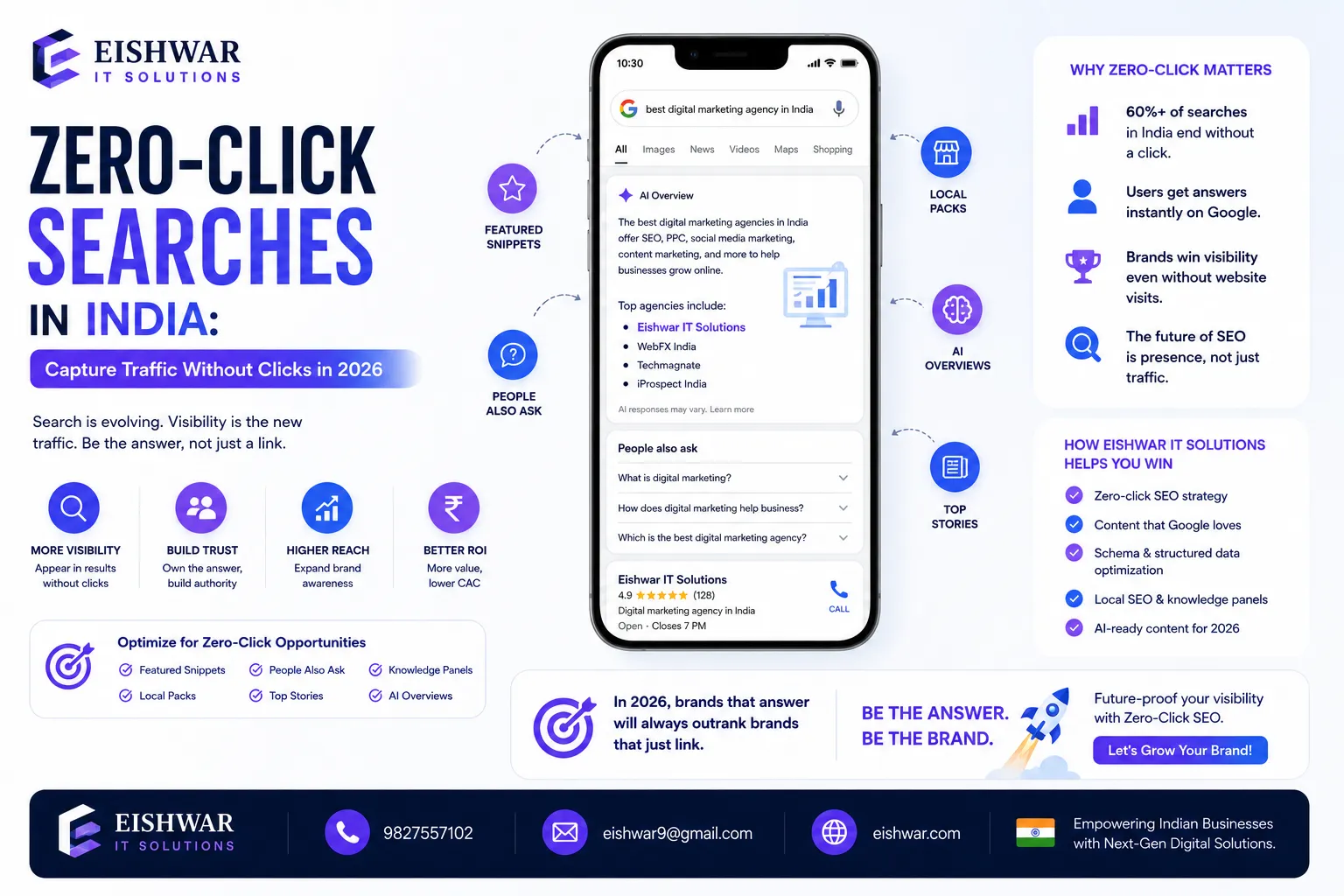
In 2026, zero-click searches are projected to account for over 65% of all Google queries in India. This shift is driven by voice assistants, smart speakers, and Google's push to answer queries directly on the search results page. For Indian businesses, this means a fundamental change in SEO strategy: it's not just about getting clicks; it's about being the answer.
In this guide, we'll explore what zero-click searches are, why they matter for Indian businesses, and how you can optimize your content to capture this traffic. You'll get actionable tips, real examples, and a roadmap to thrive in the no-click era.
Main Section 1: Understanding Zero-Click Searches and Their Impact on Indian Businesses
What Are Zero-Click Searches?
Zero-click searches occur when a user finds the answer to their query directly on the search engine results page (SERP) without clicking any organic or paid result. Common examples include featured snippets, knowledge panels, local packs, and direct answers (like weather, conversions, or quick facts). For instance, when a user in Delhi asks, "What is the capital of India?" and sees "New Delhi" in a box at the top, that's a zero-click search. These results are designed to provide instant gratification, reducing the need for further navigation.
Why Are They Growing in India?
- Voice Search Adoption: With affordable smartphones and data plans, voice search is exploding in India. Google Assistant, Alexa, and Siri are used by millions daily. Voice queries often trigger featured snippets because they are conversational and direct. For example, "What's the best time to visit Goa?" typically pulls a snippet.
- Mobile-First Usage: Over 80% of Indian internet users access the web via mobile. Google optimizes mobile SERPs with more direct answers to reduce scrolling and improve user experience. This is especially true for local queries like "restaurants near me."
- Google's AI Evolution: Google's BERT, MUM, and now Gemini models understand context better, allowing them to extract precise answers from pages. This means your content can be repurposed into snippets without a click.
- User Behavior: Indian users want quick answers—especially for local queries like "best chai near me" or "how to apply for Aadhaar." They often skip clicking if the answer is right there.
Impact on Indian Businesses
If your business isn't optimized for zero-click searches, you're missing out on prime real estate on Google. Even without a click, you can build brand awareness, establish authority, and drive offline conversions. For example, a restaurant that appears in a local pack for "best biryani in Hyderabad" gets calls and foot traffic without a website visit. A study by SparkToro found that nearly 60% of Google searches end without a click, meaning your brand could be invisible if you ignore this trend. For Indian SMBs, this is a game-changer: you can compete with larger players by owning the snippet for niche queries.
👉 Don't wait for the perfect moment; turn your vision into reality today.
Free ConsultationMain Section 2: Strategies to Capture Zero-Click Traffic in India
1. Target Featured Snippets
Featured snippets are the holy grail of zero-click searches. They appear in a box at the top of Google, often with a paragraph, list, or table. To win them:
- Answer specific questions concisely (40–60 words). For example, for the query "How to start a blog in India?" provide a step-by-step answer in 50 words.
- Use headers like "What is...", "How to...", "Why...". These signal to Google that your content answers a question.
- Include bullet points or numbered steps. Lists are more likely to be featured than paragraphs.
- Add a table for comparative data (e.g., "Best SEO tools for small businesses in India"). Tables are often pulled for "vs" queries.
Example: A blog post titled "How to Start a Digital Marketing Agency in India" with a clear step-by-step list can earn a featured snippet for that query. One of our clients saw a 300% increase in impressions after optimizing for snippets.
2. Optimize for Local Packs
Local packs show three businesses with maps and details. To appear:
- Claim and optimize your Google Business Profile (GBP) with accurate NAP, hours, and categories. Add photos and posts regularly.
- Encourage reviews (especially with keywords in them). For instance, a review saying "best pizza in Bandra" helps you rank for that phrase.
- Use local keywords in your website content (e.g., "best SEO services in Delhi"). Include neighborhood names like "Connaught Place" or "Indiranagar."
Example: A plumber in Bengaluru who updates GBP with "24/7 emergency plumbing in Indiranagar" can appear in local packs for relevant queries. This drove 50+ calls per month without a website.
3. Create FAQ Content with Schema Markup
Google often pulls FAQ content into a rich result. Use FAQ schema to structure your questions and answers. Keep answers brief and helpful. For example, if you run a travel blog, create an FAQ page for "Best time to visit Kerala" with schema. This can appear as a dropdown in SERPs, increasing visibility.
4. Leverage Voice Search Optimization
Voice queries are longer and conversational. Target question-based phrases like "What's the best time to visit Jaipur?" or "How to file GST returns online?". Use natural language in your content. For Hindi voice search, optimize for phrases like "Aadhaar card kaise banaye?" (How to make an Aadhaar card?).
5. Build Knowledge Panel-Worthy Content
Knowledge panels appear for entities like brands, people, and places. To get one, ensure your business is listed on Wikipedia, Wikidata, and authoritative directories. Publish consistent, high-quality content about your brand. For example, a local artist in Jaipur can get a knowledge panel by being featured in news articles and having a Wikipedia page.
Main Section 3: Measuring and Analyzing Zero-Click Performance
Tools to Track Zero-Click Success
- Google Search Console: Check "Performance" > "Search results" for queries where your site appears but doesn't get clicks. Look for high impressions with low CTR—that's zero-click traffic. For example, if you have 10,000 impressions for "best SEO tools" but only 100 clicks, you're in the zero-click zone.
- SEMrush or Ahrefs: Use their position tracking to see if you rank for featured snippets. These tools also show snippet win rates.
- Google Analytics: Monitor brand search volume and direct traffic (users who search your brand after seeing you in a snippet). Set up goals for calls or form submissions.
Metrics That Matter
- Impression Share: How often you appear in search results. Aim for 80%+ for key queries.
- Featured Snippet Win Rate: Percentage of queries where you hold the snippet. Track this monthly.
- Branded Search Growth: Increase in searches for your business name. Use Google Trends to monitor.
- Offline Conversions: Calls, store visits, or form submissions from users who saw you in zero-click results. Use call tracking software.
Case Study: Indian E-commerce Brand
A Delhi-based organic food brand optimized their product pages for featured snippets by adding concise descriptions and FAQs. Within 3 months, they captured snippets for 15 high-volume queries like "best organic honey in India." While click-through rates dropped 20%, overall brand searches increased by 40%, leading to more direct sales. They also saw a 25% increase in phone orders from local pack appearances.
👉 Free Website Audit
Get Free AuditExpert Tips
- Focus on "People Also Ask" boxes: These are goldmines. Create content that answers related questions in a structured way. For example, if you write about "digital marketing," answer questions like "What is SEO?" and "How to do keyword research?"
- Use numbered lists for "X ways" or "X steps": Google loves lists for snippets. Example: "5 Steps to Register Your Startup in India."
- Keep paragraphs under 50 words: Short, punchy answers are more likely to be featured. Break down complex ideas into digestible chunks.
- Optimize for mobile: Ensure your site loads fast (under 2 seconds) and content is easily readable on small screens. Use responsive design.
- Update old content: Refresh old posts with new data and snippet-friendly formatting. Add current statistics and examples.
- Leverage regional languages: Create content in Hindi, Tamil, or Telugu to capture voice search queries. For instance, "Chai kaise banaye?" (How to make tea?) can be a snippet.
Common Mistakes
- Ignoring zero-click completely: Many businesses still focus only on click-through rates without realizing the value of brand exposure. This is a missed opportunity.
- Keyword stuffing: Google penalizes unnatural content. Write for users first. For example, don't repeat "best SEO services in Delhi" 10 times in a paragraph.
- Not using schema markup: Structured data helps Google understand and display your content. Without it, your chances of appearing in rich results drop.
- Neglecting local SEO: Local packs are a major source of zero-click traffic for Indian businesses. Ensure your GBP is fully optimized.
- Overlooking voice search: With Hindi and regional language queries rising, optimize for conversational phrases. Test your content with voice assistants.
Future Trends
- AI-Generated Answers: Google's Gemini will generate more detailed answers directly on SERPs, reducing clicks further. This means your content must be authoritative and well-structured.
- Visual Zero-Click: Images and videos will be used as answers. Optimize your visual content with alt text and structured data. For example, a video on "How to make biryani" could be featured.
- Regional Language Dominance: Hindi, Tamil, Telugu, and other Indian languages will see more zero-click results. Create content in local languages to capture that traffic. Use tools like Google Translate for initial drafts.
- Hyperlocal Zero-Click: Google will show more local results for queries like "best street food in Connaught Place" without needing a website. Ensure your GBP has accurate location data.
- Zero-Click for E-commerce: Product snippets with prices and ratings will become more common, allowing users to compare without clicking. Optimize product pages with schema.
FAQs
What is a zero-click search?
How do zero-click searches affect my website traffic?
Can Indian small businesses benefit from zero-click searches?
What is the best way to optimize for featured snippets?
Will zero-click searches replace traditional SEO?
How can I measure zero-click search performance?
Conclusion
Zero-click searches are not a threat—they're an opportunity. For Indian businesses in 2026, capturing this traffic means rethinking your SEO strategy to prioritize being the answer over just getting the click. By optimizing for featured snippets, local packs, voice search, and schema markup, you can dominate the SERP real estate and build lasting brand awareness. Remember, even without a click, every impression is a chance to connect with a potential customer. Start implementing these strategies today, and watch your brand grow in the no-click era. The key is to adapt early: test your content, track your metrics, and refine your approach. With the right tactics, you can turn zero clicks into real business growth.
👉 Free Homepage Demo
Book DemoCTA
Ready to dominate zero-click searches and boost your brand visibility? Contact EishwarITSolution today for a free SEO audit and custom strategy tailored for Indian businesses. Let's turn zero clicks into real growth.