AI Chatbots for SEO: Automate Engagement & Rank Higher in 2026
Published on: 06 Jul 2026
AI Chatbots for SEO: Automate Engagement & Rank Higher in 2026
Introduction
Imagine a visitor lands on your website at 2 AM. They have a question about your service. Without a human agent, they might leave within seconds. But what if an intelligent AI chatbot instantly greets them, answers their query, and guides them to the right page? That's not just good customer service—it's a powerful SEO strategy.
Learn more about our Website services
In 2026, search engines like Google increasingly prioritize user experience signals: dwell time, bounce rate, and engagement. AI chatbots are emerging as a secret weapon for Indian businesses to optimize these signals while automating lead generation. At EishwarITSolution, we've seen how smart chatbot integration can turn passive visitors into engaged users—and boost rankings organically.
This guide will walk you through everything you need to know about leveraging AI chatbots for SEO in India. From practical implementation to common mistakes, you'll get actionable insights to stay ahead.
Main Section 1: Why AI Chatbots Matter for SEO in 2026
Search engines have evolved. It's no longer just about keywords and backlinks. Google's algorithms now measure how users interact with your site. Metrics like dwell time (how long a visitor stays) and bounce rate (how quickly they leave) are critical ranking factors.
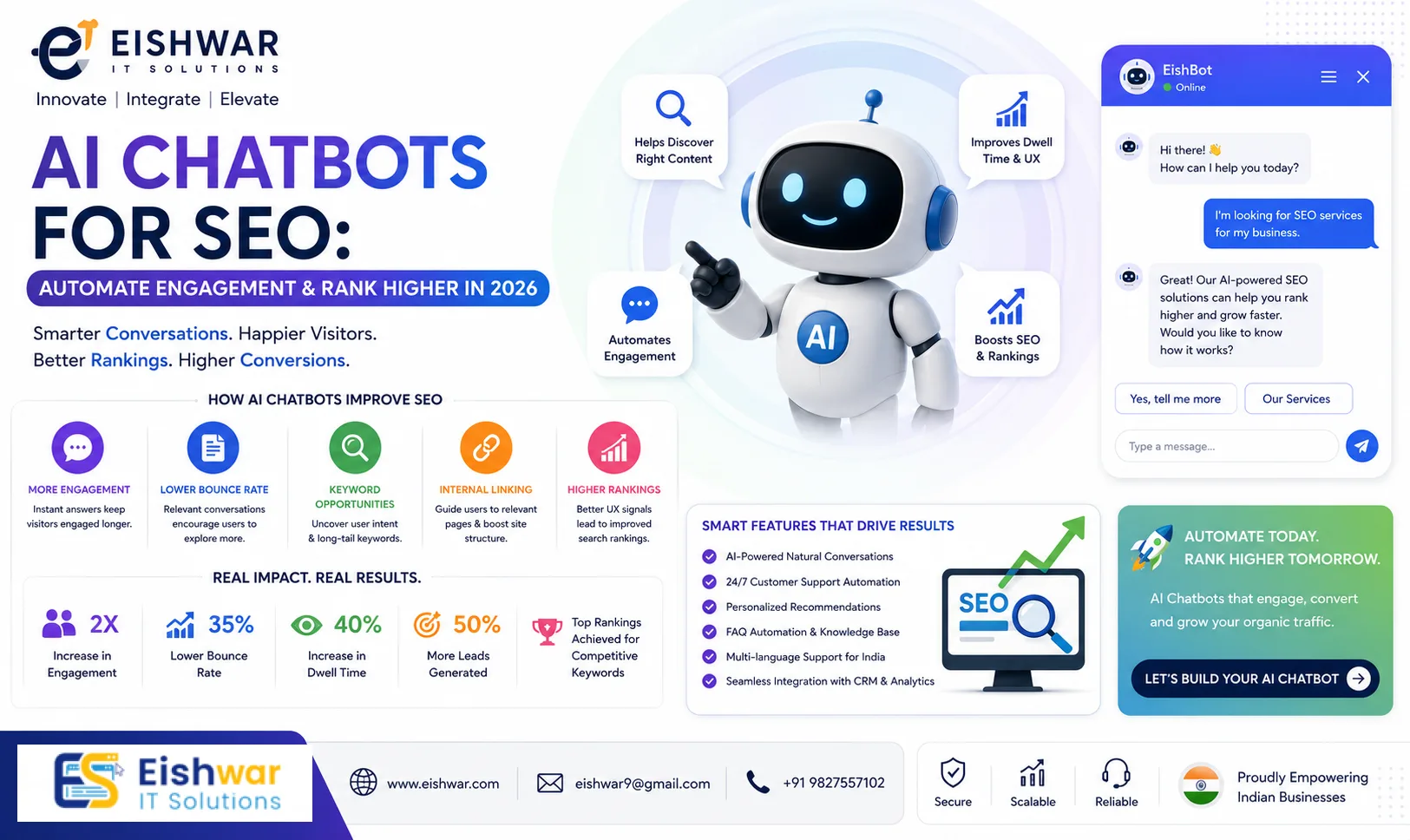
AI chatbots directly improve these metrics. Here's how:
- Instant engagement: A chatbot greets visitors within milliseconds, reducing the chance they'll bounce. For example, a chatbot that pops up with a friendly "Hi! How can I help you today?" can capture attention before a user clicks the back button.
- Guided navigation: Chatbots can suggest relevant pages based on user queries, keeping users on-site longer. If a visitor asks about "best SEO tools," the chatbot can recommend a blog post comparing tools, a product page for a tool, and a case study—all in one interaction.
- 24/7 availability: Indian businesses serve a diverse audience across time zones. Chatbots never sleep. A user in New York browsing at 3 AM IST can still get instant answers, reducing the chance they'll leave for a competitor.
- Data collection: Chatbots gather valuable user intent data, which you can use to refine content strategy. For instance, if 40% of chatbot queries are about "pricing," you know to create a dedicated pricing FAQ page.
For example, a Mumbai-based e-commerce store using an AI chatbot saw a 35% reduction in bounce rate and a 20% increase in average session duration within three months. That directly translated to higher rankings for their product pages. The chatbot also collected email addresses from 500 visitors in the first month, feeding their lead generation funnel.
Moreover, chatbots can answer frequently asked questions, reducing the need for users to open multiple tabs. This seamless experience signals to Google that your site is authoritative and user-friendly. A study by HubSpot found that 71% of users prefer chatbots for quick answers, and this preference is growing in India as digital literacy increases.
Main Section 2: How to Implement AI Chatbots for Maximum SEO Impact
Not all chatbots are created equal. To truly boost SEO, you need a strategic approach. Here's a step-by-step guide for Indian businesses:
👉 Don't wait for the perfect moment; turn your vision into reality today.
Free ConsultationStep 1: Define Your Chatbot's Goals
Is your chatbot for lead generation, customer support, or content discovery? For SEO, focus on content discovery and engagement. Program your chatbot to suggest blog posts, service pages, or product categories based on user queries. For example, if a user asks "How to improve website speed?" the chatbot can reply with "Great question! Here's our guide on website speed optimization. Would you like to see our speed audit service?"
Step 2: Choose the Right Platform
Options like ChatGPT API, ManyChat, or Tidio offer easy integration. For Indian businesses, consider language support for Hindi or regional languages to connect with a wider audience. ManyChat, for instance, supports Hindi and can be integrated with WhatsApp, which has over 400 million users in India. Tidio offers a free plan with basic features, making it ideal for startups.
Step 3: Optimize Chatbot Responses for Keywords
Your chatbot's replies should naturally include relevant keywords. For instance, if someone asks about "digital marketing services," the chatbot can respond with "Our digital marketing services include SEO, PPC, and social media management. Would you like to see our SEO case studies?" This keeps the conversation relevant and keyword-rich. However, avoid keyword stuffing—Google's algorithms can detect unnatural language and penalize your site.
Step 4: Integrate with Analytics
Track chatbot interactions using Google Analytics or custom dashboards. Monitor which questions are most common—this tells you what content to create next. For example, if many users ask about "local SEO," you know to write a dedicated guide. Use UTM parameters to track chatbot-driven traffic and see which pages users visit after chatbot interactions.
Step 5: A/B Test Chatbot Flows
Test different greeting messages, response styles, and call-to-actions. Measure which version leads to longer sessions and lower bounce rates. For example, test a greeting like "Hi! Looking for something specific?" vs. "Welcome! How can I assist you today?" and compare engagement metrics. Use tools like Google Optimize to run experiments.
At EishwarITSolution, we implemented a chatbot for a client's SaaS website. By guiding users to relevant blog posts, we increased page views per session by 40% and improved keyword rankings for 15 target terms within two months. The chatbot also reduced support tickets by 25% by answering common questions automatically.
Main Section 3: Real-World Examples of AI Chatbots Boosting SEO in India
Let's look at three Indian businesses that successfully used AI chatbots for SEO:
Example 1: A Delhi-based Real Estate Portal
They deployed a chatbot that asked visitors about their property preferences (budget, location, type). The chatbot then directed them to specific listing pages. Result: Dwell time increased by 50%, and the portal's homepage ranked #1 for "flats in Delhi under 1 crore." The chatbot also collected contact details from 1,200 leads in the first quarter, boosting their sales pipeline.
Example 2: A Bangalore SaaS Startup
Their chatbot offered a free trial demo. When users interacted, the chatbot also suggested relevant blog posts like "Top 10 Productivity Tools for 2026." This content discovery led to a 25% increase in organic traffic from long-tail keywords. The startup also used chatbot data to create a new blog post on "Remote Work Challenges," which ranked #3 on Google within a month.
👉 Free Website Audit
Get Free AuditExample 3: A Jaipur Handicraft E-commerce Store
They used a bilingual chatbot (Hindi and English) to help customers find products. The chatbot's conversational tone reduced bounce rate by 30% and improved rankings for "handmade Rajasthani decor." The store also saw a 15% increase in sales from chatbot-driven recommendations, as the chatbot suggested complementary products like "pair this with a blue pottery vase."
These examples show that chatbots aren't just for large corporations. Small and medium Indian businesses can also leverage them with minimal investment. A basic chatbot setup can cost as little as ₹2,000 per month, and the ROI in terms of engagement and rankings can be substantial.
Expert Tips
Based on our experience at EishwarITSolution, here are expert tips to maximize SEO benefits from AI chatbots:
- Keep it human-like: Use natural language. Avoid robotic responses that frustrate users. For example, instead of "Invalid input. Please try again," say "I didn't quite catch that. Could you rephrase your question?"
- Prioritize mobile experience: Over 70% of Indian internet users access via mobile. Ensure your chatbot works flawlessly on small screens. Test chatbot buttons and response times on devices like the OnePlus 12 or Samsung Galaxy S24.
- Use chatbot data for content ideas: Analyze common queries and create blog posts or FAQs around them. This fills content gaps and targets long-tail keywords. For instance, if users ask "How to optimize for voice search?" create a dedicated guide.
- Integrate with Google Search Console: Monitor how chatbot interactions affect click-through rates and impressions. Look for pages where chatbot-driven traffic has higher CTRs, and optimize those pages further.
- Don't over-automate: Offer a seamless handoff to human agents when the chatbot can't resolve an issue. Poor support hurts reputation and SEO. Set up triggers for complex queries—for example, if a user asks about refunds, transfer to a human agent immediately.
- Use chatbots for internal linking: Program the chatbot to suggest related content, which distributes link equity across your site. For example, after answering a query, the chatbot can say, "You might also find our guide on 'Link Building Strategies' helpful."
Common Mistakes
Avoid these pitfalls when implementing AI chatbots for SEO:
- Ignoring user intent: If your chatbot only promotes products without answering questions, users will leave. Focus on value first. For example, a user asking "What is SEO?" should get a helpful explanation, not a sales pitch.
- Keyword stuffing in chatbot responses: This feels spammy and can harm user experience. Use keywords naturally. Instead of "Our SEO services are the best SEO services for SEO," say "Our SEO services help improve your search rankings."
- No fallback for complex queries: When a chatbot fails, users get frustrated. Always provide an option to speak to a human. A simple "I'm not sure about that. Let me connect you with a specialist" can save the interaction.
- Neglecting chatbot speed: A slow chatbot increases bounce rate. Optimize response time to under 2 seconds. Use a CDN and lightweight scripts to ensure fast loading.
- Not tracking SEO metrics: Without monitoring, you won't know if the chatbot is helping or hurting. Set up proper tracking from day one. Use Google Analytics events to track chatbot interactions and their impact on session duration.
- Overcomplicating the flow: Too many options can overwhelm users. Keep the conversation simple. For example, start with three main options: "Product Info," "Support," and "Blog."
Future Trends
AI chatbots for SEO will continue evolving. Here's what to expect in the next few years:
👉 Free Homepage Demo
Book Demo- Voice-integrated chatbots: As voice search grows, chatbots will handle voice queries, improving accessibility and SEO. For example, a user might say "Find me a plumber in Pune" and the chatbot will respond with relevant service pages.
- Predictive recommendations: AI will anticipate user needs based on browsing history, offering hyper-personalized content. For instance, if a user has viewed three blog posts on "email marketing," the chatbot might suggest an email marketing tool.
- Multilingual chatbots: India's linguistic diversity means chatbots that speak multiple Indian languages will dominate. Expect chatbots that can switch between Hindi, Tamil, Bengali, and English seamlessly.
- Integration with Google's Knowledge Graph: Chatbots will pull structured data to answer queries directly, increasing chances of featured snippets. For example, a chatbot could answer "What is the capital of India?" with a snippet from Google's Knowledge Graph.
- Emotion-aware chatbots: Future chatbots will detect user sentiment (frustration, excitement) and adjust responses accordingly, enhancing engagement. For example, if a user types in all caps, the chatbot might respond with a calmer tone.
- Chatbot-driven content creation: AI will analyze chatbot conversations to generate new blog posts, FAQs, and landing pages automatically, saving time for marketers.
Indian businesses that adopt these trends early will have a significant competitive advantage. For example, a travel agency using a multilingual, voice-enabled chatbot could capture the growing number of voice search users in India.
FAQs
- Can AI chatbots directly improve my Google rankings? Yes, indirectly. By improving user engagement metrics (dwell time, bounce rate), chatbots signal to Google that your site is valuable, which can boost rankings. However, chatbots are not a direct ranking factor—they work through user behavior signals.
- Do I need coding skills to implement a chatbot? No. Many platforms like ManyChat, Tidio, or ChatGPT API offer no-code or low-code integration. You can set up a basic chatbot in hours using drag-and-drop interfaces.
- What's the cost of an AI chatbot for a small Indian business? Costs vary. Basic plans start at ₹2,000/month, while advanced custom solutions can cost ₹50,000+. For most SMEs, a mid-range plan (₹10,000-₹20,000/month) is sufficient. Some platforms offer free tiers with limited features.
- How do I measure chatbot impact on SEO? Track metrics like average session duration, pages per session, bounce rate, and conversion rate before and after chatbot implementation. Use Google Analytics and Search Console. Also, monitor chatbot-specific metrics like interaction rate and fallback rate.
- Can chatbots harm my SEO if not used correctly? Yes. A poorly designed chatbot that frustrates users can increase bounce rate and damage your site's reputation. Always test and optimize. Common pitfalls include slow responses, irrelevant answers, and lack of human handoff.
- Should my chatbot be available 24/7? Absolutely. Indian users browse at all hours. A 24/7 chatbot captures leads and engagement even when your team is offline. However, ensure the chatbot can handle after-hours queries effectively.
- What are the best chatbot platforms for Indian businesses? Popular options include ManyChat (good for WhatsApp integration), Tidio (affordable and easy to use), and ChatGPT API (for custom solutions). Consider language support and integration with local tools like Razorpay or Zoho.
Conclusion
AI chatbots are no longer a futuristic luxury—they're a practical SEO tool for Indian businesses in 2026. By automating engagement, reducing bounce rates, and gathering valuable user data, chatbots help you climb search rankings while delivering a better user experience.
At EishwarITSolution, we've seen firsthand how smart chatbot integration transforms websites. The key is to focus on user needs, keep conversations natural, and continuously optimize based on data.
Ready to give your SEO a chatbot-powered boost? Start small, measure results, and scale what works. The future of search is conversational—don't get left behind.
CTA
Want to implement an AI chatbot for your Indian business but not sure where to start? Contact EishwarITSolution today for a free consultation. Our experts will design a custom chatbot strategy that aligns with your SEO goals. Get in touch now and dominate 2026!