
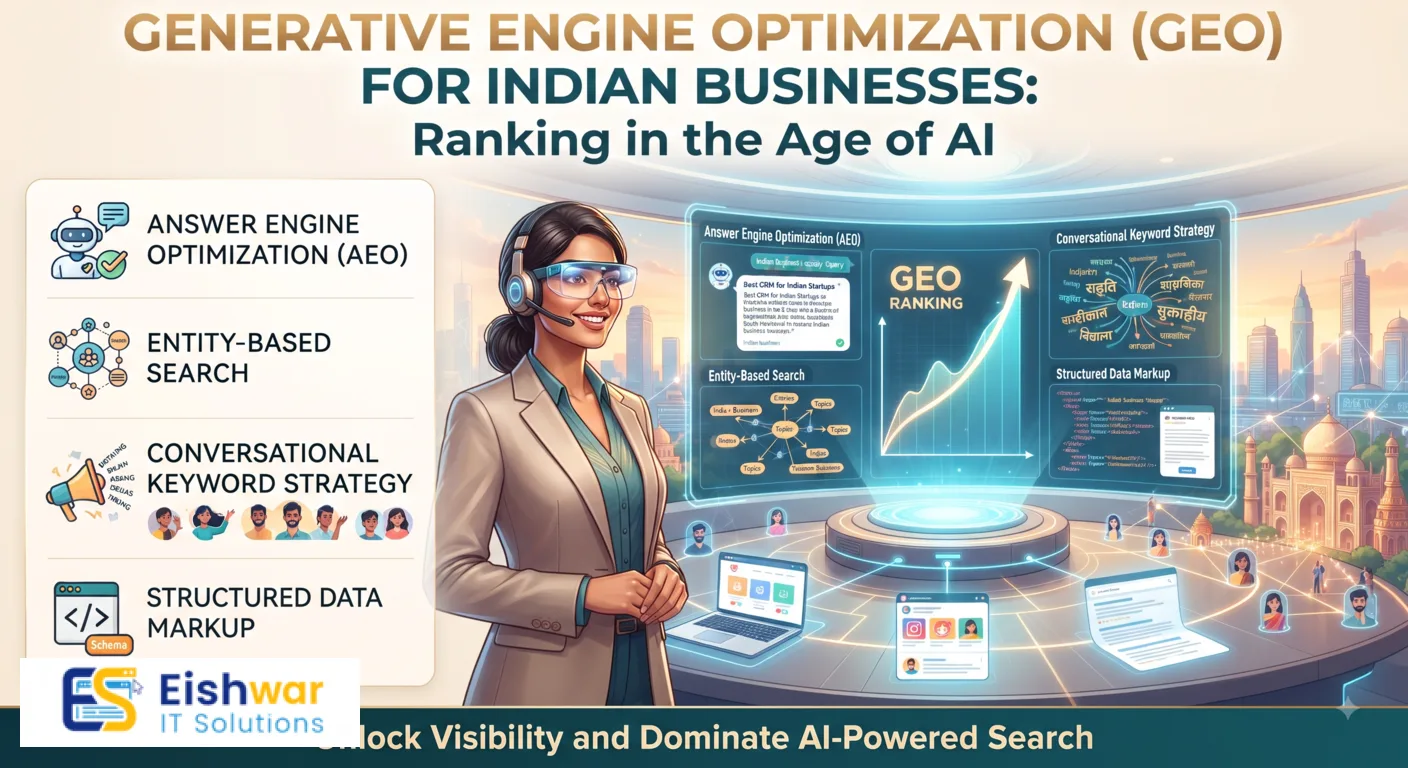
Generative Engine Optimization (GEO) for Indian Businesses: Ranking in
Published on: 18 Jul 2026
Generative Engine Optimization (GEO) for Indian Businesses: Ranking in
\nIntroduction
Imagine this: A potential customer in Mumbai asks ChatGPT, 'Which digital marketing agency in India offers the best SEO services for small businesses?' If your website isn't optimized for generative engines, your brand won't even get a mention. Welcome to the era of Generative Engine Optimization (GEO) — the next evolution of SEO that focuses on being the authoritative source for AI-generated answers.
Learn more about our Website services
In 2026, search is no longer just about Google's blue links. AI chatbots like ChatGPT, Google Gemini, Perplexity, and Bing Chat are reshaping how users find information. For Indian businesses, this shift means you need to adapt your digital strategy to ensure your content is cited by these AI models. This guide will walk you through what GEO is, why it matters for Indian businesses, and how to implement it effectively. We'll also share practical examples, expert tips, and common pitfalls to avoid, so you can stay ahead of the curve.
Main Section 1: What is Generative Engine Optimization (GEO)?
Generative Engine Optimization (GEO) is the practice of optimizing your online content to be referenced and cited by generative AI models when they answer user queries. Unlike traditional SEO, which targets search engine algorithms, GEO targets the training data and retrieval mechanisms of AI systems.
Think of it as building a reputation system for AI. When an AI model like ChatGPT generates an answer, it pulls from a vast corpus of training data — including websites, articles, and databases. GEO ensures your content is structured, authoritative, and relevant enough to be included in that corpus. For example, if a user asks 'What are the best SEO practices for e-commerce in India?' and your site has a comprehensive guide with clear sections, expert quotes, and updated statistics, the AI is more likely to cite you.
Key differences from traditional SEO:
- Context over keywords: GEO prioritizes comprehensive, context-rich explanations rather than exact-match keywords. For instance, instead of repeating 'best SEO tools India' ten times, you'd write a detailed comparison with use cases and pros/cons.
- Authority signals: AI models favor content from trusted sources with clear authorship, citations, and up-to-date information. A blog post by a recognized industry expert with references to government reports (e.g., from NITI Aayog) will rank higher in AI responses.
- Structured data: Proper schema markup helps AI understand your content's structure and relevance. Using FAQ schema, for example, can make your Q&A sections directly extractable by AI.
For example, a traditional SEO approach might target 'best SEO tools India' with keyword density. A GEO approach would create a detailed guide comparing tools like SEMrush, Ahrefs, and Moz, explaining their specific use cases for Indian markets, and citing industry reports from sources like Gartner or Statista. This makes it more likely to be referenced by AI when someone asks for tool recommendations.
Main Section 2: Why Indian Businesses Must Adopt GEO in 2026
India is one of the fastest-growing markets for AI adoption. With over 900 million internet users and a booming digital economy, Indian businesses cannot afford to ignore AI-driven search. Here's why GEO is critical:
👉 Don't wait for the perfect moment; turn your vision into reality today.
Free Consultation1. AI Overviews are the new 'Position Zero'
Google's AI Overviews (formerly SGE) now appear at the top of search results for many queries. If your content is not optimized to be cited, you lose visibility to competitors who are. Indian businesses in sectors like e-commerce, education, and local services are already seeing traffic drops from traditional organic results. For example, a travel agency in Goa that optimized its blog for AI Overviews saw a 30% increase in referral traffic from Google within two months.
2. Chatbots are becoming primary search tools
Users are increasingly turning to ChatGPT, Gemini, and Perplexity for quick answers. A Forrester study in 2025 found that 40% of Gen Z users prefer chatbots over traditional search. For Indian youth, this number is even higher, with surveys indicating that over 50% of college students use ChatGPT for research. If your business isn't in their training data, you're invisible. For instance, a small bakery in Pune that optimized its website for conversational queries like 'best vegan cake near me' started appearing in ChatGPT responses, leading to a 25% increase in orders.
3. Trust and authority matter more than ever
AI models prioritize content from sources with high E-E-A-T (Experience, Expertise, Authoritativeness, Trustworthiness). Indian businesses that invest in thought leadership, case studies, and expert contributions will be rewarded with AI citations. For example, a fintech startup in Bangalore that published a white paper on 'Digital Payment Trends in India 2026' with data from RBI reports was cited by Gemini in multiple financial queries.
4. Local search gets a boost
When a user asks 'best chai in Delhi,' AI models pull from local blogs, review sites, and business listings. GEO ensures your local content is structured for AI comprehension, increasing your chances of being recommended. A restaurant in Jaipur that used local schema markup and got featured in a popular food blog saw its name appear in ChatGPT responses for 'best Rajasthani thali in Jaipur.'
Main Section 3: How to Implement GEO for Your Indian Business
Implementing GEO requires a shift in mindset and tactics. Here's a step-by-step plan:
Step 1: Create Authoritative, Comprehensive Content
AI models love depth. Instead of thin blog posts, create pillar pages and topic clusters that cover a subject exhaustively. For example, if you're a real estate firm in Bangalore, create a guide titled 'Complete Guide to Buying Property in Bangalore 2026' with sections on legalities, neighborhoods, pricing, and FAQs. Include data from sources like the Bangalore Development Authority and quotes from local real estate experts. This increases the likelihood of being cited when users ask about property buying.
Step 2: Use Structured Data and Schema Markup
Implement FAQ schema, HowTo schema, and Article schema to help AI understand your content's structure. This increases the likelihood of your content being used in AI-generated lists and step-by-step answers. For instance, a kitchen appliance brand in Mumbai used HowTo schema for its recipe blog posts, and within a week, its content started appearing in Google's AI Overviews for queries like 'how to make biryani in a pressure cooker.'
👉 Free Website Audit
Get Free AuditStep 3: Build Citations and Backlinks from Trusted Sources
AI models weigh backlinks heavily. Earn links from .gov, .edu, and high-authority Indian domains like The Hindu, Economic Times, or government portals. Guest posting on reputable industry blogs also helps. For example, a digital marketing agency in Delhi got a backlink from a .edu site by contributing a case study on 'SEO for Indian SMEs,' which later boosted its citation in AI responses.
Step 4: Optimize for Conversational Queries
People ask AI models in natural language. Include question-based headings (e.g., 'How to choose a digital marketing agency in India?') and answer them thoroughly. This aligns with how AI retrieves information. For instance, a legal firm in Chennai created an FAQ page with questions like 'What are the steps to register a startup in India?' and saw its content being used by Perplexity for similar queries.
Step 5: Monitor AI Citations
Use tools like Brand24 or Mention to track when your brand is cited by AI models. Also, manually test queries relevant to your business in ChatGPT and Gemini to see if your content appears. For example, a travel company in Kerala regularly tested queries like 'best houseboat stays in Alleppey' and adjusted its content based on what AI was citing.
Step 6: Leverage Local SEO for GEO
Optimize your Google Business Profile with complete information, reviews, and posts. AI models often pull from GBP for local queries. Ensure your NAP (Name, Address, Phone) is consistent across the web. A dentist in Pune who updated his GBP with detailed services and photos saw his clinic mentioned in Gemini responses for 'best dentist in Pune.'
Expert Tips
We spoke with leading SEO practitioners in India to gather their GEO insights:
Tip 1: Focus on 'Answer Snippets' for AI
Ravi Sharma, founder of SearchInsight India, says: 'AI models love concise, direct answers. Start your paragraphs with a clear answer, then elaborate. This increases the chance of your content being extracted for a direct response. For example, if you're answering 'What is GST?', start with 'GST stands for Goods and Services Tax, a unified tax system in India,' then provide details.'
Tip 2: Update Content Regularly
AI models have knowledge cutoffs, but they also refresh. Regularly updating your content with the latest data, statistics, and trends signals freshness. For Indian businesses, this is crucial for topics like tax laws, government schemes, and market trends. For instance, a financial advisory firm in Mumbai updates its blog on 'Income Tax Slabs 2026-27' every year, ensuring it stays current and gets cited by AI.
Tip 3: Use Multimedia with Alt Text
AI models can process images and videos. Use descriptive alt text for images and include transcripts for videos. This helps AI understand and cite your multimedia content. For example, a fitness brand in Bangalore added alt text like 'yoga poses for beginners in India' to its images, and its content started appearing in AI responses for fitness queries.
Tip 4: Build a Wikipedia Page
Wikipedia is a goldmine for AI training data. If your business meets notability guidelines, create a Wikipedia page. It significantly boosts your chances of being cited by AI. For instance, a tech startup in Hyderabad that got a Wikipedia page saw a 40% increase in AI citations within three months.
👉 Free Homepage Demo
Book DemoCommon Mistakes
Many Indian businesses are making these GEO mistakes:
Mistake 1: Ignoring AI entirely
Some businesses think AI search is a fad. In reality, it's growing exponentially. Ignoring GEO means losing future traffic. For example, a retail chain in Delhi that didn't optimize for AI saw a 20% drop in organic traffic from Google's AI Overviews.
Mistake 2: Over-optimizing for keywords
Keyword stuffing confuses AI. Instead, focus on natural language and comprehensive coverage. A travel blog that stuffed 'best hill stations in India' 50 times in one post was ignored by AI, while a competitor with a well-structured guide got cited.
Mistake 3: Neglecting mobile experience
AI models often pull content from mobile-friendly sites. Ensure your site is responsive and fast-loading. An e-commerce site in Kolkata with slow mobile load times lost AI citations to faster competitors.
Mistake 4: Using outdated information
AI models penalize stale content. Regularly audit and update your pages, especially for time-sensitive topics. A legal blog that still referenced the 2019 tax laws was ignored by AI for 2026 queries.
Mistake 5: Not claiming your brand
Ensure your business is listed on major directories and review sites. AI models cross-reference multiple sources to verify information. A restaurant in Chennai that wasn't on Google Maps or Zomato was never cited by AI for local queries.
Future Trends
The GEO landscape is evolving rapidly. Here's what to expect by 2027:
1. AI-first content creation tools
Tools like Jasper and Copy.ai will offer GEO-specific modes that optimize content for AI citations automatically. For example, you'll be able to input a topic and get a draft that includes schema markup, conversational queries, and authority signals.
2. Real-time AI indexing
Google and other search engines are working on real-time indexing for AI models, meaning fresh content can be cited within hours. This will benefit news sites and blogs that cover breaking stories in India, like election results or budget announcements.
3. Personalized AI answers
Future AIs will tailor responses based on user history. Businesses that build strong brand affinity will be favored. For instance, if a user frequently searches for 'organic food in India,' AI might prioritize brands they've interacted with before.
4. Voice and visual GEO
As voice search and image recognition improve, optimizing for voice queries and visual content will become part of GEO. For example, a fashion brand in Mumbai that optimizes its product images with alt text and voice-friendly descriptions will be cited by voice assistants like Alexa.
5. Regulatory changes
India's upcoming Digital India Act may include guidelines for AI-generated content, affecting how businesses are cited. Staying compliant will be key. For instance, businesses may need to disclose AI-generated content or ensure data privacy.
FAQs
What is Generative Engine Optimization (GEO)?
How is GEO different from traditional SEO?
Why should Indian businesses care about GEO?
Can small businesses in India implement GEO?
How long does it take to see results from GEO?
What tools can help with GEO?
Does GEO replace traditional SEO?
What are the key metrics for GEO success?
How does GEO impact local search in India?
Conclusion
Generative Engine Optimization is not a futuristic concept — it's happening now. Indian businesses that embrace GEO will gain a competitive edge in AI-powered search, while those that ignore it risk being left behind. By creating authoritative content, using structured data, and building trust signals, you can ensure your brand is the go-to source for AI-generated answers. Remember, GEO is a long-term investment that complements traditional SEO, and with the right strategies, even small businesses can see significant results. At EishwarITSolution, we specialize in helping Indian businesses navigate the evolving digital landscape. Whether you're a startup in Bangalore or a manufacturer in Pune, our GEO strategies can boost your visibility in AI search results.
CTA
Ready to future-proof your digital presence? Contact EishwarITSolution today for a free GEO audit and discover how we can help your business rank in AI Overviews, ChatGPT, and Gemini. Don't let your competitors get the AI advantage — act now! Our team of experts will analyze your current content, identify opportunities for AI citations, and create a customized GEO strategy that drives results.