
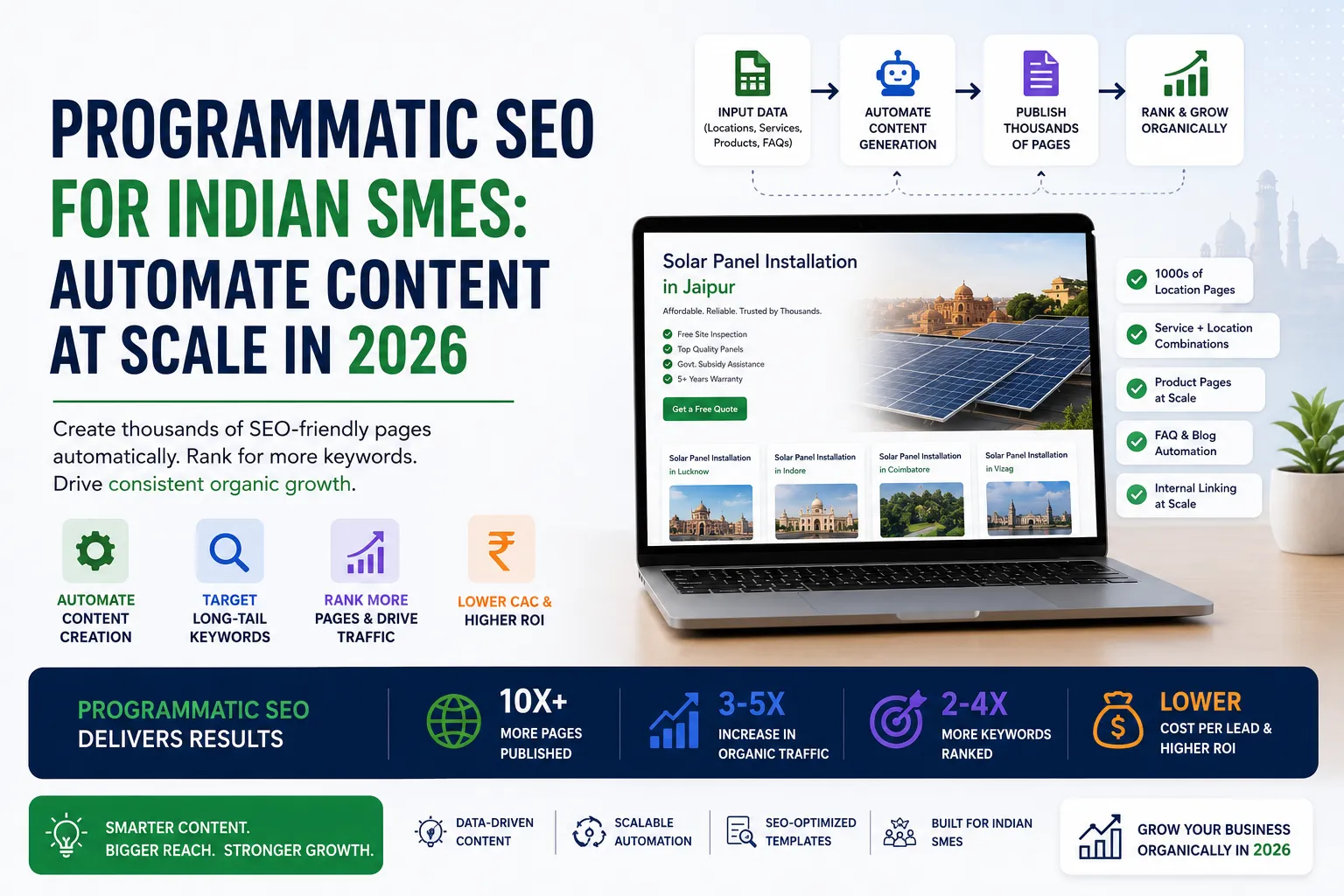
Programmatic SEO for Indian SMEs: Automate Content at Scale in 2026
Published on: 18 Jun 2026
Programmatic SEO for Indian SMEs: Automate Content at Scale in 2026
Introduction
Imagine creating 500 landing pages that each rank for a unique search query—without writing a single line of copy manually. That's the power of programmatic SEO. For Indian SMEs operating on tight budgets and lean teams, this approach is a game-changer. In 2026, as competition intensifies and AI tools become more accessible, programmatic SEO offers a scalable way to capture niche traffic, build topical authority, and generate leads automatically.
Learn more about our Website services
But how do you do it right? This guide walks you through the strategy, tools, and pitfalls of programmatic SEO tailored for Indian businesses. Whether you run a local service in Mumbai or a SaaS product in Bengaluru, these tactics will help you automate your content engine and dominate search results.
Main Section 1: What Is Programmatic SEO and Why It Matters for Indian SMEs
Programmatic SEO is the practice of using data, templates, and automation to generate large volumes of SEO-optimized pages at scale. Instead of writing each page by hand, you create a template that pulls dynamic content from a database—think city-specific service pages, product variations, or comparison tables. For example, a plumber in Delhi could automatically generate pages like "Emergency Plumber in Dwarka" or "Pipe Repair in Janakpuri" without manually drafting each one.
For Indian SMEs, this is particularly powerful because:
- Cost efficiency: One template can generate hundreds of pages, slashing content production costs. A single ₹5,000 investment in template design can yield 200 pages that would otherwise cost ₹1,00,000 in freelance writing fees.
- Long-tail keyword dominance: Target specific queries like "best digital marketing agency in Andheri West" or "affordable SEO services for restaurants in Pune." These low-competition keywords often convert at 2-3x higher rates than generic terms.
- Rapid scaling: Launch new location or service pages in days, not months. A travel agency in Goa can create pages for 50 beach destinations in a single afternoon, each optimized for local search.
In 2026, Google's algorithms favor helpful, unique content—so templates must be smart, not spammy. Indian SMEs can leverage programmatic SEO to compete with larger players by covering niche topics that big brands overlook, such as "Ayurvedic massage in Indiranagar" or "Budget wedding photographers in Thane."
Main Section 2: How to Build a Programmatic SEO Strategy for Your Indian Business
Follow these steps to create a programmatic SEO system that works:
Step 1: Identify Your Data Set
Start with structured data that can be combined into unique pages. For example:
- Locations: Cities, neighborhoods, pin codes (e.g., "SEO services in [City]"). A restaurant chain could use 100+ pin codes in Mumbai alone.
- Products/Services: Types, categories, features (e.g., "[Service] for [Industry]"). A fitness trainer might create pages for "Yoga for Desk Workers" or "HIIT for Busy Moms."
- Attributes: Price ranges, ratings, availability. A hotel aggregator could generate pages for "Budget Hotels Under ₹2000 in Jaipur" or "5-Star Resorts in Udaipur."
Practical tip: Use Google Search Console to identify which long-tail queries already drive traffic to your site. These are goldmines for programmatic expansion. For instance, if you notice "SEO for dentists in Delhi" gets clicks, create a template for "[Service] for [Profession] in [City]" across 10 professions and 20 cities.
👉 Don't wait for the perfect moment; turn your vision into reality today.
Free ConsultationStep 2: Design Templates with User Intent
Each template must serve a genuine user need. Include:
- Unique introduction for each combination (e.g., "Are you looking for [Service] in [City]? Here's what you need to know.")
- Dynamic H2s and bullet points that change based on data (e.g., "Top 5 [Service] Providers in [City]" with actual names pulled from a database)
- Localized examples and testimonials (e.g., "Ravi from Pune saved 30% on his electricity bill with our solar panel installation.")
- Clear calls-to-action (CTAs) relevant to the page (e.g., "Book a free consultation for [Service] in [City] today")
Example: A dental clinic chain can create a template for "[Treatment] in [City]" with dynamic sections for treatment description, cost range, clinic timings, and patient reviews. Each page would automatically pull data from a spreadsheet containing 50 treatments and 30 cities.
Step 3: Automate with Tools
Use platforms like Airtable, Google Sheets, and Python scripts (or no-code tools like Zapier) to merge data into HTML pages. For Indian SMEs, affordable options include:
- RankMath / Yoast for on-page SEO fields like meta titles and descriptions. These plugins can dynamically generate SEO metadata based on your template variables.
- WordPress with custom post types for dynamic content. Use plugins like Toolset or Pods to create custom fields for location, service, and price.
- Contentful or Strapi for headless CMS setups that allow more flexibility. For example, Strapi is open-source and free to start, making it ideal for budget-conscious SMEs.
Cost-saving tip: Use Google Sheets as your database and Zapier to push data to WordPress. This setup costs under ₹1,000 per month and requires no coding skills. For more advanced needs, hire a freelance Python developer on Upwork for ₹15,000 to build a custom script.
Step 4: Add Unique Value
Google penalizes thin content. Enrich each page with:
- User-generated reviews or ratings (e.g., pull from Google My Business API to show real-time reviews for each location)
- Real-time data (e.g., weather, stock levels. A fashion store could show "Available in [Size]" based on inventory)
- Interactive elements (e.g., calculators, checklists. A loan provider could embed a "EMI Calculator" on each city page)
Example: A real estate portal can generate pages like "[City] [Property Type] [Budget Range]" with live listings and neighborhood insights. For instance, "2 BHK Flats in Whitefield, Bangalore under ₹80 Lakhs" would include current listings, school ratings, and commute times—all pulled from a database.
Main Section 3: Real-World Examples of Programmatic SEO in India
Here are three Indian businesses successfully using programmatic SEO:
1. Local Service Aggregator
A platform like Urban Company could create pages for each service + city + pincode combination, e.g., "AC repair in Koramangala, Bangalore." Each page includes pricing, availability, and reviews specific to that area. By targeting 10 services × 50 cities × 100 pincodes, they can generate 50,000 unique pages. A real example: Justdial uses this approach to rank for "Plumber in [Neighborhood]" across thousands of Indian localities.
2. E-commerce Store
An Indian fashion brand can generate product category pages for combinations like "[Color] [Clothing Type] for [Occasion]"—e.g., "Red sarees for Diwali parties." These pages aggregate products and include style tips. For instance, Myntra creates pages like "Blue Kurtas for Wedding" that rank for specific search queries. They also add user-generated photos and size guides to enhance value.
👉 Free Website Audit
Get Free Audit3. SaaS Tool for Indian Businesses
A CRM software provider can create comparison pages: "[Competitor Name] vs [Your Tool] for [Industry]"—e.g., "Zoho vs Freshsales for real estate agents." Each page targets commercial intent keywords. A company like Keka (HR software) uses this to rank for "Keka vs Zoho People for startups" and "Keka vs greytHR for manufacturing." These pages include feature comparison tables, pricing, and customer testimonials.
Expert Tips
- Start small: Pilot with 50–100 pages before scaling to thousands. Monitor traffic and conversions. For example, test with 10 locations and 5 services, then expand based on which combinations perform best.
- Use canonical tags: Avoid duplicate content issues by setting the right canonical URLs. If two pages are similar (e.g., "SEO services in Delhi" and "SEO services in New Delhi"), point the canonical to the primary version.
- Internal linking: Link between programmatic pages and your main service pages to distribute link equity. For instance, link from "AC repair in Koramangala" to your main "AC Repair Services" page.
- Add manual curation: Occasionally review and update high-traffic pages with human-written content for authenticity. A page getting 1,000 visits per month deserves a custom paragraph or two.
- Leverage schema markup: Use LocalBusiness, Product, or FAQ schema to enhance visibility in rich results. For a page about "Dental Clinic in Bandra," add LocalBusiness schema with address, phone, and hours.
- Track performance by segment: Use UTM parameters to track which location or service combinations drive the most leads. This data helps you prioritize updates and expansions.
Common Mistakes
- Thin content: Creating pages with only a few sentences—Google will ignore or penalize them. Aim for at least 300 words per page, with unique data and insights.
- Keyword stuffing: Repeating the same phrases across all pages in the template. Instead, use natural language variations. For example, don't write "SEO services in Delhi" 10 times; mix in "digital marketing in Delhi" and "search engine optimization in Delhi."
- Ignoring user experience: Pages that look obviously templated with no visual breaks or unique value. Add images, videos, or infographics specific to each page. For a page about "Wedding Photography in Jaipur," include photos of actual weddings in Jaipur.
- No tracking: Failing to set up analytics and conversion tracking for each page type. Use Google Analytics 4 and set up events for form submissions, phone calls, and purchases per page group.
- Over-automation: Letting AI write everything without human oversight—quality suffers. Always review a sample of pages before publishing. A human editor can catch errors and add local flavor that AI misses.
- Neglecting mobile optimization: Many Indian users browse on mobile. Ensure your programmatic pages load quickly and are responsive. Use Google's PageSpeed Insights to test.
Future Trends
By 2026, programmatic SEO will evolve with AI-generated content that adapts in real-time based on user behavior and search intent. Expect:
👉 Free Homepage Demo
Book Demo- Dynamic personalization: Pages that change content based on the visitor's location, device, or past interactions. For instance, a user from Chennai visiting a page about "SEO services" might see pricing in INR and local case studies.
- Voice-first templates: Optimization for conversational queries like "Where can I find a cheap SEO agency in Delhi?" This means using natural language and question-based headings.
- Integration with LLMs: Use large language models to generate unique, context-aware paragraphs for each combination. For example, GPT-4 could write a paragraph about "AC repair in Bangalore" that mentions local weather patterns and common issues.
- Zero-click optimization: Design pages to appear in featured snippets and knowledge panels directly. Structure content with clear answers to common questions, using lists and tables.
- AI-driven A/B testing: Automatically test different template variations to see which ones rank best. Tools like SearchPilot can help optimize at scale.
Indian SMEs that adopt programmatic SEO early will build a significant competitive advantage in their niches. For example, a small travel agency in Kerala could create 1,000 pages for different tour packages and destinations, outranking larger competitors who only have 50 pages.
FAQs
What is programmatic SEO?
Is programmatic SEO safe from Google penalties?
What tools can Indian SMEs use for programmatic SEO?
How do I avoid duplicate content with programmatic pages?
How long does it take to see results from programmatic SEO?
Can I use AI like ChatGPT for programmatic SEO?
What is the cost of implementing programmatic SEO for an Indian SME?
Conclusion
Programmatic SEO is not a shortcut—it's a smart, scalable strategy for Indian SMEs that want to compete in 2026's crowded digital landscape. By automating content creation with data-driven templates, you can capture high-intent traffic, build topical authority, and generate leads consistently. Start with a small pilot, focus on user value, and iterate based on performance. The brands that master this approach will dominate their niches. Remember, the key is to balance automation with human oversight to ensure quality and relevance.
CTA
Ready to scale your content with programmatic SEO? Contact EishwarITSolution today for a free consultation. Our team will help you design a custom programmatic SEO strategy that drives real results for your Indian business. Don't wait—your competitors are already automating. We'll work with you to identify data sets, build templates, and set up automation that fits your budget and goals.