How to Monetize Cross-Platform Apps in India: 2026 Revenue Models for
Published on: 29 Jun 2026
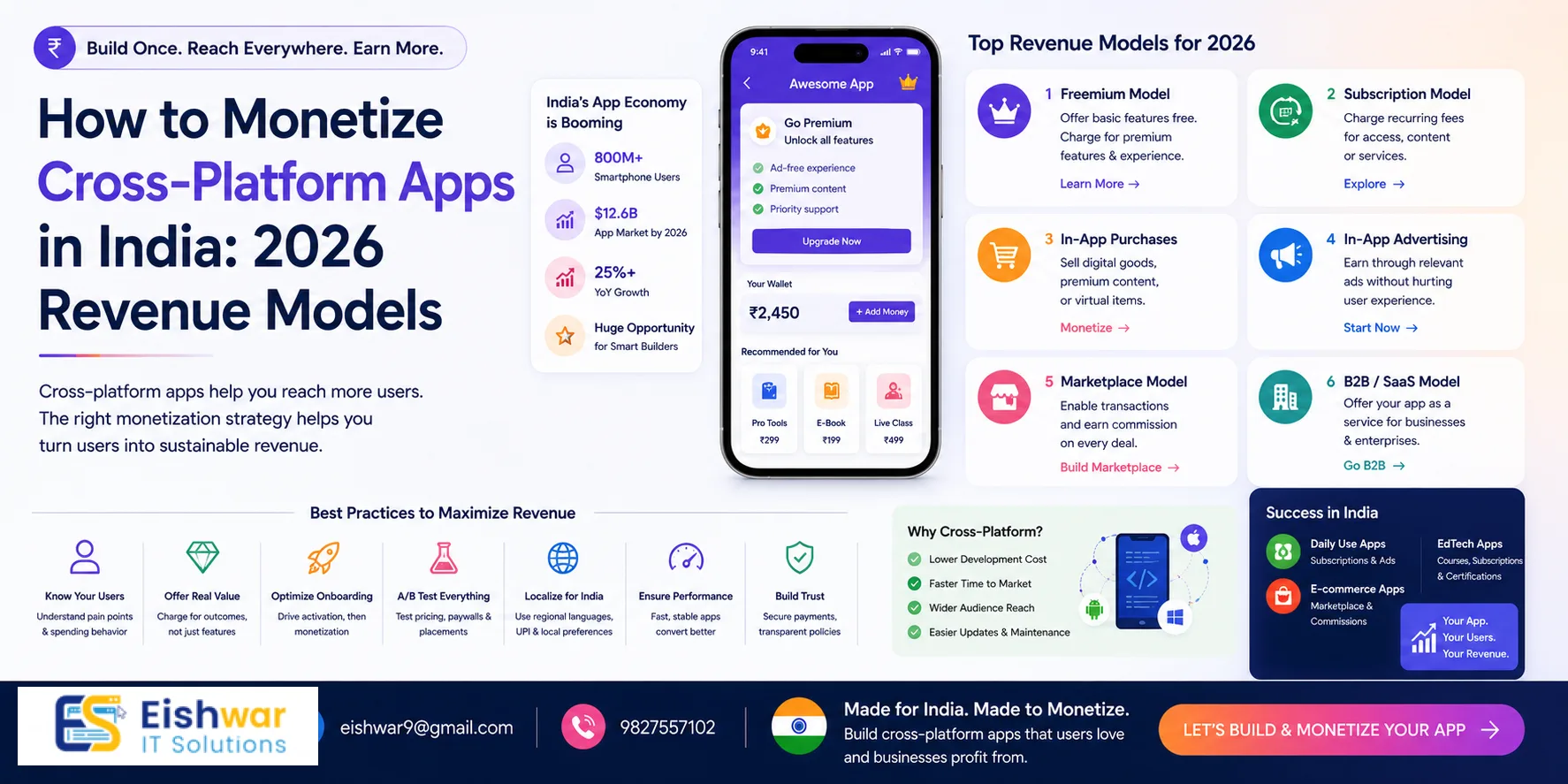
How to Monetize Cross-Platform Apps in India: 2026 Revenue Models for Business Owners
Introduction
India's mobile app market is booming. With over 750 million smartphone users and a rapidly growing digital economy, cross-platform apps have become the backbone of many businesses. But building an app is only half the battle—the real challenge is turning it into a sustainable revenue stream. In 2026, the landscape of app monetization in India is shifting. Users are more value-conscious, competition is fierce, and the one-size-fits-all approach no longer works.
Learn more about our Website services
At EishwarITSolution, we've helped numerous businesses navigate this terrain. This guide dives into the most effective revenue models for cross-platform apps in India, tailored for business owners, marketers, and professionals. Whether you're launching a new app or revamping an existing one, these strategies will help you generate consistent income while delivering real value to your users.
Main Section 1: Understanding the Indian App Monetization Landscape in 2026
The Indian market is unique. Price sensitivity is high, but willingness to pay for genuine value is increasing. UPI and digital wallets have made micro-transactions frictionless, opening doors for innovative monetization. Cross-platform frameworks like Flutter and React Native allow you to reach both Android and iOS users without doubling development costs, making them ideal for testing multiple revenue models.
Key trends shaping 2026 include the rise of vernacular content, hyper-local services, and subscription fatigue. Users are bombarded with subscription offers, so your model must stand out. Additionally, data privacy regulations (like India's Digital Personal Data Protection Act) affect how you can target ads or sell user insights. Compliance is not optional—it's a trust builder. For example, an app that transparently explains data usage in Hindi or Tamil can see a 15-20% increase in opt-in rates compared to those using only English.
Another critical factor is the growing penetration of 5G and affordable smartphones in Tier 2 and Tier 3 cities. This expands your potential user base beyond metro areas, but also means you must optimize for lower-end devices and slower networks. A cross-platform app built with Flutter, for instance, can maintain performance across a wide range of devices, from a ₹8,000 phone to a flagship model. We've seen clients achieve 30% higher retention in smaller cities by focusing on lightweight assets and offline-first features.
Main Section 2: Top Revenue Models for Cross-Platform Apps in India
1. Freemium with Tiered Upgrades
Offer a free version with essential features and charge for premium ones. This works well for productivity, health, and learning apps. For example, a language learning app can provide basic lessons for free and charge for advanced modules, offline access, or personalized coaching. The key is to make the free version valuable enough to attract users, but limited enough to motivate upgrades. In practice, consider a three-tier model: Free (basic lessons with ads), Pro (₹99/month for ad-free, offline, and advanced content), and Premium (₹299/month with live tutoring sessions). This gives users a clear upgrade path without overwhelming them.
2. In-App Purchases (IAPs)
Ideal for gaming, entertainment, and utility apps. Sell virtual goods, extra lives, ad removal, or special content. In India, small-ticket IAPs (₹10-₹100) perform best due to low price sensitivity. Ensure your payment gateway supports UPI, wallets, and cards for maximum conversion. For instance, a meditation app could offer a ₹49 one-time purchase for a sleep story pack, while a gaming app might sell a ₹29 power-up bundle. Use dynamic pricing based on user behavior—offer a first-time discount to nudge hesitant users.
👉 Don't wait for the perfect moment; turn your vision into reality today.
Free Consultation3. Subscription Models (SaaS-style)
Perfect for apps offering ongoing value—fitness coaching, business tools, or content libraries. Monthly and annual plans work, but consider introducing a lifetime option for price-sensitive users. In India, annual plans with a 20-30% discount often outperform monthly ones because users perceive better value. For example, a fitness app could charge ₹199/month or ₹1,999/year (saving 16%), with a lifetime option at ₹4,999. Test these price points with A/B testing; we've seen annual plan conversion rates jump by 40% when the discount is clearly highlighted during onboarding.
4. Advertising (Banner, Native, Video)
If your app has high daily active users (DAU), ads can be a steady revenue stream. Use native ads that blend with your UI for better user experience. Rewarded video ads (where users watch an ad to unlock a feature) are particularly popular in Indian apps. However, avoid intrusive pop-ups that hurt retention. A practical tip: limit banner ads to one per screen and use interstitials only at natural breakpoints (e.g., between levels in a game). For a news app, native ads that mimic article cards can achieve click-through rates of 2-3%, compared to 0.5% for banners.
5. Sponsorships & Partnerships
Collaborate with brands relevant to your niche. For instance, a travel app can partner with hotels or airlines for exclusive deals. This model works best when you have a loyal user base. Offer sponsored content, in-app placements, or co-branded features. For example, a recipe app could partner with a spice brand to create a sponsored 'Flavor of the Month' section, earning ₹50,000-₹1,00,000 per campaign. Ensure the partnership feels organic—users should see value, not just an ad.
6. Transaction Fees (Marketplace Model)
If your app connects buyers and sellers (e.g., freelance services, local services), take a small commission per transaction. Ensure your fee is competitive and transparent. In India, platforms like Urban Company and Practo have popularized this model. For a hyper-local service app, a 10-15% commission on each booking (e.g., plumber, tutor) can generate steady revenue. To avoid user backlash, clearly display the fee breakdown during checkout. We recommend starting with a lower commission (e.g., 8%) to attract early adopters, then gradually increasing as your platform gains traction.
Main Section 3: How to Choose the Right Model for Your App
Your choice depends on your app type, target audience, and growth stage. Start by analyzing user behavior: Are they willing to pay upfront? Do they engage daily? Use A/B testing to compare models. For example, run a version with ads and another with a low-cost subscription for a month, then measure revenue and retention. A practical framework: if your app has >50% daily active users, consider ads or subscriptions; if usage is weekly, focus on IAPs or freemium upgrades.
👉 Free Website Audit
Get Free AuditCross-platform apps give you the flexibility to pivot quickly. If one model isn't working, switch without rebuilding the entire app. Also, consider hybrid models—combine freemium with ads, or offer a free trial before subscription. The goal is to maximize lifetime value (LTV) while keeping customer acquisition cost (CAC) low. For instance, a study by EishwarITSolution found that apps using a hybrid model (freemium + rewarded ads) saw 25% higher LTV compared to those using a single model. Use tools like Firebase Predictions to identify users likely to convert and target them with personalized offers.
Expert Tips
- Start with one model, then expand. Don't overwhelm users with too many options initially. For example, launch with freemium, then add IAPs after 3 months based on user feedback.
- Optimize for Indian payment preferences. Integrate UPI, Paytm, Google Pay, and cards. Ensure your checkout supports Paytm Wallet, PhonePe, and BHIM UPI—these account for over 60% of digital transactions in India.
- Leverage push notifications to remind users of expiring trials or new premium features. But keep frequency low—1-2 notifications per week to avoid opt-outs. Personalize based on user behavior (e.g., 'Your free trial ends in 3 days—upgrade now to keep your progress').
- Monitor churn closely. If users leave after a free trial, adjust your onboarding or pricing. For instance, if 40% of users churn after a 7-day trial, extend it to 14 days or offer a discounted first month.
- Use analytics tools (like Firebase or Mixpanel) to track revenue per user and identify trends. Set up funnels to see where users drop off—e.g., if 70% abandon the payment page, simplify the checkout flow.
- Localize your content and pricing. Offer regional language support (Hindi, Tamil, Telugu) and price in INR. An app that localizes its store listing and in-app text can see a 50% increase in downloads from non-metro areas.
Common Mistakes
- Ignoring local pricing. Charging in dollars without considering INR purchasing power can alienate users. For example, a $5/month subscription (₹415) is too high for most Indian users; instead, price at ₹199-₹299.
- Overloading with ads. Too many ads degrade user experience and increase churn. Limit to 3-4 ad placements per session, and use rewarded ads to make them feel optional.
- Neglecting onboarding. If users don't see value quickly, they won't pay. Use a 3-step onboarding that highlights key features and the premium upgrade within the first 2 minutes.
- No clear value proposition. Users need to understand exactly what they get for their money. For instance, instead of 'Premium features,' say 'Unlock unlimited lessons, offline access, and personalized coaching.'
- Forgetting compliance. Violating data protection laws can lead to fines and loss of trust. Ensure your app has a clear privacy policy and opt-in consent for data collection, especially for ad targeting.
- Ignoring offline functionality. Many Indian users have intermittent internet. An app that crashes without connectivity will lose users. Implement offline-first features, like cached content or local storage, to improve retention.
Future Trends
By 2027, we expect AI-driven dynamic pricing to become mainstream—apps will adjust subscription fees based on user engagement and willingness to pay. For example, a user who opens the app daily might see a lower renewal offer than a weekly user. Also, blockchain-based micro-transactions could reduce fees, enabling new models like pay-per-use for content. Voice commerce and AR shopping within apps will open new monetization avenues—imagine a fashion app where users try on clothes virtually and purchase directly. Cross-platform apps that integrate these technologies early will have a competitive edge. At EishwarITSolution, we're already experimenting with AI pricing models for our clients, and early results show a 15% increase in subscription revenue.
👉 Free Homepage Demo
Book DemoFAQs
- What is the best monetization model for a new app in India? Freemium with a low-cost premium tier works best for most new apps. It builds trust and allows users to experience value before paying. For example, a habit-tracking app could offer basic tracking for free and charge ₹99/month for advanced analytics and reminders.
- How much should I charge for a subscription in India? Pricing varies by niche, but ₹99-₹299 per month is common. Annual plans at ₹999-₹2999 often convert well. Test different price points using A/B testing—for instance, compare ₹199/month vs. ₹249/month to find the sweet spot.
- Can I use ads in a subscription app? Yes, but be transparent. Some apps offer an ad-free version as a premium perk. Others show ads to free users only. For example, a music streaming app might play ads every 3 songs for free users, while subscribers get uninterrupted listening.
- How do I handle refunds in India? Follow app store policies (Google Play, Apple). Offer refunds within 48 hours if the service isn't as described. Good refund policies build trust. For example, clearly state '30-day money-back guarantee' in your app description to reduce purchase anxiety.
- What if my app has low downloads? Focus on user acquisition first. Use organic channels like SEO, social media, and referrals. Monetization only works with a decent user base. For instance, run a referral program that rewards users with premium features for inviting friends—this can boost downloads by 20%.
- Is it better to go free or paid upfront? For most Indian users, free is better to gain traction. Paid upfront limits your reach. Use free with optional paid features. However, if your app solves a critical business problem (e.g., invoicing for freelancers), a paid model with a free trial can work—just ensure the trial is long enough (14-30 days) to demonstrate value.
- How do I optimize for UPI payments? Integrate a UPI SDK like Razorpay or Paytm. Ensure the payment flow is simple—users should complete a transaction in under 30 seconds. Test with popular UPI apps like Google Pay and PhonePe to avoid compatibility issues.
- What metrics should I track for monetization? Key metrics include LTV (lifetime value), CAC (customer acquisition cost), churn rate, conversion rate (free to paid), and average revenue per user (ARPU). Use tools like Mixpanel to set up dashboards and monitor weekly trends.
Conclusion
Monetizing cross-platform apps in India in 2026 is all about understanding your users and adapting quickly. There's no magic formula, but by combining the right revenue model with local insights and continuous optimization, you can build a profitable app. Start small, test often, and never stop listening to your users. The Indian market is ripe with opportunity—those who innovate and respect user preferences will thrive.
CTA
Ready to turn your cross-platform app into a revenue machine? Contact EishwarITSolution today for a free consultation. Our experts will help you choose and implement the best monetization strategy for your business, from AI-driven pricing to UPI integration. Let's build your success story.