How Cross-Platform Mobile Apps Drive Business Growth for Indian Enterp
Published on: 10 Jun 2026
How Cross-Platform Mobile Apps Drive Business Growth for Indian Enterp
\nIntroduction
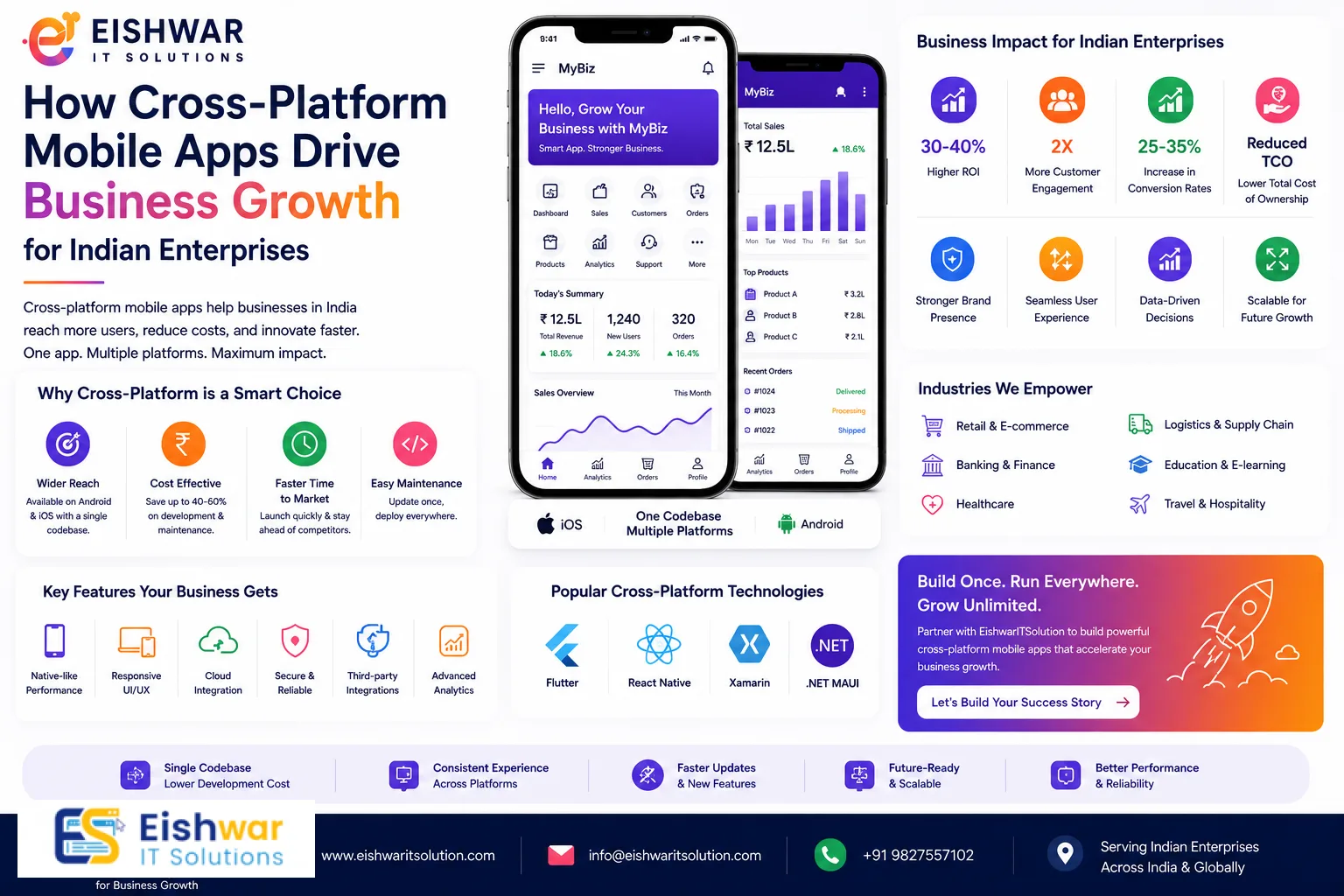
In 2026, Indian enterprises are no longer asking if they need a mobile app—they’re asking how to build one that delivers maximum ROI without draining resources. The answer lies in cross-platform mobile app development. By writing code once and deploying it on both Android and iOS, businesses can cut development costs by up to 40% and reach a massive user base faster than ever before. This article explores how cross-platform solutions are reshaping business growth strategies for Indian companies, from startups to large enterprises.
Learn more about our Website services
Whether you’re a business owner in Mumbai, a marketer in Delhi, or a tech leader in Bengaluru, understanding the power of frameworks like Flutter, React Native, and Kotlin Multiplatform can transform your digital presence. Let’s dive into the practical benefits, real-world examples, and actionable steps to leverage cross-platform mobile apps for sustainable growth.
Main Section 1: The Cost & Time Advantage for Indian Businesses
One of the most compelling reasons Indian enterprises are adopting cross-platform development is the significant reduction in both cost and time. Instead of maintaining separate teams for Android and iOS, a single codebase serves both platforms. This means faster development cycles, lower maintenance overhead, and quicker updates.
Real-world example: A Pune-based e-commerce startup used Flutter to build its app in just 4 months—compared to 8 months if they had built two native apps. They saved ₹15 lakhs in development costs and launched simultaneously on both platforms, capturing 10,000 downloads in the first week. Another example: A Delhi-based healthtech company used React Native to create a telemedicine app, reducing time-to-market by 35% and saving ₹20 lakhs annually on maintenance. For Indian SMEs operating on tight budgets, this efficiency is a game-changer. You can reinvest the savings into marketing, customer acquisition, or feature enhancements. Moreover, cross-platform apps offer near-native performance, so users don’t compromise on experience. Practical tip: When budgeting, factor in the cost of plugins and third-party integrations, which can add 10-15% to initial development but still keep overall costs lower than native.
Main Section 2: Reaching India’s Diverse Mobile Ecosystem
India’s mobile landscape is incredibly diverse—Android dominates with over 90% market share, but iOS users in metro cities are high-value. Cross-platform apps ensure you don’t alienate either segment. With a single codebase, you can deliver a consistent brand experience across budget Android phones and premium iPhones alike.
Actionable tip: Use platform-specific UI adaptations (e.g., Material Design for Android, Cupertino for iOS) within your cross-platform framework to maintain native feel. Tools like Flutter’s platform channels or React Native’s platform-specific code blocks make this easy. For example, a fintech app in Mumbai used Flutter’s platform channels to implement biometric authentication—Face ID on iOS and fingerprint on Android—without duplicating code. Additionally, cross-platform apps simplify localization for India’s 22 official languages. You can integrate language packs and cultural nuances without rebuilding the app. This directly boosts engagement in Tier 2 and Tier 3 cities, where regional language support is critical. Detailed example: An edtech company in Bengaluru added Hindi, Tamil, and Telugu support to their React Native app, resulting in a 50% increase in user retention from non-metro areas within three months.
👉 Don't wait for the perfect moment; turn your vision into reality today.
Free ConsultationMain Section 3: Scaling with Agility – Updates, Features & Integration
In a fast-moving market like India, the ability to roll out updates quickly is a competitive advantage. Cross-platform apps allow you to push new features, bug fixes, and security patches simultaneously to all users. No more staggered releases or version fragmentation.
Example: A fintech company in Bengaluru needed to implement UPI 2.0 compliance within 2 weeks. Using React Native, they updated both Android and iOS apps in a single sprint, avoiding the typical 4-week timeline for native updates. Their users experienced zero downtime. Another case: A logistics startup in Pune used Flutter to integrate a real-time tracking feature, rolling it out to 50,000 users in just 10 days. Cross-platform also excels at integrating with third-party services—payment gateways (Razorpay, Paytm), analytics (Firebase), and CRMs (Zoho). Most frameworks have pre-built plugins, reducing development effort. This agility helps Indian businesses adapt to regulatory changes or market trends instantly. Practical tip: Use feature flags (e.g., with LaunchDarkly) to test new features with a subset of users before full rollout, minimizing risk.
Expert Tips
- Choose the right framework: Flutter is great for pixel-perfect UIs and fast rendering; React Native is ideal if you need a large community and JavaScript ecosystem; Kotlin Multiplatform suits enterprises with heavy backend logic. For example, a gaming startup might prefer Flutter for smooth animations, while a B2B SaaS company might opt for React Native for its extensive library support.
- Invest in a strong MVP: Launch with core features, gather user feedback, then iterate. Cross-platform makes iterations cheap. A travel app startup in Jaipur launched with just booking and payment features, then added reviews and loyalty programs based on user data.
- Prioritize performance: Optimize images, use lazy loading, and avoid heavy animations on low-end devices to ensure smooth experience across India’s diverse hardware. For instance, compress images to WebP format and use code splitting to reduce initial load time.
- Test on real devices: Use cloud testing platforms like BrowserStack to test on 100+ Android and iOS devices before launch. A healthcare app in Chennai caught a critical UI bug on a budget Xiaomi phone during testing, avoiding a potential user exodus.
- Leverage offline-first design: Indian users often face unstable internet. Implement offline caching with SQLite or Firebase offline persistence. A retail app in Delhi used local storage to allow browsing products without connectivity, increasing session times by 30%.
Common Mistakes
- Ignoring platform guidelines: Users expect native gestures and navigation. Always follow Material Design and Human Interface Guidelines. A food delivery app in Mumbai saw a 20% drop in orders after using non-standard swipe gestures.
- Overusing third-party plugins: Too many dependencies can slow down your app and cause compatibility issues. Use native modules when performance is critical. For example, a payment app in Bengaluru replaced a slow plugin with a native module for faster transaction processing.
- Neglecting offline capabilities: Indian users often face unstable internet. Implement offline caching with SQLite or Firebase offline persistence. A news app in Kolkata lost 40% of users after a network outage because it had no offline mode.
- Skipping user research: Don’t assume what works in the US will work in India. Conduct local surveys and A/B tests. A social media app in Pune discovered that users preferred dark mode and smaller data consumption, leading to a redesign that boosted engagement by 25%.
- Underestimating app size: Cross-platform apps can be larger than native ones. Optimize assets and use app thinning to reduce download size. A gaming app in Hyderabad reduced its APK from 150 MB to 80 MB by compressing graphics, improving install rates by 15%.
Future Trends
In 2026 and beyond, cross-platform development will see deeper integration with AI/ML, enabling personalized user experiences at scale. Tools like Flutter’s machine learning plugins and React Native’s TensorFlow Lite support will become mainstream. For example, an e-commerce app in Mumbai could use AI to recommend products based on browsing history, all within a cross-platform framework. Additionally, the rise of 5G in India will push cross-platform apps to handle richer media (AR/VR) without lag. Expect more Indian enterprises to adopt super-app strategies, where a single cross-platform app bundles multiple services (payments, shopping, bookings). A Bengaluru-based conglomerate is already building a super-app with Flutter, integrating food delivery, cab booking, and bill payments. Also, watch for the growth of low-code cross-platform tools like OutSystems, which could democratize app development for smaller Indian businesses.
👉 Free Website Audit
Get Free AuditFAQs
1. What is the best cross-platform framework for Indian businesses in 2026?
Flutter remains popular for its fast development and beautiful UI, but React Native offers a larger talent pool in India. Kotlin Multiplatform is gaining traction for enterprise apps. Choose based on your team’s expertise and project needs. For instance, if you need a highly customized UI, Flutter is ideal; if you have a JavaScript-heavy team, React Native is better.
2. How much can I save by choosing cross-platform over native development?
Typically, you can save 30-40% on initial development costs and up to 50% on maintenance, as you manage one codebase instead of two. For a complex app costing ₹50 lakhs natively, cross-platform could bring it down to ₹30 lakhs, with annual maintenance savings of ₹10 lakhs.
3. Can cross-platform apps match native performance?
Yes, modern frameworks like Flutter and React Native achieve near-native performance. For graphics-heavy apps (games), native may still be better, but for most business apps, cross-platform is sufficient. Benchmarks show Flutter apps perform within 5-10% of native in UI rendering.
4. Is it easy to find cross-platform developers in India?
Absolutely. India has a vast pool of Flutter and React Native developers. Platforms like Upwork, Toptal, and local agencies (including EishwarITSolution) offer skilled talent. The average hourly rate for a Flutter developer in India ranges from ₹800 to ₹2,000, depending on experience.
5. How long does it take to build a cross-platform app?
A basic MVP can be ready in 3-4 months. Complex apps with AI/ML features may take 6-9 months. Cross-platform reduces timeline by 30-40% compared to native. For example, a simple e-commerce app might take 3 months with Flutter versus 5 months natively.
👉 Free Homepage Demo
Book Demo6. What industries benefit most from cross-platform apps in India?
E-commerce, fintech, edtech, healthcare, and logistics see the biggest gains due to rapid scaling and cost efficiency. For instance, a logistics company in Delhi used React Native to build a tracking app for 10,000 drivers, reducing operational costs by 20%.
7. Can cross-platform apps handle complex backend integrations?
Yes, frameworks like Kotlin Multiplatform are designed for heavy backend logic, while Flutter and React Native support REST APIs, GraphQL, and Firebase. A fintech app in Mumbai integrated with multiple payment gateways (Razorpay, Paytm) using React Native without issues.
Conclusion
Cross-platform mobile app development is no longer a compromise—it’s a strategic advantage for Indian enterprises aiming for growth in 2026. From cost savings and faster launches to reaching India’s diverse user base, the benefits are clear. By choosing the right framework, avoiding common pitfalls, and staying ahead of trends, your business can build a powerful mobile presence without breaking the bank. The key is to start with a clear strategy, invest in user research, and leverage the agility of cross-platform tools to adapt to market changes. As India’s digital economy expands, cross-platform apps will be the foundation for scalable, cost-effective growth.
CTA
Ready to build a cross-platform mobile app that drives real business results? <a href="http://eishwar.com/contact">Contact EishwarITSolution today</a> for a free consultation and let’s turn your idea into a market-leading app. Our team of experienced developers will help you choose the right framework, design a user-centric experience, and launch faster than ever.