Low-Code Cross-Platform App Development: A 2026 Guide for Indian Enter
Published on: 12 Jun 2026
Low-Code Cross-Platform App Development: A 2026 Guide for Indian Enterprises
Introduction
Indian enterprises are under constant pressure to deliver mobile apps quickly without sacrificing quality. Traditional development cycles often take months, draining budgets and delaying time-to-market. Enter low-code platforms — a game-changer for cross-platform app development in 2026. These platforms allow businesses to build apps with minimal hand-coding, using visual interfaces and pre-built components. For Indian companies targeting diverse user bases across iOS, Android, and the web, low-code cross-platform solutions offer speed, cost-efficiency, and scalability. In this guide, we’ll explore how low-code is revolutionizing mobile app development for Indian enterprises, provide actionable tips, and highlight trends shaping the future.
Learn more about our Website services
Consider a typical scenario: a mid-sized Indian retail chain wants to launch a customer loyalty app. With traditional development, they’d hire separate iOS and Android teams, spend months on coding, and face integration headaches. With low-code, they can use a single visual environment to design the app, connect it to their existing CRM, and deploy to both platforms in weeks. This isn’t just theory—it’s happening across industries like fintech, healthcare, and logistics in India today.
Main Section 1: What is Low-Code Cross-Platform App Development?
Low-code development is a software approach that enables rapid application creation with minimal coding. Visual drag-and-drop tools, model-driven logic, and reusable components replace much of the manual coding effort. When combined with cross-platform frameworks like Flutter, React Native, or .NET MAUI, low-code platforms allow developers to build apps that run seamlessly on multiple operating systems from a single codebase.
Key characteristics of low-code cross-platform development include:
- Visual Development Environment: Drag-and-drop UI builders reduce design time. For example, you can create a login screen by dragging a text field and button onto a canvas, then configure their behavior without writing a single line of code.
- Pre-built Templates & Connectors: Ready-made integrations for databases, APIs, and third-party services. A common use case is connecting to payment gateways like Razorpay or Paytm via pre-built connectors, saving weeks of integration work.
- Automatic Code Generation: The platform generates native code for each target platform, ensuring performance. This means your app feels native on both iOS and Android, with smooth animations and fast load times.
- Collaboration Features: Business analysts, designers, and developers can work together on the same platform. For instance, a business analyst can define business rules in a visual workflow, while a developer adds custom logic for complex calculations.
For Indian enterprises, this means faster delivery of apps for customer engagement, employee productivity, or internal operations — all while maintaining high quality. A practical tip: start by mapping your app’s core features to pre-built components. If 80% of your functionality can be built with drag-and-drop, low-code is a strong fit.
Main Section 2: Why Indian Enterprises Are Adopting Low-Code Cross-Platform Solutions in 2026
India's digital landscape is booming, with over 800 million smartphone users and a rapidly growing startup ecosystem. Enterprises face unique challenges: diverse device ecosystems, regional language support, and cost sensitivity. Low-code cross-platform development addresses these head-on.
Speed to Market
Traditional app development can take 6-12 months. Low-code reduces this to weeks. For example, a retail chain needing a loyalty app can launch a prototype in days, test with real users, and iterate quickly. In 2026, where first-mover advantage is critical, this speed is invaluable. A practical example: a Bangalore-based food delivery startup used low-code to launch a rider management app in 3 weeks, enabling them to onboard 500 new riders during a festival season.
👉 Don't wait for the perfect moment; turn your vision into reality today.
Free ConsultationCost Efficiency
With a single codebase for multiple platforms, development and maintenance costs drop by up to 40%. Indian enterprises, especially SMEs, benefit from lower upfront investment. For instance, a small manufacturing company in Pune built an inventory tracking app for ₹5 lakhs using low-code, versus an estimated ₹15 lakhs with traditional development. This cost saving allows them to reinvest in other digital initiatives.
Localization Ready
Low-code platforms often include built-in localization tools, making it easier to support Hindi, Tamil, Bengali, and other regional languages — crucial for reaching tier-2 and tier-3 cities. Many platforms now offer AI-powered translation, so you can automatically generate localized versions of your app. For example, a government healthcare app could be deployed in 10 regional languages within days, not months.
Scalability and Flexibility
Low-code doesn't mean limited. Modern platforms handle complex logic, high traffic, and integration with existing ERP or CRM systems. A logistics company can build an app that connects with SAP or Oracle without custom code. In 2026, platforms like OutSystems and Mendix support microservices architecture, allowing you to scale individual components independently. For instance, a logistics app might have a separate microservice for real-time tracking, which can be scaled during peak hours.
Real-world example: A leading Indian fintech firm used a low-code cross-platform platform to launch a mobile banking app in 8 weeks, serving 2 million users within three months. The app included features like UPI payments, loan applications, and customer support chat—all built with minimal hand-coding. The key was using a platform that generated native code, ensuring the app performed well even under high transaction volumes.
Main Section 3: How to Implement Low-Code Cross-Platform Development Successfully
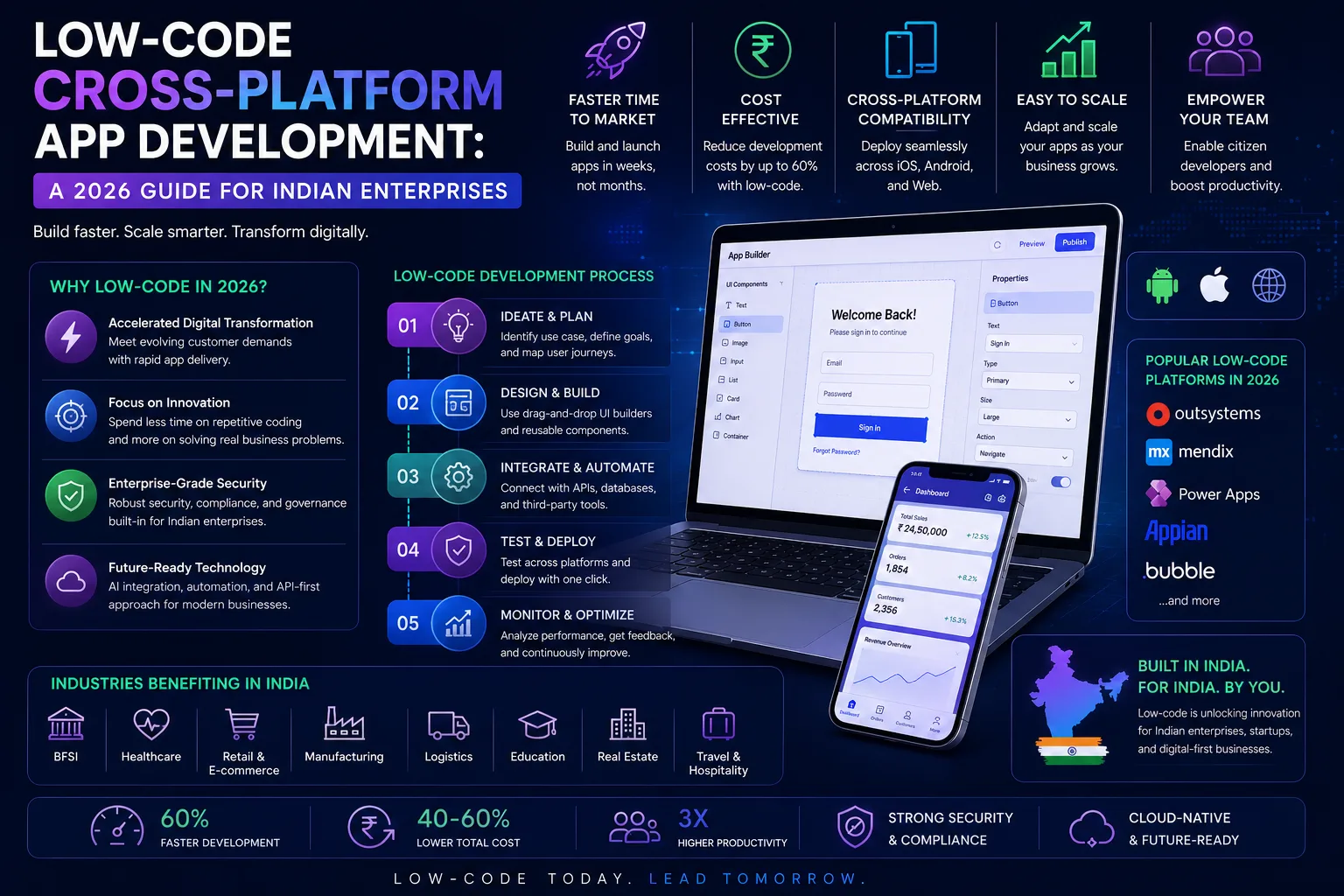
Adopting low-code requires a strategic approach. Here’s a step-by-step framework for Indian enterprises:
- Assess Your Needs: Identify which apps (customer-facing, internal, or hybrid) benefit most from rapid development. For example, internal HR apps or customer feedback portals are ideal candidates, while real-time gaming apps may not be.
- Choose the Right Platform: Evaluate platforms like OutSystems, Mendix, or Power Apps for cross-platform capabilities. Ensure they support native performance and offline functionality. For Indian enterprises, also check for data residency options—some platforms offer India-based servers to comply with local regulations.
- Build a Cross-Functional Team: Include business stakeholders, UX designers, and a few experienced developers to handle custom logic. A common mistake is relying solely on citizen developers; skilled developers are needed for complex integrations and performance optimization.
- Start with a Pilot: Pick a non-critical app to test the workflow, measure time savings, and gather feedback. For instance, build an internal leave management app first. This allows your team to learn the platform without risking customer-facing apps.
- Integrate with Existing Systems: Use the platform’s connectors to link with your ERP, CRM, or legacy databases. If your platform lacks a connector for a specific system, consider building a custom API wrapper—low-code platforms often support this.
- Establish Governance: Define roles, security protocols, and compliance checks — especially for apps handling sensitive data. For example, set up role-based access controls so only authorized users can modify app logic.
Remember, low-code is not a silver bullet. It works best for standard business apps, not for highly specialized or performance-critical applications like real-time gaming or complex AR/VR. A practical tip: use low-code for the frontend and business logic, but rely on traditional coding for backend microservices that require high performance.
👉 Free Website Audit
Get Free AuditExpert Tips
- Start with a clear roadmap. Don't jump into low-code without understanding your long-term app portfolio. Map out which apps you’ll build over the next 12-18 months and prioritize those that benefit most from rapid development.
- Invest in training. Your team needs to understand both low-code tools and cross-platform best practices. Consider sending a few developers for platform-specific certification (e.g., OutSystems Developer Certification) to build internal expertise.
- Monitor performance. Use analytics to track app load times, crashes, and user engagement — low-code apps should still be optimized. Tools like Firebase Performance Monitoring can help identify bottlenecks.
- Prioritize security. Ensure the platform offers encryption, secure authentication, and compliance with Indian data laws (e.g., DPDP Act 2023). For example, use OAuth 2.0 for authentication and encrypt data at rest and in transit.
- Keep an eye on vendor lock-in. Choose platforms that allow you to export code or integrate with open standards. For instance, OutSystems allows you to export the generated code, giving you flexibility if you decide to switch platforms later.
- Leverage community resources. Many low-code platforms have active user communities in India. Join forums or local meetups to learn from others’ experiences and share best practices.
Common Mistakes
- Treating low-code as a no-code panacea. Complex logic still requires skilled developers. Don't expect non-technical staff to build enterprise-grade apps alone. For example, a business analyst might design a workflow, but a developer should handle data validation and error handling.
- Ignoring scalability testing. Many low-code platforms handle small loads well but may struggle under heavy traffic. Test thoroughly. For instance, simulate 10,000 concurrent users during a load test to ensure your app doesn’t crash.
- Neglecting user experience. Visual builders can produce generic UIs. Customize designs to match your brand and ensure intuitive navigation. Use platform-specific UI components (e.g., Material Design for Android, Human Interface Guidelines for iOS) for a native feel.
- Skipping documentation. Low-code apps can become hard to maintain without proper documentation of logic and integrations. Create a wiki or use the platform’s built-in documentation features to record business rules and API endpoints.
- Overlooking offline capabilities. Indian users often face connectivity issues. Ensure your app works offline and syncs when online. For example, use local storage for form data and sync it to the server when connectivity is restored.
- Failing to plan for updates. Low-code platforms evolve rapidly. Plan for regular updates to your apps to leverage new features and security patches. Set up a quarterly review cycle for your app portfolio.
Future Trends
By 2027, low-code is expected to power over 65% of all app development activity. For cross-platform development in India, watch these trends:
👉 Free Homepage Demo
Book Demo- AI-Assisted Development: Low-code platforms will embed AI to suggest components, optimize code, and automate testing. For example, AI could analyze user behavior and suggest UI improvements automatically.
- Hyperautomation: Combining low-code with robotic process automation (RPA) to automate end-to-end business processes. Imagine a low-code app that automatically triggers an RPA bot to process invoices when a user uploads a document.
- Edge Computing Integration: Low-code apps that process data on local devices for faster response in remote areas. This is crucial for applications like IoT-based agriculture monitoring in rural India.
- Voice and Chat Interfaces: Building conversational UIs with low-code tools for Indian language support. Platforms will offer pre-built components for voice recognition in Hindi, Tamil, and other languages.
- Citizen Developer Ecosystems: Empowering business users to create their own apps under IT governance, accelerating digital transformation. For example, a marketing team could build a campaign tracking app without waiting for IT resources.
- Blockchain Integration: Low-code platforms will start offering connectors for blockchain networks, enabling secure, transparent transactions for supply chain apps.
FAQs
1. What is low-code cross-platform app development?
Low-code cross-platform app development uses visual tools and pre-built components to create apps that run on multiple operating systems (iOS, Android, web) with minimal hand-coding. It accelerates development while maintaining native performance. For Indian enterprises, this means faster time-to-market and lower costs compared to traditional development.
2. How does low-code differ from no-code?
Low-code platforms allow for custom code when needed, making them suitable for complex enterprise apps. No-code platforms are fully visual and target non-technical users for simple apps. For cross-platform development, low-code offers more flexibility—you can start with visual tools and add custom code for unique features like advanced data analytics or custom animations.
3. Is low-code secure enough for enterprise apps in India?
Yes, when properly configured. Leading low-code platforms offer encryption, role-based access, audit logs, and compliance with Indian data protection laws like the DPDP Act 2023. However, security must be a priority during development and deployment. For example, always use HTTPS, implement multi-factor authentication, and regularly audit access logs.
4. Can low-code handle high-traffic apps for Indian users?
Many low-code platforms are cloud-native and auto-scale. However, performance depends on the platform's architecture and your app's design. Load testing is essential for high-traffic apps. For instance, simulate peak loads during festivals like Diwali to ensure your app can handle spikes. Platforms like OutSystems offer built-in load testing tools.
5. What are the best low-code platforms for cross-platform development?
Popular options include OutSystems, Mendix, Microsoft Power Apps, and Appian. For cross-platform specifically, platforms that generate native code (like OutSystems with Flutter) are ideal. Evaluate based on your team's skills and app complexity. For Indian enterprises, also consider platforms with strong local support, such as OutSystems’ partner network in India.
6. How long does it take to build a cross-platform app with low-code?
A simple app can be ready in 2-4 weeks. Complex enterprise apps with integrations may take 8-12 weeks — still significantly faster than traditional development (6-12 months). For example, a customer feedback app with basic analytics might take 3 weeks, while a full-fledged e-commerce app with payment integration could take 10 weeks.
7. What are the costs involved in low-code cross-platform development?
Costs vary based on platform licensing, team size, and app complexity. Platform licenses can range from ₹50,000 per year for small teams to ₹10 lakhs for enterprise plans. Development costs are typically 30-50% lower than traditional development due to reduced coding time. For Indian SMEs, many platforms offer tiered pricing or free tiers for small projects.
8. Can low-code apps be integrated with legacy systems?
Yes, most low-code platforms offer connectors for popular legacy systems like SAP, Oracle, and IBM Mainframe. For custom legacy systems, you can build REST APIs or use the platform’s integration capabilities. For example, a manufacturing company integrated their low-code inventory app with an old AS/400 system using a custom API connector.
Conclusion
Low-code cross-platform app development is no longer a futuristic concept — it's a practical reality for Indian enterprises in 2026. By combining the speed of visual development with the reach of cross-platform frameworks, businesses can launch apps faster, reduce costs, and stay competitive. The key is to choose the right platform, involve skilled developers for complex logic, and focus on user experience and security. As AI and automation continue to evolve, low-code will become even more powerful. Now is the time to explore how low-code can accelerate your digital transformation journey. Whether you’re a startup looking to launch a MVP or an enterprise modernizing your app portfolio, low-code offers a path to faster, more efficient development.
CTA
Ready to build your next cross-platform app in record time? Contact EishwarITSolution today for a free consultation. Our experts will help you select the right low-code platform, design a scalable architecture, and launch your app within weeks — not months. Get in touch now and let's turn your app idea into reality. We’ll provide a customized roadmap based on your business needs, including platform recommendations, cost estimates, and a pilot project plan.