Super Apps in India: Why Cross-Platform Development is Your 2026 Growt
Published on: 14 Jun 2026
Super Apps in India: Why Cross-Platform Development is Your 2026 Growth Hack
Introduction
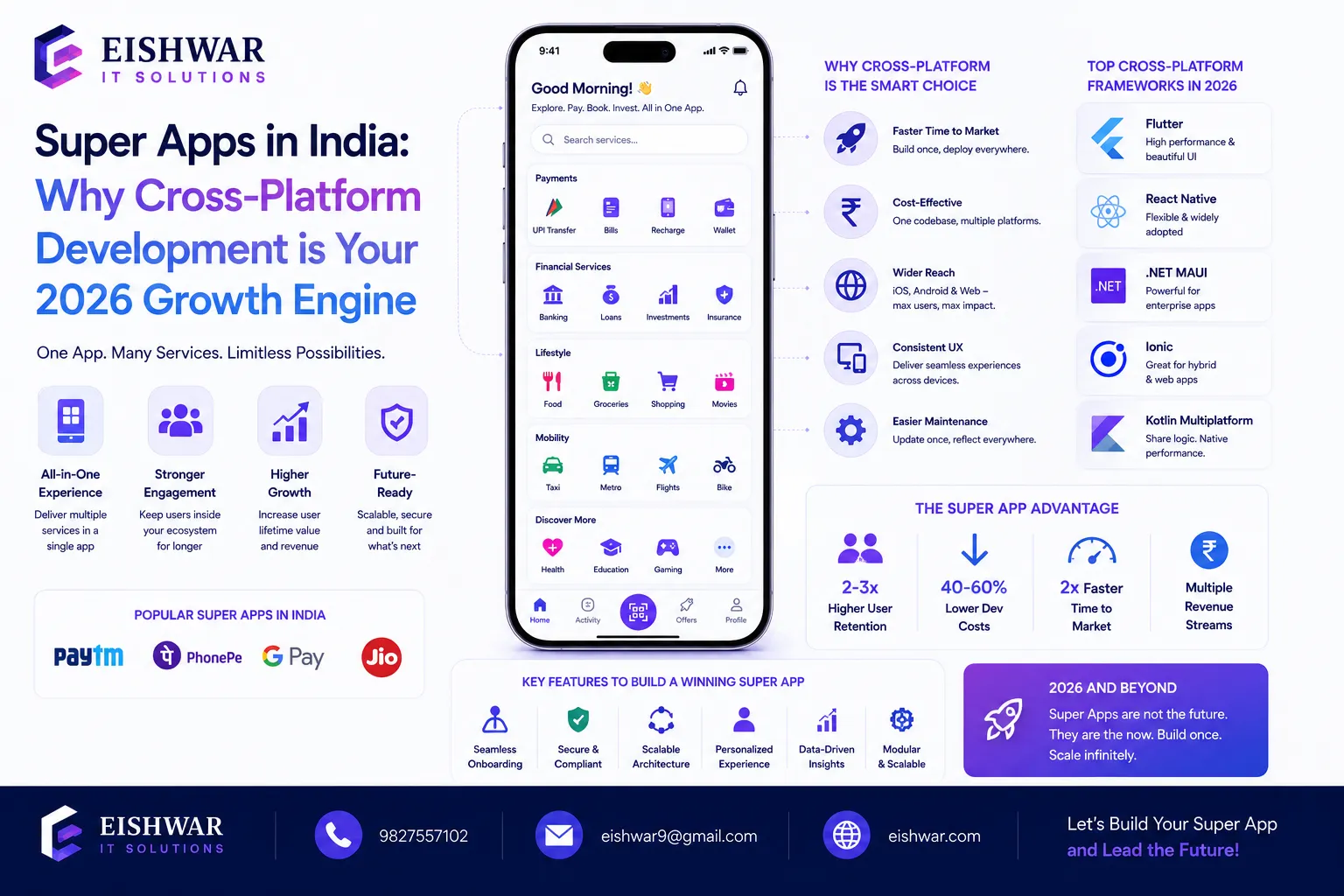
Imagine an app that does it all—booking a cab, ordering food, paying bills, chatting with friends, and even managing your investments. That's the magic of a super app. In 2026, super apps are no longer just for giants like WeChat or Gojek. Indian businesses, from startups to established enterprises, are jumping on the bandwagon. And the secret weapon? Cross-platform development.
Learn more about our Website services
At EishwarITSolution, we've seen how cross-platform frameworks like Flutter and React Native empower businesses to build super apps faster and cheaper than ever. In this guide, we'll explore why 2026 is the year of the super app in India, how cross-platform development makes it possible, and actionable steps to launch your own.
India's digital landscape is uniquely primed for this shift. With over 800 million smartphone users, the world's cheapest mobile data plans, and a unified payments interface (UPI) that processes billions of transactions monthly, the infrastructure is ready. But building a super app natively for both iOS and Android has traditionally been a costly, time-consuming endeavor. That's where cross-platform development changes the game. By allowing you to write code once and deploy it on both platforms, frameworks like Flutter and React Native slash development time by up to 40% and reduce costs significantly. In this expanded guide, we'll dive deep into the strategies, tools, and best practices that will make your super app a success in 2026.
Main Section 1: What is a Super App and Why India is Ready in 2026
A super app is a single mobile application that offers multiple services, creating an ecosystem where users rarely need to leave. Think of it as a digital Swiss Army knife. India's massive smartphone user base, affordable data plans, and digital payment infrastructure (UPI) make it fertile ground.
In 2026, the Indian super app market is projected to grow by 35% year-on-year. Why? Users want convenience, and businesses want higher retention. A super app keeps users engaged longer, collects valuable data, and opens cross-selling opportunities.
For example, a local grocery delivery startup could add bill payments, pharmacy orders, and even a small loan service. Instead of building five separate apps, they build one super app. And cross-platform development is the fastest path.
Consider the success of Paytm, which started as a mobile recharge platform and evolved into a full-fledged financial super app offering payments, insurance, investments, and even movie tickets. Similarly, Zomato expanded from food delivery to dining out, grocery, and event bookings. These examples show that the super app model isn't just for global players—it's a proven growth strategy for Indian businesses. In 2026, with the rise of 5G and increased smartphone penetration in tier-2 and tier-3 cities, the opportunity is even greater. Users in smaller towns are leapfrogging desktop internet and going straight to mobile, making super apps the perfect gateway to a wide range of services.
Another key driver is the Indian government's push for digital inclusion. Initiatives like Aadhaar-based eKYC, DigiLocker, and the Open Network for Digital Commerce (ONDC) are creating standardized digital rails that super apps can plug into. This reduces the complexity of integrating multiple services and allows even small businesses to offer a rich ecosystem. For instance, a local kirana store could partner with a super app to offer home delivery, bill payments, and loyalty rewards—all without building their own technology stack.
👉 Don't wait for the perfect moment; turn your vision into reality today.
Free ConsultationMain Section 2: Why Cross-Platform Development is the Backbone of Super Apps
Building a super app natively for iOS and Android separately doubles time and cost. Cross-platform frameworks like Flutter and React Native let you write code once and deploy everywhere. In 2026, these frameworks are mature, performant, and packed with features.
Here's why cross-platform wins for super apps:
- Faster time to market: Launch on both platforms simultaneously. A typical native development cycle for a super app with 3-4 services can take 8-12 months. With cross-platform, you can reduce that to 4-6 months, giving you a critical edge in a fast-moving market.
- Lower development cost: One codebase, one team. Instead of hiring separate iOS and Android developers, you can work with a single cross-platform team. This can reduce development costs by 30-40%, freeing up budget for marketing and user acquisition.
- Easier maintenance: Update once, both platforms get the fix. When you need to add a new service or fix a bug, you do it once. This is especially valuable for super apps that evolve rapidly based on user feedback.
- Consistent UX: Users get the same experience on any device. This is crucial for brand trust and usability. With native development, inconsistencies often creep in due to different codebases.
- Access to native features: Plugins and modules let you use camera, GPS, payments, etc. Both Flutter and React Native have extensive plugin ecosystems that cover everything from UPI integration to biometric authentication.
Take the example of a mid-sized Indian retail chain. They wanted a super app with loyalty rewards, in-store navigation, and order-ahead. Using Flutter, they launched in 4 months instead of 8. Their development cost was 40% lower than native. Moreover, they were able to iterate quickly based on early user feedback, adding a pharmacy delivery module within two months of launch. This agility is a direct result of cross-platform development.
Another practical tip: When choosing between Flutter and React Native, consider your team's existing skills. If your developers know JavaScript, React Native is a natural choice. If you're starting fresh, Flutter's Dart language is easy to learn and offers better performance for complex animations and UI transitions—common in super apps with multiple services. Both frameworks now support hot reload, which means you can see changes in real-time during development, further speeding up the process.
Main Section 3: How to Build a Super App for Your Indian Business in 2026
Ready to build? Here's a step-by-step strategy:
- Identify your core service: What is your primary value? For a bank, it's transactions. For a retailer, it's shopping. Your core service should be something you already do well. For example, if you run a successful food delivery business, that's your anchor service.
- Add complementary services: Think about what your users need alongside your core. A food delivery app could add grocery, pharmacy, or even laundry. The key is to choose services that have high synergy—services that your existing users are likely to need. Use data from your current app to identify top requests.
- Choose the right framework: Flutter is great for rich UIs, React Native for large ecosystems. Both work for super apps. Evaluate based on your specific needs: if you need heavy animation or custom UI, Flutter is often better. If you need to integrate with a large number of third-party services, React Native's mature ecosystem may be advantageous.
- Design for modularity: Each service should be a separate module. This makes updates and scaling easier. Use a microservices architecture on the backend and modular components on the frontend. For example, your payment module should be independent of your food ordering module, so you can update one without breaking the other.
- Integrate UPI and other payments: India runs on UPI. Make sure your super app supports it seamlessly. Integrate with popular gateways like Razorpay, Paytm, and PhonePe. Also consider offering multiple payment options—credit/debit cards, net banking, and digital wallets—to cater to different user preferences.
- Focus on data privacy: With India's Digital Personal Data Protection Act, compliance is non-negotiable. Implement strong encryption, obtain explicit user consent for data collection, and provide clear privacy policies. Consider appointing a data protection officer if your app handles sensitive information.
At EishwarITSolution, we recommend starting with a Minimum Viable Super App (MVSA)—launch with 2-3 services, gather feedback, then expand. For example, a local service provider could start with a booking system for home cleaning and plumbing, then add electrical repairs and pest control based on demand. This lean approach minimizes risk and ensures you're building what users actually want.
👉 Free Website Audit
Get Free AuditAnother critical step is to optimize for low-end devices. India has a large number of budget smartphones with limited RAM and storage. Use lazy loading, compress images, and minimize network calls to ensure smooth performance. Tools like Flutter's DevTools and React Native's Flipper can help you profile and optimize your app's performance.
Expert Tips
- Start small, think big: Don't try to build a full super app on day one. Launch with your strongest service and add modules gradually. This allows you to validate your core value proposition before investing in additional features.
- Use shared state management: Tools like Riverpod (Flutter) or Redux (React Native) keep your app consistent as it grows. As you add more services, a centralized state management system prevents data conflicts and ensures a seamless user experience.
- Invest in analytics: Super apps generate tons of data. Use it to understand user behavior and optimize services. Implement tools like Firebase Analytics, Mixpanel, or Amplitude to track user journeys, identify drop-off points, and measure feature adoption.
- Test on real devices: India has many low-end smartphones. Ensure your app runs smoothly on them. Use device farms like BrowserStack or AWS Device Farm to test on a wide range of devices, including older Android versions.
- Partner with local payment gateways: Razorpay, Paytm, and PhonePe are must-haves. They offer easy integration, support for multiple payment methods, and are trusted by Indian users.
- Leverage AI for personalization: Use machine learning to recommend services based on user behavior. For example, if a user frequently orders food on weekends, the app could suggest a grocery delivery service on weekdays. Flutter's TensorFlow Lite and React Native's ML Kit make it easy to add these features.
Common Mistakes
- Overloading the app: Too many services at launch can confuse users and slow performance. Stick to 2-3 core services initially and expand based on user feedback.
- Ignoring offline capabilities: Indian users often face network issues. Make core features work offline. For example, allow users to browse menus, view saved addresses, and add items to a cart without an internet connection, then sync when online.
- Poor onboarding: Users should understand your super app's value within 30 seconds. Use a clear, concise onboarding flow that highlights your key services. Avoid lengthy tutorials—let users explore the app naturally.
- Neglecting security: A super app is a treasure trove of personal data. Encrypt everything. Use HTTPS, implement secure authentication (like OAuth 2.0), and regularly audit your code for vulnerabilities.
- Not planning for scale: Your app should handle thousands of concurrent users from day one. Use cloud services like AWS, Google Cloud, or Azure that can auto-scale. Load test your app before launch to identify bottlenecks.
- Ignoring localization: India has 22 official languages. Offer your app in multiple languages, especially Hindi, Tamil, Telugu, and Bengali. Use localization libraries like Flutter's intl or React Native's i18n to manage translations efficiently.
Future Trends
In 2026 and beyond, super apps will evolve with AI. Imagine a super app that predicts what service you need next—based on your location, time of day, and past behavior. Voice interfaces will also become common, especially in India's multilingual market.
👉 Free Homepage Demo
Book DemoCross-platform frameworks are already adding AI/ML support. Flutter's TensorFlow Lite integration and React Native's ML Kit modules make it easy to add smart features. Also, expect more government services to integrate into super apps, from Aadhaar verification to tax filing. The Open Network for Digital Commerce (ONDC) will enable super apps to offer services from multiple providers seamlessly, creating a truly open ecosystem.
Another trend is the rise of super apps for specific verticals, such as healthcare super apps that combine telemedicine, pharmacy delivery, diagnostic bookings, and health insurance. Similarly, education super apps could offer online courses, test preparation, career counseling, and student loans. The modular nature of cross-platform development makes it easy to build these vertical-specific ecosystems.
Finally, expect increased focus on sustainability. Super apps can encourage eco-friendly behaviors, such as offering discounts for ordering from local restaurants or using public transport. By integrating carbon footprint tracking and green rewards, super apps can appeal to the growing number of environmentally conscious consumers in India.
FAQs
What is a super app?
A super app is a mobile application that offers multiple services within a single platform, such as messaging, payments, e-commerce, and more. Examples include WeChat, Gojek, and Grab. In India, Paytm and Tata Neu are emerging super apps.
Why is cross-platform development ideal for super apps?
Cross-platform development allows you to build a single codebase that runs on both iOS and Android, reducing development time and cost. This is crucial for super apps that need to launch quickly on both platforms. It also simplifies maintenance and ensures a consistent user experience.
Which cross-platform framework is best for a super app in 2026?
Both Flutter and React Native are excellent. Flutter offers better performance and UI consistency, making it ideal for apps with complex animations. React Native has a larger ecosystem and is easier for teams with JavaScript expertise. Choose based on your team's skills and project requirements.
How much does it cost to build a super app in India?
Costs vary widely based on features. A basic super app with 2-3 services can start from ₹15-25 lakhs, while a full-featured one can go up to ₹1 crore or more. Cross-platform development can reduce costs by 30-40% compared to native. Additional costs include backend infrastructure, third-party integrations, and ongoing maintenance.
What are the key features of a successful super app?
Key features include seamless user experience, integrated payments (UPI), modular architecture, offline support, strong security, and personalization using AI/ML. Additionally, a successful super app should have a clear value proposition, easy onboarding, and robust analytics to track user behavior.
How can EishwarITSolution help build my super app?
EishwarITSolution specializes in cross-platform development using Flutter and React Native. We offer end-to-end services from strategy to deployment, ensuring your super app is scalable, secure, and user-friendly. Our team has experience building super apps for retail, finance, and healthcare sectors. Contact us for a free consultation to discuss your vision.
What is a Minimum Viable Super App (MVSA)?
A Minimum Viable Super App (MVSA) is a version of your super app that includes only the essential services needed to deliver value to users. Typically, this means launching with 2-3 core services and then expanding based on user feedback. This approach reduces initial development time and cost, and helps you validate your concept before investing in additional features.
How do I ensure my super app complies with Indian data privacy laws?
To comply with India's Digital Personal Data Protection Act, implement strong encryption for data at rest and in transit, obtain explicit user consent for data collection, and provide a clear privacy policy. Limit data collection to what is necessary for your services, and allow users to access, correct, or delete their data. Consider working with a legal expert to ensure full compliance.
Conclusion
Super apps are not just for tech giants anymore. With cross-platform development, any Indian business can build a powerful ecosystem that keeps users engaged and drives growth. The key is to start smart, focus on user needs, and leverage the right technology.
2026 is the perfect time to launch your super app. The market is ready, the tools are mature, and the opportunities are endless. At EishwarITSolution, we're here to help you every step of the way. Whether you're a startup looking to disrupt a niche or an established enterprise aiming to expand your digital footprint, our team has the expertise to turn your vision into reality.
CTA
Ready to build your super app? Contact EishwarITSolution today for a free strategy session. Let's turn your vision into a digital ecosystem that your users will love. Our experts will help you choose the right framework, design a modular architecture, and launch your super app in record time. Don't wait—the super app revolution is happening now, and your business can be part of it.