PWAs in 2026: The Cross-Platform Game Changer for Indian Businesses
Published on: 15 Jun 2026
PWAs in 2026: The Cross-Platform Game Changer for Indian Businesses
Introduction
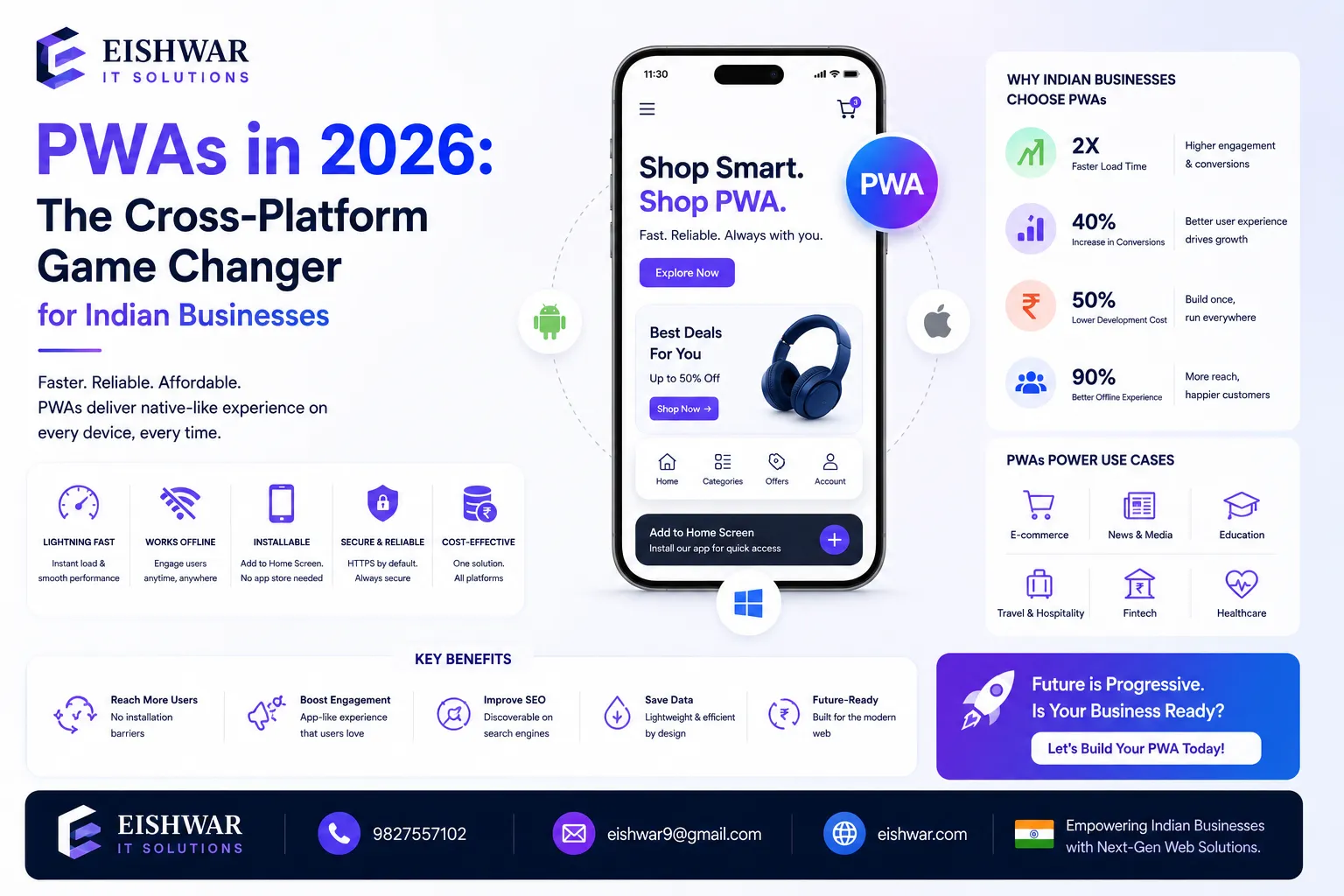
Imagine an app that loads instantly, works offline, and takes up almost no storage on your users' phones—without ever visiting an app store. That's the promise of Progressive Web Apps (PWAs), and in 2026, they are no longer just a buzzword. For Indian businesses, especially those targeting mobile-first audiences, PWAs have emerged as a powerful cross-platform alternative that combines the best of web and native apps.
Learn more about our Website services
With over 700 million smartphone users in India, the pressure to deliver seamless mobile experiences is immense. But building separate native apps for iOS and Android is expensive and time-consuming. PWAs offer a unified solution: one codebase, instant updates, and deep engagement—all without the friction of app store downloads. In this guide, we explore why PWAs are the 2026 cross-platform game changer for Indian businesses, backed by real-world examples and actionable advice.
Main Section 1: What Are PWAs and Why They Matter in 2026
PWAs are web applications that use modern web capabilities to deliver an app-like experience. They are reliable (load even on flaky networks), fast (respond quickly to user interactions), and engaging (feel like a native app with push notifications and home screen access). In 2026, with 5G expanding across India and data costs dropping, PWAs have become even more viable.
Why 2026 is the year of PWAs for Indian businesses:
- Cost efficiency: Developing a PWA costs 3–5x less than building two native apps. For example, a typical e-commerce PWA in India costs ₹5–15 lakhs, compared to ₹20–30 lakhs for dual native apps.
- Instant updates: No app store approval delays—update your app in real-time. This is critical for businesses like news portals or fintech apps that need to push changes quickly.
- Better reach: PWAs work on any device with a browser, including low-end smartphones common in Indian tier-2/3 cities. Devices with 1GB RAM or less can run PWAs smoothly, whereas native apps often lag.
- SEO benefits: PWAs are indexable by Google, driving organic traffic. A well-optimized PWA can rank higher in search results due to faster load times and mobile-friendliness.
- Offline capability: Service workers allow users to browse content without internet—critical in areas with poor connectivity. For instance, in rural Bihar, where 4G signals are weak, a PWA can cache product catalogs for later viewing.
For example, Flipkart Lite, a PWA, saw a 70% increase in conversions and 3x higher engagement compared to their native app. In 2026, with user expectations higher than ever, PWAs offer a pragmatic path to mobile excellence.
Main Section 2: How Indian Businesses Can Leverage PWAs for Growth
Indian startups and established enterprises alike are turning to PWAs to solve real business problems. Here's how you can leverage this technology:
E-commerce and Retail
PWAs enable fast product browsing, cart persistence, and push notifications for abandoned carts. Myntra reported a 40% increase in time spent on site after switching to a PWA. For small retailers, a PWA can replace a native app entirely, reducing development costs by 60%. For example, a local clothing brand in Jaipur used a PWA to showcase products, allow WhatsApp sharing, and process orders via UPI—all without an app store presence.
👉 Don't wait for the perfect moment; turn your vision into reality today.
Free ConsultationEdTech and Online Learning
With offline access to course materials and quizzes, PWAs make learning accessible in rural India. BYJU's PWA allows students to download lessons and learn without internet—a game changer for the 60% of Indian students with limited connectivity. In 2026, EdTech PWAs can also integrate push notifications for exam reminders and progress updates.
Healthcare and Telemedicine
PWAs enable appointment booking, prescription renewals, and health tracking offline. Practo uses a PWA to serve users in areas where app store downloads are impractical due to storage constraints. A practical tip: Include a symptom checker that works offline, using cached medical databases.
Fintech and Banking
Lightweight PWAs for balance checks, UPI payments, and mini statements are perfect for feature phone users. PhonePe offers a PWA for quick transactions without the full app. In 2026, with UPI transactions exceeding 10 billion per month, a PWA can handle high traffic without crashing.
Actionable tip: Start small by converting a high-traffic landing page into a PWA using tools like Workbox. Measure engagement metrics (time on site, conversion rate) and scale from there. For instance, a travel booking site in India converted its flight search page to a PWA and saw a 25% increase in bookings within three months.
Main Section 3: Technical Best Practices for Building a PWA in 2026
To build a PWA that stands out, follow these technical best practices:
- Service Worker Strategy: Implement a 'Cache First' strategy for static assets (CSS, JS, images) and 'Network First' for dynamic content (API responses). Use Workbox to simplify service worker management. For example, cache your app shell and product images, but fetch user-specific data from the network.
- App Shell Architecture: Separate the UI shell (header, navigation) from dynamic content. This ensures instant loading even on slow networks. A news PWA can cache the navigation bar and load articles on demand.
- Push Notifications: Use Push API with VAPID keys to send personalized notifications. Keep them relevant to avoid user fatigue. For example, a food delivery PWA can send a notification when a restaurant near the user offers a discount.
- Performance Optimization: Aim for a Lighthouse score of 90+. Minimize JavaScript, use lazy loading for images and videos, and compress images with WebP format. For Indian users on 2G networks, keep the initial bundle size under 100KB.
- SEO Integration: Use structured data (JSON-LD) for rich snippets. Ensure the PWA is crawlable and has a sitemap. For an e-commerce PWA, add product schema to appear in Google Shopping results.
- Security: Serve over HTTPS only. Use Content Security Policy (CSP) headers to prevent XSS attacks. Also, implement Subresource Integrity (SRI) for third-party scripts.
For Indian developers, testing on real devices like Micromax, Xiaomi, and Samsung Galaxy M-series is crucial. Use BrowserStack or local emulators to simulate low-end hardware. Also, test on 2G/3G networks using Chrome DevTools' network throttling.
Expert Tips
We spoke with leading PWA developers and business strategists to bring you these insights:
- Ravi Sharma, CTO at TechPWA: "Don't try to replicate every native feature. Focus on core user journeys—like product search, checkout, or content reading. PWAs excel at simplicity. For instance, a recipe PWA should prioritize offline access to recipes over complex animations."
- Priya Verma, Product Manager at WebApp Studios: "Use analytics to understand where users drop off. PWAs allow you to A/B test features faster than native apps. Iterate weekly. For example, test different checkout flows to see which reduces cart abandonment."
- Ankit Agarwal, Founder of AppLite: "For Indian audiences, offline capability is not a nice-to-have—it's a must. 40% of our users in tier-3 cities rely on offline mode daily. Cache critical content like product lists and user profiles."
- Neha Gupta, Digital Strategist: "Combine your PWA with a smart push notification strategy. Send location-based offers or educational content to re-engage users. But respect privacy—Indian users are becoming more data-conscious. Always ask for permission and provide an opt-out option."
Common Mistakes
Avoid these pitfalls when adopting PWAs:
👉 Free Website Audit
Get Free Audit- Treating PWAs as a 'lite' version: Users expect full functionality. Don't strip features—optimize them. For example, if your native app has a barcode scanner, implement it using the Web Barcode Detection API.
- Ignoring app store presence: Even if you have a PWA, consider using Trusted Web Activity (TWA) to publish it on Google Play for discoverability. This can increase downloads by 20-30%.
- Poor offline handling: Show a clear 'offline' indicator and offer cached content. Don't let users stare at a blank screen. For example, display a message like 'You're offline. Here's your saved content.'
- Overusing push notifications: Indian users are sensitive to spam. Keep notifications actionable and personalized. Send no more than 2-3 notifications per week, and allow users to customize preferences.
- Neglecting performance on low-end devices: Test on 2G/3G networks and devices with 1GB RAM. Optimize bundle size below 200KB. Use code splitting to load only necessary components.
Future Trends
The PWA landscape is evolving rapidly. Here's what to watch in the next 2-3 years:
- Web NFC and Bluetooth: PWAs will interact with physical devices, enabling contactless payments and IoT control. For example, a PWA could read an NFC tag on a product to show its details.
- File System Access API: Users will be able to open and edit files directly in a PWA, blurring the line between web and desktop apps. This is useful for productivity PWAs like document editors.
- AI integration: PWAs will leverage on-device AI (via WebNN) for personalized recommendations without server round-trips. For example, a shopping PWA could recommend products based on browsing history stored locally.
- Better monetization: Web Monetization API and in-app purchases via Payment Request API will make PWAs more profitable. Indian businesses can use UPI for seamless payments.
- Regulatory support: Indian government initiatives like 'Digital India' may incentivize PWA adoption for public services. For instance, a PWA for Aadhaar updates could reduce server load.
By 2028, PWAs could handle 50% of all mobile interactions in India, according to industry analysts. Early adopters will have a competitive edge.
👉 Free Homepage Demo
Book DemoFAQs
Can a PWA completely replace a native app for my business?
For most businesses, yes—especially if your app is content-driven or e-commerce. However, if you need deep device features like Bluetooth, advanced camera controls, or ARKit/ARCore, a native app may still be necessary. PWAs are ideal for 80% of use cases. For example, a social media app with heavy video editing may need native capabilities, but a news app can thrive as a PWA.
How do PWAs affect SEO in 2026?
PWAs are indexed by Google and can rank higher due to fast loading times and mobile-friendliness. Use structured data and ensure your PWA is crawlable. Google's 'page experience' update favors PWAs. For instance, a PWA with a Lighthouse score of 95+ can see a 20% boost in organic traffic.
What is the average cost of developing a PWA in India?
A basic PWA costs ₹1-3 lakhs, while a feature-rich PWA can range ₹5-15 lakhs. This is significantly cheaper than native apps (₹10-30 lakhs per platform). Ongoing maintenance is also lower, typically 10-15% of initial development cost per year.
Do PWAs work on all browsers and devices?
PWAs work on Chrome, Firefox, Safari, and Edge. Safari has limited PWA support (no push notifications on iOS until 2023, now available). For older devices, use progressive enhancement—basic functionality works everywhere. For example, a PWA on a 2016 Android phone may not support push notifications but will still load content.
How do I measure PWA success?
Track metrics like Lighthouse score, time to interactive, conversion rate, user retention, and offline usage. Tools like Google Analytics, Firebase, and custom service worker events provide insights. For example, monitor how many users add the PWA to their home screen and how often they use offline mode.
What are the limitations of PWAs in 2026?
PWAs still have limitations: they cannot access all device hardware (e.g., Bluetooth in Safari), have limited storage (up to 50% of disk space, but capped on iOS), and may not support background sync on all browsers. However, for most business use cases, these are not deal-breakers.
How can I monetize a PWA effectively?
Monetization options include in-app purchases via Payment Request API, subscriptions, ads (using Google AdSense or AdMob), and affiliate marketing. For Indian businesses, integrating UPI payments can boost conversion rates by 30%.
Conclusion
Progressive Web Apps are not just a trend—they are a strategic advantage for Indian businesses in 2026. By offering a fast, reliable, and engaging experience across all devices, PWAs solve the core challenges of mobile reach, cost, and performance. Whether you're a startup looking to launch quickly or an enterprise seeking to optimize user engagement, PWAs deliver measurable results.
The key is to start with a clear use case, follow technical best practices, and iterate based on user feedback. With the right approach, your PWA can become the primary touchpoint for your customers, driving growth and loyalty in India's dynamic digital landscape.
CTA
Ready to build a PWA that transforms your mobile strategy? At EishwarITSolution, we specialize in cross-platform development, including cutting-edge PWAs tailored for Indian businesses. Contact us today for a free consultation and let's create an app that works everywhere, for everyone.