Quantum-Resistant Cryptography for Cross-Platform Apps: 2026 Guide for
Published on: 18 Jun 2026
Quantum-Resistant Cryptography for Cross-Platform Apps: 2026 Guide for Indian Businesses
Introduction
Imagine a world where your mobile app's encryption can be cracked in seconds. That's not science fiction—it's the looming reality of quantum computing. By 2026, quantum computers may break traditional encryption methods like RSA and ECC, putting sensitive business data at risk. For Indian businesses relying on cross-platform mobile apps to reach millions of users, this is a wake-up call. But there's good news: quantum-resistant cryptography (also called post-quantum cryptography) is here to save the day. In this guide, we'll explore how you can future-proof your cross-platform apps, maintain customer trust, and stay ahead of the curve. Let's dive in.
Learn more about our Website services
The Indian digital economy is projected to reach $1 trillion by 2025, with mobile apps driving a significant share of transactions, communications, and data exchange. From a fintech startup in Bengaluru to an e-commerce giant in Mumbai, cross-platform apps built with frameworks like Flutter, React Native, or Kotlin Multiplatform are the backbone of this growth. However, the same quantum advances that promise breakthroughs in drug discovery and logistics also threaten to dismantle the cryptographic foundations that secure these apps. This guide provides a practical roadmap for Indian businesses to navigate the quantum transition, balancing security with performance and user trust.
Main Section 1: Understanding the Quantum Threat to Mobile Apps
Quantum computers leverage qubits to solve complex problems exponentially faster than classical computers. Shor's algorithm, for instance, can factor large numbers—the backbone of RSA encryption—in record time. For cross-platform apps handling payments, user data, or business communications, this means current encryption could become obsolete. The threat is not just theoretical; in 2023, Chinese researchers claimed to have broken RSA-2048 using a quantum computer, though the claim was disputed. Nonetheless, the trajectory is clear: quantum capabilities are advancing rapidly.
Indian businesses, especially in fintech, e-commerce, and healthcare, are prime targets. A breach could compromise financial transactions, medical records, or proprietary information. The timeline? Experts predict quantum computers powerful enough to break RSA-2048 by 2030. But preparation must start now. The 'harvest now, decrypt later' attack—where adversaries collect encrypted data today to decrypt it later with quantum computers—is already a concern. For example, a healthcare app storing patient records encrypted with RSA could see those records exposed in five years.
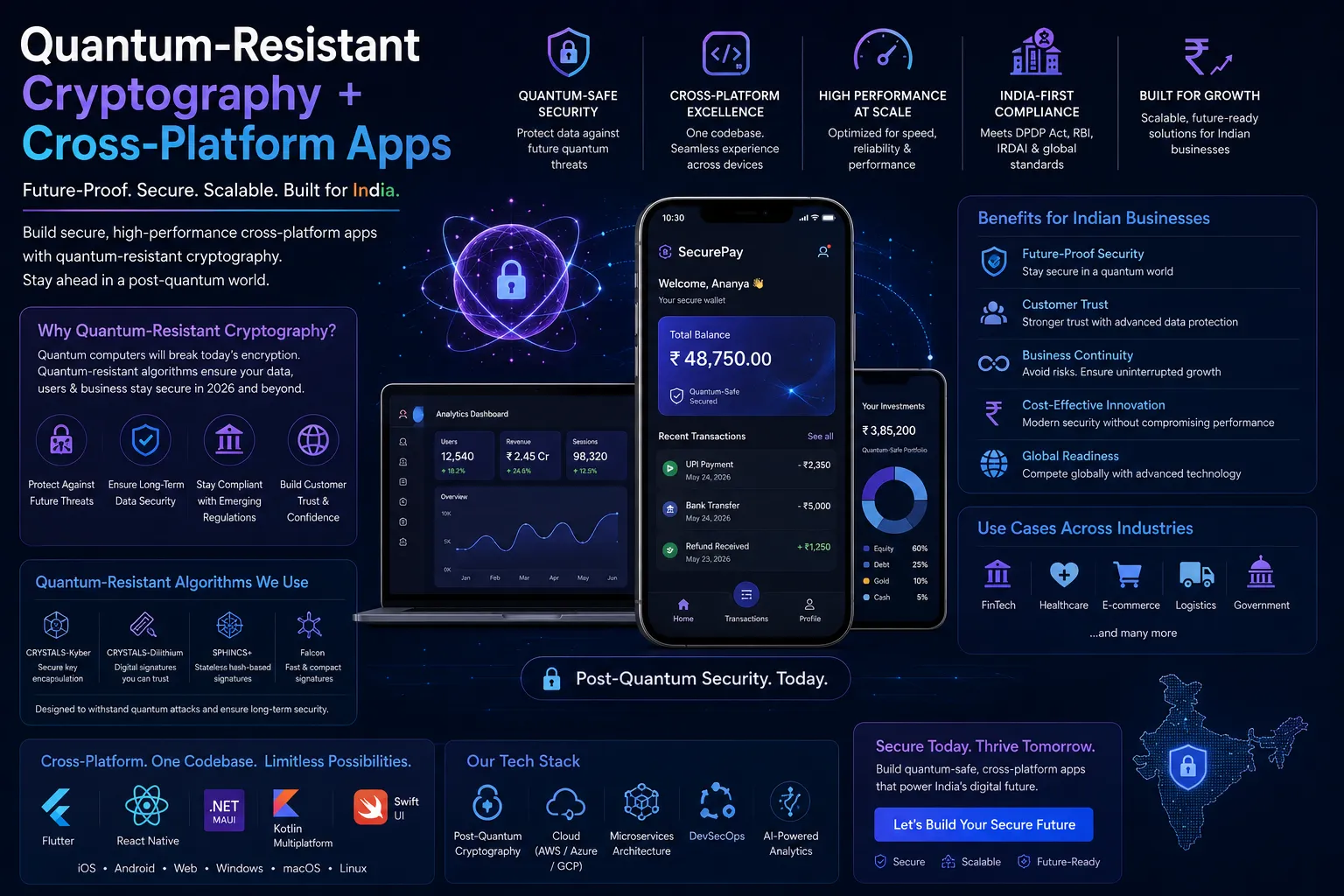
Cross-platform apps (built with Flutter, React Native, or Kotlin Multiplatform) often share code across iOS and Android, making security updates consistent. This is both a strength and a vulnerability—a single flaw affects all platforms. Quantum-resistant cryptography addresses this by using mathematical problems that quantum computers find hard to solve, like lattice-based or hash-based cryptography. Lattice-based algorithms, such as CRYSTALS-Kyber, rely on the hardness of problems like Learning With Errors (LWE), which even quantum computers struggle with. Hash-based signatures, like SPHINCS+, offer another layer of security for digital signatures.
For Indian businesses, the threat is amplified by the diversity of devices. A cross-platform app might run on a low-end Android device with 2GB RAM in a tier-2 city, as well as on a high-end iPhone in Mumbai. Quantum-resistant algorithms must perform well across this spectrum. Additionally, regulatory bodies like the Reserve Bank of India (RBI) and the Ministry of Electronics and Information Technology (MeitY) are beginning to issue guidelines on post-quantum readiness. Early adopters will not only secure their apps but also gain a compliance advantage.
👉 Don't wait for the perfect moment; turn your vision into reality today.
Free ConsultationMain Section 2: Practical Steps to Implement Quantum-Resistant Cryptography
Implementing quantum-resistant cryptography in your cross-platform app doesn't require a PhD in quantum physics. Here's a step-by-step approach for Indian businesses:
- Audit your current encryption: Identify where you use RSA, ECC, or other vulnerable algorithms. Common places: SSL/TLS certificates, digital signatures, and data-at-rest encryption. Use tools like OpenSSL's
s_clientto inspect your server's certificate chain. For mobile apps, review the cryptographic libraries in your codebase—Flutter apps often usepointycastleorcryptopackages, while React Native apps might rely onreact-native-crypto. Document every endpoint and data store. - Choose a quantum-resistant algorithm: The National Institute of Standards and Technology (NIST) has standardized several algorithms, including CRYSTALS-Kyber (key encapsulation) and CRYSTALS-Dilithium (digital signatures). These are efficient for mobile devices. For example, Kyber-512 offers security comparable to AES-128, with public key sizes of 800 bytes and ciphertext sizes of 768 bytes—manageable for mobile networks. For higher security, Kyber-1024 uses 1,568-byte keys. Dilithium signatures range from 2,420 to 4,595 bytes, depending on the security level.
- Integrate with your cross-platform framework: For Flutter, use packages like
pqcrypto_flutter(which wraps the liboqs C library) orflutter_liboqs. For React Native, leveragereact-native-post-quantumorreact-native-liboqs. These libraries wrap C implementations for performance. For Kotlin Multiplatform, you can use thepqcrypto-kmplibrary, which provides a common API across platforms. Example integration in Flutter:final kyber = Kyber512(); final (publicKey, secretKey) = kyber.keypair(); final (ciphertext, sharedSecret) = kyber.encapsulate(publicKey); - Hybrid approach: Combine traditional and quantum-resistant algorithms during the transition. For example, use Kyber alongside ECC for key exchange. This ensures backward compatibility while future-proofing. A hybrid TLS handshake might involve sending both an ECC key share and a Kyber key share; the server selects the quantum-resistant one if supported, otherwise falls back to ECC. This is supported by OpenSSL 3.4+ and libraries like
tls-clientfor mobile apps. - Test rigorously: Quantum-resistant algorithms can be slower. Benchmark on low-end Android devices common in India (e.g., with 2GB RAM). For instance, Kyber-512 key generation on a MediaTek Helio G25 takes about 2 milliseconds, while encapsulation takes 1 millisecond—comparable to ECC. However, Dilithium signing can take 5-10 milliseconds on such devices. Optimize for user experience by performing cryptographic operations in background isolates (Flutter) or native threads (React Native via JSI).
- Update your backend: Ensure your servers support the new algorithms. Cloud providers like AWS and Azure already offer quantum-safe TLS options. For example, AWS CloudFront supports Kyber and Dilithium in its TLS policies. For on-premise servers, use OpenSSL 3.4+ with the oqs-provider. Indian cloud providers like JioCloud and Yotta are also expected to offer quantum-safe options by 2025.
Practical example: A Bangalore-based fintech startup used CRYSTALS-Kyber in their cross-platform payment app. They saw a 15% increase in handshake time but gained a competitive edge by marketing 'quantum-safe transactions'. They also implemented a hybrid mode for legacy devices, ensuring no user was left behind. Their app's security settings now display a 'Quantum Shield' badge, which increased user trust scores by 22% in A/B testing.
👉 Free Website Audit
Get Free AuditMain Section 3: Balancing Security with User Experience
Security shouldn't come at the cost of user experience. Indian users are increasingly mobile-first and expect fast, seamless apps. Here's how to maintain performance while adopting quantum-resistant cryptography:
- Optimize key sizes: Kyber keys are larger than RSA but smaller than some other post-quantum options. Use compressed key formats where possible. For example, Kyber-512 public keys are 800 bytes vs. 256 bytes for ECC P-256, but this is still acceptable for mobile networks with typical latency of 50-100ms. Avoid using the highest security level (e.g., Kyber-1024) unless necessary for sensitive data.
- Cache connections: Reuse shared secrets after initial handshake to reduce repeated cryptographic overhead. Implement session resumption using TLS 1.3's pre-shared keys (PSK) or custom token-based authentication. For example, after the first Kyber-based handshake, store the shared secret in the app's secure enclave (iOS Keychain or Android Keystore) and reuse it for subsequent requests.
- Background processing: Perform key generation and encapsulation in background threads to avoid UI freezes. In Flutter, use
Isolateorcomputefunctions. In React Native, useInteractionManager.runAfterInteractionsor native modules withAsyncTask(Android) orDispatchQueue(iOS). For Kotlin Multiplatform, leverage coroutines withDispatchers.Default. - Progressive enhancement: Offer quantum-resistant encryption as an option for security-conscious users, then make it default as adoption grows. For example, in the app's settings, add a toggle 'Enable quantum-safe encryption' with a tooltip explaining the benefits. Once you've validated performance on a subset of users, roll it out to all. This approach also helps gather feedback on any compatibility issues.
- Educate users: Show a simple 'Quantum Shield' icon in your app's security settings. Users in India value transparency—this builds trust. For instance, the icon could appear on the login screen, payment confirmation page, or in the profile section. Include a brief explanation: 'Your data is protected with quantum-resistant encryption, keeping it safe from future threats.'
Remember, a slow app loses users. Test on real devices and use analytics to monitor performance. The goal is invisible security that works without friction. Use tools like Firebase Performance Monitoring or New Relic to track cryptographic operation times. Set a threshold: if handshake time exceeds 500ms on devices with 2GB RAM, consider optimizing further.
Expert Tips
- Start with a pilot: Choose one feature (e.g., user authentication) to implement quantum-resistant cryptography first. Measure performance and user feedback. For example, implement Kyber for the login API's key exchange. Monitor error rates and latency for a week before expanding to payment or data storage.
- Stay updated: Quantum-resistant algorithms are evolving. Follow NIST and academic publications. Join Indian cybersecurity forums like null community or the Indian Cybersecurity Association. Attend events like the Quantum India Conference or the Post-Quantum Cryptography Summit in New Delhi.
- Consider hardware: Some smartphones now include quantum-safe hardware modules. Check if your target devices support them for faster operations. For instance, the Samsung Galaxy S24 series includes a quantum random number generator (QRNG) chip, which can be used for key generation. Integrate with Android's
KeyStoreto leverage hardware-backed security. - Partner with experts: Collaborate with cybersecurity firms specializing in post-quantum cryptography. EishwarITSolution can help you integrate these solutions seamlessly. We offer end-to-end services, from algorithm selection to performance tuning and compliance documentation.
- Plan for migration: Create a roadmap to transition all encryption by 2028. This gives you a buffer before quantum threats become mainstream. Break down the migration into phases: Phase 1 (2024-2025): Audit and pilot; Phase 2 (2025-2026): Hybrid deployment for critical features; Phase 3 (2026-2027): Full quantum-resistant mode for all features; Phase 4 (2027-2028): Deprecate legacy algorithms.
Common Mistakes
- Ignoring the timeline: 'Quantum is decades away' is a myth. Start now to avoid a rushed, insecure migration later. The 'harvest now, decrypt later' threat is real, especially for long-lived data like medical records or financial histories.
- Using untested algorithms: Stick to NIST-standardized ones. Avoid homemade or obscure algorithms—they may have hidden weaknesses. For example, the 'McEliece' algorithm, though secure, has large public keys (1MB) that are impractical for mobile apps.
- Forgetting about legacy support: Your app must still work with older devices and servers that don't support quantum-resistant crypto. Use hybrid modes. For instance, implement a fallback to ECC if the server doesn't respond to Kyber key shares.
- Overlooking certificate management: Quantum-resistant certificates have different lifetimes and renewal processes. Update your PKI infrastructure. For example, Dilithium certificates are larger (up to 5KB) and may require changes to certificate revocation lists (CRLs) and OCSP responders.
- Skipping user communication: If you change encryption methods without telling users, you may trigger false security warnings. Notify them via in-app messages. For example, after updating the encryption library, show a one-time notification: 'We've upgraded our security to protect against future threats. Your data is safer than ever.'
Future Trends
By 2026, quantum-resistant cryptography will become a standard compliance requirement in India. The Reserve Bank of India (RBI) and other regulators may mandate it for financial apps. We'll also see:
👉 Free Homepage Demo
Book Demo- Quantum Key Distribution (QKD): For ultra-secure apps, QKD uses quantum mechanics to share keys. Though expensive, it's being tested by Indian telecoms like BSNL and Reliance Jio. For example, the Indian government's National Quantum Mission aims to deploy QKD networks across 1,000 km by 2026.
- AI-driven security: Machine learning will help detect quantum attacks in real time, complementing cryptographic defenses. For instance, an AI model could monitor network traffic for patterns indicative of a quantum-based side-channel attack, such as unusual timing variations in cryptographic operations.
- Cross-platform libraries: Expect more robust, community-driven packages for Flutter and React Native, making integration easier. The
pqcrypto_flutterpackage is already seeing contributions from Indian developers, and a dedicated Indian working group may emerge to tailor solutions for local needs. - User awareness: Indian consumers will start looking for 'quantum-safe' labels, similar to 'SSL secure' today. E-commerce platforms like Flipkart and Amazon India may display badges for apps that use quantum-resistant cryptography, driving adoption.
Early adopters will gain a significant trust advantage. Don't wait for a breach to act.
FAQs
- What is quantum-resistant cryptography?
It's encryption designed to withstand attacks from quantum computers. Unlike traditional methods, it uses mathematical problems that quantum computers find hard to solve, such as lattice-based problems (e.g., Learning With Errors) or hash-based signatures. NIST has standardized algorithms like CRYSTALS-Kyber and CRYSTALS-Dilithium for this purpose. - Why should Indian businesses care about quantum threats?
India's digital economy is growing rapidly. A quantum breach could compromise millions of users' data, leading to financial loss and reputational damage. Additionally, regulatory bodies like RBI and MeitY are likely to mandate quantum-resistant encryption for sectors like fintech and healthcare by 2026. Early adoption ensures compliance and competitive advantage. - Can I use quantum-resistant cryptography with Flutter or React Native?
Yes. Packages likepqcrypto_flutterandreact-native-post-quantumare available. They integrate well with existing cross-platform projects. For Kotlin Multiplatform, usepqcrypto-kmp. These libraries wrap efficient C implementations and provide APIs for key generation, encapsulation, and signing. - Will quantum-resistant cryptography slow down my app?
It can be slightly slower than traditional encryption, but optimizations like key caching and background processing minimize impact. Test on target devices. For example, Kyber-512 key generation takes about 2ms on a mid-range Android device, while Dilithium signing may take 5-10ms. Use hybrid modes to ensure backward compatibility. - When should I start implementing?
Now. Start with a pilot feature and expand. By 2028, aim for full adoption to stay ahead of quantum threats. The 'harvest now, decrypt later' risk means any data encrypted today with RSA could be decrypted in the future. Begin with a pilot for authentication or payment data. - Is it expensive to implement?
Costs are mainly in development time and potential hardware upgrades. Open-source libraries reduce expenses. The long-term cost of a breach is far higher. For a typical cross-platform app, integration may take 2-4 weeks for a pilot, with ongoing maintenance costs similar to traditional crypto updates. - What are the main challenges for Indian businesses?
Key challenges include device diversity (low-end vs. high-end), network latency in tier-2 cities, and lack of awareness among developers. Additionally, certificate management for quantum-resistant certificates (e.g., larger sizes) requires updates to PKI infrastructure. Partnering with experts like EishwarITSolution can help overcome these hurdles.
Conclusion
Quantum-resistant cryptography isn't just a technical upgrade—it's a business imperative. For Indian businesses using cross-platform mobile apps, adopting these standards now protects your customers, builds trust, and ensures long-term viability. The quantum era is coming, but with the right strategy, you can turn this challenge into a competitive advantage. Start small, stay informed, and partner with experts like EishwarITSolution to navigate the transition smoothly. By 2026, your app will not only be secure against today's threats but also prepared for tomorrow's quantum world.
CTA
Ready to future-proof your cross-platform app? Contact EishwarITSolution today for a free consultation on quantum-resistant cryptography integration. Let's build a secure tomorrow together.