
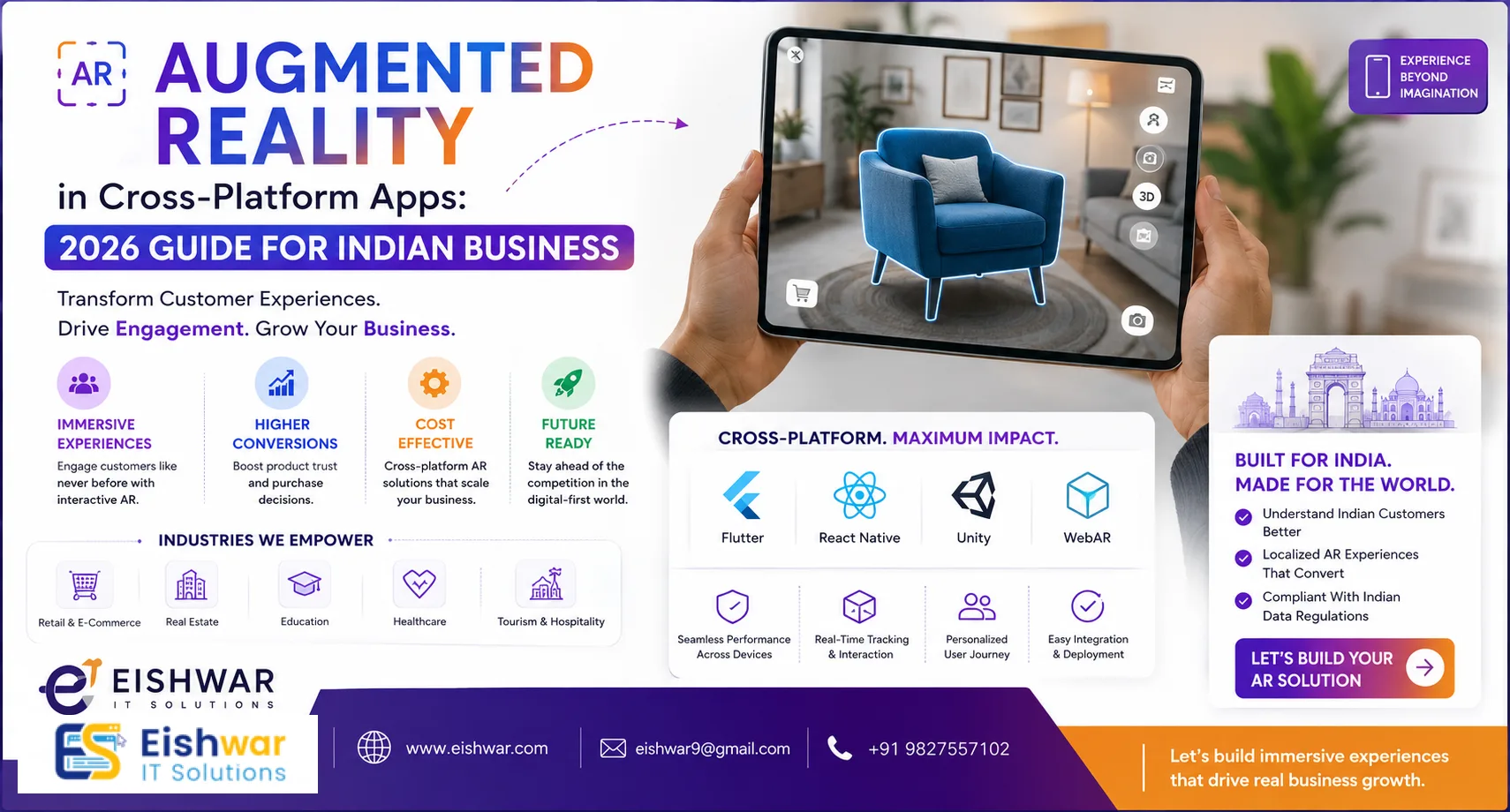
Augmented Reality in Cross-Platform Apps: 2026 Guide for Indian Busine
Published on: 06 Jul 2026
Augmented Reality in Cross-Platform Apps: 2026 Guide for Indian Businesses
Introduction
Augmented reality (AR) is no longer a futuristic concept—it's a powerful tool reshaping how Indian businesses engage customers. By 2026, cross-platform apps with AR capabilities will be mainstream, offering immersive experiences across Android and iOS without doubling development costs. Whether you run a retail store, a real estate firm, or an educational platform, integrating AR into your cross-platform app can boost conversions, brand loyalty, and user retention.
Learn more about our Website services
In this guide, we'll explore why AR matters for cross-platform apps in India, practical implementation strategies, expert tips, common pitfalls, and future trends. By the end, you'll have a clear roadmap to leverage AR for your business growth.
Why Augmented Reality in Cross-Platform Apps Matters in 2026
India's smartphone penetration crossed 800 million users in 2025, and with 5G coverage expanding rapidly, AR experiences are more accessible than ever. Cross-platform frameworks like Flutter, React Native, and Kotlin Multiplatform now offer robust AR plugins, making it easier to build once and deploy everywhere.
For businesses, AR in cross-platform apps means:
- Enhanced user engagement: Interactive 3D models, virtual try-ons, and gamified experiences keep users hooked. For example, a beauty app that lets users try different lipstick shades in real-time can increase session duration by 40%.
- Higher conversion rates: IKEA's AR app saw a 30% increase in sales. Indian brands like Myntra and Lenskart already use AR for virtual try-ons, reporting conversion lifts of 20-35%.
- Cost efficiency: One codebase for both platforms reduces development and maintenance costs by up to 40%. A Bangalore-based startup saved ₹12 lakhs by choosing Flutter over separate native apps.
- Competitive edge: Early adopters in India stand out in crowded markets. A small furniture store in Mumbai built a cross-platform app with AR that lets customers visualize sofas in their living rooms—boosting confidence and reducing returns by 25%.
Moreover, with 5G enabling low-latency experiences, AR is no longer a gimmick but a practical tool. For instance, a Pune-based real estate developer used AR in their cross-platform app to offer virtual property tours, cutting down physical visits by 60% and closing deals 30% faster.
Main Section 1: Key AR Technologies for Cross-Platform Apps
To integrate AR effectively, you need the right tools. Here are the leading technologies for cross-platform AR development in 2026:
1. ARKit and ARCore Integration
Apple's ARKit and Google's ARCore are the foundational SDKs for AR on mobile. Cross-platform frameworks now provide unified APIs. For instance, Flutter's ar_flutter_plugin lets you access both ARKit and ARCore with a single codebase. This means you can detect planes, track images, and place 3D objects consistently across devices. A practical tip: use ARCore's Augmented Images to trigger AR experiences when a user scans a product label—ideal for packaging-based marketing.
2. WebAR for Progressive Web Apps (PWAs)
WebAR runs directly in browsers, eliminating app downloads. Tools like 8th Wall and Zappar enable AR experiences in PWAs. This is ideal for Indian businesses targeting users with limited storage. For example, a small restaurant chain in Delhi used WebAR to let customers view 3D menu items by scanning a QR code on the table—no app required. The campaign saw a 15% increase in order value.
👉 Don't wait for the perfect moment; turn your vision into reality today.
Free Consultation3. Markerless AR and Spatial Mapping
Modern AR apps detect surfaces without markers. Use ARCore's Cloud Anchors for shared experiences—great for multiplayer games or collaborative design. A Chennai-based education startup used markerless AR to let students place 3D models of the solar system on their desks, enhancing learning retention by 50%.
4. AI-Powered AR
Combine AR with machine learning for object recognition and real-time translations. For example, a restaurant app could overlay menu translations in AR, or a retail app could recognize a product and show reviews. TensorFlow Lite and ML Kit integrate seamlessly with cross-platform frameworks for this purpose.
Actionable tip: Start with a simple AR feature like a virtual try-on for one product category. Test with a small user group before scaling. For instance, a Jaipur-based jewelry brand began with AR ring try-on and expanded to necklaces after positive feedback.
Main Section 2: Step-by-Step Integration of AR in Cross-Platform Apps
Here's a practical roadmap for Indian businesses:
Step 1: Define Your AR Use Case
Identify a specific problem AR solves. Examples:
- Retail: Virtual try-on for clothes, accessories, or makeup. For example, a Kolkata-based sari store used AR to let customers see how different drapes look.
- Real Estate: 3D property walkthroughs. A Hyderabad developer allowed buyers to virtually walk through apartments, reducing site visits by 40%.
- Education: Interactive 3D models of historical artifacts. A Mumbai museum app lets users point their phone at exhibits to see animations.
- Automotive: Visualize car models in your driveway. A Delhi car dealer used AR to show custom paint colors on a virtual car.
Step 2: Choose Your Cross-Platform Framework
- Flutter: Best for custom UI and AR plugins like
arcore_flutter_plugin. Ideal for startups. Example: A Bangalore food delivery app used Flutter to create an AR feature showing portion sizes. - React Native: Use
react-native-vision-camerawith AR libraries. Great for teams with JavaScript expertise. A Pune fitness app used it to overlay workout instructions on the user's surroundings. - Kotlin Multiplatform: For performance-critical apps with native AR integration. A Chennai gaming studio used it for a multiplayer AR game.
Step 3: Design for Performance
AR is resource-intensive. Optimize 3D models (use glTF format), reduce polygon counts, and implement LOD (level of detail). Test on mid-range devices common in India (e.g., Xiaomi Redmi Note series, Realme 9). For instance, a Delhi-based startup reduced model size from 50MB to 5MB by using compressed textures, ensuring smooth performance on devices with 4GB RAM.
Step 4: Develop and Test
Use emulators for initial testing, but always test on real devices. Leverage cloud-based device labs like BrowserStack for cross-device testing. Create a checklist: test in different lighting conditions, with and without internet, and on low-end devices. A Mumbai team found that their AR app crashed on devices with 3GB RAM—they fixed it by reducing memory usage.
Step 5: Launch and Iterate
Gather user feedback via in-app surveys. Track metrics like time spent in AR, conversion lift, and crash rates. For example, a Delhi-based jewelry brand used Flutter to build an AR ring try-on feature. Within three months, returns dropped by 25% and sales increased by 18%. They iterated by adding a 'share on WhatsApp' feature, which boosted social sharing by 30%.
👉 Free Website Audit
Get Free AuditMain Section 3: Business Benefits of AR in Cross-Platform Apps for India
Let's dive deeper into the ROI:
1. Increased Customer Trust
AR reduces uncertainty. A study found that 71% of shoppers would buy more if they could see products in AR. For Indian e-commerce, this is a game-changer. A Jaipur-based handicraft store saw a 40% increase in conversion after adding AR to show product dimensions.
2. Lower Return Rates
Virtual try-ons help customers make informed decisions. Flipkart reported a 20% reduction in returns for AR-enabled products. A Chennai clothing brand saw returns drop from 15% to 8% after implementing AR try-on.
3. Better Brand Recall
Interactive experiences are memorable. Users spend 2x longer on AR apps compared to non-AR ones. A Bangalore travel agency used AR to show 360-degree views of hotel rooms, leading to a 50% higher booking rate.
4. Data Insights
AR apps collect valuable data on user preferences—which products they try, how long they engage, etc. Use this to personalize marketing. For example, a Delhi beauty brand used AR data to send targeted offers for products users tried virtually.
5. Competitive Differentiation
In a crowded market, AR sets you apart. For instance, a small travel agency could offer AR previews of hotel rooms, differentiating from larger competitors. A Pune-based furniture store gained 10,000 new users in a month by offering AR room planning.
Expert Tips
- Start small, scale fast. Launch an MVP with one AR feature, then expand based on user feedback. For example, a Mumbai startup started with AR for one product category and added more based on demand.
- Focus on mid-range devices. Most Indian users have phones with 4-6GB RAM. Optimize accordingly. Use tools like Unity's Profiler to identify bottlenecks.
- Leverage cloud AR. Offload heavy processing to the cloud to reduce battery drain. Services like AWS Sumerian or Google Cloud AR can help.
- Use analytics. Track which AR features drive conversions and double down on them. Heatmaps can show where users focus in AR.
- Collaborate with AR specialists. Partner with agencies or hire freelancers experienced in cross-platform AR. Platforms like Upwork have many Indian AR developers.
- Test offline functionality. Many users have intermittent connectivity. Cache essential AR assets. For instance, a Delhi education app allowed students to download 3D models for offline use.
- Incorporate user onboarding. A short tutorial can reduce abandonment. Use tooltips or a demo video to guide first-time users.
Common Mistakes
- Overcomplicating the first version. Avoid building a full AR experience. Start with one feature. A Hyderabad startup wasted 6 months building a complex AR app that users found confusing.
- Ignoring performance. Laggy AR frustrates users. Always test on low-end devices. A Bangalore team learned this when their app crashed on Xiaomi Redmi Note 8.
- Skipping user education. Add a simple tutorial or onboarding flow for AR features. A Chennai app saw a 50% drop in usage because users didn't know how to activate AR.
- Not optimizing for lighting. AR works best in good lighting. Warn users if conditions are poor. A Delhi app added a brightness indicator to improve experience.
- Forgetting privacy. AR apps often use camera and location. Be transparent about data usage. Comply with India's Digital Personal Data Protection Act. A Pune startup faced backlash for not disclosing camera use.
- Neglecting accessibility. Ensure AR features are usable by people with disabilities. Add voice commands or alternative text for 3D objects.
Future Trends
- AR Glasses Integration: By 2026, lightweight AR glasses will enter the Indian market. Cross-platform apps will need to support them. For example, a Mumbai logistics company is testing AR glasses for warehouse navigation.
- Spatial Computing: Apps will blend digital objects with real environments seamlessly, powered by 5G and edge computing. A Bangalore gaming studio is developing a multiplayer AR game using edge servers.
- AR Commerce: Social commerce platforms like Instagram and WhatsApp will integrate AR shopping directly. A Delhi fashion brand plans to launch AR try-on within WhatsApp.
- Voice + AR: Users will interact with AR objects using voice commands (e.g., "Show me this sofa in blue"). A Chennai startup is building a voice-controlled AR interior design app.
- AR Analytics: Heatmaps of where users look in AR will provide deeper insights. A Pune retail chain uses AR analytics to optimize product placement.
- Blockchain + AR: NFTs and AR will merge for virtual collectibles. An Indian art platform is experimenting with AR art exhibitions.
FAQs
1. What is the cost of adding AR to a cross-platform app in India?
2. Which cross-platform framework is best for AR?
3. Do I need 5G for AR apps?
4. How long does it take to build an AR cross-platform app?
5. What are the best AR use cases for small businesses in India?
6. Is AR safe for user privacy?
7. Can AR work on low-end smartphones?
8. How do I measure ROI of AR in my app?
Conclusion
Augmented reality is set to revolutionize cross-platform apps for Indian businesses in 2026. By starting small, choosing the right framework, and focusing on user experience, you can harness AR to drive engagement, conversions, and loyalty. The future is immersive—don't get left behind. With the right strategy, AR can transform your business, whether you're a startup or an established enterprise. Embrace the opportunity today.
👉 Free Homepage Demo
Book DemoCTA
Ready to integrate AR into your cross-platform app? Contact EishwarITSolution today for a free consultation. Our experts will help you build a custom AR strategy that fits your budget and goals. Let's create something amazing together!