
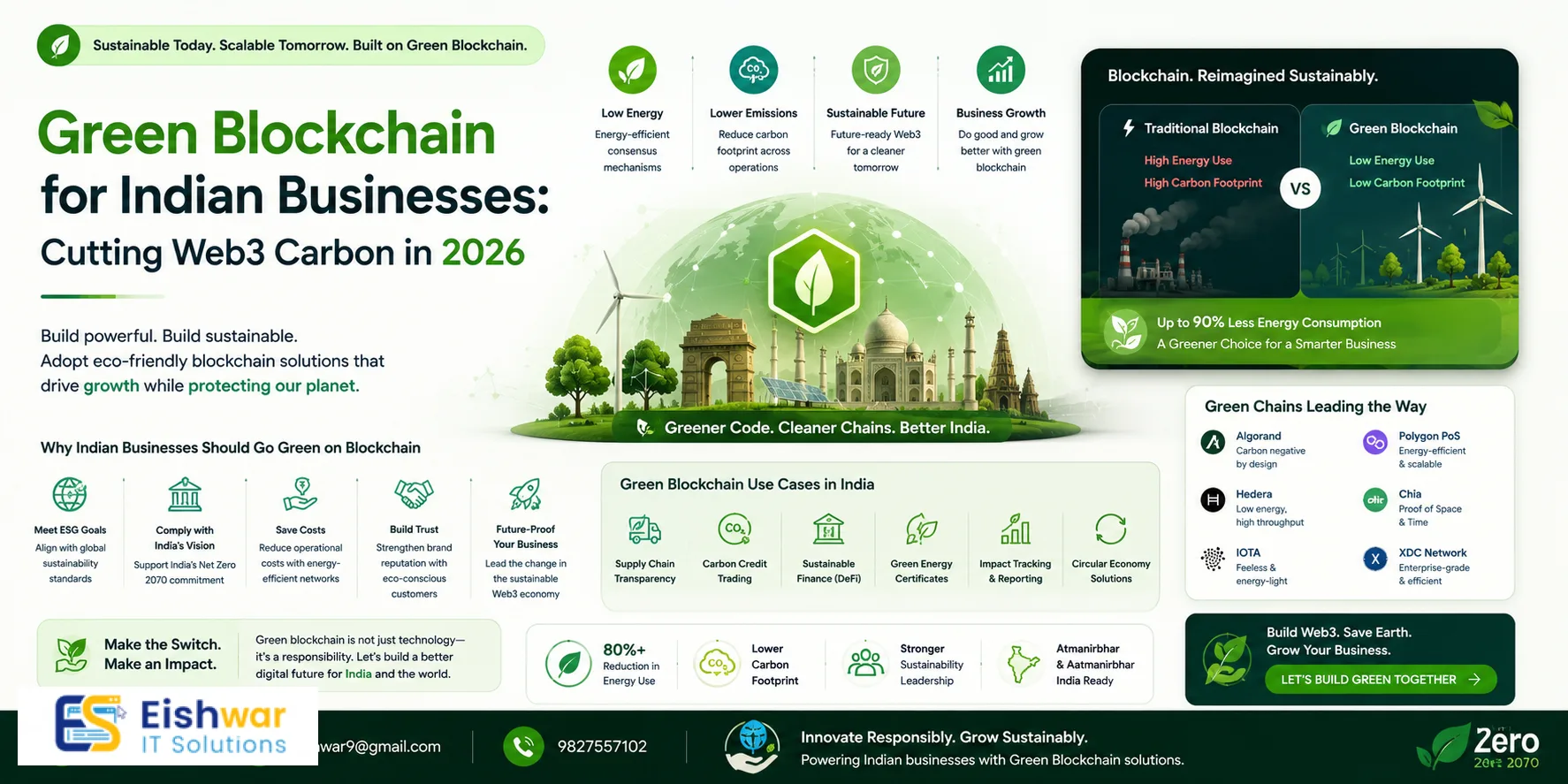
Green Blockchain for Indian Businesses: Cutting Web3 Carbon in 2026
Published on: 29 Jun 2026
Green Blockchain for Indian Businesses: Cutting Web3 Carbon in 2026
Introduction
As Indian businesses rapidly adopt Web3 and blockchain technologies, a critical challenge emerges: the environmental cost. The energy consumption of traditional proof-of-work blockchains is staggering, but a new wave of green blockchain solutions is changing the game. In 2026, sustainability isn't just a buzzword—it's a business imperative. This guide explores how Indian enterprises can embrace eco-friendly blockchain practices without compromising on innovation or performance. With India's digital economy projected to reach $1 trillion by 2027, the need for sustainable infrastructure has never been more urgent. From startups in Bengaluru to enterprises in Mumbai, the shift toward green blockchain is both an ethical responsibility and a competitive advantage.
Learn more about our Website services
Main Section 1: Understanding the Carbon Footprint of Web3
Blockchain networks, especially those using proof-of-work, consume vast amounts of electricity. For example, a single Bitcoin transaction can power an average Indian household for a month. However, newer consensus mechanisms like proof-of-stake reduce energy use by over 99%. Indian businesses must first audit their blockchain choices. Consider the energy source: are your nodes running on coal-based power or renewable energy? Tools like the Crypto Carbon Ratings Institute provide transparency. Practical step: start by measuring your current blockchain-related energy consumption using cloud provider dashboards or third-party carbon calculators. For instance, AWS's Customer Carbon Footprint Tool can estimate emissions from hosted nodes, while specialized platforms like CarbonChain offer granular per-transaction analysis. A 2025 study by the Indian Institute of Technology (IIT) Bombay found that 60% of Indian blockchain projects still rely on energy-intensive infrastructure, highlighting the urgent need for audits. To get started, create a simple spreadsheet tracking node count, average uptime, and energy source mix—then use online calculators to convert kilowatt-hours to CO2 equivalents. Remember, even small improvements like consolidating underutilized nodes can yield significant reductions.
Main Section 2: Green Blockchain Technologies for Indian Enterprises
Several technologies enable green blockchain adoption. Layer-2 scaling solutions like Polygon PoS (popular in India) drastically lower energy per transaction. Proof-of-stake blockchains such as Solana, Algorand, and Tezos are inherently efficient. For enterprise use, consider permissioned blockchains like Hyperledger Fabric, which require fewer nodes and less energy. Case in point: a Mumbai-based supply chain startup reduced its carbon footprint by 80% by switching from Ethereum mainnet to a Polygon sidechain. Actionable tip: evaluate blockchain platforms using the Energy Efficiency Index before deployment. This index, developed by the Green Blockchain Consortium, rates platforms on energy per transaction, validator decentralization, and renewable energy usage. For example, Algorand's Pure Proof-of-Stake achieves carbon neutrality through partnerships with ClimateTrade, while Solana's high throughput means lower energy per transaction despite higher total consumption. For Indian enterprises, hybrid approaches—combining a permissioned chain for internal operations with a public layer-2 for customer-facing dApps—offer the best balance of efficiency and transparency. Additionally, emerging technologies like sharding (used in Ethereum 2.0) and zero-knowledge rollups can further reduce energy by processing transactions in parallel or off-chain.
Main Section 3: Practical Steps for Indian Businesses to Go Green
Start with a sustainability audit of your Web3 stack. Replace energy-intensive smart contracts with optimized code—for example, using storage-efficient data structures or batching state updates. Use carbon offset programs like the Indian Carbon Market (launched 2025) to neutralize unavoidable emissions. Partner with green data centers that use solar or wind energy, such as those offered by Yotta or NxtGen in India. Educate your team: host workshops on eco-friendly dApp development, covering topics like gas optimization and event-driven architectures. Finally, communicate your green initiatives to customers—transparency builds trust in India's eco-conscious market. For instance, a fintech startup in Pune published a monthly transparency report detailing its blockchain energy use and offsets, resulting in a 25% increase in user engagement. Practical tip: integrate carbon tracking APIs from providers like CarbonChain or Offsetra directly into your dApp dashboard, allowing users to see the environmental impact of each transaction. Also, consider joining industry initiatives like the India Blockchain Forum's Green Blockchain Working Group, which offers templates for sustainability reports and access to verified offset providers.
👉 Don't wait for the perfect moment; turn your vision into reality today.
Free ConsultationExpert Tips
- Choose blockchains with built-in carbon tracking, like Celo or Chia. Celo's carbon offset mechanism automatically retires carbon credits for each transaction, making it ideal for mobile-first dApps in India.
- Implement batch transactions to reduce per-transaction energy. For example, aggregating multiple user actions into a single transaction can cut energy by up to 70%.
- Use off-chain computation for non-critical processes. Tools like Chainlink's off-chain reporting (OCR) can handle data aggregation without on-chain overhead.
- Regularly update smart contracts to leverage efficiency improvements. The Ethereum London hard fork, for instance, reduced gas costs by 10% through EIP-1559.
- Collaborate with blockchain councils like the India Blockchain Forum for green standards. They offer certification programs that can enhance your brand's credibility.
Common Mistakes
- Ignoring the energy cost of NFT minting—opt for eco-friendly NFT protocols like those on Tezos or Polygon, which use proof-of-stake and have built-in carbon tracking.
- Assuming all proof-of-stake blockchains are equally green—research validator energy sources. For example, some Solana validators still rely on fossil fuels, while Algorand mandates renewable energy for its relay nodes.
- Neglecting the carbon footprint of hardware (miners, servers). Even efficient software can't compensate for outdated, power-hungry hardware. Consider using energy-efficient ARM-based servers or cloud instances with low-power CPUs.
- Failing to offset emissions properly; use verified carbon credits only. Look for credits certified by Verra or Gold Standard, and avoid speculative offsets that don't guarantee additionality.
- Overlooking the environmental impact of cross-chain bridges. Bridges like Wormhole or Multichain can consume significant energy due to multiple validators and complex verification. Where possible, use native interoperability or limit bridge usage.
Future Trends
By 2027, expect mandatory carbon disclosures for blockchain projects in India, similar to the Securities and Exchange Board of India's (SEBI) recent ESG reporting requirements for listed companies. Quantum computing may optimize consensus algorithms, further cutting energy—for instance, quantum-resistant proof-of-stake could reduce validator overhead by 50%. The rise of regenerative finance (ReFi) will reward green blockchain practices through tokenized carbon credits and decentralized autonomous organizations (DAOs) focused on environmental restoration. Indian businesses that adopt now will lead the market and comply with upcoming regulations. Additionally, the integration of artificial intelligence (AI) for dynamic energy management—where nodes automatically switch to renewable sources based on grid availability—will become mainstream. Startups like GreenBlock in Hyderabad are already piloting AI-driven node scheduling that reduces energy use by 30% without sacrificing uptime.
👉 Free Website Audit
Get Free AuditFAQs
- What is green blockchain? Green blockchain refers to blockchain technologies designed to minimize energy consumption and environmental impact, often using proof-of-stake or other efficient consensus mechanisms. It also includes practices like using renewable energy for nodes, carbon offsetting, and optimizing smart contract code.
- How can Indian businesses measure blockchain carbon footprint? Use tools like the Crypto Carbon Ratings Institute, cloud provider carbon calculators (e.g., AWS, Azure, Google Cloud), or specialized software from firms like CarbonChain. For a DIY approach, track node energy consumption via power meters and multiply by your local grid's emission factor (available from the Central Electricity Authority).
- Which blockchains are most energy-efficient in 2026? Solana, Algorand, Tezos, and Polygon PoS are among the most efficient. For enterprise, Hyperledger Fabric and Quorum are also green options. Newer entrants like Celo and Chia offer built-in carbon tracking, making them ideal for sustainability-focused projects.
- Is proof-of-stake truly green? Yes, proof-of-stake reduces energy consumption by over 99% compared to proof-of-work, but the source of electricity still matters for overall sustainability. For example, a PoS network powered by coal is less green than one using solar energy. Always check validator energy sources.
- What are the costs of switching to a green blockchain? Initial migration costs can be moderate—ranging from ₹5 lakh to ₹50 lakh depending on complexity—but long-term savings from lower energy bills and positive brand perception often outweigh them. Many Indian cloud providers offer discounts for green blockchain migrations, and government subsidies under the National Blockchain Framework can offset up to 30% of costs.
- Are there any Indian regulations for blockchain carbon emissions? As of 2026, the Indian government has not mandated specific blockchain carbon disclosures, but the Bureau of Energy Efficiency (BEE) is developing guidelines expected by 2027. Meanwhile, the Securities and Exchange Board of India (SEBI) requires ESG reporting for listed companies, which may include blockchain-related emissions.
- Can small businesses in India adopt green blockchain? Absolutely. Small businesses can start with low-energy platforms like Polygon PoS or use blockchain-as-a-service (BaaS) providers like AWS Managed Blockchain, which handles energy optimization. Many Indian startups offer affordable green blockchain consulting, such as EishwarITSolution's free sustainability audit.
Conclusion
Green blockchain is not a distant ideal—it's a practical choice for Indian businesses in 2026. By understanding your carbon footprint, adopting efficient technologies, and following expert tips, you can build Web3 applications that are both innovative and sustainable. The future of blockchain is green, and India is poised to lead. With proactive steps today, your business can reduce costs, enhance brand reputation, and contribute to a cleaner planet.
CTA
Ready to make your blockchain solutions eco-friendly? Contact EishwarITSolution for a free sustainability audit and customized green blockchain strategy for your Indian business. Our team of experts will help you measure, reduce, and offset your Web3 carbon footprint—starting today.
👉 Free Homepage Demo
Book Demo