AI and Blockchain Convergence for Trustworthy Web Apps in India
Published on: 13 Jun 2026
AI and Blockchain Convergence for Trustworthy Web Apps in India
Introduction
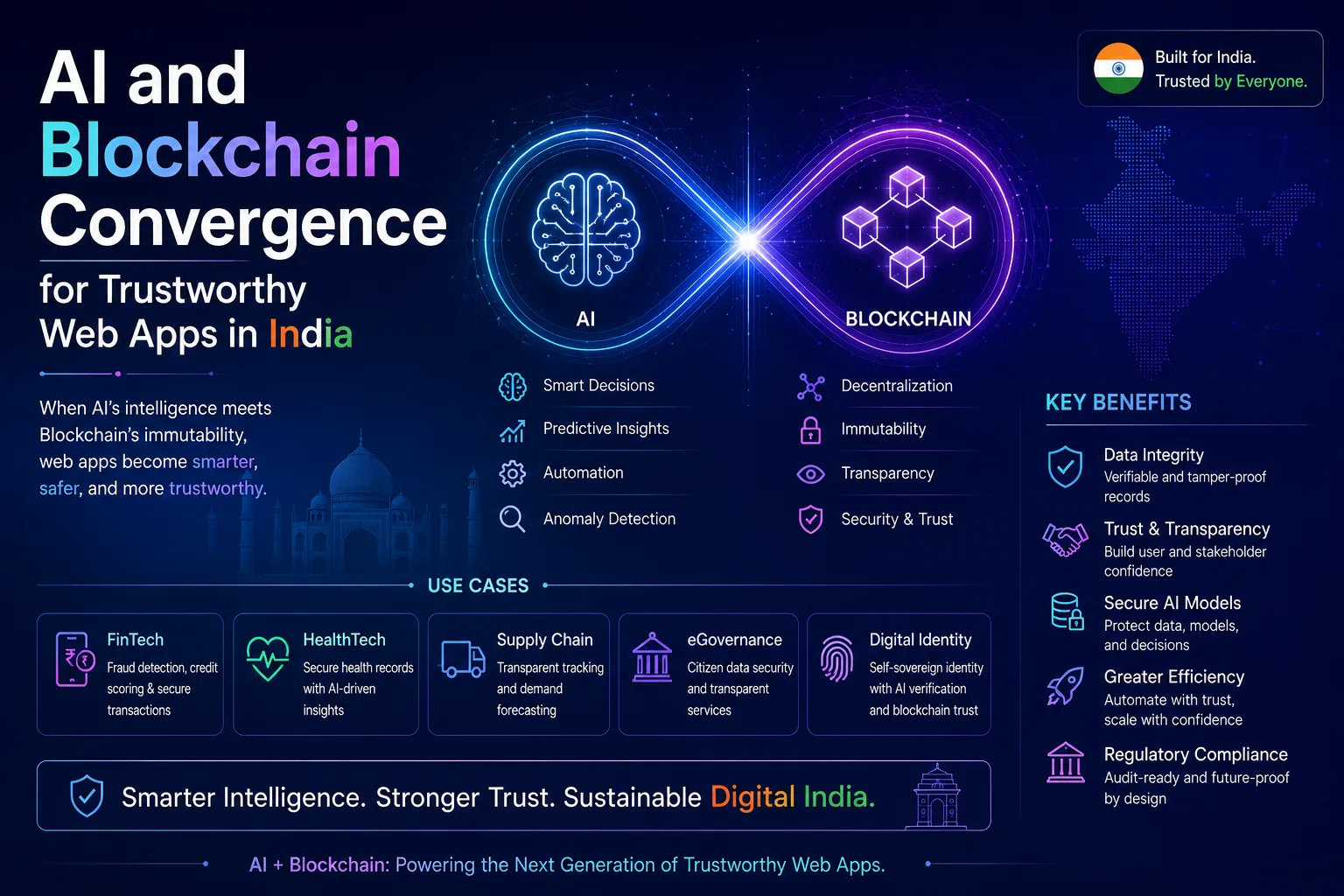
Indian businesses are rapidly digitizing, but trust remains a major hurdle. Customers worry about data breaches, manipulated reviews, and opaque algorithms. At the same time, businesses struggle with inefficient processes and siloed data. The convergence of Artificial Intelligence (AI) and blockchain offers a powerful solution. AI brings intelligence, automation, and personalization, while blockchain provides immutability, transparency, and decentralization. Together, they can power web applications that are not only smart but also verifiably trustworthy. This guide explores how Indian business owners, marketers, and professionals can leverage this synergy to build next-generation web solutions. For instance, consider a small e-commerce startup in Mumbai: by integrating AI for personalized product recommendations and blockchain for tamper-proof customer reviews, they can differentiate themselves in a crowded market and build long-term loyalty.
Learn more about our Website services
Main Section 1: Understanding the Synergy – Why AI and Blockchain Are Better Together
AI thrives on data – the more quality data it has, the better its predictions and decisions. However, data used by AI can be manipulated, biased, or sourced from untrusted origins. Blockchain solves this by providing a tamper-proof ledger where data provenance and integrity are guaranteed. Smart contracts can automate AI model updates, payments, and data sharing agreements. For example, a supply chain web app can use blockchain to record every step of a product’s journey, while AI analyzes that data to predict delays and optimize routes. The result: a transparent, efficient, and trustworthy system. In practice, a logistics company in Delhi could use IoT sensors to record temperature and location data on a blockchain, while an AI model predicts spoilage risks for perishable goods. This not only reduces waste but also provides verifiable proof to regulators and customers.
Key Benefits for Indian Businesses
- Enhanced Trust: Blockchain verifies data integrity, so AI decisions are based on unaltered information. For example, a fintech app using AI for loan approvals can record all input data on-chain, allowing auditors to verify that no manipulation occurred.
- Reduced Fraud: Immutable records prevent tampering with transaction histories or customer data. In the insurance sector, AI-powered claim processing combined with blockchain records can drastically reduce fraudulent claims.
- Improved Efficiency: Smart contracts automate routine tasks, while AI optimizes complex processes. A real-world example is a rental platform that uses smart contracts to release security deposits automatically when AI-verified condition reports are submitted.
- Data Monetization: Businesses can share data securely on blockchain, with AI analyzing it for insights, all while preserving privacy. A healthcare startup could allow patients to share anonymized data for AI research, with blockchain ensuring consent and compensation.
For instance, a lending web app could use AI to assess credit risk using blockchain-stored identity and transaction data, reducing defaults and increasing access to credit for small businesses. This is particularly impactful in rural India, where traditional credit scores are often unavailable.
Main Section 2: Building Trustworthy Web Applications – A Step-by-Step Approach
Creating a web app that combines AI and blockchain requires careful planning. Here’s a practical framework for Indian businesses:
1. Identify the Trust Gap
Pinpoint where your current web app lacks transparency or security. Is it customer reviews? Payment disputes? Data privacy? For example, an e-commerce platform may have fake reviews. Blockchain can record reviews immutably, and AI can detect patterns of fake review behavior. A practical tip: conduct user surveys to understand which trust issues matter most to your audience. For a travel booking site, users might worry about hidden fees; blockchain can record pricing histories, and AI can flag anomalies.
👉 Don't wait for the perfect moment; turn your vision into reality today.
Free Consultation2. Choose the Right Blockchain
Public blockchains like Ethereum or Polygon offer decentralization but may have higher costs. Private or consortium blockchains (Hyperledger, Quorum) offer better control and scalability for enterprise apps. Indian businesses often prefer permissioned blockchains for regulatory compliance. For example, a consortium of banks in India could use a private blockchain for shared KYC data, with AI automating verification. Consider factors like transaction speed, cost per transaction, and regulatory requirements. For high-volume apps, layer-2 solutions like Polygon can reduce costs significantly.
3. Integrate AI Models
Use AI for tasks like fraud detection, personalized recommendations, or predictive analytics. Ensure the AI model’s inputs and outputs are recorded on-chain for auditability. For example, a health insurance web app can use AI to process claims, with each step logged on blockchain. A practical approach: start with pre-trained models from platforms like TensorFlow or PyTorch, and fine-tune them on your specific data. Use blockchain to store model version hashes, so users can verify which model was used for their decision.
4. Implement Smart Contracts
Smart contracts automate agreements. For a logistics web app, a smart contract can release payment only when GPS and IoT data (recorded on blockchain) confirm delivery. AI can optimize contract terms based on historical data. For instance, a smart contract for a freelance platform could automatically release payment when AI-verified deliverables are submitted. Use tools like OpenZeppelin for secure contract templates, and test thoroughly on testnets like Goerli before mainnet deployment.
5. Test and Iterate
Deploy a minimum viable product (MVP) focusing on one trust-critical feature. Gather feedback from users in your target Indian market. For instance, a real estate web app could first use blockchain for property title verification and AI for property valuation. A practical example: a startup in Bangalore built an MVP that used blockchain to verify rental agreements and AI to recommend fair rent prices. User feedback helped them add features like automated dispute resolution.
Actionable Tip: Start small. Choose one pain point (e.g., verifying user identity) and build a simple blockchain-AI solution around it before scaling. Use no-code or low-code platforms like Bubble for the frontend, and integrate blockchain via APIs from providers like Alchemy.
Main Section 3: Real-World Use Cases for Indian Businesses
The AI-blockchain convergence is already transforming industries in India. Here are three practical examples:
Agri-Tech: Farm-to-Fork Traceability
A web app for organic farmers records crop data (pesticide use, harvest date) on blockchain. AI analyzes weather patterns and soil data to predict yield and optimize pricing. Consumers scan a QR code to see the entire journey, building trust in the brand. For example, a cooperative in Maharashtra uses this system to export organic spices, with blockchain records satisfying international certification requirements. The AI component helps farmers decide the best time to sell, increasing profits by up to 20%.
👉 Free Website Audit
Get Free AuditEdTech: Verifiable Credentials
Online courses issue blockchain-based certificates that cannot be forged. AI personalizes learning paths based on student performance. Employers can instantly verify credentials, reducing hiring fraud. A practical implementation: a platform like Coursera could issue certificates on the Polygon blockchain, with AI recommending courses based on skill gaps. In India, this is especially useful for vocational training programs, where trust in credentials is critical for job placement.
Healthcare: Patient Data Management
Patients control access to their medical records stored on blockchain. AI diagnostics use this data to provide personalized treatment plans. Consent and data usage are recorded transparently, complying with India’s digital health regulations. For instance, a hospital chain in Chennai uses a blockchain-based system where patients grant temporary access to specialists. AI analyzes aggregated anonymized data to identify disease outbreaks, while individual privacy is preserved.
These examples show how combining AI’s analytical power with blockchain’s trust layer creates web apps that are both intelligent and reliable. Each use case demonstrates a clear ROI: reduced fraud, improved efficiency, and enhanced customer loyalty.
Expert Tips
- Prioritize User Experience: Don’t let blockchain complexity hinder usability. Abstract away technical details – users should not need to understand wallets or gas fees. For example, use social login with wallet creation in the background, and subsidize gas fees through meta-transactions.
- Ensure Regulatory Compliance: India’s data protection laws (DPDP Act) and crypto regulations are evolving. Work with legal experts to stay compliant. For instance, ensure that personally identifiable information (PII) is stored off-chain and only hashed on-chain.
- Use Hybrid Architectures: Store large data off-chain (IPFS or cloud) and only hash references on blockchain to save costs and improve speed. For example, store product images on IPFS and record the hash on Ethereum.
- Invest in AI Explainability: When AI makes decisions recorded on blockchain, ensure the reasoning is understandable to auditors and users. Use techniques like LIME or SHAP to generate explanations that can be stored on-chain.
- Partner with Experienced Developers: Building AI-blockchain apps requires niche skills. Consider collaborating with firms like EishwarITSolution that specialize in emerging tech. They can help with architecture design, smart contract auditing, and AI model deployment.
Common Mistakes
- Over-engineering: Adding blockchain and AI to every feature unnecessarily. Focus on areas where trust or automation adds real value. For example, a simple blog doesn’t need blockchain; a platform for verified news does.
- Ignoring Scalability: Public blockchains can be slow. Use layer-2 solutions or sidechains for high-throughput applications. For instance, use Polygon for a gaming app with thousands of transactions per second.
- Neglecting Data Privacy: Public blockchains are transparent. Ensure sensitive data is encrypted or stored off-chain. Use zero-knowledge proofs for privacy-preserving verification.
- Underestimating Costs: Development and maintenance of AI models and blockchain nodes can be expensive. Plan a realistic budget. For example, cloud-based blockchain services like AWS Managed Blockchain can reduce upfront costs.
- Lack of User Education: Explain to users how the technology benefits them – e.g., “Your data is encrypted and only you control access.” Use simple analogies and visual aids in your app’s onboarding flow.
Future Trends
The convergence will deepen. Expect to see AI-powered DAOs (Decentralized Autonomous Organizations) that manage web apps autonomously, with AI optimizing treasury management and voting outcomes. Zero-knowledge proofs will enable privacy-preserving AI, where algorithms verify data without seeing it – crucial for healthcare and finance. Tokenized incentives will reward users for contributing data to train AI models, creating new economic models. For Indian businesses, the rise of government-backed blockchain initiatives (e.g., for land records, digital identity) will create new opportunities to build trustworthy web services on top of existing infrastructure. For instance, the Indian government’s National Blockchain Framework could be leveraged for supply chain transparency in agriculture. Additionally, the integration of AI with blockchain for decentralized finance (DeFi) will enable new lending and insurance products tailored to Indian SMEs.
👉 Free Homepage Demo
Book DemoFAQs
- Q: Is blockchain necessary for AI-based web apps? A: Not always. Blockchain is only needed when you require trust, transparency, or decentralized control. Many AI apps work fine without it. For example, a recommendation engine for a movie streaming service doesn’t need blockchain. However, if you need to prove that recommendations are unbiased, blockchain can log the input data and model version.
- Q: What are the costs of building such a web app in India? A: Costs vary widely. A simple MVP can start from ₹5-10 lakhs, while full-scale enterprise solutions can go into crores. EishwarITSolution offers custom quotes based on your requirements. Factors include blockchain network fees, AI model training costs, and developer salaries. Using cloud services and pre-trained models can reduce costs.
- Q: Can small Indian businesses afford this technology? A: Yes. Start with cloud-based blockchain services (e.g., AWS Managed Blockchain) and pre-trained AI models to reduce upfront investment. For example, a small retailer can use a blockchain-as-a-service platform for supply chain tracking, paying only for transactions. Government subsidies for digital adoption may also be available.
- Q: How does this improve customer trust? A: By making data tamper-proof and AI decisions auditable. Customers can verify claims (e.g., product origin, review authenticity) independently. For instance, a customer can scan a QR code to see the entire supply chain history of a product, recorded on blockchain. AI ensures that the data is analyzed for consistency.
- Q: What programming skills are needed? A: For blockchain: Solidity (Ethereum), Hyperledger Fabric. For AI: Python, TensorFlow, PyTorch. Full-stack web development skills (React, Node.js) are also essential. Additionally, knowledge of IPFS for off-chain storage and Web3.js for blockchain integration is beneficial. Consider hiring a team or partnering with a firm like EishwarITSolution.
- Q: How long does it take to develop? A: A basic prototype can take 2-3 months. A production-ready app may take 6-12 months depending on complexity. For example, a simple credential verification app might take 3 months, while a full-fledged supply chain solution with IoT integration could take 9-12 months. Agile development with iterative releases is recommended.
Conclusion
The convergence of AI and blockchain is not just a tech trend – it’s a strategic advantage for Indian businesses aiming to build web applications that users can trust. By combining AI’s intelligence with blockchain’s integrity, you can create solutions that are transparent, secure, and efficient. Start small, focus on a specific trust problem, and iterate. With the right approach and expert guidance, your web app can stand out in a crowded digital marketplace. Remember, the goal is not to use technology for its own sake, but to solve real problems for your customers. Whether it’s verifying the authenticity of organic produce or ensuring fair lending practices, the AI-blockchain synergy can help you build a brand that customers trust and recommend.
CTA
Ready to build a trustworthy web application powered by AI and blockchain? Contact EishwarITSolution today for a free consultation. Our team of experts will help you design and develop a solution tailored to your Indian business needs. We offer end-to-end services, from ideation to deployment, and can help you navigate the technical and regulatory landscape. Don’t let trust be a barrier to your digital growth – take the first step today.