Blockchain Oracles for Indian Business: 2026 Guide to Real-World Data
Published on: 16 Jun 2026
Blockchain Oracles for Indian Business: 2026 Guide to Real-World Data Integration
Introduction
Imagine a smart contract that automatically releases payment when a shipment reaches a specific GPS location, or an insurance policy that pays out instantly when a weather station reports a flood. This isn't science fiction—it's the power of blockchain oracles. For Indian businesses in 2026, oracles are the key to unlocking the full potential of smart contracts by connecting them to real-world data. Whether you're in supply chain, finance, insurance, or agriculture, understanding oracles can help you automate processes, reduce fraud, and build trust with your customers. In this guide, we'll explore what blockchain oracles are, how they work, and how you can leverage them for your business. With India's digital infrastructure expanding rapidly—from UPI to ONDC—oracles serve as the connective tissue that brings verifiable external data onto immutable ledgers, enabling a new wave of efficiency and transparency.
Learn more about our Website services
What Are Blockchain Oracles and Why Do Indian Businesses Need Them?
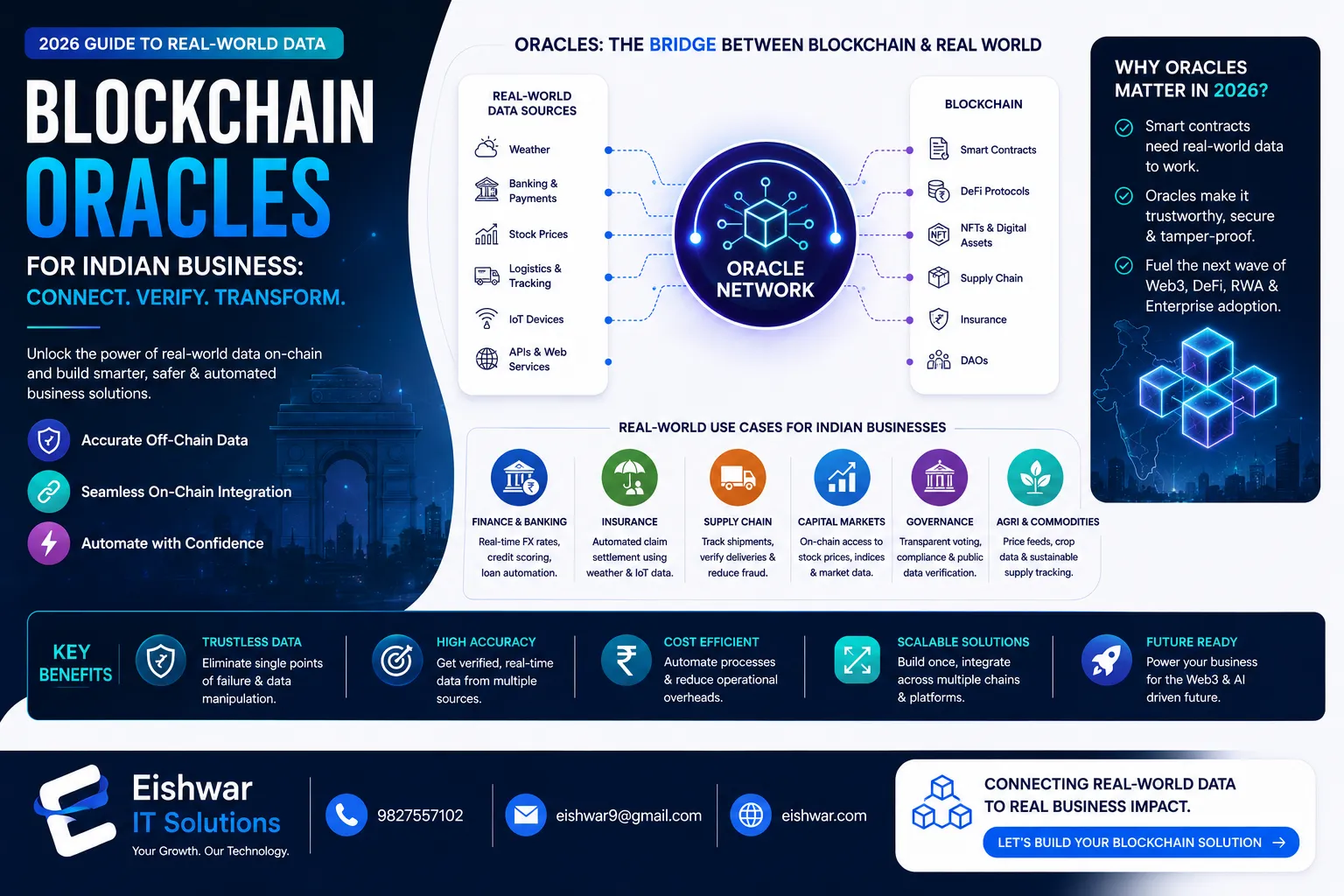
Blockchain oracles are third-party services that provide smart contracts with external information. They act as bridges between blockchains and the outside world—such as market prices, weather data, IoT sensor readings, payment confirmations, or even election results. Without oracles, smart contracts are blind to real-world events. For Indian businesses, this is a game-changer. Consider a farmer in Punjab who uses a smart contract for crop insurance. An oracle can feed weather data to automatically trigger a payout when rainfall exceeds a threshold. Or a logistics company in Mumbai that uses GPS oracles to release payments only when goods arrive at a warehouse. Oracles make blockchain applications practical, trustworthy, and scalable. In a country where trust deficits often hinder digital adoption, oracles provide a cryptographic guarantee that data hasn't been tampered with, enabling peer-to-peer transactions without intermediaries. For example, a small tea exporter in Assam can use an oracle to verify that a shipment's temperature never exceeded 25°C during transit, automatically triggering a quality certificate upon arrival. This reduces disputes and builds buyer confidence.
Types of Blockchain Oracles: Which One Fits Your Business Model?
Not all oracles are the same. Understanding the types helps you choose the right solution. Software oracles fetch data from online sources—like stock prices, exchange rates, or flight statuses. Hardware oracles read from IoT devices, such as temperature sensors in cold storage or RFID tags in inventory. Inbound oracles bring data onto the blockchain, while outbound oracles send data from the blockchain to external systems—for instance, triggering a bank transfer via API. Centralized oracles are controlled by a single entity—fast but less trustable. Decentralized oracles like Chainlink aggregate data from multiple sources, reducing manipulation risk. For Indian SMBs, decentralized oracles are often the best balance of cost, security, and reliability. For example, a supply chain startup can use decentralized oracles to verify product authenticity across multiple checkpoints, pulling data from government APIs, warehouse scans, and customer feedback. Another emerging type is the consensus-based oracle, where multiple independent nodes vote on data accuracy before submitting it to the blockchain—ideal for high-stakes applications like land registry verification. When selecting an oracle, consider factors like data freshness, cost per request, and the reputation of the data providers. For instance, a fintech app requiring real-time forex rates might prefer a software oracle with sub-second latency, while an agricultural insurance platform can tolerate hourly updates from weather stations.
👉 Don't wait for the perfect moment; turn your vision into reality today.
Free ConsultationReal-World Use Cases for Indian Businesses in 2026
Supply Chain & Logistics: Indian exporters can use oracles to track shipment conditions (temperature, humidity, location) and automate customs documentation. For example, a spice exporter from Kerala can integrate IoT sensors with a decentralized oracle to generate an immutable log of storage conditions, which customs authorities can verify instantly. Insurance: Parametric insurance for farmers, travelers, or event organizers can trigger instant payouts based on oracle-fed weather or flight delay data. A farmer in Maharashtra, for instance, could receive an automatic payout when a rainfall oracle reports a deficit below a predefined threshold—eliminating the need for manual claims processing. DeFi & Lending: Indian fintechs can use price oracles to calculate collateral values for crypto-backed loans, reducing liquidation risks. A platform like CoinDCX could integrate oracles to monitor Bitcoin prices every minute, automatically adjusting loan-to-value ratios to protect lenders. Agriculture: Smart contracts can automate subsidy distribution based on crop yields verified by satellite oracles. The government could use NDVI (Normalized Difference Vegetation Index) data from satellite imagery to trigger direct benefit transfers to farmers whose crops meet certain health criteria. E-Governance: Government schemes can use oracles to verify beneficiary eligibility (e.g., land records, income data) via trusted data feeds. For example, a smart contract for a housing subsidy could pull data from the Aadhaar database and land registry through a secure oracle, ensuring only eligible citizens receive funds. Energy Trading: With India's push toward renewable energy, oracles can enable peer-to-peer solar energy trading. A household with rooftop panels can use a smart meter oracle to automatically sell excess energy to neighbors, with payments settled via smart contracts. These applications reduce manual work, cut costs, and increase transparency—key benefits for a rapidly digitizing economy.
Expert Tips for Implementing Blockchain Oracles in Your Business
- Start small, think big: Pilot with a single use case—like automating a payment trigger—before scaling. For instance, test a weather oracle for a small insurance cohort before rolling out statewide.
- Choose reliable data sources: Use oracles that aggregate data from multiple independent providers to avoid single points of failure. For critical applications, consider using oracles with built-in reputation systems that penalize dishonest nodes.
- Consider hybrid solutions: Combine centralized oracles for speed with decentralized oracles for critical verifications. A logistics platform might use a centralized GPS oracle for real-time tracking but a decentralized oracle for final delivery confirmation.
- Audit your oracles: Regularly verify that oracle data is accurate and tamper-proof. Use tools like Chainlink's monitoring dashboards or set up automated alerts for data anomalies. Conduct periodic third-party audits of your smart contract's oracle integration.
- Plan for gas costs: Oracle calls incur network fees. Optimize by batching data requests or using layer-2 solutions like Polygon or Arbitrum, which offer lower transaction costs. For example, instead of fetching a price every block, batch updates every 10 blocks.
- Compliance first: Ensure your oracle setup complies with Indian data protection laws (DPDP Act 2023) and industry regulations. For instance, if your oracle processes personal data, implement encryption and access controls. Work with legal experts to draft data-sharing agreements with oracle providers.
- Test with testnets: Before deploying on mainnet, thoroughly test your oracle integration on testnets like Mumbai (Polygon) or Sepolia (Ethereum). This helps identify edge cases and optimize gas usage without risking real funds.
Common Mistakes to Avoid When Using Blockchain Oracles
- Relying on a single oracle: This creates a central point of failure and trust. Always use decentralized oracles for critical data. A single compromised oracle could lead to catastrophic losses, as seen in past DeFi exploits.
- Ignoring data latency: Some data (like stock prices) changes rapidly. Choose oracles that match your required update frequency. For high-frequency trading, use oracles with sub-second updates; for agricultural data, hourly updates may suffice.
- Overlooking oracle costs: Each data request costs gas. Budget accordingly and consider off-chain computation where possible. For example, use off-chain aggregation to compute averages before submitting a single value on-chain.
- Neglecting security: Oracle manipulation attacks (e.g., flash loan attacks) are real. Use time-tested oracle networks with proven security, such as Chainlink or Band Protocol. Implement circuit breakers to pause contracts if anomalous data is detected.
- Assuming oracles are plug-and-play: Integration requires careful smart contract design and testing. Work with experienced blockchain developers who understand oracle patterns, such as the 'pull' vs 'push' models.
- Forgetting about data licensing: Some data sources have usage restrictions. Ensure your oracle provider has the rights to redistribute the data, especially for commercial applications like financial indices.
Future Trends: Oracle Networks in 2026 and Beyond
The oracle ecosystem is evolving rapidly. Zero-knowledge oracles will allow verification of data without revealing the data itself—critical for privacy-sensitive applications like credit scoring or medical records. For instance, a bank could verify a borrower's income without seeing the actual numbers. Cross-chain oracles will enable seamless data flow between different blockchains, powering interoperable Indian Web3 ecosystems. A supply chain might use data from a Polygon-based tracking system to trigger a payment on an Ethereum-based escrow contract. AI-enhanced oracles will use machine learning to detect anomalies and prevent fraud in real-time. For example, an oracle could flag a sudden spike in temperature data that suggests sensor tampering. Regulatory oracles will emerge to automatically enforce compliance with Indian laws—for example, verifying KYC status before a transaction or ensuring that a DeFi protocol doesn't exceed leverage limits set by the RBI. Decentralized physical infrastructure networks (DePIN) will integrate with oracles to create verifiable maps of real-world assets, such as telecom towers or EV charging stations, enabling new insurance and financing models. Indian businesses that adopt oracles early will gain a competitive edge in automation, trust, and efficiency, positioning themselves as leaders in the country's Web3 revolution.
👉 Free Website Audit
Get Free Audit👉 Free Homepage Demo
Book DemoFAQs
- What is a blockchain oracle in simple terms? A blockchain oracle is a service that brings real-world data (like weather, prices, or GPS) into a smart contract so it can act automatically based on that data. Think of it as a trusted messenger that tells the blockchain what's happening outside.
- Are blockchain oracles secure? Yes, when using decentralized oracles that aggregate data from multiple sources. Centralized oracles are less secure because they represent a single point of failure. Always choose reputable providers like Chainlink, which uses a network of independent node operators and cryptographic proofs to ensure data integrity.
- How much does it cost to use an oracle? Costs vary based on the oracle network, data frequency, and blockchain gas fees. Typically, each data request costs a small fee in the blockchain's native token—ranging from a few cents to a few dollars on Ethereum mainnet, but significantly cheaper on layer-2 networks like Polygon. Some oracle networks also charge subscription fees for premium data feeds.
- Can I build my own oracle? Yes, but it's complex and risky. You'd need to run your own nodes, ensure data accuracy, and secure the system against attacks. For most businesses, using established decentralized oracle networks is safer and more cost-effective. Building a custom oracle is only advisable for niche use cases with unique data requirements.
- Which Indian industries benefit most from oracles? Supply chain, agriculture, insurance, fintech, logistics, and e-governance are top candidates due to their reliance on external data. For example, the insurance sector can use weather oracles for parametric crop insurance, while fintech can use price oracles for crypto lending. Even the entertainment industry can use oracles for ticketing and royalty distribution.
- Do oracles work with all blockchains? Most oracles are blockchain-agnostic. Popular networks like Chainlink support Ethereum, Polygon, Solana, and many others. Some oracles are built specifically for a single blockchain, but the trend is toward cross-chain compatibility. When choosing an oracle, ensure it supports the blockchain you're using.
- What happens if an oracle provides wrong data? This can cause incorrect smart contract execution, leading to financial losses or operational failures. That's why using decentralized oracles with reputation systems and dispute resolution is critical. Some oracle networks have built-in slashing mechanisms that penalize dishonest nodes, and users can challenge data through arbitration processes.
- How do I choose the right oracle for my business? Consider factors like data source reliability, update frequency, cost, security track record, and regulatory compliance. Start by listing your data requirements (e.g., type, latency, volume) and then evaluate oracle providers against those criteria. It's also wise to consult with blockchain developers who have experience with oracle integration.
Conclusion
Blockchain oracles are the unsung heroes of the Web3 revolution, enabling smart contracts to interact with the real world. For Indian businesses in 2026, they offer a practical path to automation, transparency, and efficiency. Whether you're streamlining supply chains, automating insurance payouts, or building DeFi products, oracles can help you turn blockchain potential into real-world value. Start small, choose reliable oracle networks, and always prioritize security and compliance. The future of business is connected—and oracles are the bridge. By embracing this technology now, Indian enterprises can not only optimize their operations but also build trust with customers and partners in an increasingly digital economy.
CTA
Ready to integrate blockchain oracles into your business? Contact EishwarITSolution today for a free consultation. Our experts will help you design, implement, and scale oracle-powered smart contracts tailored to your industry. Let's build the future of Indian Web solutions together.