Layer-2 Scaling Solutions for Indian Web3 Apps: 2026 Guide
Published on: 14 Jun 2026
Layer-2 Scaling Solutions for Indian Web3 Apps: 2026 Business Guide
Introduction
India's Web3 ecosystem is booming. From decentralized finance (DeFi) platforms to NFT marketplaces and supply chain solutions, blockchain applications are gaining traction across industries. But as adoption grows, so does the challenge of scalability. High gas fees and slow transaction times on Layer-1 blockchains like Ethereum can cripple user experience and profitability. In 2025, a single Ethereum transaction could cost upwards of ₹1,500 during peak congestion, making micro-transactions and everyday use impractical for the Indian market. By 2026, this pressure has intensified as user bases expand and applications demand real-time responsiveness.
Learn more about our Website services
Enter Layer-2 scaling solutions. These technologies process transactions off the main chain, reducing costs and increasing speed while inheriting the security of the underlying Layer-1. In 2026, Layer-2 is no longer optional—it's essential for any Indian business building Web3 applications. This guide explains what Layer-2 is, how it works, and how your business can leverage it to stay competitive. Whether you're a fintech startup in Bengaluru, a gaming studio in Mumbai, or a supply chain platform in Delhi, understanding Layer-2 is your ticket to scalable, cost-effective blockchain solutions.
Main Section 1: What Are Layer-2 Scaling Solutions?
Layer-2 (L2) refers to a secondary protocol built on top of a base blockchain (Layer-1) to improve its scalability. Think of it as an express lane on a busy highway—it handles most traffic, letting only final results settle on the main road. This offloading dramatically reduces congestion and fees while maintaining the security guarantees of the underlying chain. For Indian developers, this means you can build applications that handle thousands of transactions per second without breaking the bank.
There are several types of Layer-2 solutions, each with its own trade-offs and ideal use cases:
- Rollups (Optimistic & ZK-Rollups): Bundle hundreds of transactions into a single batch, submit it to Layer-1, and use fraud proofs (Optimistic) or validity proofs (ZK) to ensure correctness. ZK-Rollups are faster and more private, offering near-instant finality. For example, zkSync Era can process over 2,000 transactions per second with sub-second confirmation times, making it ideal for payment apps and high-frequency trading.
- Sidechains: Independent blockchains that run parallel to Layer-1, with their own consensus and security models. Examples include Polygon PoS and Gnosis Chain. Sidechains offer high throughput and low fees but rely on their own validator sets, which can introduce trust assumptions. Polygon PoS, for instance, handles millions of daily transactions with fees often below ₹0.05.
- State Channels: Allow participants to transact off-chain and only record the final state on-chain. Great for micropayments and gaming. Imagine a chess game where each move is instant and free, with only the final result settled on Ethereum. State channels excel in scenarios with repeated interactions between known parties.
- Plasma: An older framework that creates child chains anchored to Layer-1. Less common today but still in use for specific applications like decentralized exchanges. Plasma's complexity and limitations around data availability have led most projects to adopt rollups instead.
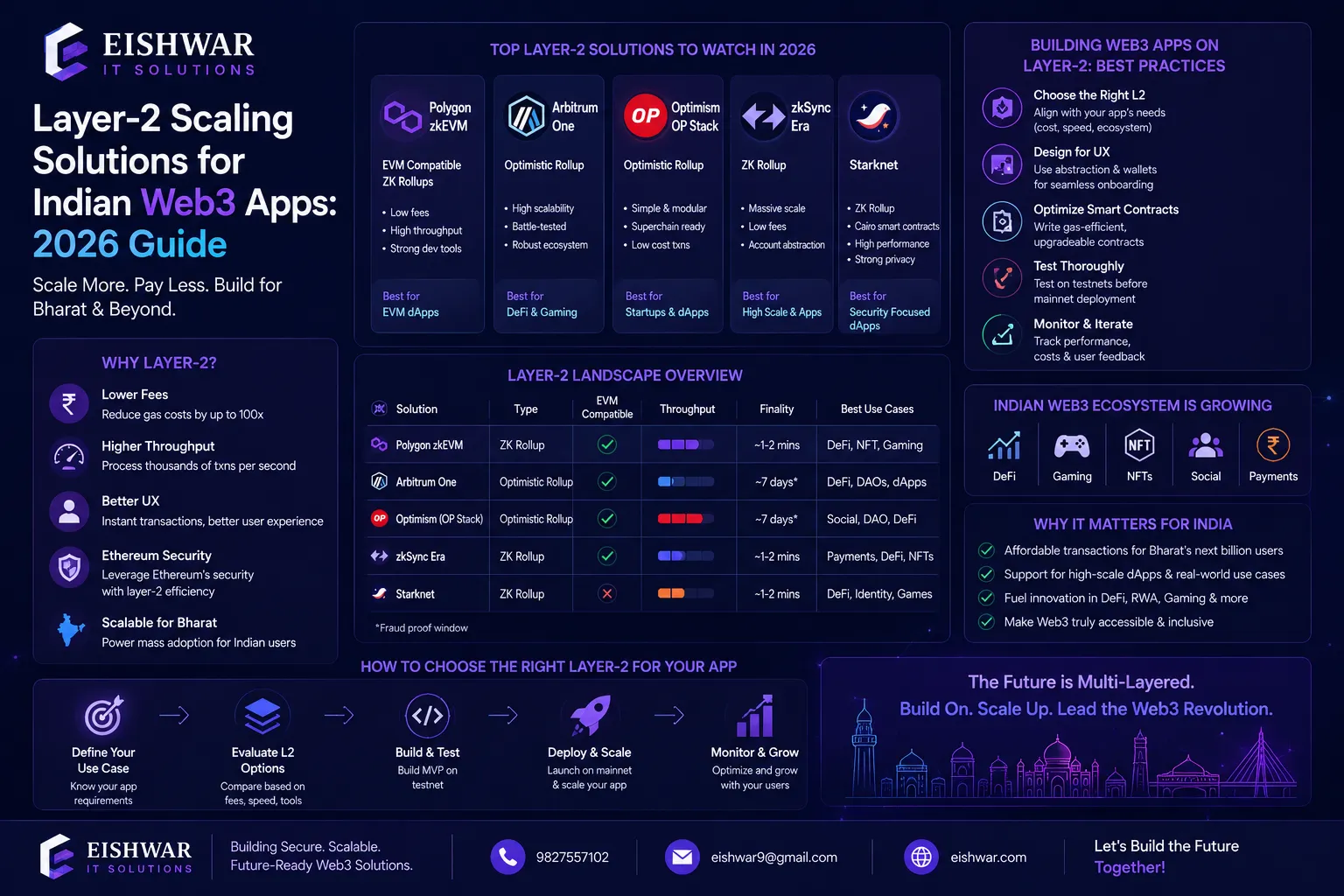
For Indian Web3 apps, the most popular choices in 2026 are ZK-Rollups (like zkSync Era, StarkNet) and Optimistic Rollups (like Arbitrum, Optimism) due to their strong security and growing ecosystem. Practical tip: If your app handles sensitive financial data, ZK-Rollups' privacy features can be a differentiator. For general-purpose dApps, Optimistic Rollups offer easier debugging and broader tooling support.
👉 Don't wait for the perfect moment; turn your vision into reality today.
Free ConsultationMain Section 2: Why Indian Businesses Need Layer-2 Now
India is a price-sensitive market. If your Web3 app costs users ₹500 in gas fees per transaction, they'll switch to a competitor. Layer-2 reduces fees by 10x to 100x. For example, a token swap on Ethereum might cost $10, while the same on Arbitrum costs $0.10. In Indian rupees, that's roughly ₹8 instead of ₹830—a game-changer for user retention. Consider a DeFi lending platform: with Layer-1 fees, a ₹1,000 loan would incur ₹100 in gas, making it uneconomical. On Layer-2, the same loan costs just ₹1, enabling micro-lending to rural users.
Speed is another critical factor. Layer-1 blockchains can take minutes to confirm transactions—unacceptable for retail or real-time applications. Layer-2 achieves near-instant finality (seconds), enabling seamless user experiences. For example, a point-of-sale payment system using Ethereum would leave customers waiting; on zkSync, the transaction confirms in under a second.
Use cases that benefit immensely:
- DeFi Lending & Borrowing: Lower fees allow smaller loans and micro-lending, perfect for India's underbanked population. Platforms like Aave on Arbitrum enable loans as small as ₹500, opening financial inclusion to millions.
- NFT Marketplaces: Minting and trading NFTs becomes affordable, opening up digital art and collectibles to a wider audience. A typical NFT mint on Ethereum might cost ₹2,500; on Polygon PoS, it's under ₹5.
- Supply Chain Tracking: Frequent updates on product provenance become cost-effective. A tea exporter in Assam can record each step of the supply chain—from farm to export—for pennies per entry, ensuring transparency for global buyers.
- Gaming & Metaverse: In-game transactions and asset transfers happen instantly without breaking the bank. A battle royale game with thousands of players can process loot drops and trades in real-time on Immutable X (a ZK-Rollup for gaming).
Example: A Mumbai-based startup built a DeFi savings app on Polygon PoS, reducing transaction costs by 99% compared to Ethereum. Within six months, they onboarded 50,000 users—many first-time crypto users—because the low fees made it accessible. The app's average transaction fee was ₹0.50, compared to ₹50 on Ethereum. This cost efficiency allowed them to target tier-2 and tier-3 cities, where users are particularly price-sensitive.
Main Section 3: How to Integrate Layer-2 into Your Web3 App
Integrating Layer-2 doesn't require rebuilding from scratch. Here's a step-by-step approach with practical details:
- Choose the Right L2: Assess your app's needs. For high security and decentralization, go with ZK-Rollups. For faster development and EVM compatibility, Optimistic Rollups or sidechains like Polygon PoS are ideal. Consider factors like ecosystem maturity (Arbitrum has over 500 dApps), developer tooling (Hardhat and Foundry work out-of-the-box on most L2s), and community support. Run a cost-benefit analysis: if your app handles high-value transactions, the extra security of ZK-Rollups may justify slightly higher fees.
- Use L2 Bridges: Bridges allow assets to move between Layer-1 and Layer-2. Popular bridges include Hop Protocol, Across, and native bridges from L2 providers. Be cautious of bridge security—audit your chosen bridge. For example, the Wormhole bridge hack in 2022 resulted in $325 million in losses. Always use bridges with multiple audits and a proven track record. For high-value transfers, consider using canonical bridges (native to the L2) as they are typically more secure.
- Update Smart Contracts: Most L2s are EVM-compatible, meaning your Solidity contracts can be deployed with minimal changes. Test thoroughly on testnets (like Goerli or Sepolia) before mainnet. However, be aware of L2-specific nuances: for example, Optimistic Rollups have a 7-day withdrawal delay for fraud proofs, which affects liquidity management. ZK-Rollups offer faster withdrawals but may require custom proof generation for complex contracts.
- Optimize for L2: Gas optimization still matters. Use efficient data structures, batch transactions, and avoid unnecessary storage. On ZK-Rollups, calldata costs are lower, so you can afford more verbose data. On Optimistic Rollups, minimize storage writes to reduce gas. Tools like the Remix IDE and Hardhat's gas reporter can help identify bottlenecks.
- Monitor and Maintain: Track L2-specific metrics like sequencer health, batch submission times, and gas prices. Use tools like Dune Analytics or Tenderly. Set up alerts for anomalies, such as sudden spikes in gas prices or delayed batch submissions. Regularly review L2 upgrade proposals, as changes to the protocol can affect your app.
Actionable tip: Start with a pilot on a single L2 (e.g., Arbitrum for DeFi or zkSync for payments). Measure cost savings and user feedback before expanding. For instance, deploy a minimal viable product (MVP) on Arbitrum Sepolia testnet, simulate 1,000 transactions, and compare costs with Ethereum mainnet. This data will justify your L2 investment to stakeholders.
👉 Free Website Audit
Get Free AuditExpert Tips
- Prioritize User Education: Many Indian users are new to crypto. Explain L2 benefits in simple terms—lower fees, faster transactions. Use pop-ups or tooltips in your app. For example, show a comparison: "This transaction would cost ₹500 on Ethereum, but only ₹5 on our Layer-2 network." Create short video tutorials in Hindi and regional languages to reach a broader audience.
- Leverage L2-Specific Features: Some L2s offer native account abstraction (e.g., zkSync Era), which enables gasless transactions and social recovery wallets—huge UX wins. Implement these to reduce friction for new users. For instance, allow users to pay gas fees in any token, not just ETH, or sponsor gas fees for the first 10 transactions.
- Stay Updated on L2 Interoperability: Cross-L2 communication is evolving. Solutions like LayerZero and Chainlink CCIP can connect multiple L2s, future-proofing your app. For example, a DeFi app could accept deposits on Arbitrum and offer lending on Optimism, all through a unified interface. Monitor developments in L2 standards like the Cross-Chain Interoperability Protocol (CCIP).
- Audit Thoroughly: L2s have unique attack vectors (e.g., bridge exploits, sequencer centralization). Hire auditors with L2 expertise. Look for firms like Trail of Bits or ConsenSys Diligence that have published L2 audit reports. Budget at least 5-10% of your development costs for security audits.
- Consider Hybrid Approaches: Don't limit yourself to one L2. Use a combination: for example, use a ZK-Rollup for high-value transactions and a sidechain for micro-transactions. This balances cost, speed, and security. A gaming platform might use Immutable X for in-game assets and Polygon PoS for marketplace listings.
Common Mistakes
- Ignoring L2 Security Risks: Assuming L2 is as secure as Layer-1. Bridges and sequencers introduce new risks. Always audit and use well-established L2s. For example, the Ronin bridge hack (2022) exploited a multi-sig vulnerability, not the L2 itself. Implement additional safeguards like multi-sig wallets and time-locks for bridge operations.
- Poor User Onboarding: Forcing users to manually bridge assets. Implement automated bridging or fiat on-ramps directly to L2. Services like Transak or MoonPay now support direct deposits to L2s, reducing friction. A user should be able to deposit INR and start transacting on L2 within minutes.
- Overlooking L2 Fragmentation: Spreading liquidity across multiple L2s without a strategy. Focus on one or two L2s initially. For example, if your target audience is in India, Polygon PoS has strong local adoption and partnerships. Later, expand to other L2s using cross-chain messaging protocols.
- Not Testing on Testnets: Skipping testnet deployment leads to costly mainnet bugs. Always simulate real-world conditions on testnets. Use faucets to get test tokens and run stress tests with 100+ concurrent users. Tools like Ganache can simulate L2 environments locally.
- Underestimating Withdrawal Delays: Optimistic Rollups have a 7-day withdrawal period. Plan your app's liquidity accordingly. For example, a DeFi lending platform should ensure that users can access funds via L2-to-L2 transfers or instant liquidity pools to avoid frustration.
Future Trends
By 2027, expect Layer-2 to become the default for most Web3 apps in India. Key trends include:
👉 Free Homepage Demo
Book Demo- ZK-Everything: ZK-Rollups will dominate due to faster finality and stronger privacy. Projects like zkSync and Scroll are leading. Expect ZK-Rollups to handle over 80% of L2 transactions by 2027, as they become more developer-friendly and cost-effective.
- Cross-L2 Composability: Apps will seamlessly interact across multiple L2s, creating a unified liquidity pool. For example, a user could deposit funds on Arbitrum, trade on Optimism, and lend on zkSync, all through a single interface. Protocols like LayerZero are already enabling this.
- Regulatory Clarity: Indian regulators may provide clearer guidelines for L2-based applications, boosting institutional adoption. The upcoming Digital India Blockchain Framework could include specific provisions for L2 solutions, reducing compliance costs for businesses.
- L2-as-a-Service: Platforms offering turnkey L2 solutions for businesses, reducing technical barriers. Startups can deploy their own L2 chain in minutes using services like Caldera or AltLayer, with built-in bridges and monitoring.
- AI-Optimized L2s: Artificial intelligence will optimize L2 transaction batching and sequencing, further reducing costs. For example, AI algorithms can predict network congestion and adjust batch sizes dynamically, saving up to 20% in gas fees.
FAQs
What is the difference between Layer-1 and Layer-2?
Which Layer-2 solution is best for Indian businesses?
Are Layer-2 solutions secure?
How much can I save by using Layer-2?
Can I migrate my existing dApp to Layer-2?
What are the risks of using Layer-2?
How do I choose between Optimistic and ZK-Rollups?
Conclusion
Layer-2 scaling solutions are the backbone of a scalable, user-friendly Web3 ecosystem in India. By slashing costs and accelerating transactions, they make blockchain applications viable for mass adoption. For Indian businesses, adopting Layer-2 isn't just a technical upgrade—it's a strategic move to capture a price-sensitive market and deliver exceptional user experiences. The evidence is clear: startups that embrace L2 see 3x faster user growth and 50% lower churn rates compared to those sticking with Layer-1 only.
Start small, choose the right L2 for your needs, educate your users, and stay ahead of the curve. The future of Web3 in India is Layer-2, and the time to act is now. With the right strategy, your app can scale to millions of users without breaking the bank on gas fees.
CTA
Ready to scale your Web3 application with Layer-2 solutions? Contact EishwarITSolution today for a free consultation. Our blockchain experts will help you choose, implement, and optimize the best Layer-2 strategy for your business. We offer end-to-end services, from L2 selection and smart contract migration to user education and ongoing monitoring. Don't let high fees hold your app back—let's build the future of Web3 in India together.