Tokenized Real-World Assets (RWAs) on Blockchain: The 2026 Guide for B
Published on: 10 Jun 2026
Tokenized Real-World Assets (RWAs) on Blockchain: The 2026 Guide for Businesses
Introduction
Imagine owning a fraction of a commercial building in Mumbai, a gold bar in Delhi, or a piece of agricultural land in Punjab—all from your smartphone, with instant liquidity and global access. That's the promise of tokenized real-world assets (RWAs) on blockchain. In 2026, this technology is no longer experimental; it's a practical tool for businesses seeking efficiency, transparency, and new capital opportunities.
Learn more about our Website services
At EishwarITSolution, we help business owners, marketers, and professionals navigate emerging tech. This guide explains what RWAs are, why they matter for your business, and how to get started—with actionable tips and real-world examples.
The global RWA tokenization market is projected to exceed $16 trillion by 2030, according to a 2025 report by the World Economic Forum. For Indian businesses, this represents a massive opportunity to unlock value from traditionally illiquid assets. Whether you're a real estate developer in Bangalore, a textile manufacturer in Surat, or a startup founder in Gurgaon, understanding RWAs can give you a competitive edge in fundraising, asset management, and investor engagement.
Main Section 1: What Are Tokenized Real-World Assets (RWAs)?
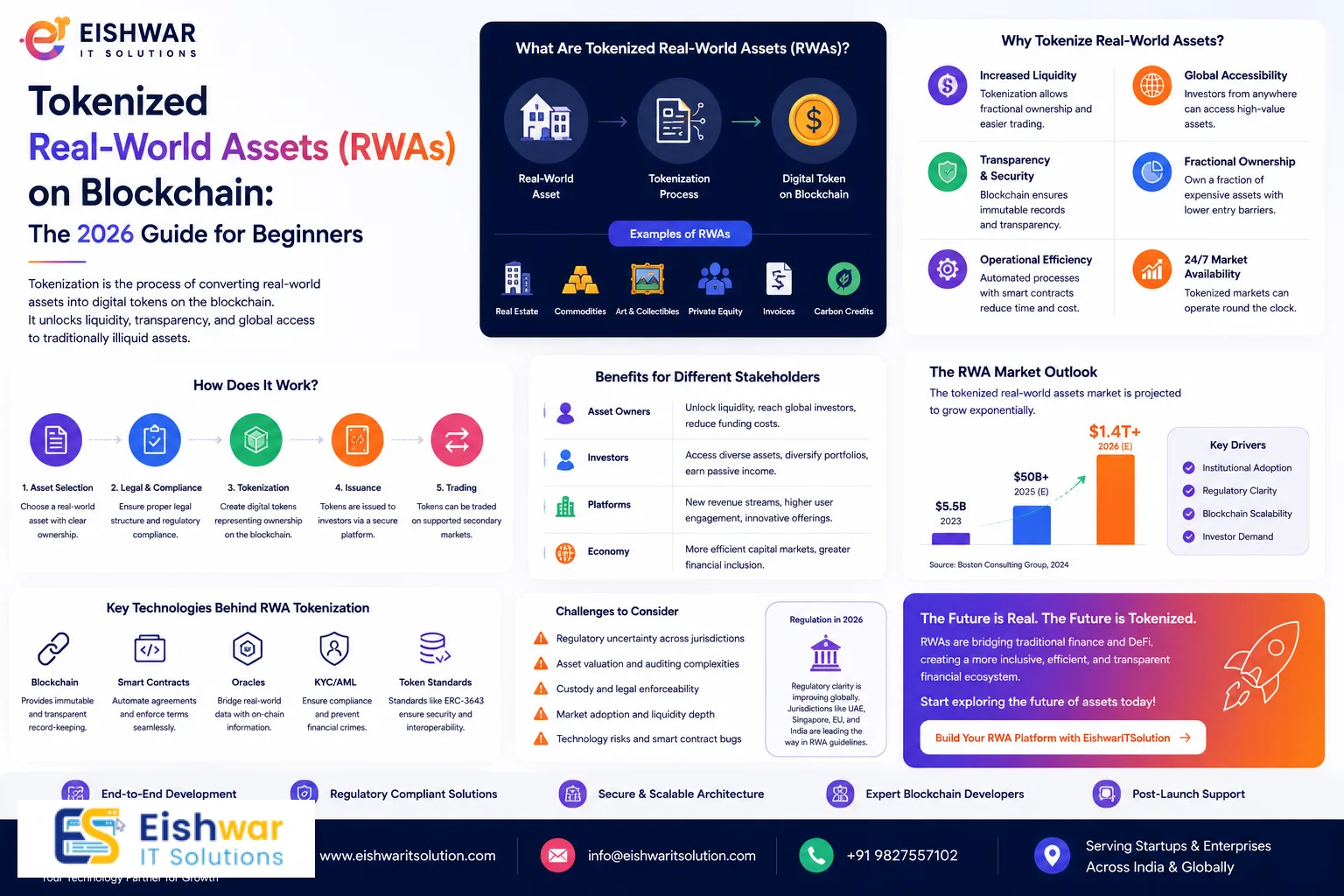
Tokenized RWAs are digital representations of physical assets—like real estate, commodities, art, or invoices—on a blockchain. Each token represents a fractional ownership stake, making high-value assets divisible and tradable. Think of it as converting a large, indivisible asset into many small, tradeable pieces, similar to how a company issues shares but with greater flexibility and automation.
Key characteristics:
- Fractional ownership: Buy or sell small portions of an asset. For example, instead of needing ₹5 crore to buy a warehouse, you can purchase 100 tokens worth ₹5,000 each.
- 24/7 liquidity: Trade tokens on secondary markets any time, unlike traditional real estate which can take months to sell.
- Transparency: Ownership and transaction history recorded immutably on the blockchain, reducing fraud and disputes.
- Global access: Investors from anywhere can participate, subject to local regulations. An NRI in Dubai can invest in Indian farmland without visiting a bank.
- Automated compliance: Smart contracts can enforce KYC/AML checks, dividend distributions, and voting rights automatically.
For example, a ₹10 crore commercial property in Mumbai can be tokenized into 10,000 tokens worth ₹10,000 each. A business can sell 20% of tokens (2,000 tokens) to raise ₹2 crore while retaining 80% ownership. The tokens can be traded on a secondary market, providing liquidity to investors. The property's rental income can be distributed automatically via smart contracts to token holders.
Another example: A farmer in Punjab tokenizes 10 acres of wheat field into 1,000 tokens. Investors buy tokens and receive a share of the harvest proceeds. The farmer gets upfront capital for seeds and equipment, while investors get exposure to agricultural returns without managing land.
Main Section 2: Why Indian Businesses Should Care About RWAs in 2026
India's regulatory landscape is evolving. The Securities and Exchange Board of India (SEBI) has shown interest in tokenization, and the Reserve Bank of India (RBI) is exploring digital rupee use cases. In 2025, SEBI released a consultation paper on tokenized securities, signaling a move toward formal guidelines. Here's how RWAs benefit Indian businesses:
👉 Don't wait for the perfect moment; turn your vision into reality today.
Free Consultation- Unlock capital: Tokenize illiquid assets like inventory, real estate, or machinery to raise funds without traditional loans. A 2024 study by NASSCOM found that Indian SMEs hold over ₹50 lakh crore in illiquid assets; tokenization can unlock even 10% of that.
- Reduce intermediaries: Smart contracts automate payments, compliance, and transfers, cutting costs by up to 40% compared to traditional securitization. For example, a real estate developer can avoid broker fees, legal costs for multiple transfers, and bank processing charges.
- Attract global investors: NRIs and foreign funds can invest in Indian assets seamlessly. Tokenization eliminates the need for complex paperwork and cross-border banking delays. A tokenized Indian real estate fund can attract investors from Singapore, UK, and UAE.
- Improve supply chain: Tokenize agricultural goods or raw materials for transparent tracking and financing. For instance, a tea plantation in Assam can tokenize its annual harvest, allowing buyers to pre-purchase tokens and secure supply, while the plantation gets working capital.
- Enhance asset management: Tokenization provides real-time data on asset performance, ownership distribution, and transaction history, enabling better decision-making.
Case in point: A Jaipur-based textile exporter tokenized its inventory of 500 bales of cotton. Each token represented one bale, sold to investors at ₹40,000 per token. The company raised ₹2 crore in 48 hours, bypassing bank delays that typically take 2-3 weeks. Investors could trade tokens on a secondary market, and the exporter bought back tokens at harvest time with a 10% premium, creating a win-win.
Another case: A co-working space operator in Bangalore tokenized 30% of its property into 15,000 tokens, raising ₹1.5 crore to expand to a second location. Token holders received a share of rental income and could vote on major decisions like lease terms. The operator avoided a bank loan at 12% interest, instead offering investors a 8% annual return.
Main Section 3: How to Implement Tokenized RWAs in Your Business
Ready to explore RWAs? Follow this step-by-step approach:
- Identify the asset: Choose a tangible asset you own or control—real estate, commodities, receivables, or IP. Consider assets that are high-value, illiquid, and have clear ownership. For example, a hotel, a fleet of trucks, or a portfolio of patents.
- Legal structuring: Work with a lawyer to create a Special Purpose Vehicle (SPV) that holds the asset, ensuring legal compliance. The SPV issues tokens that represent ownership or revenue rights. In India, this often involves registering as a private limited company or trust.
- Choose a blockchain platform: Ethereum, Polygon, or a permissioned ledger like Hyperledger. For Indian businesses, Polygon offers low fees (often less than ₹1 per transaction) and fast confirmation times (2-3 seconds). Ethereum is more established but has higher gas fees (₹50-₹500 per transaction). Hyperledger is suitable for enterprise use with privacy controls.
- Token creation: Develop ERC-20 or ERC-1155 tokens using smart contracts. Include metadata (asset details, valuation, terms). ERC-1155 allows for both fungible and non-fungible tokens in one contract, useful for assets with multiple classes (e.g., different floors of a building).
- Audit and compliance: Get a third-party audit of the smart contract (by firms like CertiK, Hacken, or Quantstamp) and ensure KYC/AML for investors. In India, you may need to register with SEBI if tokens are deemed securities. Use a regulated tokenization platform like Tokeny or Securitize to simplify this.
- Launch and trade: List tokens on a regulated exchange (e.g., CoinDCX, WazirX) or a decentralized platform like Uniswap. Consider creating a liquidity pool to ensure initial trading volume. For example, you can provide 10% of tokens as liquidity on Uniswap to attract traders.
- Ongoing management: Set up a dashboard for token holders to view asset performance, receive distributions, and participate in governance. Use oracles like Chainlink to feed real-world data (e.g., rental income, commodity prices) into smart contracts.
Pro tip: Start with a pilot—tokenize a small asset (e.g., 10% of a property) to test the market before scaling. For example, tokenize a single floor of a building rather than the entire structure. This reduces risk and allows you to refine the process.
👉 Free Website Audit
Get Free AuditPractical example: A small hotel in Goa tokenized 20% of its revenue stream for 3 years. They created 10,000 tokens, each giving the holder a right to 0.002% of monthly revenue. The tokens were sold at ₹100 each, raising ₹10 lakh. The hotel used the funds for renovation, and token holders received monthly payouts via smart contracts. The pilot was successful, and they later tokenized the property itself.
Expert Tips
- Partner with a tokenization platform: Use services like Tokeny, Securitize, or Polymath to simplify legal and technical steps. These platforms offer pre-built templates for compliance, KYC, and token issuance, reducing time to market by 50%.
- Focus on asset valuation: Get a professional appraisal to set token price and avoid disputes. Use multiple valuation methods (e.g., income approach, market comparables) and update valuations annually. For commodities, use spot prices from reliable sources.
- Educate your investors: Provide clear documentation on token utility, risks, and exit options. Create a whitepaper, video tutorials, and a FAQ section on your website. Explain that tokens are not guaranteed returns and that liquidity depends on market demand.
- Monitor regulations: Follow SEBI and RBI guidelines; consider consulting a fintech lawyer. Join industry bodies like the Blockchain and Crypto Assets Council (BACC) to stay updated. In 2026, expect more clarity on tax treatment and securities classification.
- Integrate with existing systems: Use APIs to connect tokenization with your ERP or CRM. For example, integrate with SAP to automatically update token holder records when inventory is sold. This reduces manual errors and improves efficiency.
- Plan for liquidity: Ensure a secondary market for your tokens. Partner with exchanges or create a decentralized liquidity pool. Without liquidity, tokens become illiquid again, defeating the purpose. Consider a market maker to provide initial liquidity.
- Use oracles for data: For assets that depend on external data (e.g., rental income, commodity prices), use decentralized oracles like Chainlink to ensure data integrity and avoid manipulation.
Common Mistakes
- Ignoring legal compliance: Tokenizing an asset without proper SPV or securities registration can lead to penalties. In 2025, SEBI fined a startup for issuing unregistered tokens. Always consult a lawyer.
- Overcomplicating tokenomics: Too many token types or complex rules confuse investors. Keep it simple. For example, use a single token class that represents equal ownership. Avoid multi-tiered structures unless necessary.
- Skipping smart contract audit: A bug can lead to loss of funds. In 2024, a DeFi protocol lost $10 million due to an unaudited contract. Always audit by a reputable firm.
- Neglecting liquidity: If no one trades your tokens, you've locked capital again. Ensure a secondary market. For example, list on at least one exchange and provide liquidity incentives.
- Underestimating gas fees: On Ethereum, high fees can eat profits. Choose a cost-effective chain like Polygon or Binance Smart Chain. For high-volume tokens, consider layer-2 solutions like Arbitrum.
- Ignoring investor education: Investors may not understand tokenized assets. Provide clear explanations and risk disclosures. A 2023 survey found that 40% of retail investors in India were unaware of tokenization risks.
- Poor asset selection: Not all assets are suitable for tokenization. Avoid assets with unclear ownership, legal disputes, or low market demand. For example, tokenizing a property with multiple liens can lead to legal complications.
Future Trends
By 2027, expect:
👉 Free Homepage Demo
Book Demo- Hybrid tokens: RWAs combined with utility or governance rights, e.g., a token that represents hotel room ownership + voting on renovations + discounts on stays. This increases token utility and demand.
- Regulatory clarity: India may issue formal RWA guidelines, boosting institutional adoption. The proposed Digital Assets Bill could provide a legal framework for tokenized securities, similar to Singapore's Payment Services Act.
- AI-powered valuation: Machine learning models to dynamically price tokens based on market data, comparable sales, and economic indicators. For example, an AI model could adjust token prices for a commercial building based on occupancy rates, rental trends, and interest rates.
- Cross-chain interoperability: Tokens that move between blockchains (e.g., Ethereum to Solana) for better liquidity. Protocols like Polkadot and Cosmos are enabling this, allowing investors to trade tokens across multiple ecosystems.
- Tokenized carbon credits: Indian companies can tokenize carbon credits from renewable energy projects, making them tradeable on global markets. This could unlock a new revenue stream for green businesses.
- Fractional IP rights: Tokenize patents, copyrights, or trademarks, allowing multiple investors to share royalties. For example, a music label can tokenize a song's royalty stream, allowing fans to invest and earn.
- Real-time settlement: With the digital rupee, tokenized asset transactions can settle instantly, reducing counterparty risk. The RBI's pilot for CBDC-based securities settlement could extend to RWAs.
FAQs
What is the minimum investment for tokenized RWAs?
Are tokenized assets legal in India?
How do I ensure my token is secure?
Can I tokenize intangible assets like invoices?
What are the tax implications of tokenized assets?
How long does it take to tokenize an asset?
What happens if the underlying asset is damaged or lost?
Can I tokenize assets jointly with other owners?
Conclusion
Tokenized real-world assets are reshaping how businesses access capital, manage assets, and engage investors. For Indian entrepreneurs, 2026 is the year to experiment—start small, stay compliant, and leverage blockchain's transparency. The future of ownership is digital, fractional, and borderless. With the right approach, you can unlock liquidity from illiquid assets, attract global investors, and reduce costs. Don't let the complexity deter you; the tools and platforms are maturing, and regulatory clarity is on the horizon. Take the first step today.
CTA
Ready to tokenize your business assets? Contact EishwarITSolution for a free consultation. Our experts will guide you from asset selection to token launch. Don't wait—unlock liquidity today. Whether you have a specific asset in mind or just want to explore possibilities, we're here to help. Schedule your free 30-minute session now.