
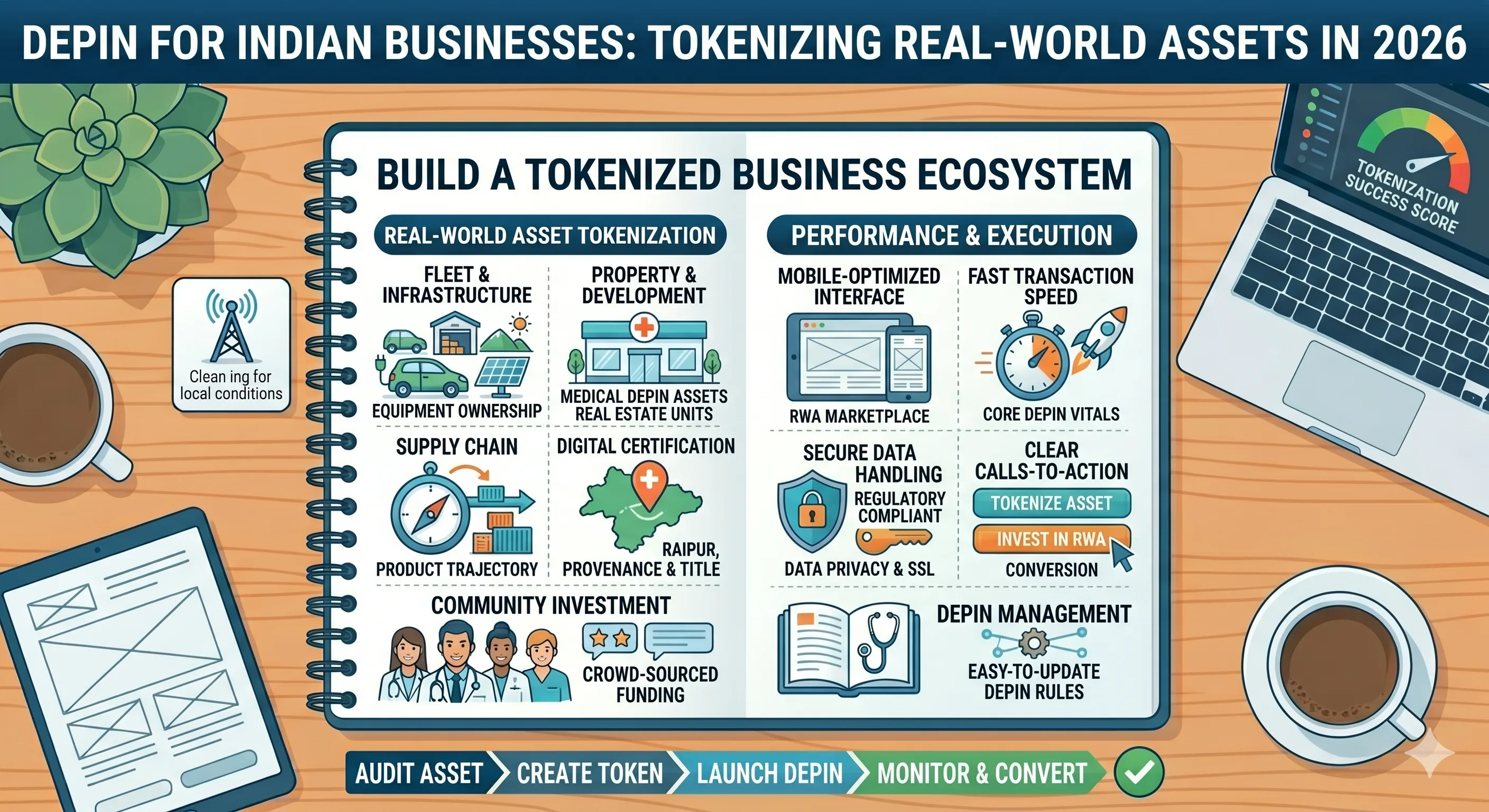
DePIN for Indian Businesses: Tokenizing Real-World Assets in 2026
Published on: 12 Jun 2026
DePIN for Indian Businesses: Tokenizing Real-World Assets in 2026
Introduction
Imagine a world where your office building, your fleet of delivery trucks, or even a solar panel on your factory roof can be turned into a digital asset that anyone can invest in, trade, or verify—without a middleman. That’s the promise of Decentralized Physical Infrastructure Networks (DePIN). For Indian business owners, marketers, and professionals, DePIN isn’t just a buzzword; it’s a practical tool to unlock liquidity, build trust, and streamline operations. In this guide, we’ll explore what DePIN means for you, how tokenizing real-world assets (RWAs) works, and how EishwarITSolution can help you leverage this emerging tech for real results.
Learn more about our Website services
By 2026, the global DePIN market is projected to exceed $3 trillion, and India is poised to capture a significant share. With over 600 million internet users, a thriving startup ecosystem, and a government pushing for digital public infrastructure, Indian businesses are uniquely positioned to lead this revolution. Whether you’re a small retailer in Delhi or a manufacturer in Chennai, DePIN offers a way to turn idle assets into income streams, attract global investors, and build transparent operations. Let’s dive deep into how you can get started.
What is DePIN and Why Should Indian Businesses Care?
DePIN stands for Decentralized Physical Infrastructure Networks. In simple terms, it’s a way to use blockchain technology to manage, share, and monetize physical assets—like buildings, vehicles, or energy grids—through tokens. Instead of one company owning everything, a network of people can own fractions of an asset, earning rewards when that asset is used.
For Indian businesses, this is a game-changer. Think about real estate: many small businesses in India struggle to get loans because they lack formal credit history. With DePIN, a property can be tokenized, and its value verified on a public ledger. This makes it easier to raise capital from investors globally. Similarly, supply chain companies can tokenize inventory, allowing transparent tracking and financing.
At EishwarITSolution, we’ve seen how DePIN can reduce fraud, lower costs, and open new revenue streams. The technology is still young, but India’s regulatory environment is becoming more supportive, with the Securities and Exchange Board of India (SEBI) exploring tokenized securities. For example, in 2025, SEBI launched a sandbox for tokenized assets, allowing businesses to test DePIN models under regulatory supervision. This reduces risk and paves the way for mainstream adoption.
How Tokenizing Real-World Assets Works in Practice
Tokenization means creating a digital representation of a physical asset on a blockchain. Each token represents a share of ownership. Here’s a step-by-step look at how an Indian business might do it:
- Identify the asset: Could be a warehouse, a fleet of vehicles, or even intellectual property like a patent. For instance, a textile mill in Surat might tokenize its inventory of raw cotton.
- Legal structuring: Work with lawyers to ensure compliance with Indian laws, such as the Companies Act or SEBI regulations. This includes drafting a prospectus if the tokens are considered securities.
- Choose a blockchain: Popular choices include Ethereum, Polygon, or Solana. For Indian businesses, Polygon is often preferred due to low fees and strong local developer community. For example, Polygon’s transaction costs are typically under ₹1, compared to Ethereum’s ₹50-100.
- Mint tokens: Create the digital tokens that represent ownership. Each token might equal 1 square foot of warehouse space or 1% of a vehicle’s value. Use a standard like ERC-20 or ERC-721 for compatibility.
- Launch a token sale: Offer tokens to investors via a regulated platform. Investors can buy, sell, or trade these tokens. Platforms like WazirX or CoinDCX are exploring tokenized asset listings.
- Manage the asset: Use smart contracts to automate revenue sharing. For example, if the warehouse generates rent, that rent is automatically distributed to token holders. Oracles like Chainlink can feed real-world data (e.g., occupancy rates) into the contract.
For example, a logistics company in Mumbai tokenized its delivery trucks. Investors bought tokens representing 10% of the fleet’s value. The company used the funds to expand, and investors earned a share of delivery fees. This is DePIN in action. The company reported a 20% reduction in fundraising costs compared to traditional bank loans.
👉 Don't wait for the perfect moment; turn your vision into reality today.
Free ConsultationMain Section 1: Key Benefits for Indian Business Owners
Access to Global Capital
Indian businesses often face high interest rates (12-18% from banks) and strict collateral requirements from banks. Tokenized assets can be sold to investors worldwide, often at better terms. A small manufacturer in Pune can raise funds from a European investor without leaving the country. For instance, a DePIN platform like EishwarITSolution can help you list tokens on global decentralized exchanges, reaching investors in the US, Europe, and Southeast Asia.
Transparency and Trust
Blockchain records every transaction. If you tokenize your supply chain, every step—from raw material to finished product—is visible. This builds trust with customers and partners. For example, a coffee exporter can prove that beans were sourced ethically, and buyers can verify it on-chain. This is especially valuable for industries like organic farming or fair-trade goods, where provenance is critical.
Fractional Ownership
Not every business can afford a full warehouse or a solar farm. Tokenization lets you buy or sell fractions, making big assets accessible. A group of small retailers could jointly own a cold storage facility, each owning tokens proportional to their usage. This lowers the entry barrier and spreads risk. For example, a cooperative of 50 farmers in Karnataka tokenized a shared cold storage unit, reducing spoilage costs by 30%.
Automated Operations
Smart contracts handle payments, compliance, and maintenance schedules. A hotel chain could tokenize room bookings, with smart contracts automatically releasing payments to cleaning staff when a guest checks out. This reduces administrative overhead. In practice, a hotel in Goa used DePIN to manage its solar panels: smart contracts automatically sold excess energy to the grid and distributed profits to token holders.
Main Section 2: Practical Steps to Start with DePIN
Step 1: Audit Your Assets
Make a list of physical assets that are underutilized or could generate passive income. For example, unused office space, idle machinery, or even parking lots. Consider assets with clear revenue streams, like rental properties or equipment leases. Use a spreadsheet to estimate their market value and potential tokenization costs.
👉 Free Website Audit
Get Free AuditStep 2: Partner with a Tech Provider
Work with a company like EishwarITSolution that understands both blockchain and Indian business needs. We can help you choose the right blockchain, write smart contracts, and navigate regulations. Look for providers with experience in tokenization projects, ideally with a portfolio of Indian use cases.
Step 3: Educate Your Stakeholders
Your team, investors, and customers need to understand how tokenization works. Hold workshops or webinars. Use simple analogies: “Think of it like buying shares in a company, but the company is a building.” Provide easy-to-read guides on using wallets (e.g., MetaMask) and trading tokens. At EishwarITSolution, we offer training sessions tailored to non-technical audiences.
Step 4: Start Small
Tokenize one asset first. Learn from the process. For instance, tokenize a single delivery van before doing the entire fleet. This minimizes risk and helps you refine your approach. A common mistake is trying to tokenize too many assets at once, leading to legal and technical complications.
Step 5: Ensure Compliance
Work with legal experts to ensure your token offering complies with Indian securities laws. The Reserve Bank of India (RBI) and SEBI have guidelines that may apply. Non-compliance can lead to fines or shutdown. For example, if your tokens represent equity, you may need to register with SEBI as a public offering. Use legal firms specializing in blockchain, such as those in the India Blockchain Alliance.
Main Section 3: Real-World Use Cases in India
Real Estate Tokenization
A developer in Bangalore tokenized a commercial complex. Small investors bought tokens for as little as ₹10,000. The developer used the funds to complete construction, and investors receive rental income quarterly. This model is now being replicated in Tier-2 cities like Jaipur and Lucknow. The developer reported a 40% faster fundraising cycle compared to traditional methods.
Energy Grids
A community in rural Maharashtra set up a solar microgrid. Tokens represent energy credits. Households earn tokens by contributing excess solar power, and they can use tokens to pay for electricity from the grid. This reduces dependence on fossil fuels and empowers locals. The project was funded by a mix of local investors and international climate funds, all tracked on-chain.
Supply Chain Finance
An agricultural cooperative in Punjab tokenized its grain storage. Farmers deposit wheat and receive tokens representing its value. They can trade these tokens for cash or supplies, avoiding middlemen. The cooperative uses smart contracts to ensure quality and quantity. This reduced transaction costs by 25% and improved farmer incomes.
Expert Tips
- Start with a clear use case: Don’t tokenize for the sake of tokenizing. Solve a real problem—like raising capital or improving transparency. For example, if your main challenge is slow payments from customers, tokenizing invoices might be more effective than tokenizing physical assets.
- Focus on liquidity: The main advantage of tokenization is liquidity. Ensure there’s a secondary market where tokens can be traded. Platforms like Uniswap or local exchanges can help. Consider listing on decentralized exchanges (DEXs) to avoid high listing fees.
- Use oracles for real-world data: Oracles bring off-chain data (like temperature or delivery status) onto the blockchain. This is critical for DePIN. Consider Chainlink or Band Protocol. For example, a cold storage tokenization project used oracles to monitor temperature and trigger insurance payouts if the cooling system failed.
- Build a community: Token holders are your investors and advocates. Engage them through Telegram groups, regular updates, and governance votes. Use platforms like Discord or Telegram to answer questions and share progress.
- Plan for scalability: Choose a blockchain that can handle high transaction volumes. Layer-2 solutions like Polygon or Arbitrum are often better than Ethereum mainnet. For example, Polygon can process up to 7,000 transactions per second, compared to Ethereum’s 15.
Common Mistakes
- Ignoring legal frameworks: Many Indian businesses rush to tokenize without consulting lawyers. This can lead to regulatory action. Always get professional advice. For instance, a startup in Delhi faced a SEBI notice for issuing unregistered security tokens.
- Overcomplicating the tokenomics: Too many token types or complex reward mechanisms confuse investors. Keep it simple: one token per asset. Use a standard like ERC-20 for fungible assets or ERC-721 for unique assets.
- Neglecting security: Smart contract bugs can lead to loss of funds. Audit your code by firms like CertiK or SlowMist. Also, secure private keys and use multi-signature wallets. A single-signature wallet was hacked in a 2024 DePIN project, resulting in ₹50 lakh loss.
- Underestimating user education: If your investors don’t understand how to use a wallet or trade tokens, they won’t participate. Provide easy tutorials and customer support. At EishwarITSolution, we provide video guides and 24/7 chat support.
- Forgetting about maintenance: Physical assets need upkeep. Smart contracts can’t fix a broken roof. Have a plan for real-world asset management and insurance. For example, a tokenized warehouse should have a maintenance fund built into the tokenomics.
Future Trends
By 2026, DePIN is expected to grow significantly in India. The government’s push for digital infrastructure and the rise of Web3 startups will fuel adoption. We anticipate:
👉 Free Homepage Demo
Book Demo- Integration with IoT: Sensors will automatically update tokenized asset status. For example, a temperature sensor in a cold storage will trigger alerts if the temperature rises, protecting perishable goods. This will enable real-time risk management.
- Regulatory clarity: SEBI and RBI are likely to release formal guidelines for tokenized assets, making it safer for businesses. The proposed Digital India Act may also include provisions for DePIN.
- Cross-border tokenization: Indian assets will be traded on global exchanges, attracting foreign investment. For example, a tokenized solar farm in Rajasthan could be bought by a European green fund.
- Green DePIN: Tokenized carbon credits and renewable energy certificates will become mainstream, helping Indian companies meet ESG goals. The voluntary carbon market in India is expected to reach $10 billion by 2026.
FAQs
What is the difference between DePIN and traditional infrastructure?
Traditional infrastructure is owned and operated by a single entity (like a company or government). DePIN distributes ownership and control across a network, using blockchain to coordinate and incentivize participants. This reduces central points of failure and opens access to more people. For example, a traditional toll road is owned by a government, while a DePIN toll road could be owned by thousands of token holders who share revenue.
Is tokenizing real-world assets legal in India?
Yes, but it depends on how the tokens are structured. If they represent securities (like shares), they fall under SEBI regulations. If they represent commodities or utility, other laws apply. Always consult with a legal expert specializing in blockchain and Indian securities law. The Securities Contracts (Regulation) Act, 1956, may also apply if tokens are traded on exchanges.
How much does it cost to tokenize an asset?
Costs vary based on complexity. Basic tokenization on Polygon might cost ₹2-5 lakhs for development, legal fees, and audits. More complex projects with custom smart contracts and oracles can cost ₹10-20 lakhs. However, these costs are often offset by lower fundraising costs compared to traditional loans. For example, a tokenized asset can raise capital at 8-10% cost, versus 15-18% for a bank loan.
What if the physical asset is damaged or destroyed?
Smart contracts can include insurance mechanisms. For example, a portion of the token sale proceeds can be used to buy insurance. If the asset is damaged, the insurance payout is distributed to token holders automatically via the blockchain. Oracles can verify damage reports (e.g., from IoT sensors) to trigger payouts. This ensures transparency and speed.
Can small businesses benefit from DePIN?
Absolutely. Small businesses can tokenize a single asset, like a delivery vehicle or a piece of equipment, to raise funds. They can also participate in larger DePIN networks as users or investors. The key is to start small and use platforms that support fractional ownership. For example, a small restaurant in Mumbai tokenized its kitchen equipment to raise ₹5 lakhs for expansion.
What blockchain is best for Indian DePIN projects?
Polygon is often recommended due to its low fees (under ₹1 per transaction), strong developer community in India, and compatibility with Ethereum. Other options include Solana for high speed, or Binance Smart Chain for low costs. The choice depends on your specific needs, such as transaction volume and security requirements.
How do I ensure my token sale complies with Indian laws?
Work with a legal team experienced in blockchain and securities law. They can help you structure the token as a utility token (if it provides access to a service) or a security token (if it represents investment). Register with SEBI if required, and ensure all disclosures are made. Use regulated platforms for the token sale to avoid legal issues.
Conclusion
DePIN and tokenized real-world assets represent a paradigm shift for Indian businesses. By leveraging blockchain technology, you can unlock new capital, build trust, and streamline operations—all while staying ahead of the competition. The journey starts with a single step: identifying an asset that can be tokenized and partnering with experts who understand the landscape. EishwarITSolution is here to guide you through every stage, from strategy to implementation. With the right approach, DePIN can transform your business into a global, transparent, and efficient operation.
Ready to Transform Your Business with DePIN?
Don’t let your physical assets sit idle. Contact EishwarITSolution today for a free consultation. Our team of blockchain specialists will help you identify opportunities, navigate regulations, and build a customized tokenization plan. Let’s turn your assets into engines of growth. Schedule your call now and take the first step toward the future of business.
CTA
Ready to Transform Your Business with DePIN? Don’t let your physical assets sit idle. Contact EishwarITSolution today for a free consultation. Our team of blockchain specialists will help you identify opportunities, navigate regulations, and build a customized tokenization plan. Let’s turn your assets into engines of growth. Schedule your call now and take the first step toward the future of business.