SME Digital Maturity Assessment: Benchmark Your Business in 2026
Published on: 18 Jul 2026
SME Digital Maturity Assessment: Benchmark Your Business in 2026
Introduction
Digital transformation isn't a one-time project—it's an ongoing journey. But how do you know where your SME stands today? Without a clear benchmark, you risk investing in the wrong tools or missing critical opportunities. A digital maturity assessment helps you evaluate your current capabilities, identify gaps, and prioritize your next steps. In 2026, with rapid tech evolution and rising customer expectations, Indian SMEs can't afford to guess. This guide walks you through a simple, actionable framework to assess your digital maturity and build a roadmap for growth.
Learn more about our Website services
Consider a small textile manufacturer in Surat that invested heavily in a fancy ERP system but still struggled with order delays. Why? Because they skipped the assessment phase. They didn't realize their team wasn't trained, their data was scattered across Excel sheets, and their suppliers weren't integrated. A maturity assessment would have revealed these gaps early, saving time and money. That's the power of knowing where you truly stand before you leap.
Main Section 1: What is Digital Maturity and Why Does It Matter?
Digital maturity refers to how deeply your business integrates digital technologies into its operations, culture, and strategy. It's not just about having a website or using WhatsApp for customer communication. True maturity means leveraging data, automation, and digital channels to drive efficiency, customer satisfaction, and innovation.
For Indian SMEs, digital maturity directly impacts competitiveness. A 2025 study by NASSCOM found that digitally mature SMEs grew revenue 2.5x faster than their less mature peers. Yet many SMEs remain stuck at basic levels—using spreadsheets for accounting, manual order processing, and relying on walk-in customers. For example, a family-run restaurant in Pune that still takes orders by phone and writes them on paper slips is missing out on data that could reveal popular dishes, peak hours, and customer preferences. A digitally mature competitor, on the other hand, uses a POS system to track sales, an online ordering platform to reach more customers, and analytics to optimize the menu.
Assessing your maturity helps you:
- Identify quick wins (e.g., automate invoicing to reduce errors by 40%)
- Allocate budget effectively—don't spend on AI if you haven't digitized basic inventory
- Align team efforts with business goals, ensuring everyone pulls in the same direction
- Track progress over time, celebrating milestones and recalibrating when needed
In 2026, with government initiatives like Digital India and ONDC (Open Network for Digital Commerce) gaining traction, SMEs that assess and improve their maturity can tap into new markets and subsidies. Ignoring this could mean falling behind competitors who are already leveraging these platforms.
Main Section 2: The 5 Levels of Digital Maturity for SMEs
We'll use a simplified five-level model tailored for Indian SMEs. Each level builds on the previous, and the goal is steady progress, not perfection.
Level 1: Initial (Ad-hoc)
Business runs on paper, phone calls, and basic spreadsheets. No formal digital tools. Example: A small retail shop that still uses a ledger for sales. The owner knows every customer by name, but can't analyze sales trends or manage stock efficiently. A single employee's absence can disrupt operations because all knowledge is in their head.
👉 Don't wait for the perfect moment; turn your vision into reality today.
Free ConsultationTip: Start by digitizing one process, like using a free accounting app (e.g., Zoho Books or Vyapar) to record transactions. This alone can reduce errors and save hours each week.
Level 2: Emerging (Basic Digital)
Adoption of standalone digital tools like a simple website, social media pages, and accounting software. Data is siloed. Example: A boutique using Instagram for marketing but manual order tracking. They post beautiful photos, but when a customer orders via DM, they write it in a notebook. This leads to missed orders and unhappy customers.
Tip: Integrate your social media with a simple CRM like HubSpot's free tier. This way, leads from Instagram automatically populate your customer database, and you can send follow-ups without manual effort.
Level 3: Defined (Integrated)
Digital tools are connected—CRM, ERP, and payment gateways share data. Processes are documented. Example: A manufacturer using cloud-based inventory and order management. When a customer places an order on the website, the inventory updates in real-time, and the production team gets a notification. This reduces stockouts and overstocking.
Tip: Use integration platforms like Zapier or native integrations in tools like Tally and Shopify to connect your systems. Start with the most critical flow—order to payment to inventory.
Level 4: Managed (Data-Driven)
Analytics and AI guide decisions. Customer insights are used for personalization. Example: A restaurant chain using POS data to predict demand and optimize supply. They know that on Fridays, biryani sales spike by 30%, so they order extra ingredients and staff accordingly. They also send personalized offers to regular customers based on their order history.
Tip: Invest in a simple BI tool like Google Data Studio or Power BI. Connect it to your sales and inventory data. Start with one dashboard that shows your top 5 products, customer acquisition cost, and order fulfillment time.
Level 5: Optimized (Innovative)
Continuous innovation, experimentation, and digital culture. SME adopts emerging tech like IoT or AI-driven customer support. Example: A logistics SME using real-time tracking and route optimization. They use GPS trackers on vehicles, AI to predict delivery delays, and chatbots to handle customer queries. This reduces fuel costs by 15% and improves on-time delivery by 25%.
Tip: Don't chase every new tech. Focus on one innovation that directly impacts your bottom line. For instance, a small bakery could use a simple IoT sensor to monitor oven temperature remotely, reducing waste.
Main Section 3: Step-by-Step Guide to Conducting Your Assessment
Follow these steps to benchmark your SME. Remember, this is a team effort, not a solo exercise.
Step 1: Gather Your Team
Include founders, department heads, and a tech-savvy employee. Diverse perspectives prevent blind spots. For example, the sales head might rave about the new CRM, but the operations manager knows it's not syncing with the inventory system. A cross-functional team ensures a 360-degree view.
Practical tip: Schedule a half-day workshop. Use a whiteboard or digital tool like Miro to map out current processes. Ask each person to list the digital tools they use and the pain points they face.
👉 Free Website Audit
Get Free AuditStep 2: Evaluate Key Dimensions
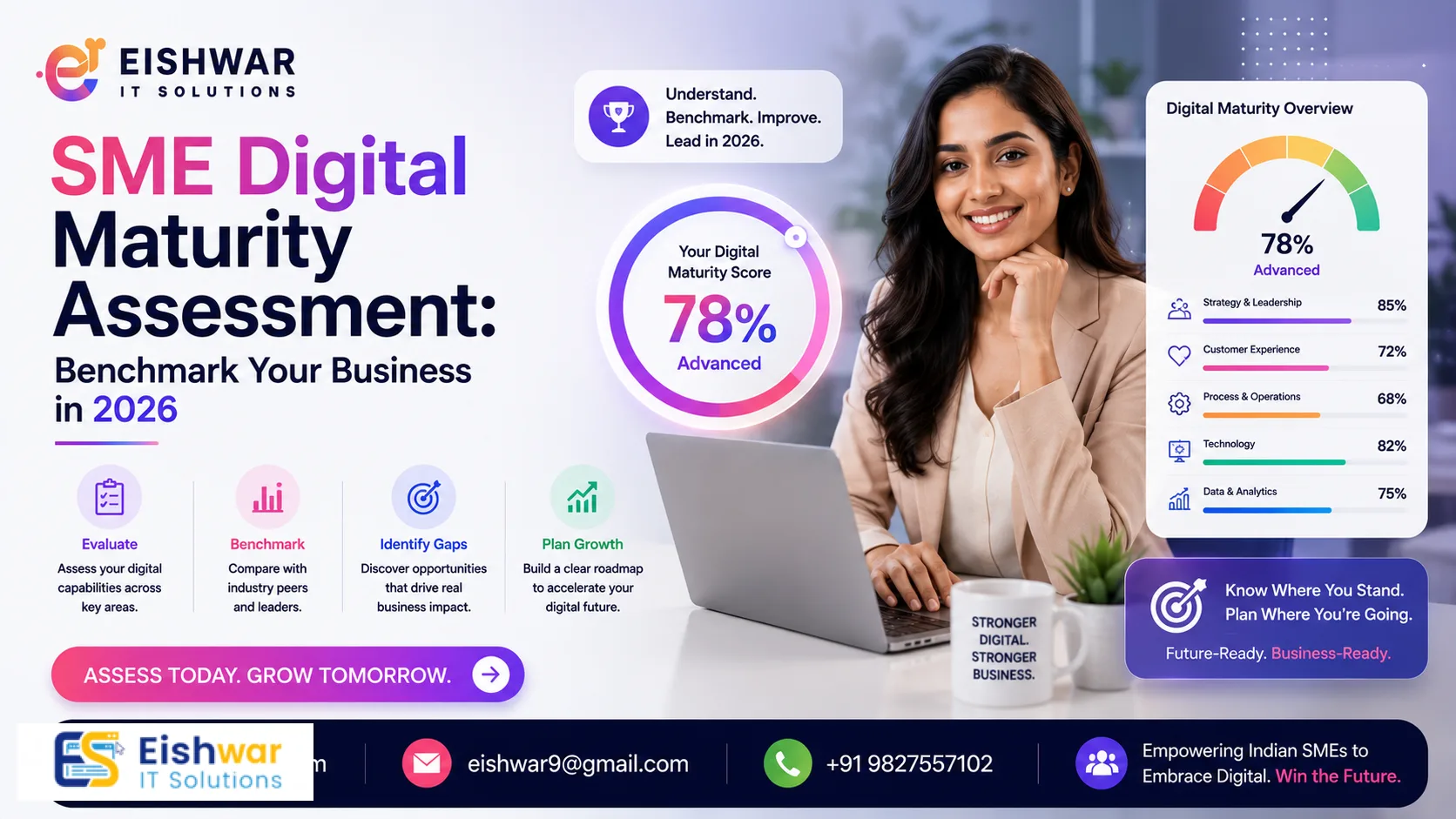
Score your SME (1-5) across these areas. Be brutally honest—overestimating leads to wasted investments.
- Strategy & Leadership: Is digital transformation a priority? Do leaders champion it? For example, does the CEO regularly discuss digital goals in meetings, or is it delegated to a junior employee?
- Customer Experience: How do customers interact with you online? Is it seamless? Can a customer order, pay, and track delivery without calling you? If not, you're likely at Level 2 or below.
- Operations & Processes: Are core processes digitized and automated? For instance, is invoice generation manual or automated? Are approvals done via email or a workflow tool?
- Technology & Data: What tools do you use? How do you manage data? Do you have a single source of truth for customer data, or is it scattered across Excel files and sticky notes?
- People & Culture: Are employees trained and open to digital change? Do they resist new tools, or do they actively suggest improvements? A culture of learning is critical.
Scoring guide: 1 = Not started, 2 = Basic adoption, 3 = Integrated but not optimized, 4 = Data-driven, 5 = Innovative and continuous improvement.
Step 3: Identify Your Maturity Level
Average the scores. The result indicates your current level (1-5). For example, if you score 2.5 across dimensions, you're between Level 2 and Level 3. Focus on moving to Level 3 by integrating tools and documenting processes.
Example: A small IT services firm in Bangalore scored 3.2 on average. Their customer experience was strong (4) because they used a CRM, but operations (2.5) lagged because project management was still done via email. Their priority became implementing a project management tool like Asana or Trello.
Step 4: Prioritize Gaps
List the biggest gaps between current and desired level. For example, if you're Level 2 but want Level 3, focus on integration. If you're Level 3 but want Level 4, focus on data analytics. Use a simple matrix: impact vs. effort. Quick wins (high impact, low effort) should be tackled first.
Practical example: A retailer found that automating invoice generation (low effort, high impact) could save 10 hours per week. They implemented it in two days using a free tool. This built momentum for bigger projects like CRM integration.
Step 5: Create an Action Plan
Set 3-6 month goals. Example: 'Implement a CRM within 90 days' or 'Automate invoice generation by next quarter.' Break each goal into weekly tasks. Assign ownership. For instance, the operations head might be responsible for researching CRM options, while the IT person handles integration.
Tip: Use a simple project management tool like Trello or a shared Google Sheet to track progress. Review monthly with your team to adjust priorities if needed.
Expert Tips
- Start small, think big: Don't try to jump from Level 1 to Level 5 overnight. Focus on one dimension at a time. For example, a small grocery store might start by digitizing inventory with a barcode scanner before moving to online ordering.
- Use free tools: Google's Digital Maturity Quiz or the Digital Readiness Tool by MSME Ministry can give you a quick baseline. These are designed for Indian SMEs and consider local constraints like internet bandwidth and budget.
- Involve your team: Digital maturity is cultural. Train employees and celebrate small wins to build momentum. For instance, when a team member successfully uses the new CRM for the first time, acknowledge it in a team meeting. This reduces resistance and fosters ownership.
- Reassess regularly: Conduct this assessment every 6-12 months to track progress and adjust strategy. Technology evolves, and so do your business needs. A reassessment might reveal that a tool you adopted six months ago is now outdated or that a new opportunity has emerged.
- Leverage government schemes: The Indian government offers subsidies and training under the Digital MSME scheme. Check if you're eligible for support to offset costs of software or training.
Common Mistakes
- Over-relying on technology: Tools alone won't transform your business. Process change and people buy-in are equally important. A CRM is useless if your sales team doesn't use it. Invest in training and change management.
- Ignoring data security: As you digitize, protect customer and business data. Basic cybersecurity measures are non-negotiable. Use strong passwords, enable two-factor authentication, and back up data regularly. A data breach can destroy trust and lead to legal issues.
- Copying larger competitors: SMEs have different constraints. Choose solutions that scale with your budget and needs. A multinational might use a $10,000 ERP, but a small business can start with a $50 per month cloud-based solution that does 80% of the same functions.
- Skipping measurement: Without metrics, you can't know if you're improving. Define KPIs like customer acquisition cost, order processing time, or website conversion rate. Track them monthly. For example, if you implement a chatbot, measure how many queries it resolves without human intervention.
- Underestimating the human factor: Digital transformation can be intimidating for employees. Provide continuous training and support. Create a 'digital champions' program where enthusiastic employees help others adopt new tools.
Future Trends
By 2027, digital maturity assessments will likely incorporate AI-driven benchmarking tools that compare your SME with industry peers in real-time. Imagine logging into a dashboard that shows you're at Level 3.2, while similar businesses in your sector average 3.8. This would highlight specific areas to improve, like customer experience or data analytics.
👉 Free Homepage Demo
Book DemoExpect more focus on sustainability metrics—how digital tools reduce waste and carbon footprint. For example, a digital inventory system can reduce overstocking, which in turn cuts waste. SMEs that can demonstrate sustainability gains may attract eco-conscious customers and even qualify for green loans.
Also, the rise of generative AI will push SMEs to assess their readiness for AI-powered content, customer service, and process automation. Early adopters will gain a competitive edge. For instance, a small marketing agency could use AI to generate social media posts, freeing up time for strategy. But this requires a foundation of clean data and skilled staff.
Finally, the integration of ONDC will make digital maturity even more critical. SMEs that are digitally mature can easily onboard onto ONDC and reach millions of customers. Those that aren't will struggle to participate in this growing ecosystem.
FAQs
What is a digital maturity assessment?
It's a structured evaluation of how effectively your business uses digital technologies across strategy, operations, customer experience, and culture. It helps you identify strengths and gaps, so you can prioritize investments and track progress over time.
How long does it take to complete an assessment?
A basic assessment can be done in a few hours with a team meeting. A more detailed one, including data collection and analysis, may take 1-2 days. The key is to involve the right people and be honest in your scoring.
Is this assessment only for tech companies?
No. Any SME—from retail to manufacturing to services—can benefit. Digital maturity applies to all industries. A small restaurant can assess how it uses online ordering, a manufacturer can evaluate its supply chain digitization, and a consultancy can look at client management tools.
What if my SME scores very low?
That's actually a good starting point. Low scores highlight immediate opportunities for quick wins, like digitizing billing or setting up a basic website. Start with one small change, and build momentum. Many successful SMEs began at Level 1 and moved up step by step.
How often should we reassess?
Every 6 to 12 months is ideal. This keeps your strategy aligned with business growth and tech advancements. For example, if you've implemented a CRM, reassess to see how it's impacting customer satisfaction and whether you're ready for the next step, like automation.
Can we do this ourselves or need a consultant?
You can start with a DIY approach using free templates and tools like the MSME Ministry's Digital Readiness Tool. However, an external consultant can provide unbiased insights and industry benchmarks. If your budget allows, consider a consultant for the first assessment to set a solid foundation.
What are the costs involved in improving digital maturity?
Costs vary widely. You can start with free tools (e.g., Google Workspace for email and docs, Zoho CRM free tier). As you progress, you might invest in paid tools like TallyPrime (₹18,000 one-time) or a cloud ERP like Odoo (₹1,200/user/month). The key is to match spending with expected ROI. A simple automation that saves 10 hours a week can justify a small monthly subscription.
Conclusion
Digital maturity isn't about having the most expensive tech—it's about using the right tools strategically. By conducting a simple assessment, your SME can move from guesswork to a clear roadmap. In 2026, the businesses that thrive will be those that know exactly where they stand and take deliberate steps forward. Start your assessment today and turn digital transformation from a buzzword into a growth engine. Remember, every big journey begins with a single step—and that step is understanding your current reality.
CTA
Ready to benchmark your SME? Contact EishwarITSolution for a free digital maturity consultation. Our experts will help you assess your current state and create a personalized transformation plan. Don't wait—the future is digital. Whether you're at Level 1 or Level 4, we can guide you to the next level with practical, affordable solutions tailored for Indian SMEs.