
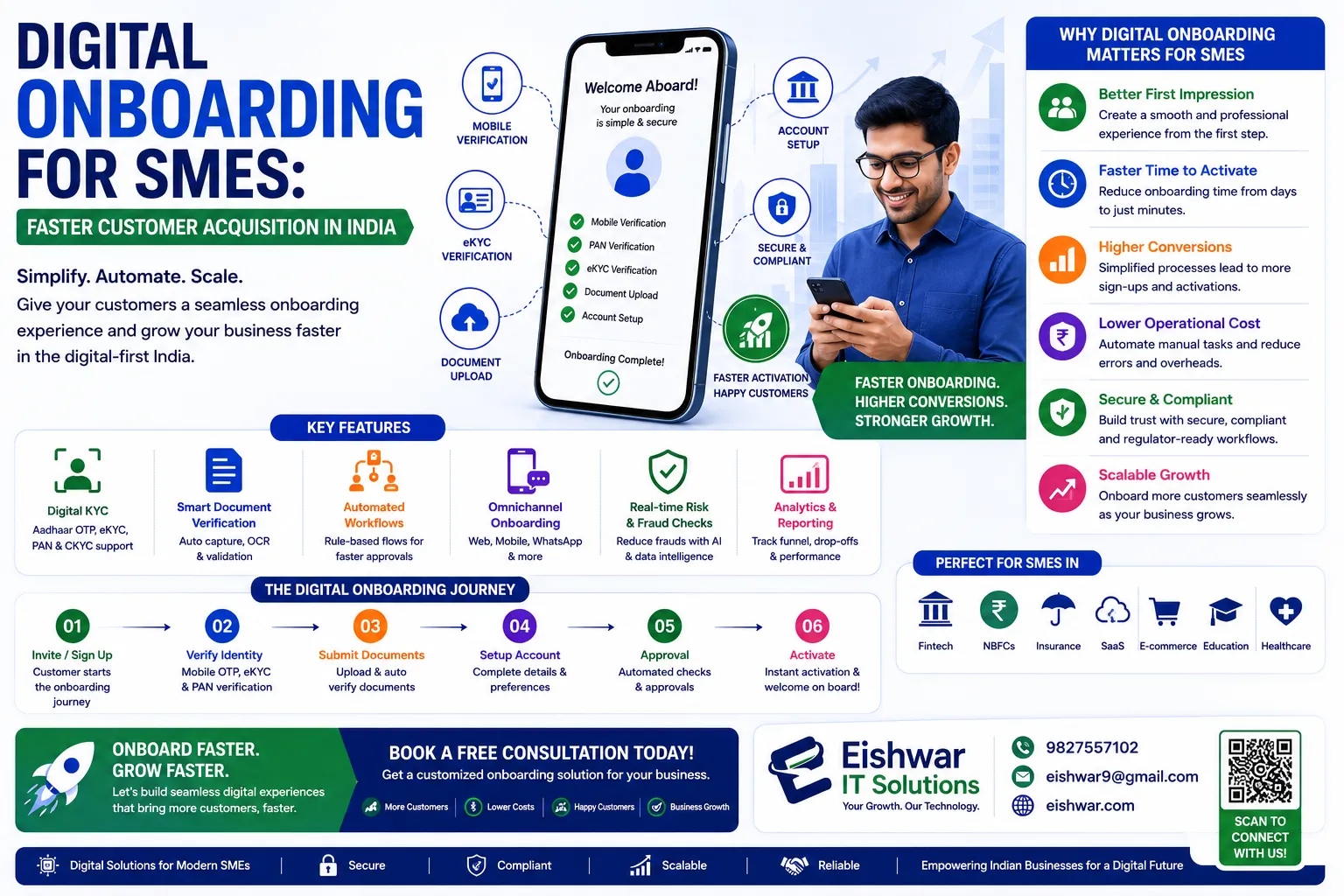
Digital Onboarding for SMEs: Faster Customer Acquisition in India
Published on: 17 Jun 2026
Digital Onboarding for SMEs: Faster Customer Acquisition in India
Introduction
In 2026, Indian SMEs face a critical challenge: acquiring customers quickly without sacrificing security or compliance. Traditional paper-based onboarding is slow, error-prone, and off-putting to modern customers. Digital onboarding—the process of verifying and enrolling customers entirely online—offers a powerful solution. This guide explores how SMEs can implement digital onboarding to accelerate growth, reduce costs, and enhance customer experience.
Learn more about our Website services
Consider a small retail business in Mumbai that used to take 2–3 days to manually verify customer documents for a loyalty program. After switching to a digital onboarding system using Aadhaar eKYC and a mobile app, they reduced the process to under 5 minutes. Customer sign-ups increased by 60%, and the cost per acquisition dropped by 40%. This is the kind of transformation digital onboarding can deliver for SMEs across India.
Main Section 1: What is Digital Onboarding and Why It Matters for SMEs
Digital onboarding uses technology to verify customer identity, collect required documents, and create accounts without physical interaction. For SMEs, this means faster conversions, lower operational costs, and access to a wider customer base. In India, with the rise of Aadhaar-based eKYC and UPI, digital onboarding has become both feasible and expected.
For example, a small fintech lending startup reduced its customer acquisition time from 3 days to 15 minutes by implementing a mobile-first digital onboarding flow. The result? A 40% increase in loan applications and a 25% reduction in drop-offs. Similarly, a micro-insurance provider in rural Rajasthan used a WhatsApp-based onboarding bot to enroll farmers in crop insurance. The bot guided users through Aadhaar verification and document upload in under 2 minutes, leading to a 50% increase in enrollments during the sowing season.
Why does this matter? Because in a competitive market, speed and convenience are key differentiators. A customer who abandons a lengthy onboarding process is unlikely to return. Digital onboarding not only captures customers faster but also builds trust by offering a seamless, modern experience. For SMEs with limited resources, it reduces the need for manual data entry, paperwork storage, and physical verification visits, freeing up staff to focus on core business activities.
Practical tip: Start by identifying the most time-consuming step in your current onboarding. If it's document collection, digitize that first. If it's identity verification, integrate Aadhaar eKYC. Small, incremental changes can yield big results.
Main Section 2: Key Components of a Digital Onboarding System
To build an effective digital onboarding system, SMEs need:
- Identity Verification: Use Aadhaar-based eKYC, PAN verification, or video-based KYC to confirm customer identity. For example, a small NBFC in Pune uses Aadhaar OTP verification for low-value loans and video KYC for loans above ₹50,000, balancing speed and security.
- Document Collection: Allow customers to upload documents via mobile camera or cloud storage. Use OCR to auto-extract data, reducing manual errors. A logistics SME in Delhi integrated OCR for driver license verification, cutting document processing time from 10 minutes to 30 seconds.
- Biometric Authentication: Integrate fingerprint or facial recognition for added security. A small pharmacy chain in Bengaluru uses facial recognition for customer loyalty accounts, ensuring only the account holder can access discounts.
- Digital Signature: Enable e-signatures to complete agreements instantly. A real estate agent in Chennai uses e-signatures for rental agreements, allowing tenants to sign from anywhere, reducing lease cycle time from 3 days to 2 hours.
- Compliance Checks: Automate AML and fraud checks using third-party APIs. For instance, a small investment advisory firm uses an API that cross-references customer data with government watchlists, ensuring compliance with SEBI regulations without manual effort.
Actionable Tip: Start with a simple mobile app or web portal that supports Aadhaar OTP-based verification. This is low-cost and widely accepted. As you grow, layer on additional features like video KYC or biometrics. Remember, the goal is to reduce friction, not add complexity.
👉 Don't wait for the perfect moment; turn your vision into reality today.
Free ConsultationMain Section 3: Implementation Steps for SMEs
Follow these steps to implement digital onboarding:
- Assess Your Needs: Identify the most common customer onboarding pain points in your business. For example, a small e-commerce seller found that customers abandoned sign-up because they had to manually enter address details. By integrating Google Maps autofill, they reduced drop-offs by 20%.
- Choose the Right Technology: Select a platform that offers eKYC APIs, document verification, and e-signature capabilities. Look for solutions that comply with Indian regulations. For instance, a small accounting firm chose a platform that supports both Aadhaar eKYC and PAN verification, ensuring they can onboard both individual and business clients.
- Integrate with Existing Systems: Ensure the onboarding system works with your CRM, accounting software, and other tools. A small manufacturing company integrated its digital onboarding with Tally, so customer data automatically populated invoices and ledgers, saving 5 hours of manual data entry per week.
- Test Thoroughly: Run pilot tests with a small group of customers to identify issues. A small health clinic tested its onboarding app with 50 patients and discovered that the document upload feature failed on older Android phones. They optimized the app to compress images before upload, resolving the issue.
- Train Your Team: Educate staff on the new process and how to assist customers. A small travel agency created a 15-minute video tutorial for its agents, showing them how to guide customers through the digital onboarding flow. This reduced support calls by 30%.
- Monitor and Optimize: Track conversion rates, drop-off points, and customer feedback to continuously improve. A small food delivery service used analytics to find that 40% of users dropped off at the document upload step. They simplified the process by allowing customers to take a photo of their ID instead of uploading a file, boosting completion rates by 25%.
Example: A small e-commerce seller integrated a WhatsApp-based onboarding bot. Customers could verify their identity and create an account in under 2 minutes—leading to a 30% increase in repeat purchases. The bot also sent automated reminders for incomplete applications, recovering 15% of abandoned sign-ups.
Expert Tips
Here are expert tips for successful digital onboarding:
- Keep It Simple: Minimize the number of steps. Every additional field reduces conversion by 10%. A small online tutoring platform reduced its sign-up form from 12 fields to 5, and saw a 35% increase in completed registrations.
- Mobile-First Design: Ensure your onboarding works flawlessly on smartphones, as most Indian users access the internet via mobile. A small grocery delivery service found that 80% of its customers used mobile devices, so they optimized their onboarding for small screens, resulting in a 20% higher conversion rate than their desktop version.
- Provide Clear Instructions: Use simple language and visual guides to help customers through the process. A small insurance company added step-by-step images and tooltips to its onboarding flow, reducing customer queries by 40%.
- Offer Support: Include live chat or a helpline for customers who face issues. A small fintech startup integrated a chatbot that could answer common questions about document requirements, reducing the need for human support by 50%.
- Prioritize Security: Use encryption and comply with India's data protection laws (DPDP Act 2023). A small healthcare provider implemented end-to-end encryption for all customer data and conducted regular security audits, building trust and reducing data breach risks.
Common Mistakes
Avoid these common pitfalls:
👉 Free Website Audit
Get Free Audit- Overcomplicating the Process: Asking for too many documents or steps leads to high abandonment rates. A small lending company initially required 8 documents for a loan application. After reducing it to 3 (Aadhaar, PAN, and bank statement), applications increased by 50%.
- Ignoring User Experience: A clunky interface or slow loading times drives customers away. A small e-commerce site lost 30% of potential customers because its onboarding page took 10 seconds to load. After optimizing images and using a CDN, load time dropped to 2 seconds, and conversions improved.
- Neglecting Compliance: Failing to follow RBI or SEBI guidelines can result in penalties. A small investment firm was fined ₹50,000 for not conducting proper video KYC for high-value transactions. They now use a compliant video KYC solution that records and stores sessions securely.
- Not Testing Across Devices: The onboarding may work on some devices but fail on others. A small travel agency discovered that its onboarding form didn't render properly on iPhones, causing a 20% drop in sign-ups from iOS users. They fixed the CSS issues and regained lost conversions.
- Forgetting the Human Touch: While automation is key, some customers may need personal assistance. A small insurance broker offers a callback option for customers who struggle with digital onboarding. This hybrid approach has helped them retain elderly customers who prefer human interaction.
Future Trends
Looking ahead, digital onboarding for SMEs will evolve with:
- AI-Powered Verification: Machine learning will detect fake documents and fraud patterns more accurately. For example, a small fintech startup uses AI to analyze document metadata and flag inconsistencies, reducing fraud by 70%.
- Video KYC Becoming Standard: Live video verification will be common for high-value transactions. A small wealth management firm now uses video KYC for all accounts above ₹1 lakh, ensuring compliance while maintaining a personal touch.
- Blockchain for Identity Management: Self-sovereign identity solutions will give customers control over their data. A small healthcare SME is piloting a blockchain-based system where patients share only necessary health records, reducing data exposure.
- Integration with Open Banking: SMEs will be able to verify income and credit history instantly via APIs. A small lending startup now uses open banking APIs to fetch bank transaction data, enabling instant loan approvals without manual income proof.
- Voice-Based Onboarding: Voice recognition will enable onboarding for illiterate or less tech-savvy customers. A small agricultural cooperative in Uttar Pradesh is testing a voice-based system where farmers can verify their identity using voice biometrics, making onboarding accessible to all.
FAQs
- What is digital onboarding for SMEs? It is the process of verifying and enrolling customers using digital tools like eKYC, document uploads, and e-signatures, without physical interaction. This includes identity verification, document collection, and account creation, all done online.
- Is digital onboarding legal in India? Yes, it is legal and regulated by authorities like RBI, SEBI, and UIDAI. eKYC via Aadhaar is widely accepted. However, SMEs must ensure compliance with sector-specific guidelines, such as RBI's KYC norms for financial services.
- How much does digital onboarding cost for a small business? Costs vary but can start as low as ₹5,000 per month for basic API integrations, plus per-verification fees (e.g., ₹2–₹5 per Aadhaar eKYC). For a more comprehensive solution with video KYC and e-signatures, costs may range from ₹15,000 to ₹50,000 per month, depending on volume.
- Can I use Aadhaar for digital onboarding? Yes, Aadhaar-based eKYC is one of the most common and cost-effective methods for identity verification. It uses OTP or biometric authentication to verify identity instantly. However, ensure you comply with UIDAI's usage guidelines and obtain customer consent.
- What are the security risks? Risks include data breaches and identity theft. Mitigate them by using encryption, secure APIs, and complying with DPDP Act 2023. Additionally, implement multi-factor authentication and regular security audits to protect customer data.
- How long does it take to implement digital onboarding? Implementation can take anywhere from 2 weeks to 3 months, depending on complexity. A basic Aadhaar eKYC integration can be done in 2–4 weeks, while a full-fledged system with video KYC and CRM integration may take 6–12 weeks.
- Can digital onboarding work for rural customers? Yes, with the right approach. Use simple interfaces, support local languages, and offer offline fallback options. For example, a small agri-tech company in Madhya Pradesh uses a voice-guided onboarding process in Hindi, enabling farmers with low literacy to enroll easily.
Conclusion
Digital onboarding is no longer a luxury for Indian SMEs—it's a necessity. By adopting a streamlined, secure, and user-friendly onboarding process, you can acquire customers faster, reduce costs, and stay ahead of the competition in 2026. Start small, test often, and scale as you grow. Remember, the key is to balance speed with security, and automation with human touch. Whether you're a small retailer, a fintech startup, or a service provider, digital onboarding can transform your customer acquisition journey.
👉 Free Homepage Demo
Book DemoCTA
Ready to transform your customer acquisition? Contact EishwarITSolution today for a free consultation on implementing digital onboarding tailored to your SME. Our experts will help you choose the right tools, integrate with your existing systems, and ensure compliance with Indian regulations. Don't let slow onboarding hold your business back—embrace digital transformation now.