
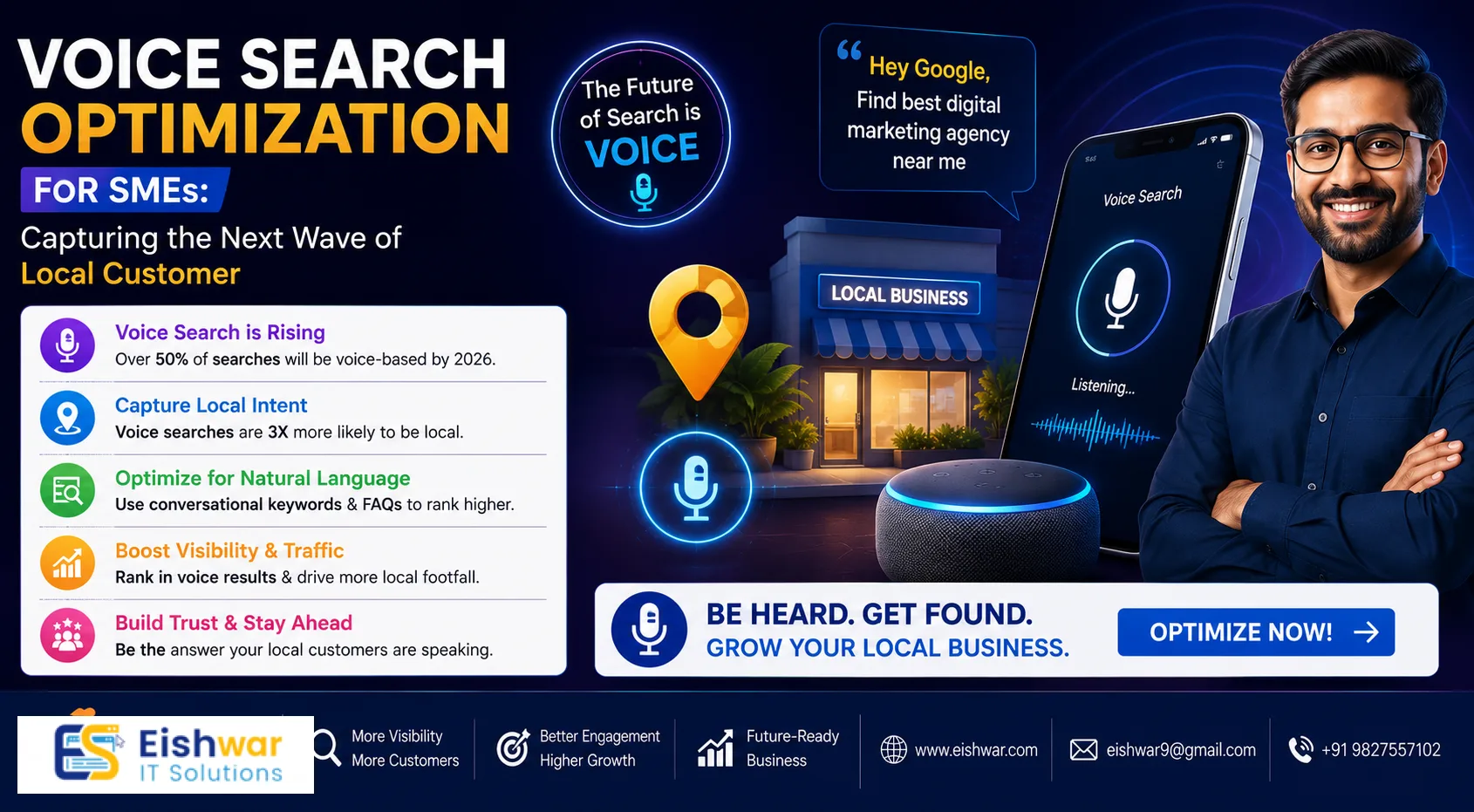
Voice Search Optimization for SMEs: Capturing the Next Wave of Local C
Published on: 06 Jul 2026
Voice Search Optimization for SMEs: Capturing the Next Wave of Local Customers in India
Introduction
Imagine a busy mom in Mumbai asking her phone, 'Where’s the best bakery near me that delivers?' Or a startup founder in Bengaluru saying, 'Hey Google, find a reliable IT support company.' These are not futuristic scenarios—they’re happening right now. Voice search is exploding in India, driven by affordable smartphones, cheap data, and the rise of vernacular assistants. For SMEs, this shift is a golden opportunity to capture local customers without a massive marketing budget.
Learn more about our Website services
Voice search optimization (VSO) is the process of making your business discoverable through spoken queries. Unlike text searches, voice queries are longer, more conversational, and often location-specific. If your SME isn’t optimized for voice, you’re missing out on a growing segment of buyers who prefer speaking over typing. In this guide, we’ll walk you through everything you need to know—from understanding how voice search works to practical steps you can take today.
Main Section 1: Why Voice Search Matters for Indian SMEs
India is a mobile-first nation with over 800 million internet users. Voice search adoption is skyrocketing because it’s faster, easier, and supports multiple languages. According to a 2025 report, nearly 40% of online searches in India are now voice-based, and that number is climbing. For SMEs, this means your customers are using voice to find everything from plumbers to pizza joints.
Voice search is inherently local. When someone asks, 'Where can I get my laptop repaired in Pune?' they’re ready to buy. If your business appears in the top results, you’ve won a customer. Moreover, voice assistants like Google Assistant, Alexa, and Siri often pull from Google My Business (GMB) listings and local directories. Optimizing for voice isn’t just about tech—it’s about being where your customers are, when they need you.
For Indian SMEs, the cost of ignoring voice search is high. Competitors who optimize first will grab the lion’s share of local traffic. The good news? Voice optimization doesn’t require a huge budget. It’s about smart, targeted changes to your online presence. For example, a small salon in Delhi could see a 30% increase in bookings just by updating its GMB profile and adding FAQ content for voice queries like 'best haircut near Connaught Place.'
Main Section 2: How Voice Search Works and What It Means for Your SME
Voice search relies on natural language processing (NLP) and machine learning. When a user speaks a query, the assistant interprets the intent, checks local databases, and returns a concise answer—often from a featured snippet or GMB listing. This is different from text search, where users type keywords like 'bakery Mumbai.' Voice queries are longer: 'What’s the best bakery in Andheri that’s open now?'
For SMEs, this means you need to optimize for conversational phrases and questions. Think about how your customers speak. Use tools like AnswerThePublic or Google’s 'People also ask' to find common voice queries. Also, ensure your website loads fast—voice search prioritizes speed. A slow site will lose you customers. For instance, a study by Google shows that 53% of mobile users abandon a site if it takes longer than 3 seconds to load. That’s a direct hit to voice search performance.
👉 Don't wait for the perfect moment; turn your vision into reality today.
Free ConsultationAnother key factor is local intent. Most voice searches have a local modifier: 'near me,' 'in Delhi,' 'open now.' Your Google My Business profile must be accurate, complete, and regularly updated. Include your business hours, address, phone number, and services. Encourage reviews—voice assistants often read out positive ratings. A practical tip: Add a Q&A section to your GMB listing, answering common questions like 'Do you offer home delivery?' or 'What are your weekend timings?'
Main Section 3: Practical Steps to Optimize Your SME for Voice Search
Here’s a step-by-step action plan you can implement today:
- Step 1: Claim and Optimize Your Google My Business Listing. Fill every field. Add high-quality photos, respond to reviews, and post updates. This is the single most important step for local voice search. For example, a restaurant in Jaipur that posts weekly updates about special thalis can appear in voice results for 'best thali near Hawa Mahal.'
- Step 2: Use Natural Language in Your Content. Write FAQ pages that answer common questions your customers ask. Use a conversational tone. For example, instead of 'IT support services,' write 'We provide fast IT support for small businesses in Chennai.' Include phrases like 'how to fix a slow laptop' or 'where to get affordable website design.'
- Step 3: Target Long-Tail Keywords. Use phrases like 'affordable website design for startups in Bangalore' rather than just 'website design.' Tools like Ubersuggest and SEMrush can help. Also, consider voice-specific queries like 'what is the best time to visit your store?' or 'do you offer discounts for first-time customers?'
- Step 4: Improve Your Website Speed. Use Google’s PageSpeed Insights. Compress images, enable caching, and use a CDN. Voice users expect instant answers. A slow site can drop your ranking in voice results. Aim for a load time under 2.5 seconds.
- Step 5: Implement Structured Data (Schema Markup). Add LocalBusiness schema to your site. This helps search engines understand your business details and increases chances of appearing in voice results. Include fields like opening hours, payment methods, and service area.
- Step 6: Build Local Citations. List your business on directories like Justdial, Sulekha, and IndiaMart. Consistency in NAP (Name, Address, Phone) across all platforms is crucial. Even a small mismatch can confuse voice assistants and hurt your visibility.
- Step 7: Create Voice-Friendly Content. Write short paragraphs, use bullet points, and include clear headings. Voice assistants often read the first few lines of a page. For example, a plumber in Pune could create a page titled 'Emergency plumber in Kothrud' with a quick answer like 'We offer 24/7 plumbing services. Call now for fast response.'
For example, a small restaurant in Jaipur could add a page titled 'Best Rajasthani thali near Hawa Mahal' with answers to common questions like 'Do you offer home delivery?' or 'What are your timings?' That page could show up in voice results, driving foot traffic. Another example: A boutique in Mumbai could optimize for 'ethnic wear for weddings in Bandra' by including a FAQ section on sizing, delivery, and customization.
👉 Free Website Audit
Get Free AuditExpert Tips
We spoke with digital marketing experts who specialize in voice search for Indian SMEs. Here are their top tips:
- Priya Sharma, SEO Consultant: 'Don’t just focus on English. Indian users often mix languages—Hinglish queries are common. Optimize for phrases like 'accha pizza near me' or 'sasta mobile repair.' Use tools like Google Trends to identify popular Hinglish phrases in your niche.'
- Rahul Verma, Voice Tech Strategist: 'Use conversational AI tools like Chatbots on your website. They can answer voice-like queries and improve user experience, which indirectly boosts your voice search ranking. For instance, a chatbot that answers 'What are your store hours?' can be trained to respond naturally.'
- Anjali Mehta, Local SEO Specialist: 'Leverage user-generated content. Encourage customers to leave voice reviews on Google. These are gold for voice search because they contain natural language. A review like 'The service was amazing and quick' can match voice queries like 'quick service near me.'
- Vikram Singh, SME Digital Transformation Coach: 'Think about voice commerce. If you sell products, enable voice ordering through assistants like Alexa. It’s still early, but early adopters will win. For example, a grocery store in Bangalore could allow customers to add items to a cart via voice commands.'
Common Mistakes
Avoid these pitfalls when optimizing for voice search:
- Ignoring Mobile Optimization: Voice searches happen mostly on mobile. If your site isn’t mobile-friendly, you’re invisible. Use responsive design and test on real devices. A common error is having text that’s too small to read on a phone screen.
- Using Jargon or Complex Language: Voice queries are simple. Your content should be too. Avoid industry buzzwords that customers wouldn’t say aloud. Instead of 'comprehensive IT solutions,' say 'we fix computers and set up networks.'
- Neglecting Reviews: Positive reviews boost your local ranking and are often read by voice assistants. Don’t ignore them. Respond to every review, good or bad. For example, a hotel in Goa that responds to reviews can appear in voice results for 'best beach resort with good reviews.'
- Forgetting About Privacy: Some users hesitate to use voice search due to privacy concerns. Be transparent about data usage on your site and in your marketing. Add a clear privacy policy and mention that voice interactions are secure.
- Not Monitoring Performance: Use Google Search Console and GMB insights to track voice search queries. Adjust your strategy based on what’s working. For instance, if you notice queries like 'cheapest salon near me' are common, create content targeting that phrase.
Future Trends
Voice search is evolving fast. Here’s what Indian SMEs should watch for in the next 2–3 years:
👉 Free Homepage Demo
Book Demo- Vernacular Voice Assistants: Google and Amazon are investing heavily in Hindi, Tamil, Telugu, and other Indian languages. SMEs will need to optimize for multiple languages. Start by adding content in the most spoken language in your region.
- Voice Commerce (V-Commerce): Customers will order products using voice. SMEs with streamlined checkout and voice-enabled catalogs will benefit. For example, a clothing store could allow customers to say 'order a blue kurta in size M' and complete the purchase.
- Hyperlocal Targeting: Voice assistants will get smarter about context—like traffic, weather, and past behavior. SMEs can use this to offer personalized deals. A café could send a voice notification: 'It’s raining in your area. Get 20% off on hot coffee today.'
- Integration with IoT: Smart speakers and car assistants will become common. SMEs that optimize for these devices will have an edge. For instance, a car repair shop could be discovered via voice commands in a connected car.
- AI-Powered Voice Analytics: Tools that analyze voice search data will help SMEs refine their strategies. Early adoption will be a competitive advantage. Imagine a tool that tells you exactly which voice queries are driving calls to your business.
FAQs
What is voice search optimization, and why do SMEs need it?
How does voice search differ from traditional text search?
What are the best tools for voice search optimization?
Can small businesses with limited budgets afford voice search optimization?
How long does it take to see results from voice search optimization?
Do I need to create content in multiple Indian languages for voice search?
What is the role of Google My Business in voice search?
How can I measure the success of my voice search optimization efforts?
Conclusion
Voice search is not a passing trend—it’s a fundamental shift in how people find businesses. For Indian SMEs, it’s a chance to compete with larger companies by being more local, more conversational, and more responsive. By following the steps in this guide—optimizing your GMB listing, using natural language, improving site speed, and leveraging structured data—you can capture the growing wave of voice-driven customers.
The key is to start now. Voice search adoption in India is accelerating, and early movers will reap the rewards. Don’t let your SME be left behind in the voice revolution. Take action today, and watch your local customer base grow.
CTA
Ready to make your SME voice-search ready? Contact EishwarITSolution today for a free consultation. Our experts will audit your current online presence and create a custom voice optimization plan tailored to your business. Call us at +91-XXXXXXXXXX or email info@eishwar.com. Let’s help you be the answer your customers are looking for.