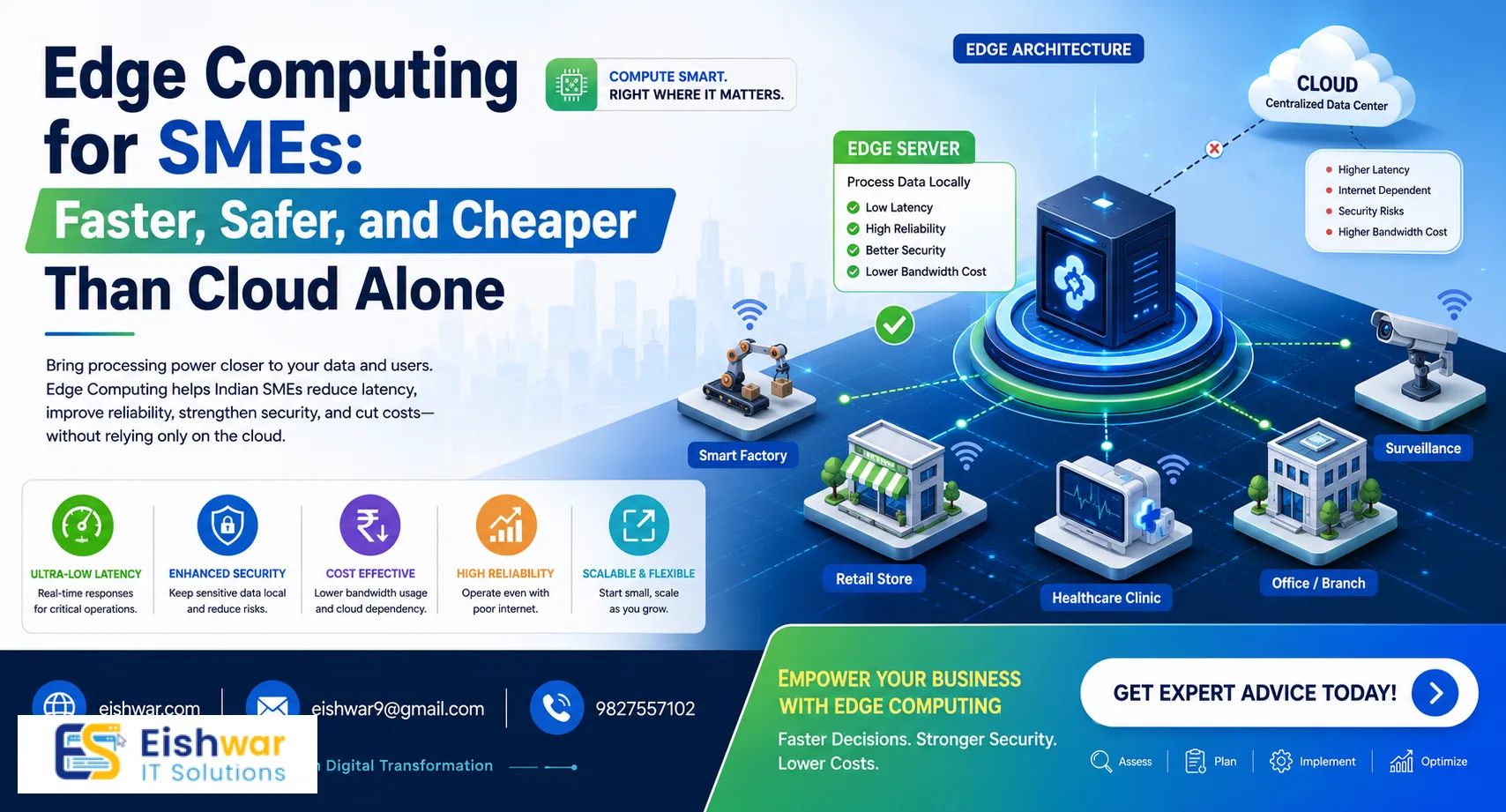
Edge Computing for SMEs: Faster, Safer, and Cheaper Than Cloud Alone
Introduction
Imagine your retail store's CCTV camera instantly alerting security when a suspicious person loiters near the stockroom—without sending a single frame to the cloud. Or your manufacturing unit detecting a machine vibration anomaly in milliseconds, preventing a costly breakdown. This isn't sci-fi; it's edge computing. And for Indian SMEs, it's a game-changer that's often overlooked.
Most small businesses assume digital transformation means moving everything to the cloud. But the cloud has limits: latency, bandwidth costs, and privacy risks. Edge computing flips the script by processing data locally—on devices, gateways, or small servers near the data source. Only relevant insights travel to the cloud. The result? Faster decisions, lower costs, and stronger data control.
In this guide, we'll demystify edge computing for SME owners, marketers, and professionals. You'll learn practical ways to adopt it, real-world examples from Indian businesses, and why it's becoming essential for staying competitive in 2026 and beyond.
Main Section 1: What Is Edge Computing and Why Should SMEs Care?
Edge computing is a distributed computing model where data processing happens close to where data is generated—at the 'edge' of the network—rather than in a centralized cloud data center. Think of it as bringing the brain closer to the senses.
For SMEs, this matters because:
- Speed: Real-time decisions (e.g., stopping a faulty machine) happen in milliseconds, not seconds. For example, a bakery in Mumbai uses edge sensors to monitor oven temperature—if it spikes, the system adjusts the flame instantly, preventing burnt batches.
- Cost: Less data sent to the cloud means lower bandwidth and storage bills. A small logistics firm in Delhi reduced its monthly cloud bill by 60% by processing route data locally.
- Reliability: Even if internet goes down, edge devices keep working. A clinic in a remote village in Uttar Pradesh continues to run its patient management system offline, syncing data when connectivity returns.
- Privacy: Sensitive data (customer info, trade secrets) stays local. A boutique clothing store in Jaipur processes customer purchase history on an edge device, never uploading it to the cloud, ensuring compliance with India's DPDP Act.
Example: A small cold storage business in Pune uses edge sensors to monitor temperature. If a unit fails, the edge gateway triggers an alert locally and sends a summary to the owner's phone. No cloud dependency, no data overload—just instant action. The owner saved ₹50,000 in potential spoilage costs in the first month alone.
Contrast this with pure cloud: every temperature reading would be sent to a server in Mumbai, processed, then sent back—adding delay and cost. For time-critical operations, that's unacceptable. Edge computing eliminates the round trip.
Main Section 2: Practical Edge Computing Use Cases for Indian SMEs
Retail & Local Shops
Edge-powered POS systems can analyze foot traffic, inventory levels, and customer preferences in real time. A grocery store in Bangalore uses an edge device to track shelf stock. When milk packets run low, the system automatically reorders from the distributor—without human intervention. The store owner checks a dashboard once a day. This reduced stockouts by 30% and saved 10 hours per week in manual inventory checks.
Tip: Start with a single edge-enabled camera to count foot traffic. Use free software like TensorFlow Lite on a Raspberry Pi to analyze customer movement patterns.
Manufacturing & Workshops
Small factories in Gujarat use edge devices to monitor machine vibration, temperature, and output. Predictive maintenance alerts prevent breakdowns that could cost lakhs in downtime. One auto parts workshop reduced unplanned downtime by 40% within three months of deploying edge sensors. The edge device sends an alert when vibration exceeds a threshold, allowing the team to replace a bearing before it fails.
Practical detail: The initial investment was ₹25,000 for three edge sensors and a gateway. The savings from avoiding one major breakdown covered the cost within two months.
Logistics & Delivery
Local delivery fleets use edge computing in vehicles to optimize routes in real time. The edge device processes GPS data, traffic updates, and delivery schedules locally, sending only aggregated performance reports to the cloud. This cuts data usage by 70% and ensures route optimization even in areas with patchy internet. A food delivery startup in Hyderabad saw a 15% increase in on-time deliveries after implementing edge-based route planning.
Example: A courier company in Chennai uses edge devices on 50 delivery bikes. The devices calculate the fastest route using local maps, and only upload trip summaries at the end of the day. This saved ₹12,000 per month in data costs.
Healthcare Clinics
A chain of diagnostic clinics in Tier-2 cities uses edge devices to process patient scans locally, generating preliminary reports within seconds. Only anonymized data is sent to the cloud for AI training. This speeds up diagnosis and protects patient privacy under India's DPDP Act. One clinic in Indore reduced report turnaround time from 24 hours to 30 minutes.
Tip: For clinics, start with edge processing for X-rays or ECG readings. Use open-source AI models that run on low-cost hardware like NVIDIA Jetson Nano (₹25,000).
Main Section 3: How to Start with Edge Computing on a Shoestring Budget
You don't need a data center. Here's a step-by-step approach:
- Identify a single pain point: Start with one process that needs real-time response or has high cloud costs. Example: monitoring temperature in a warehouse. A spice trader in Kerala used this approach to reduce spoilage by 20%.
- Choose the right edge device: Raspberry Pi (under ₹5,000) or industrial edge gateways (₹15,000–₹50,000) can handle most SME needs. For heavy AI workloads, consider NVIDIA Jetson Nano (₹25,000).
- Use open-source software: Platforms like EdgeX Foundry or Kaa IoT are free and customizable. For beginners, try Node-RED—a visual programming tool that runs on Raspberry Pi.
- Integrate with existing systems: Most edge devices support APIs to connect with your ERP, CRM, or accounting software. For example, a small retailer integrated edge inventory data with Tally using a simple REST API.
- Start small, scale gradually: Run a pilot for 30 days. Measure latency reduction, bandwidth savings, and downtime avoided. Then expand. A workshop in Pune started with one edge sensor on a critical machine and now has 12 sensors across the factory.
Pro tip: Many Indian telecom providers (Jio, Airtel) now offer edge-as-a-service bundles for SMEs—pay-as-you-go models that include hardware, software, and support. No upfront investment needed. Jio's Edge Starter plan costs ₹999 per month for a basic gateway and 5GB data processing.
Expert Tips
- Prioritize security from day one: Edge devices can be entry points for hackers. Always change default passwords, enable encryption, and keep firmware updated. Use a firewall to isolate edge devices from your main network.
- Don't ditch the cloud entirely: Use a hybrid model—edge for real-time decisions, cloud for analytics, backup, and long-term storage. For example, a retail chain processes sales data locally but sends daily summaries to the cloud for trend analysis.
- Involve your team early: Train staff on basic troubleshooting. Edge devices are simpler than servers but still need care. Create a simple checklist: check power, verify connectivity, review alerts daily.
- Look for government subsidies: India's MSME Ministry and state governments often offer grants for digital adoption. Check for schemes like 'Digital MSME' or state-level innovation funds. For example, the Gujarat government offers up to ₹1 lakh subsidy for IoT adoption in small factories.
- Measure ROI in non-financial terms too: Faster response, customer satisfaction, and compliance are valuable but often ignored. Track metrics like average response time, customer complaints, and audit readiness.
Common Mistakes
- Over-engineering: Buying expensive industrial edge hardware when a Raspberry Pi would suffice. Match device specs to your actual workload. A bakery in Mumbai bought a ₹50,000 industrial gateway to monitor a single oven—a ₹5,000 Raspberry Pi would have worked.
- Ignoring power backup: Edge devices need reliable electricity. Use UPS or solar-powered options, especially in areas with frequent outages. A clinic in Bihar lost patient data because the edge device shut down during a power cut.
- Neglecting data governance: Even if data stays local, you still need policies for who can access it and how long it's retained. A retailer in Delhi faced a privacy complaint after an employee accessed customer data without authorization.
- Expecting instant results: Edge computing requires a mindset shift. Give your team time to adapt to real-time decision-making. A logistics company saw a dip in performance for the first two weeks as drivers adjusted to automated route suggestions.
- Forgetting about scalability: Choose platforms that allow easy addition of more edge nodes as your business grows. A workshop that started with one sensor struggled to add 10 more because the initial platform didn't support scaling.
Future Trends
Edge computing is evolving rapidly. By 2027, Gartner predicts that 75% of enterprise-generated data will be processed outside traditional data centers. For SMEs, this means:
- AI at the edge: TinyML and on-device AI models will let even small devices run smart algorithms—like detecting defective products on a conveyor belt without cloud dependency. A small packaging company in Pune is already piloting a TinyML model on a Raspberry Pi to spot damaged boxes.
- 5G integration: With 5G rollout in Indian cities, edge devices will communicate faster, enabling real-time video analytics and remote control of machinery. A factory in Bengaluru is testing 5G-connected edge cameras for quality inspection.
- Edge-native applications: Expect more SaaS tools designed specifically for hybrid edge-cloud environments, tailored for SMEs. For example, a new platform called 'EdgeSuite' offers pre-built modules for inventory, security, and maintenance.
- Green edge: Energy-efficient edge devices will help SMEs reduce their carbon footprint—a growing compliance requirement for exports. A textile exporter in Tirupur reduced energy consumption by 15% by switching to solar-powered edge sensors.
FAQs
What is edge computing in simple words?
Edge computing processes data near where it's created (e.g., on a sensor, camera, or local server) instead of sending it all to a faraway cloud. It's like having a mini brain on-site that makes quick decisions.
Is edge computing expensive for a small business?
Not anymore. Basic edge devices start at ₹5,000. Cloud savings often offset the hardware cost within months. Many telecom providers offer affordable edge-as-a-service plans for SMEs starting at ₹999 per month.
Can edge computing work without internet?
Yes, that's one of its biggest strengths. Edge devices can operate independently, storing data locally and syncing to the cloud when connectivity is available. This is ideal for rural areas or factories with unreliable internet.
How is edge computing different from cloud computing?
Cloud computing centralizes processing in remote data centers, while edge computing distributes it to local devices. Edge is faster and more private; cloud offers unlimited storage and advanced analytics. They complement each other—use edge for real-time tasks and cloud for long-term analysis.
What are examples of edge devices?
Raspberry Pi, industrial gateways, smart cameras, IoT sensors, and even modern smartphones can act as edge devices. The key is that they have processing power and can run software locally. For SMEs, Raspberry Pi is a popular, low-cost choice.
Does edge computing require special IT skills?
Basic familiarity with networking and device configuration helps, but many managed edge services handle setup and maintenance. You can also partner with a local IT service provider. Many SMEs start with a managed service to avoid the learning curve.
How long does it take to see ROI from edge computing?
Most SMEs see ROI within 3–6 months. For example, a cold storage business saved ₹50,000 in spoilage costs in the first month. A logistics firm reduced data costs by 70% in two months. The key is to start with a high-impact use case.
Can edge computing help with compliance under India's DPDP Act?
Yes. By processing sensitive data locally, edge computing reduces the risk of data breaches during transmission. This helps SMEs comply with data localization requirements. For example, a clinic in Indore processes patient scans on edge devices, keeping personal data within the clinic premises.
Conclusion
Edge computing isn't just for tech giants. For Indian SMEs, it's a practical, affordable way to gain speed, security, and cost control. By processing data locally, you reduce cloud dependency, protect sensitive information, and enable real-time decisions that can save money and improve customer experience.
Start small—pick one use case, test an edge device, and measure the results. As 5G and AI at the edge become mainstream, early adopters will have a significant competitive advantage. The future of digital transformation is not just in the cloud; it's at the edge.
CTA
Ready to explore edge computing for your SME? Contact EishwarITSolution for a free consultation. Our experts will help you identify the right edge use case, recommend cost-effective hardware, and guide you through implementation. Don't let your data travel farther than it needs to—bring intelligence to the edge.