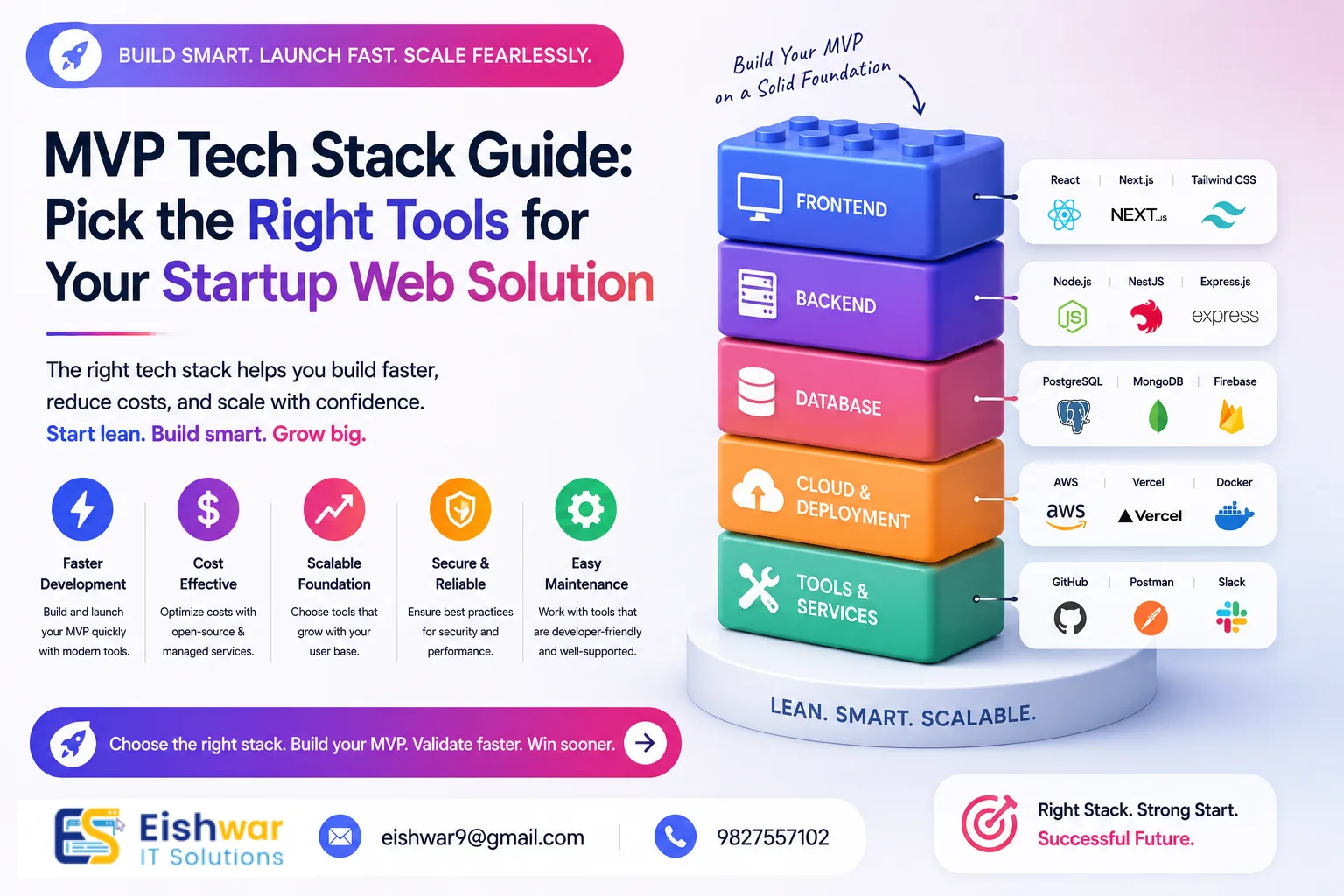
MVP Tech Stack Guide: Pick the Right Tools for Your Startup Web Solution
Introduction
Building a Minimum Viable Product (MVP) is the smartest way to test your startup idea without burning through your budget. But one of the biggest decisions you'll face is choosing the right tech stack. Your tech stack—the combination of programming languages, frameworks, and tools—determines how fast you can build, how easy it is to scale, and how much it costs. For Indian startups operating on tight budgets, this choice can make or break your MVP. In this guide, we'll walk you through how to choose the right tech stack for your MVP web solution, with practical examples and actionable tips. Whether you're a solo founder in Bangalore or a small team in Mumbai, these insights will help you launch faster and smarter.
Consider this: A poorly chosen tech stack can lead to months of rework, skyrocketing hosting costs, or a product that crashes under minimal load. On the other hand, the right stack can accelerate development, reduce expenses, and set you up for seamless growth. For instance, a food delivery startup we advised initially chose a monolithic PHP framework for speed, but later migrated to Node.js when real-time order tracking became essential. The lesson? Start simple, but plan for evolution. Let's dive into the details.
Main Section 1: Understand Your MVP Requirements First
Before diving into technologies, clearly define what your MVP needs to do. List core features, user flows, and performance requirements. For example, if you're building a simple booking platform, you might need user authentication, a database, and a payment gateway. Avoid over-engineering—your MVP should solve one problem well. This clarity will guide your tech stack choices.
Consider your target audience: Are they mobile-first users in India? Then prioritize mobile responsiveness and fast load times. Also, think about your team's expertise. If you're a solo founder or a small team, stick to technologies you know well to avoid learning curves that delay launch. For instance, if you're proficient in Python, Django or Flask can be excellent choices. If your team excels in JavaScript, the MERN stack might be a natural fit. A practical tip: Create a simple feature list and map each feature to potential tools. For example, user authentication can be handled by Firebase or Auth0, while payment processing might require Razorpay or Stripe integration. This mapping helps you see the big picture without getting lost in technical details.
Another key consideration is data storage. Will your MVP need a relational database (like PostgreSQL) for structured data, or a NoSQL database (like MongoDB) for flexibility? For a job board startup, PostgreSQL worked well because of complex queries for filtering candidates. For a real-time chat app, MongoDB's schema-less design was ideal. Also, think about third-party integrations—if you plan to use APIs for SMS (e.g., Twilio) or email (e.g., SendGrid), ensure your stack supports them easily. Finally, don't forget about hosting: shared hosting might suffice for a simple site, but a VPS or cloud platform like AWS or DigitalOcean offers more control as you grow.
Main Section 2: Popular Tech Stacks for MVP Web Solutions
Here are three popular tech stacks that work well for MVPs:
- LAMP Stack (Linux, Apache, MySQL, PHP): Cost-effective and widely supported. Great for simple content-driven sites. Example: A local service directory for small Indian towns. With PHP frameworks like Laravel, you can add features like user reviews and booking quickly. Hosting costs can be as low as ₹500 per month on a shared server.
- MEAN Stack (MongoDB, Express.js, Angular, Node.js): JavaScript all the way, ideal for real-time apps like chat or collaboration tools. Example: A team task manager for freelancers. Angular provides a robust frontend framework, while Node.js handles concurrent connections efficiently. However, Angular has a steeper learning curve, so consider this if your team has frontend expertise.
- MERN Stack (MongoDB, Express.js, React, Node.js): Similar to MEAN but with React for dynamic UIs. Excellent for interactive platforms like e-commerce or social networks. Example: A hyperlocal marketplace for handmade goods. React's component-based architecture makes it easy to build reusable UI elements, and its large community means plenty of ready-made libraries. For instance, you can use React-Bootstrap for responsive design or Redux for state management.
For rapid prototyping, consider low-code or no-code platforms like Bubble or Webflow. They let you launch quickly without deep coding, but you may face limitations later. Choose based on your need for speed versus flexibility. A real-world example: A startup in Pune built a prototype of their rental platform using Bubble in two weeks, validated the idea with 100 users, then rebuilt it with MERN for production. This approach saved them months of development time and reduced initial costs by 60%.
Other stacks worth mentioning include Ruby on Rails (for rapid development with convention over configuration) and Python with Django (for data-heavy applications). For instance, a fintech startup used Django for its built-in admin panel and security features, which accelerated their MVP launch. The key is to match the stack to your specific needs—don't just follow trends.
Main Section 3: Factors to Consider When Choosing Your Tech Stack
Key factors include scalability, cost, community support, and time to market. For Indian startups, cost is often the biggest constraint. Open-source technologies like Python (Django) or Ruby on Rails can reduce licensing fees. Scalability matters if you expect rapid growth—Node.js and cloud services like AWS or DigitalOcean can handle spikes. For example, a social media startup we worked with used Node.js for its event-driven architecture, which handled 10,000 concurrent users during a viral campaign without downtime.
Community support ensures you can find tutorials, forums, and developers. For example, Laravel (PHP) has a strong Indian developer community, making hiring easier. Time to market is crucial—choose frameworks that allow rapid development, like Next.js for React or Flask for Python. Next.js offers server-side rendering out of the box, which improves SEO and performance—a must for content-heavy MVPs.
Another factor is maintenance overhead. Some technologies require frequent updates (e.g., JavaScript frameworks), while others are more stable (e.g., PHP). For a long-term project, choose LTS versions. Also, consider the availability of managed services. For instance, using Firebase for authentication and database can reduce backend complexity, but it ties you to Google's ecosystem. Weigh the trade-offs carefully. A practical tip: Create a decision matrix with weights for each factor (e.g., cost 40%, scalability 30%, community 20%, time to market 10%) and score each stack. This quantitative approach can help you make an objective choice.
Expert Tips
- Start with what you know: If your team is strong in Python, use Django. Avoid switching to a new language just for hype. A founder we know wasted three months learning Go for his MVP, only to switch back to Python. Stick to your strengths.
- Plan for pivots: Choose modular technologies that allow you to swap components easily. For example, use a headless CMS so you can change the frontend later. Strapi or Contentful are great options for content management without vendor lock-in.
- Prioritize performance: Indian users often have slower internet. Optimize images, use caching (e.g., Redis or Varnish), and consider a CDN like Cloudflare. A travel booking startup reduced page load time from 5 seconds to 1.5 seconds by implementing lazy loading and a CDN, boosting conversions by 30%.
- Think about maintenance: Choose technologies with long-term support (LTS) versions to avoid frequent upgrades. For example, Node.js 18 LTS is supported until 2025, giving you stability. Also, automate deployments with CI/CD tools like GitHub Actions or Jenkins to reduce manual effort.
- Test early and often: Use tools like Postman for API testing and Cypress for end-to-end testing. Catching bugs early saves time and money. A fintech startup we advised integrated automated testing from day one, which reduced post-launch issues by 40%.
Common Mistakes
- Over-engineering from day one: Don't add microservices or complex architectures for an MVP. Keep it simple. A startup tried to implement Kubernetes for their MVP, which delayed launch by six months. Start with a monolithic approach and break it down only when needed.
- Ignoring mobile users: Ensure your tech stack supports responsive design or consider a mobile-first approach. With over 70% of Indian internet users on mobile, this is critical. Use frameworks like Bootstrap or Tailwind CSS for responsive layouts.
- Choosing based on hype: Just because a new framework is popular doesn't mean it's right for your MVP. Stick to proven tools. For instance, Svelte is exciting, but its ecosystem is smaller than React's, making it harder to find developers and libraries.
- Neglecting security: Even an MVP needs basic security like HTTPS, input validation, and secure authentication. Use libraries like Helmet for Express.js or Django's built-in security features. A data breach can kill your startup before it starts.
- Underestimating hosting costs: Free tiers on platforms like Heroku or AWS have limitations. Plan for scaling costs early. A startup using Heroku's free tier hit the 10,000 row limit in a month and had to migrate urgently. Budget for hosting from the beginning.
Future Trends
Serverless architecture (e.g., AWS Lambda, Vercel) is gaining traction for MVPs because it reduces cost and scales automatically. You only pay for what you use, making it ideal for startups with unpredictable traffic. For example, a content platform used Vercel for its frontend and AWS Lambda for backend functions, cutting hosting costs by 50% compared to a traditional server. JAMstack (JavaScript, APIs, Markup) offers fast, secure sites ideal for content-driven MVPs. Static site generators like Gatsby or Next.js pre-render pages, resulting in lightning-fast load times.
Also, AI-powered development tools like GitHub Copilot can speed up coding by generating boilerplate code and suggesting improvements. For Indian startups, these trends mean you can launch faster and cheaper than ever before. Another trend is the rise of edge computing, where data is processed closer to the user, reducing latency. Platforms like Cloudflare Workers allow you to run code at the edge, ideal for real-time applications. Finally, consider the growing importance of privacy regulations like India's Digital Personal Data Protection Act. Choose technologies that support data encryption and compliance, such as PostgreSQL with row-level security or cloud providers with data residency options.
FAQs
- What is the cheapest tech stack for an MVP? LAMP (Linux, Apache, MySQL, PHP) is very cost-effective. You can use free hosting like InfinityFree or low-cost VPS from DigitalOcean for as little as $5 per month. For a simple site, PHP with a framework like Laravel can keep costs under ₹10,000 for the first year.
- Can I change my tech stack after launching? Yes, but it can be costly and time-consuming. Choose a flexible stack that allows gradual migration. For example, use a microservices architecture from the start, but only if necessary. A better approach is to use APIs to decouple components, making it easier to swap out parts later.
- Should I use a no-code platform for my MVP? If your idea is simple and you need to launch quickly, no-code is great. But be aware of limitations in customization and scaling. For instance, a no-code platform might not support complex business logic or high traffic. Use it for validation, then rebuild with code if needed.
- How important is scalability for an MVP? You need enough scalability to handle initial users, but don't over-invest. Cloud services like AWS or Google Cloud can scale as you grow. Start with a simple setup (e.g., a single server) and use auto-scaling features when traffic increases. A good rule of thumb: design for 10x your expected initial users.
- What tech stack do successful Indian startups use? Many use MERN (MongoDB, Express, React, Node.js) or Python with Django. Examples: Zomato (started with Ruby on Rails), Ola (used Node.js), and Swiggy (uses a mix of Java and Node.js). The key is to choose a stack that aligns with your product's needs and team's skills.
- How do I choose between relational and NoSQL databases? Use relational databases (e.g., PostgreSQL) for structured data with complex relationships, like e-commerce orders. Use NoSQL (e.g., MongoDB) for flexible, schema-less data, like user-generated content. For a social media MVP, MongoDB worked well because of varying post formats.
- What hosting should I use for an MVP? Start with affordable options like DigitalOcean or Linode for VPS, or use platform-as-a-service like Heroku for simplicity. For Indian startups, consider local providers like Netmagic or CtrlS for lower latency. Avoid expensive enterprise hosting until you have traction.
Conclusion
Choosing the right tech stack for your MVP web solution is a strategic decision that impacts speed, cost, and future growth. Start by understanding your core requirements, evaluate popular stacks like LAMP, MEAN, or MERN, and consider factors like scalability and team expertise. Avoid common mistakes like over-engineering or chasing trends. Remember, your MVP is just the beginning—you can always iterate. At EishwarITSolution, we help Indian startups build MVPs that work. Ready to launch your idea? Let's talk.
CTA
Ready to build your MVP with the perfect tech stack? Contact EishwarITSolution today for a free consultation. Our experts will help you choose the right tools and launch your startup web solution in weeks, not months. Get started now.