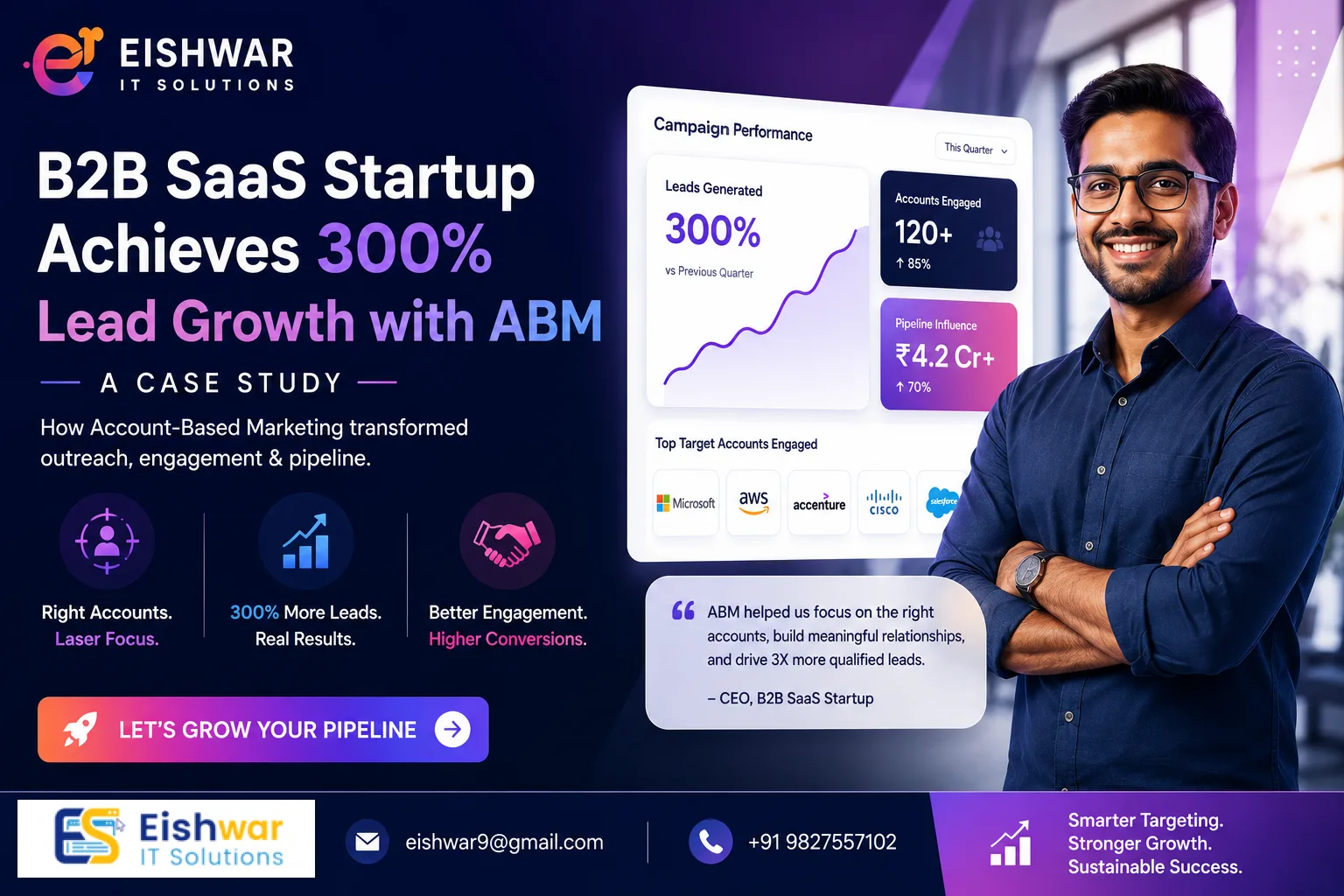
How a B2B SaaS Startup Achieved 300% Lead Growth with Account-Based Marketing – A Real Case Study
Introduction
In the competitive world of B2B SaaS, generating high-quality leads is the lifeblood of growth. But traditional lead generation methods often fall short, delivering volume without relevance. That’s where Account-Based Marketing (ABM) steps in — a strategic approach that treats individual accounts as markets in themselves.
In this case study, we’ll unpack the journey of CloudSyncPro (name changed for confidentiality), a mid-sized B2B SaaS startup based in Bangalore, India. They faced stagnant lead growth despite decent website traffic. Within six months of implementing a structured ABM strategy, they achieved a staggering 300% increase in qualified leads and a 40% boost in deal velocity.
Whether you’re a business owner, marketer, or sales professional, you’ll find actionable insights here that you can adapt for your own growth. We’ll dive deep into the challenges, the step-by-step strategy, the impressive results, and the practical lessons learned along the way.
Main Section 1: The Challenge – Stagnant Growth and Scattered Efforts
CloudSyncPro offered a cloud-based project management tool tailored for mid-sized teams. They had a solid product but struggled with lead quality. Their marketing funnel was broad — running generic Google Ads, social media campaigns, and email blasts. The result? High traffic but low conversion rates.
Key pain points:
- Sales team spent 60% of time on unqualified leads, leading to frustration and burnout.
- Marketing and sales were misaligned, with no shared account targeting or common goals.
- CRM data was messy, making personalization nearly impossible due to duplicate entries and outdated contacts.
- Customer acquisition cost (CAC) was rising by 15% quarter-over-quarter, while lifetime value (LTV) remained flat.
- Marketing campaigns were generating 500+ leads per month, but only 20 were truly qualified, wasting budget on low-intent prospects.
They needed a shift from “spray and pray” to precision targeting. That’s when they decided to adopt Account-Based Marketing, recognizing that a focused approach could transform their pipeline.
Main Section 2: The ABM Strategy – From Research to Personalization
CloudSyncPro partnered with a fractional CMO who specialized in ABM. Here’s the step-by-step strategy they followed:
Step 1: Ideal Customer Profile (ICP) Refinement
They analyzed their best-performing accounts from the last two years, looking at common traits like industry, company size, revenue, and decision-maker roles. The ICP became: mid-sized tech companies (50-200 employees) in India and Southeast Asia, with annual revenue between $5M-$50M, and a tech-savvy leadership team. They also identified key personas: CTOs, VP of Engineering, and Head of Product.
Step 2: Target Account Selection
Using tools like LinkedIn Sales Navigator and ZoomInfo, they built a list of 100 high-fit accounts. Each account was scored based on fit (e.g., industry match) and intent signals (e.g., job postings for project management tools, content consumption on related topics). They prioritized accounts showing active research behavior.
Step 3: Multi-Channel Personalization
Instead of one-size-fits-all messaging, they created personalized content for each account:
- Custom landing pages that addressed specific pain points of the account, such as “Streamline Remote Team Collaboration for [Company Name].”
- Personalized video emails from the sales team referencing recent company news, like a funding round or product launch.
- LinkedIn ads tailored to decision-makers within the account, using dynamic content based on job title and industry.
- Direct mail – a branded notebook and a handwritten note, which increased response rates by 40%.
- Account-specific case studies showing how similar companies benefited from CloudSyncPro.
Step 4: Sales & Marketing Alignment
Weekly alignment meetings were instituted where marketing shared account insights (e.g., content engagement, ad clicks) and sales provided feedback on conversations. Both teams used a shared CRM (HubSpot) to track interactions, ensuring no duplicate outreach. They also created a service-level agreement (SLA) defining response times and lead handoff protocols.
Step 5: Measurement & Iteration
They tracked metrics like account engagement score (based on email opens, website visits, and ad interactions), pipeline velocity, and deal size. Monthly reviews helped refine targeting and messaging. For example, they discovered that accounts with high intent signals but low engagement needed more educational content, while engaged accounts required direct sales outreach.
Main Section 3: The Results – 300% Lead Growth and Beyond
Within six months, the numbers spoke for themselves:
- Qualified leads increased by 300% – from 20 per month to 80 per month, with a 50% increase in lead-to-opportunity conversion rate.
- Deal velocity improved by 40% – sales cycles shortened from 90 days to 54 days, thanks to better-targeted outreach.
- Customer acquisition cost dropped 25% – because resources were focused on high-probability accounts, reducing wasted ad spend.
- Average deal size grew 35% – as they closed larger contracts with better-fit customers, from $15,000 to $20,250 annually.
- Customer satisfaction improved – since the product was now solving real problems for targeted accounts, leading to a 20% increase in Net Promoter Score (NPS).
One standout success was onboarding a mid-sized logistics company that had been a target account. The personalized approach, including a custom demo highlighting their supply chain challenges, led to a $50,000 annual contract within 3 months. This account alone covered the cost of the entire ABM campaign.
Expert Tips
Based on this case study, here are actionable tips for implementing ABM in your business:
- Start small. Pick 20-30 high-value accounts and go deep rather than wide. Test your approach before scaling.
- Invest in intent data. Tools like Bombora or G2 Buyer Intent can reveal which accounts are actively researching solutions like yours, helping you prioritize outreach.
- Personalize at scale. Use automation platforms like HubSpot or Marketo to deliver tailored content without manual effort, such as dynamic email templates and personalized landing pages.
- Align sales and marketing. Schedule weekly syncs and share a single source of truth for account data. Create shared KPIs like pipeline revenue from target accounts.
- Measure what matters. Focus on account engagement, pipeline influence, and revenue, not just vanity metrics like email opens. Use attribution models to track impact.
- Be patient. ABM is a long-term game. Expect results in 3-6 months, but significant ROI often takes 6-12 months as relationships mature.
Common Mistakes
Avoid these pitfalls when adopting ABM:
- Going too broad too fast. ABM requires focus. Trying to target hundreds of accounts dilutes your efforts and reduces personalization quality.
- Ignoring data quality. Garbage in, garbage out. Clean your CRM data before starting, deduplicating records and updating contact information.
- Lack of personalization. Sending a generic email to a target account defeats the purpose. Every touchpoint should feel tailored, from subject lines to content offers.
- Forgetting existing customers. ABM can also be used for upselling and cross-selling to current accounts, which often have higher conversion rates.
- Underestimating the time investment. ABM is resource-intensive. Ensure you have dedicated personnel or consider outsourcing to a specialist agency like EishwarITSolution.
Future Trends
ABM is evolving rapidly. Here are trends to watch:
- AI-powered hyper-personalization. Machine learning will predict the best content and channel for each account, automating personalization at scale.
- Intent data integration. Real-time buying signals will drive immediate, relevant outreach, such as triggering a sales call when an account visits pricing pages.
- ABM for small businesses. As tools become more affordable, even SMBs can adopt ABM with manual processes and free tools like LinkedIn.
- Privacy-first ABM. With cookie deprecation, first-party data and contextual targeting will become critical, relying on owned channels like email and webinars.
- Full-funnel ABM. Instead of just top-of-funnel, ABM will be used throughout the customer lifecycle, including retention, upsell, and advocacy programs.
FAQs
What is Account-Based Marketing (ABM)?
ABM is a strategic B2B marketing approach where marketing and sales teams work together to target specific high-value accounts with personalized campaigns. Instead of casting a wide net, you focus on a select group of accounts that are most likely to convert, treating each account as a market of one.
How is ABM different from traditional lead generation?
Traditional lead generation targets individuals broadly, often using inbound tactics like content marketing and ads to attract anyone. ABM flips this by targeting specific accounts first, then engaging individuals within those accounts. This alignment leads to higher conversion rates, larger deal sizes, and better sales and marketing collaboration.
What tools are essential for ABM?
Popular ABM tools include HubSpot for CRM and automation, Demandbase and 6sense for account identification and intent data, ZoomInfo for contact data, and LinkedIn Sales Navigator for prospecting. For intent data, Bombora and G2 are excellent. The key is to integrate these tools with your CRM for seamless tracking and reporting.
How long does it take to see results from ABM?
Typically, you can expect initial results within 3-6 months, such as increased engagement and pipeline velocity. However, significant ROI often takes 6-12 months as you refine targeting, build relationships with key accounts, and close larger deals. Patience and consistent iteration are crucial.
Can small businesses implement ABM?
Absolutely. Small businesses can start with a manual ABM approach using spreadsheets and free tools like LinkedIn. For example, identify 10-20 target accounts, research decision-makers, and send personalized emails or LinkedIn messages. As they grow, they can invest in paid tools. The key is to focus on a handful of high-potential accounts and deliver exceptional personalization.
What are the biggest challenges in ABM?
The top challenges include sales and marketing alignment, data quality, scaling personalization, and measuring ROI. Overcoming these requires strong leadership to foster collaboration, clean data practices, the right technology stack for automation, and clear metrics like account engagement and pipeline revenue. Regular reviews help address issues early.
Conclusion
CloudSyncPro’s story is a powerful testament to the effectiveness of Account-Based Marketing. By shifting from a volume-driven to a precision-driven approach, they not only achieved a 300% lead growth but also built stronger relationships with their ideal customers, reduced costs, and accelerated sales cycles.
ABM isn’t just a tactic — it’s a mindset. It requires patience, data discipline, and genuine personalization. But as this case study shows, the rewards are substantial. Whether you’re a startup or an established business, ABM can transform your growth trajectory.
CTA
Ready to transform your lead generation with ABM? At EishwarITSolution, we specialize in crafting data-driven ABM strategies that deliver real results. Contact us today for a free consultation and let’s map out your path to 300% lead growth.