Dark Patterns vs. Ethical Design: Balancing Conversion Goals with Long-Term User Trust
Introduction
Every business wants more conversions. But the path you choose to get them can make or break your brand. In the race to increase sign-ups, purchases, or subscriptions, many companies resort to dark patterns—design tricks that nudge users into actions they didn't intend. While these tactics can boost short-term metrics, they often damage user trust and hurt long-term growth. For instance, a user who feels tricked into a subscription may not only cancel but also share their frustration on social media, amplifying the negative impact.
At EishwarITSolution, we believe in ethical design that respects user autonomy. In this post, we'll explore the real cost of dark patterns, how ethical design can drive conversions without manipulation, and how user behaviour analytics can help you balance both goals. By understanding user intent and friction points, you can create experiences that feel natural and trustworthy, leading to sustainable growth.
Main Section 1: What Are Dark Patterns and Why Do They Work?
Dark patterns are interface designs intentionally crafted to trick users into doing something they wouldn't normally do—like signing up for a recurring subscription or sharing more personal data than intended. Coined by UX researcher Harry Brignull, these patterns exploit cognitive biases and heuristics, such as the fear of missing out (FOMO) or the tendency to stick with default options.
Common examples include:
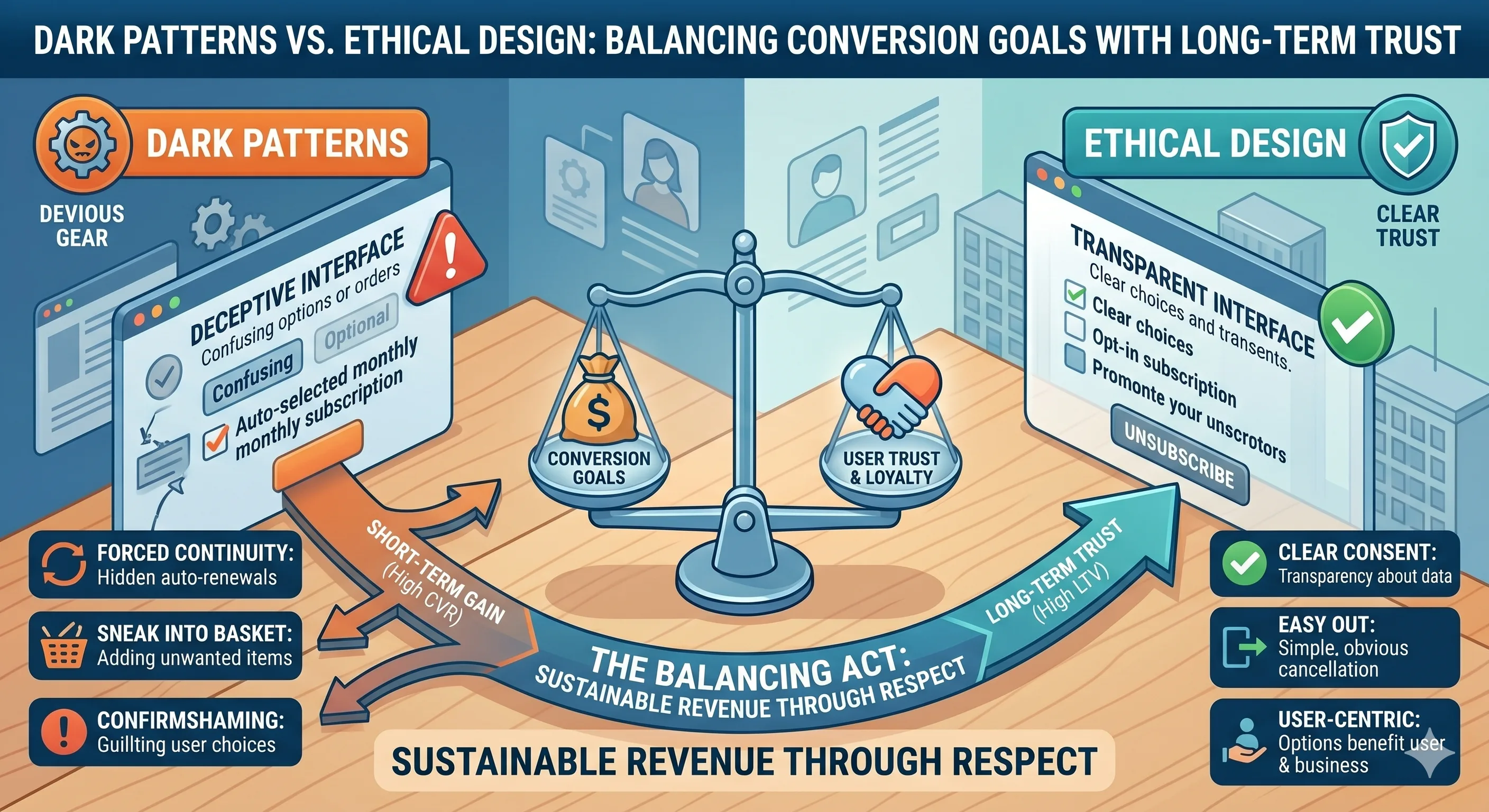
- Confirmshaming: "No thanks, I don't want to save money." This guilt-trips users into accepting an offer they might not want.
- Hidden Costs: Surprise fees at checkout, like a "service charge" that appears only after entering payment details.
- Forced Continuity: Free trials that auto-renew without clear warnings, often requiring users to dig through settings to cancel.
- Misdirection: A brightly colored "Subscribe" button next to a greyed-out "No thanks." The visual hierarchy steers users toward the desired action.
- Roach Motel: Easy to get in, hard to get out. For example, signing up for a newsletter is one click, but unsubscribing requires filling out a form.
Why do they work? Because they leverage our natural tendencies: avoiding loss, seeking convenience, and fearing missing out. For Indian businesses, where price sensitivity is high, a "limited-time offer" countdown can push hesitant buyers. However, the short-term win often comes at a cost. A 2023 study by the Indian Institute of Technology found that 72% of users who encountered dark patterns felt annoyed, and 45% said they would never return to the site.
Main Section 2: The Hidden Cost of Dark Patterns – User Trust and Brand Reputation
Dark patterns might increase conversion rates by 10–20% in the short run, but they erode trust over time. When users realize they've been tricked, they feel manipulated. This leads to:
- Negative reviews on social media and review platforms. A single viral post about a deceptive practice can reach thousands of potential customers.
- High churn rates – users who feel cheated rarely return. In fact, research shows that acquiring a new customer costs five times more than retaining an existing one.
- Regulatory risks – India's upcoming Digital Personal Data Protection Act (2023) penalizes deceptive data practices, with fines up to ₹250 crore for serious violations.
- Brand dilution – In a competitive market, trust is a key differentiator. A brand known for dark patterns struggles to build loyalty.
User behaviour analytics can reveal the real impact. For example, a travel booking site that used hidden fees saw a 15% drop in repeat customers within six months. By tracking user flows and exit points, the company discovered that users who encountered hidden costs were 3x more likely to abandon the site permanently. Additionally, session recordings showed users scrolling back and forth in confusion, indicating frustration. In India, where word-of-mouth and trust are critical for small businesses, a single bad experience can ripple through communities. Ethical design isn't just moral—it's strategic.
Main Section 3: Ethical Design – A Smarter Path to Conversions
Ethical design doesn't mean sacrificing conversions. It means aligning your business goals with user needs. Here's how you can achieve both:
- Transparency: Clearly communicate pricing, terms, and data usage. For example, show the total cost upfront, including taxes and fees. A practical tip: use a summary box at checkout that lists all charges before the user confirms.
- Ease of opt-out: Make canceling a subscription as easy as signing up. This builds trust and reduces negative sentiment. For instance, provide a one-click cancellation link in emails.
- Meaningful defaults: Pre-check boxes only for genuinely beneficial options (e.g., "Send me order updates") rather than marketing newsletters. Users appreciate when defaults save them time without being manipulative.
- User control: Allow users to customize their experience without pressure. For example, let them choose notification frequency instead of bombarding them with alerts.
- Clear language: Avoid jargon or vague terms. Instead of "We may use your data for personalization," say "We'll use your browsing history to recommend products you might like."
Case in point: A leading Indian e-commerce platform redesigned its checkout flow to include a clear breakdown of costs, with no hidden charges. Result? A 12% increase in completed purchases and a 25% drop in customer support queries about billing. Moreover, net promoter score (NPS) improved by 8 points within three months. This shows that ethical design can directly impact the bottom line.
Expert Tips
- Use behaviour analytics to identify friction points: Tools like Hotjar or Google Analytics can show where users hesitate or drop off. If they abandon carts after seeing shipping costs, your pricing display may need transparency. For example, you might discover that users spend extra time on the payment page, indicating confusion about fees.
- A/B test ethical vs. manipulative designs: Test a transparent pricing page against a hidden-cost version. Track not just conversion rate but also repeat visits, time on site, and support tickets. In one test, a transparent design led to a 5% lower initial conversion but a 20% higher customer lifetime value over six months.
- Create an ethics checklist: For every design decision, ask: "Would I be comfortable if my grandmother used this?" If not, redesign it. Also, include questions like: "Does this choice respect user autonomy?" and "Is the information presented clearly?"
- Leverage social proof honestly: Show real customer reviews and ratings, not fabricated ones. Authentic social proof builds trust and drives conversions. For instance, display verified purchase badges to ensure credibility.
- Involve users in testing: Conduct usability tests with diverse user groups to catch potential dark patterns. What seems clear to you may confuse others. Use tools like UserTesting to get real-time feedback.
Common Mistakes
- Assuming users won't notice: Indian users are increasingly savvy. A 2023 survey found that 68% of Indian internet users have encountered dark patterns and feel annoyed. Ignoring this risks alienating your audience.
- Prioritizing short-term metrics over lifetime value: A one-time purchase from a tricked user is worth less than a loyal customer who refers friends. Focus on metrics like repeat purchase rate and referral traffic.
- Ignoring cultural context: In collectivist cultures like India, trust is communal. A deceptive design can harm your brand across entire social circles. For example, a bad experience shared on WhatsApp groups can spread quickly.
- Not testing with real users: What seems clear to you may confuse users. Always test designs with diverse user groups, including those with low digital literacy. Use A/B testing to validate assumptions.
- Overcomplicating opt-out processes: Making cancellation difficult is a common dark pattern. Instead, streamline it. For instance, offer a "Cancel Subscription" button in the account settings with a single confirmation step.
Future Trends
As regulations tighten globally, ethical design will become a competitive advantage. India's data protection law and the EU's Digital Services Act are pushing companies to be more transparent. We'll see:
- AI-driven ethics audits: Tools that automatically scan interfaces for dark patterns, such as identifying hidden costs or misleading buttons. These can be integrated into CI/CD pipelines for continuous monitoring.
- User-controlled data dashboards: Giving users granular control over their data, including the ability to delete or export it easily. This aligns with data privacy laws and builds trust.
- Ethical design certifications: Brands will showcase badges to prove they avoid dark patterns, similar to SSL certificates. This can become a trust signal for users.
- Behavioural nudges for good: Using the same cognitive biases that power dark patterns but for positive outcomes, like encouraging healthy habits or saving money. For example, a "Save for later" button that helps users avoid impulse purchases.
Businesses that adopt ethical design early will build stronger brand equity and avoid regulatory fines. In India, where digital adoption is growing rapidly, being a trusted brand can be a significant market differentiator.
FAQs
What are dark patterns in UX/UI design?
Dark patterns are design elements that trick users into taking actions they didn't intend, such as signing up for subscriptions or sharing personal data. Examples include hidden costs, confirmshaming, and forced continuity. They exploit cognitive biases to manipulate user behavior.
How do dark patterns affect user trust?
Dark patterns erode trust over time. Users who feel manipulated are more likely to leave negative reviews, churn, and avoid your brand. In India, where word-of-mouth is powerful, this can damage your reputation significantly. A single bad experience can lead to lost referrals and social media backlash.
Can ethical design still achieve high conversions?
Yes. Ethical design focuses on transparency and user control, which builds trust. Trust leads to higher lifetime value, repeat purchases, and referrals. A/B tests often show that ethical designs perform better in the long run, with lower churn and higher customer satisfaction.
How can user behaviour analytics help in ethical design?
Behaviour analytics tools like heatmaps, session recordings, and funnel analysis reveal where users get confused or frustrated. You can then redesign those friction points ethically, improving both user experience and conversions. For example, if users drop off at a confusing form, simplify it.
What are the legal implications of using dark patterns in India?
Under India's Digital Personal Data Protection Act, deceptive practices related to data collection can lead to penalties of up to ₹250 crore. Additionally, consumer protection laws may apply. Ethical design helps you stay compliant and avoid fines, while also protecting your brand reputation.
How can I start transitioning from dark patterns to ethical design?
Begin by auditing your current interfaces for dark patterns. Prioritize transparency in pricing and terms. Make opt-out processes easy. Use behaviour analytics to measure the impact of changes. Finally, involve users in testing to ensure clarity. Start with one flow, like checkout, and iterate based on feedback.
What tools can help detect dark patterns in my design?
Tools like Dark Pattern Detector (browser extension), UX Check, and AI-based platforms like Ethicly can scan interfaces for common dark patterns. Additionally, user testing with real users can uncover subtle manipulative elements that automated tools might miss.
Conclusion
Dark patterns may offer a quick conversion boost, but they undermine the foundation of your business: user trust. In a market like India, where relationships matter, ethical design is not just a nice-to-have—it's a necessity. By leveraging user behaviour analytics, you can optimize for both conversions and trust, creating a sustainable growth engine. The key is to view users as partners, not targets, and design experiences that respect their autonomy while guiding them toward valuable actions.
CTA
Ready to audit your design for dark patterns and implement ethical, conversion-friendly UX? Contact EishwarITSolution today for a free consultation. Let's build trust together.