
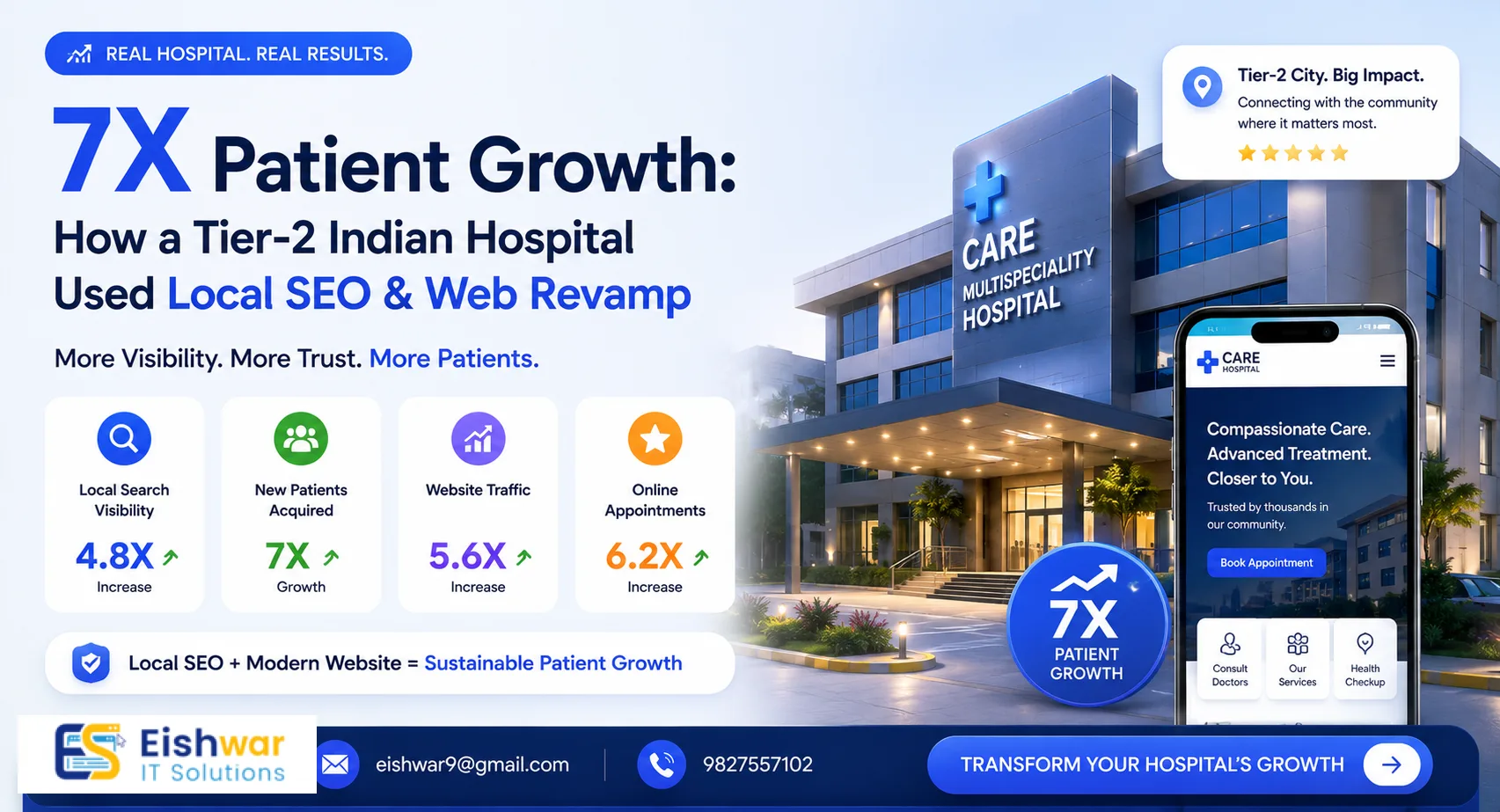
7X Patient Growth: How a Tier-2 Indian Hospital Used Local SEO & Web R
Published on: 29 Jun 2026
7X Patient Growth: How a Tier-2 Indian Hospital Used Local SEO & Web Revamp
Introduction
In today's digital-first world, even healthcare providers in Tier-2 Indian cities face fierce competition. Patients now turn to Google to find the best doctor, clinic, or hospital nearby. Yet many hospitals still rely on outdated websites and generic marketing. This case study reveals how a medium-sized hospital in Nagpur, struggling with low online visibility and patient inquiries, partnered with EishwarITSolution to completely revamp its digital presence. The result? A stunning 7X increase in patient acquisition within six months. Let's break down the exact strategies used.
Learn more about our Website services
Nagpur, a bustling city in Maharashtra, is home to numerous healthcare facilities, but digital maturity varies widely. CityCare Hospital, a 50-bed multi-specialty facility, had been serving the community for over a decade. Despite its solid reputation among existing patients, it was losing ground to newer, more digitally savvy competitors. The hospital's administration realized that their traditional word-of-mouth marketing was no longer sufficient in an era where patients research online before booking an appointment. This realization sparked a transformative partnership with EishwarITSolution, a digital marketing agency specializing in healthcare.
Main Section 1: The Challenge – Invisible to the Right Patients
The hospital, which we'll call CityCare Hospital, had been operating for over a decade. It had a good reputation locally but was losing ground to newer, more digitally savvy competitors. Key challenges included:
- Outdated website: Slow, non-mobile-friendly, and hard to navigate. The site took over 8 seconds to load on mobile, and the design hadn't been updated in 5 years. Patients often complained about broken links and confusing menus.
- Poor local SEO: Barely appearing in Google Maps or local search results for terms like "best cardiologist in Nagpur." A quick audit revealed that the hospital's Google Business Profile was unclaimed, with incorrect hours and no photos.
- No online booking: Patients had to call during business hours, leading to missed inquiries. The phone line was often busy, and after-hours calls went unanswered, causing frustration.
- Low trust signals: No patient testimonials, doctor profiles, or health blog content. The website had a single generic page listing services, with no way for potential patients to learn about the doctors' expertise or read success stories.
CityCare was losing potential patients to hospitals that simply appeared higher on Google. For example, a competing hospital with a modern website and active Google Business Profile was capturing 80% of the organic traffic for keywords like "emergency care Nagpur." The administration knew they needed a digital transformation, but budget constraints and lack of in-house expertise held them back. That's when they reached out to EishwarITSolution for a comprehensive solution.
To quantify the problem, we conducted a baseline analysis. The hospital's website was receiving only 150 monthly visitors, with a bounce rate of 75%. The Google Business Profile had zero reviews, and the hospital appeared on the third page of search results for its own name. Patient inquiries via the website were negligible—less than 5 per month. The situation was dire, but it also presented a clear opportunity for improvement.
👉 Don't wait for the perfect moment; turn your vision into reality today.
Free ConsultationMain Section 2: The Strategy – Local SEO & Web Revamp in Sync
We implemented a two-pronged approach: a complete website redesign and a targeted local SEO campaign. The key was to ensure that both efforts worked in harmony, creating a seamless experience from search to conversion.
Website Revamp
- Mobile-first design: Over 70% of their traffic came from mobile devices. We built a responsive, fast-loading site using a lightweight framework, achieving a load time of under 2 seconds on 4G networks. We also implemented lazy loading for images and optimized all assets.
- Clear user journey: Prominent 'Book Appointment' button on every page, specialty pages with detailed descriptions, doctor profiles with credentials and photos, and patient testimonials with real names and conditions. We also added a live chat feature for instant queries.
- Health blog integration: Regularly updated articles on common health concerns (e.g., "5 Signs of Heart Disease," "When to See a Gynecologist") to attract organic traffic. We published two articles per week, each optimized for local keywords and answering specific patient questions.
- Online booking system: Simple form with real-time availability, reducing friction for new patients. The system integrated with the hospital's existing calendar, allowing patients to book appointments 24/7. We also added automated confirmation and reminder emails.
For example, we created a dedicated page for cardiology services that included a video introduction from the lead cardiologist, a list of common procedures, and a FAQ section. This page alone started ranking for "heart specialist in Nagpur" within two months.
Local SEO Optimization
- Google Business Profile (GBP) overhaul: Verified listing, added high-quality photos of the hospital interior, staff, and equipment. We responded to all reviews—both positive and negative—within 24 hours, and posted weekly updates about health tips and hospital events. We also added attributes like "Women-led" and "Has emergency service" to stand out.
- Local keyword research: Targeted phrases like "hospital in Nagpur," "child specialist near me," and "emergency care Nagpur." We used tools like Google Keyword Planner and local search data to identify high-intent, low-competition keywords. For instance, we found that "best maternity hospital in Nagpur" had a monthly search volume of 1,200 but low competition.
- Citation building: Consistent NAP (Name, Address, Phone) across 30+ local directories and healthcare listings, including Practo, Justdial, and Sulekha. We also cleaned up existing citations that had incorrect phone numbers or addresses.
- Local link building: Partnered with local health bloggers and community websites for backlinks. For example, we sponsored a health awareness event and got a link from the Nagpur Times website. We also contributed guest posts to local news sites about preventive healthcare.
The synergy between a fast, user-friendly website and a robust local SEO foundation created a powerful flywheel: better rankings drove more traffic, and the excellent on-site experience converted visitors into patients. For instance, a patient searching for "fever clinic Nagpur" would find the hospital's GBP listing with a direct link to the appointment booking page, reducing the steps to conversion.
Main Section 3: The Results – 7X Patient Acquisition and More
Within six months, the hospital saw remarkable improvements:
👉 Free Website Audit
Get Free Audit- 7X increase in patient inquiries via online booking and phone calls. From 5 inquiries per month to 35, with a conversion rate of 60% from booking to actual visit.
- 40% reduction in website bounce rate thanks to faster load times and intuitive navigation. The bounce rate dropped from 75% to 45%, indicating that visitors were engaging with the content.
- 300% increase in organic traffic from local search terms. Monthly visitors grew from 150 to 600, with most coming from Google organic search.
- Top 3 local pack rankings for 15+ high-intent keywords, including "best cardiologist in Nagpur," "emergency hospital Nagpur," and "child specialist near me."
- Positive ROI within 4 months – the cost of the project was recovered quickly through new patient revenue. The hospital estimated that each new patient generated an average revenue of ₹5,000, and the campaign brought in 30 new patients per month, resulting in ₹1.5 lakh monthly revenue increase.
The hospital's administration was thrilled. Dr. Priya Sharma, the Medical Director, commented: "We went from being invisible online to being the go-to hospital in Nagpur for quality care. The team at EishwarITSolution truly understood our needs. The online booking system alone saved our reception staff hours of phone time, and patients love the convenience."
Additionally, the hospital's Google Business Profile accumulated 50 positive reviews within six months, with an average rating of 4.5 stars. This social proof further boosted trust and rankings. The health blog also gained traction, with some articles ranking on the first page for long-tail queries like "how to manage diabetes in summer."
Expert Tips
- Claim and optimize your Google Business Profile fully. It's the single most important asset for local healthcare SEO. Add photos, respond to reviews, and post updates weekly. Use all available attributes and categories.
- Prioritize mobile user experience. A slow or clunky site on mobile will repel patients. Use Google's Mobile-Friendly Test and aim for a load time under 3 seconds. Consider implementing Accelerated Mobile Pages (AMP) for blog posts.
- Publish helpful, locally relevant content. Answer the questions your patients are searching for. For example, write about "best time to visit a dermatologist in Nagpur" or "monsoon health tips for Nagpur residents." Use local landmarks and references to build relevance.
- Encourage and manage online reviews. Positive reviews build trust and influence rankings. Train your staff to ask satisfied patients to leave a review on Google. Respond to all reviews professionally, addressing any concerns.
- Track everything with Google Analytics and Search Console. Data-driven decisions lead to better outcomes. Monitor metrics like organic traffic, bounce rate, conversion rate, and keyword rankings. Set up goals for appointment bookings and phone calls.
Common Mistakes
- Ignoring local citations: Inconsistent NAP data confuses search engines and harms rankings. Use tools like Moz Local or BrightLocal to audit and fix citations regularly.
- Using generic keywords: "Hospital" is too broad – target "best maternity hospital in [city]" or "affordable dental clinic near me." Long-tail keywords have higher conversion rates.
- Neglecting page speed: A one-second delay can reduce conversions by 7%. Use tools like GTmetrix to identify and fix speed issues, such as large images or render-blocking scripts.
- Not having a clear call-to-action: Every page should guide visitors to book an appointment or call. Use contrasting colors for buttons and place them above the fold.
- Forgetting about aftercare: Retargeting ads and email follow-ups can convert undecided visitors. For example, send a reminder email to users who started but didn't complete the booking form.
Future Trends
Healthcare digital marketing is evolving rapidly. Here's what to watch for:
👉 Free Homepage Demo
Book Demo- Voice search optimization: More patients use voice assistants to find "hospitals near me." Optimize for conversational queries like "where is the nearest 24-hour hospital?" Use natural language and FAQ schema.
- AI-powered chatbots: Instant answers to common health queries and appointment scheduling. Chatbots can handle up to 80% of routine inquiries, freeing staff for complex cases. Implement a chatbot that integrates with your booking system.
- Video content: Virtual tours of facilities, doctor Q&As, and patient success stories. Video increases engagement and trust. Create short, informative videos for social media and embed them on your website.
- Telemedicine integration: Seamless online consultation booking and follow-up. With the rise of telemedicine, ensure your website has a dedicated page for online consultations with clear instructions and booking options.
- Hyperlocal targeting: Ads and content tailored to specific neighborhoods or landmarks. For example, target patients in specific areas of Nagpur with ads mentioning local landmarks like "near Sitabuldi" or "opposite Futala Lake."
Hospitals that embrace these trends early will have a significant competitive advantage in the coming years. For instance, implementing a chatbot can reduce response time from minutes to seconds, improving patient satisfaction.
FAQs
- How long does it take to see results from local SEO for hospitals?
Typically 3-6 months for significant improvements, but some changes (like GBP optimization) can yield quick wins within weeks. For example, claiming and optimizing your Google Business Profile can lead to a 20% increase in calls within the first month. - Is local SEO expensive for healthcare providers?
It's one of the most cost-effective digital strategies. The ROI is often high because you're targeting patients actively searching for your services. A typical local SEO campaign for a Tier-2 hospital costs between ₹50,000 to ₹1,00,000 per month, but can generate 10-20 new patients per month, each worth thousands in revenue. - Do I need a new website if my current one is functional?
If your site is slow, not mobile-friendly, or hard to navigate, a revamp is essential. A modern site builds trust and improves conversions. For example, CityCare's old site had a bounce rate of 75%, while the new site reduced it to 45%, directly increasing patient inquiries. - Can small hospitals compete with large chains?
Absolutely. Local SEO levels the playing field. Smaller hospitals can outrank big chains by focusing on hyperlocal keywords and personalized content. For instance, a small hospital can rank for "best pediatrician in [neighborhood]" while a chain might target broader terms. - What metrics should I track for patient acquisition?
Focus on organic traffic, Google Business Profile insights (calls, direction requests), online appointment bookings, and phone call volume from search. Use UTM parameters to track specific campaigns and set up conversion tracking in Google Analytics. - How often should I update my health blog?
Aim for at least 2-4 articles per month. Consistency is key. Focus on topics that address common patient concerns and local health issues. For example, write about seasonal allergies in Nagpur or dengue prevention tips. - What is the best way to get patient reviews?
Train your staff to ask for reviews after a positive experience. Send a follow-up email or SMS with a direct link to your Google Business Profile. Offer a small incentive, like a discount on the next visit, but ensure compliance with healthcare regulations.
Conclusion
CityCare Hospital's journey from digital obscurity to a 7X patient acquisition success story proves that even Tier-2 healthcare providers can dominate their local market with the right strategy. By combining a modern, user-focused website with a disciplined local SEO approach, they attracted more patients, built trust, and achieved a stellar return on investment. The key takeaway? Your digital presence is your new front door – make it welcoming, fast, and easy to find. Ready to write your own success story? EishwarITSolution can help you design a custom digital strategy that drives real results.
CTA
Ready to transform your hospital's digital presence and attract more patients? Contact EishwarITSolution today for a free consultation. Let's build a strategy that puts your healthcare brand on the map.