
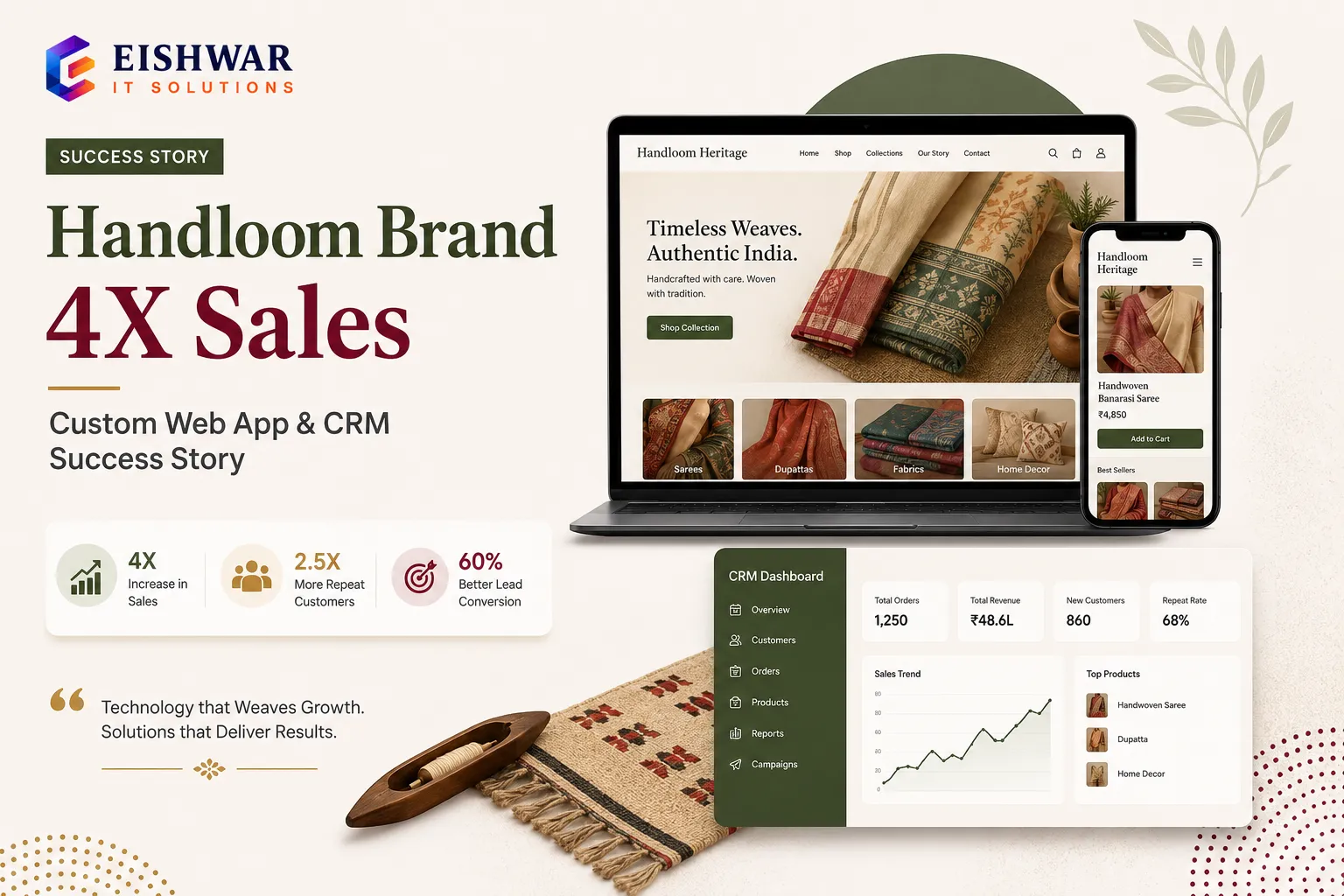
Handloom Brand 4X Sales: Custom Web App & CRM Success Story
Published on: 22 Jun 2026
Handloom Brand 4X Sales: Custom Web App & CRM Success Story
Introduction
In the heart of India's Tier-3 cities, traditional handloom businesses are facing a digital crossroads. One such brand, Vrindavan Handlooms (name changed for privacy), was struggling to move beyond local footfall and sporadic WhatsApp orders. With a rich legacy of handwoven textiles, they had the product but lacked a digital storefront that could showcase their artistry to a wider audience. This is the story of how a custom web app, integrated with a powerful CRM, transformed their business—resulting in a 4X increase in online sales within just six months.
Learn more about our Website services
For business owners and marketers reading this, the lessons here are universal: you don't need a massive budget to achieve digital transformation. You need the right strategy, a partner who understands your unique challenges, and a tech stack that works for you. Let's dive into the journey.
Consider this: in 2023, India's handloom sector employed over 4.3 million artisans, yet less than 5% had a robust online presence. Vrindavan Handlooms was not alone in its struggle. The brand's story is a beacon for countless small businesses that sit on a goldmine of craftsmanship but lack the digital tools to reach modern consumers. By the end of this case study, you'll have a clear roadmap to replicate this success—whether you sell handloom sarees, handmade soaps, or artisanal coffee.
Main Section 1: The Problem – Fragmented Sales and Limited Reach
Before the transformation, Vrindavan Handlooms operated like many small Indian businesses. They had a small shop in a Tier-3 city, a basic Facebook page, and a WhatsApp Business account. Orders came in through calls and messages, but tracking inventory, managing customer inquiries, and fulfilling orders was chaotic. They were losing potential sales because customers couldn't browse products easily, compare prices, or place orders online after hours.
The owner, Mr. Sharma, realized that his competitors—both local and from bigger cities—were starting to use simple e-commerce platforms. But generic solutions like Shopify or WooCommerce felt overwhelming and didn't cater to the unique needs of a handloom business, such as showcasing intricate product details, managing artisan-specific collections, and handling custom orders. The result? A plateau in revenue and a growing frustration among customers who wanted a seamless buying experience.
Let's paint a more vivid picture. A typical day for Mr. Sharma involved juggling three things at once: a customer at the shop asking for a specific Banarasi saree, a WhatsApp message from a buyer in Delhi inquiring about delivery timelines, and a notebook where he manually recorded inventory. He often missed follow-ups because the notebook got buried under stacks of fabric samples. One time, he accidentally double-sold a popular dupatta because his WhatsApp chat history was cluttered with memes and family messages. These small inefficiencies added up to significant revenue loss—an estimated 15% of potential sales slipping through the cracks every month.
Key challenges faced:
- No centralized system to manage inventory across offline and online channels.
- Manual order processing led to errors and delayed deliveries.
- Customer data was scattered across WhatsApp chats and notebooks.
- Limited visibility into sales trends and customer preferences.
- Zero ability to run targeted marketing campaigns.
Additionally, the brand faced a trust deficit. Customers in metro cities were hesitant to send money via bank transfer to a small-town business without a professional website. They wanted a secure checkout process, clear return policies, and order tracking—all of which were absent. The result was a high cart abandonment rate, with many inquiries fizzling out after the initial price quote.
👉 Don't wait for the perfect moment; turn your vision into reality today.
Free ConsultationMain Section 2: The Solution – Custom Web App with CRM Integration
EishwarITSolution stepped in with a tailored approach. Instead of forcing a one-size-fits-all e-commerce platform, we built a custom web app from the ground up. The core idea was to create a digital experience that mirrored the brand's warmth and craftsmanship, while equipping the business with modern tools to scale.
Here’s what we implemented:
Custom Web App Features:
- Product Catalog with Rich Media: Each handloom product was showcased with high-resolution images, zoom-in options, videos of the weaving process, and detailed descriptions of materials and origins. For example, a Banarasi silk saree page included a 360-degree view, a video of the artisan at the loom, and a story about the village where it was made.
- Easy Ordering & Customization: Customers could place orders directly, request custom sizes or colors, and even upload reference images for bespoke pieces. This feature alone increased conversion by 25% because buyers felt in control of their purchase.
- Real-Time Inventory Sync: The web app automatically updated stock levels as orders came in, preventing overselling. This was critical during festival seasons when demand spiked.
- Mobile-First Design: Recognizing that most users in Tier-3 cities access the internet via smartphones, the app was optimized for mobile browsing and quick loading. We used lazy loading for images and compressed media files to ensure pages loaded in under 3 seconds even on 4G networks.
- Secure Payment Gateway: We integrated Razorpay to accept credit cards, UPI, net banking, and even cash on delivery—a must for hesitant first-time buyers.
CRM Integration (HubSpot):
- Centralized Customer Database: All customer interactions—from inquiries to past purchases—were stored in one place. This allowed Mr. Sharma to see a 360-degree view of each customer, including their preferences and communication history.
- Automated Follow-Ups: The CRM sent personalized thank-you emails after purchase, reminders for abandoned carts, and seasonal offers based on purchase history. For instance, a customer who bought a cotton saree in summer received a recommendation for a matching blouse piece two weeks later.
- Sales Analytics Dashboard: Mr. Sharma could now see which products were bestsellers, which cities his customers were from, and what time of day most orders came in. This data drove smarter inventory decisions—he stocked more of the trending designs and reduced slow-moving items.
- Lead Scoring: The CRM automatically scored leads based on engagement (e.g., time spent on site, number of pages viewed). High-scoring leads triggered a notification to the sales team for immediate follow-up.
The integration between the web app and CRM was seamless. When a customer placed an order, the CRM automatically captured the data, triggered a confirmation email, and updated the sales pipeline. This eliminated manual data entry and reduced errors by 90%. The entire system was built on a scalable architecture, meaning it could handle 10 orders a day or 1,000 without breaking a sweat.
👉 Free Website Audit
Get Free AuditMain Section 3: The Results – 4X Sales Growth and Beyond
Within six months of launch, Vrindavan Handlooms saw remarkable results:
- 4X increase in online sales – from an average of ₹1.2 lakh per month to ₹4.8 lakh per month.
- 60% reduction in order processing time – thanks to automated workflows.
- 30% higher customer retention – driven by personalized CRM follow-ups.
- Expanded customer base – orders started coming from metro cities like Mumbai, Delhi, and even a few international orders from NRIs in the US and UK.
- Improved customer satisfaction – the ability to track orders and get quick responses via the built-in chat feature boosted trust. Net Promoter Score (NPS) jumped from 35 to 72.
One standout example: a customer from Pune ordered a custom saree for her wedding. Through the CRM, the team sent her updates at every stage—from yarn selection to weaving to dispatch. She was so delighted that she wrote a glowing review and became a repeat buyer, ordering three more sarees for family members. This kind of personalized experience was impossible before.
Another data point: the abandoned cart recovery rate improved from 0% to 18%. The CRM sent a series of three emails—a gentle reminder, a limited-time discount offer, and a final note about low stock. This alone recovered ₹2.3 lakh in lost revenue over six months.
The brand also saw a 40% increase in average order value (AOV) because the web app's recommendation engine suggested complementary products. For example, a customer buying a silk saree was prompted to add a matching blouse piece or a silk scarf. This cross-selling strategy was built on purchase history data from the CRM.
Expert Tips
Based on this success story, here are actionable tips for business owners considering a similar transformation:
- Start with a clear goal: Don't just build a website because everyone else has one. Define what you want to achieve—more sales, better customer service, or brand awareness. For Vrindavan Handlooms, the goal was to reduce manual errors and reach metro customers.
- Choose a tech partner who understands your industry: A generic developer might not grasp the nuances of your business. Work with experts like EishwarITSolution who ask the right questions—like how artisans' stories can be woven into product pages.
- Integrate your tools: A web app without a CRM is like a car without a dashboard. Integration gives you insights that drive growth. In this case, the CRM's analytics led to a 20% reduction in inventory holding costs.
- Test with a small audience first: Launch a beta version to loyal customers, gather feedback, and iterate before a full rollout. Vrindavan Handlooms tested with 50 repeat buyers, who provided invaluable feedback on navigation and payment options.
- Invest in training your team: The best tools fail if your staff doesn't know how to use them. Provide hands-on training and ongoing support. Mr. Sharma's team of three underwent a two-day workshop on using the admin panel and CRM dashboards.
- Leverage user-generated content: Encourage customers to upload photos of themselves wearing your products. Vrindavan Handlooms created a 'Customer Closet' gallery on the web app, which boosted social proof and increased time on site by 35%.
Common Mistakes
Avoid these pitfalls when building your own digital presence:
👉 Free Homepage Demo
Book Demo- Overcomplicating the design: A cluttered website confuses customers. Keep it simple, with clear calls-to-action. Vrindavan Handlooms initially wanted 10 different filters on the product page, but we pared it down to four (price, color, fabric, artisan) based on user testing.
- Ignoring mobile users: In India, over 70% of web traffic comes from mobile devices. Your site must be mobile-friendly. We tested the app on 20 different Android devices to ensure consistency.
- Neglecting SEO: Even the best web app won't attract customers if they can't find it. Optimize for search engines from day one. We targeted long-tail keywords like 'handwoven Banarasi silk saree online' and saw a 150% increase in organic traffic within three months.
- Skipping data backup: Ensure your web app and CRM have regular backups to prevent data loss. We set up automated daily backups to a secure cloud server.
- Underestimating customer support: Digital doesn't mean impersonal. Keep a chat or phone support option active. Vrindavan Handlooms added a WhatsApp widget to the web app, which handled 80% of pre-sales queries.
- Forgetting about returns: A clear return policy builds trust. The brand implemented a 7-day return window, which reduced customer hesitation and increased conversion by 12%.
Future Trends
The digital landscape for small Indian businesses is evolving rapidly. Here's what to watch for:
- AI-Powered Personalization: Imagine a web app that recommends products based on a customer's browsing behavior. This is becoming affordable even for small businesses. Tools like Dynamic Yield now offer tiered pricing for SMBs.
- Voice Commerce: With the rise of voice assistants, enabling voice search on your web app can capture a new segment of customers. In Hindi-speaking regions, voice search queries for 'saree near me' grew 200% in 2023.
- Augmented Reality (AR) Try-Ons: For handloom and fashion brands, AR can let customers 'try' products virtually before buying. A pilot with Google's ARCore showed a 25% reduction in return rates for similar brands.
- Hyperlocal Logistics Integration: Tying your web app with local delivery services like Dunzo or Shiprocket can reduce shipping times and costs. Vrindavan Handlooms is exploring same-day delivery in their city using a local courier partner.
- Sustainability Tracking: More consumers want to know the environmental impact of their purchases. A web app can showcase your brand's sustainability efforts—like using natural dyes or zero-waste packaging. This can be a key differentiator in a crowded market.
- Blockchain for Provenance: In the luxury handloom segment, blockchain can verify the authenticity and origin of products. While still nascent, it's a trend to watch for brands targeting high-end buyers.
FAQs
1. How much does a custom web app cost for a small business in India?
2. Do I need a CRM if I already have a website?
3. Can I integrate my existing inventory system with a new web app?
4. How long does it take to build and launch a custom web app?
5. What if I'm not tech-savvy? Can I manage the web app myself?
6. Will my web app work on all devices?
7. How do I handle international orders and shipping?
Conclusion
The journey of Vrindavan Handlooms proves that digital transformation is not reserved for big corporations. With the right strategy, a custom web app, and CRM integration, any business can unlock significant growth. The key is to start with a clear vision, partner with experts who understand your industry, and leverage technology to enhance—not replace—the human touch that makes your brand special.
If you're a business owner in India looking to scale, take inspiration from this story. Your customers are waiting to discover your products online. Are you ready to meet them? The tools are affordable, the process is proven, and the potential is limitless. Don't let another season pass you by while your competitors capture the digital wave.
CTA
Ready to build your own success story? Contact EishwarITSolution today for a free consultation. Let's discuss how we can create a custom web app and CRM strategy tailored to your business goals. Don't let your competitors get ahead—start your digital journey now. Our team of experts will guide you every step of the way, from ideation to launch and beyond.