
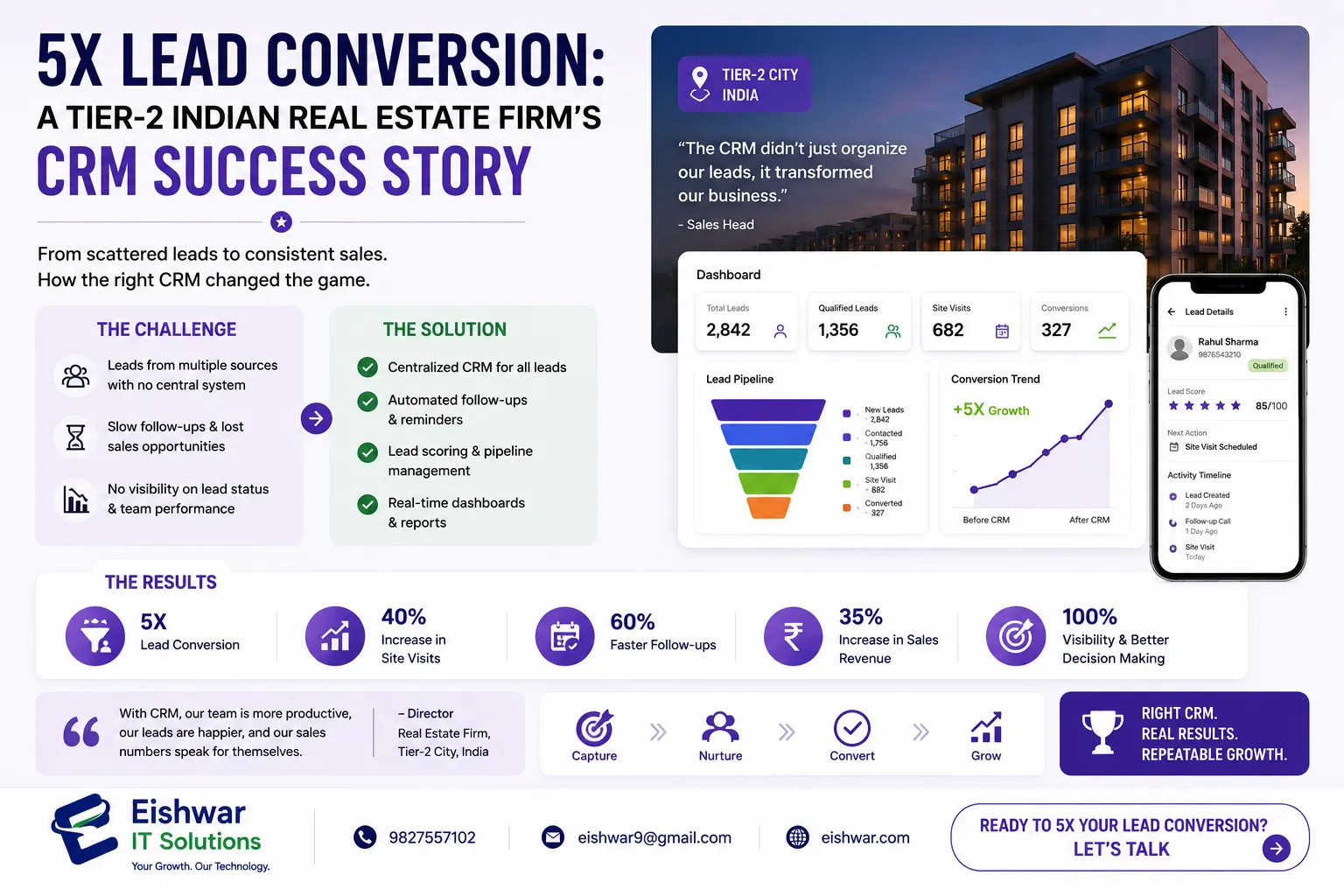
5X Lead Conversion: A Tier-2 Indian Real Estate Firm’s CRM Success Sto
Published on: 17 Jun 2026
5X Lead Conversion: A Tier-2 Indian Real Estate Firm’s CRM Success Story
Introduction
In the bustling real estate market of tier-2 Indian cities, competition is fierce. One mid-sized firm in Lucknow was struggling with lead leakage, slow follow-ups, and low conversion rates—hovering around just 2%. After implementing a robust CRM system with automated follow-ups, they achieved a staggering 5X increase in lead conversion within six months. This case study breaks down their journey, challenges, and actionable strategies that any business can replicate. The firm, which had been operating for over a decade, faced a turning point when a new competitor opened a flashy office nearby, offering instant WhatsApp responses and virtual tours. The owner realized that without a systematic approach to lead management, their traditional methods would soon become obsolete. This story is not just about technology; it’s about a mindset shift from reactive selling to proactive nurturing.
Learn more about our Website services
Main Section 1: The Problem – Lead Leakage and Missed Opportunities
Before the CRM overhaul, the firm relied on spreadsheets and manual call logs. Leads from multiple sources—website, Facebook, Google Ads, and referrals—were scattered across different inboxes and notebooks. Sales reps often forgot to follow up, and hot leads went cold. The average response time was 48 hours, far too slow in a market where buyers expect instant replies. For example, a prospective buyer named Rajesh submitted an inquiry for a 3BHK apartment on a Sunday evening. By the time a sales rep called him on Tuesday, Rajesh had already visited two other projects and booked a unit with a competitor who responded within 10 minutes. This scenario played out repeatedly, costing the firm an estimated 15–20 lost deals per month.
Key pain points included:
- No centralized lead database: Leads were stored in Excel sheets on individual laptops, making it impossible to track the full history of a prospect. When a rep left the company, their leads vanished with them.
- Inconsistent follow-up schedules: Some reps followed up aggressively, while others ignored leads after the first call. There was no standard timeline for nurturing.
- No tracking of lead source performance: The firm spent ₹2 lakhs monthly on Google Ads and Facebook, but had no idea which channel delivered the best return. They were flying blind.
- Low accountability among sales team: Without a shared system, managers couldn’t see who was handling which lead. Blame games were common when deals fell through.
To quantify the problem, the firm conducted a two-week audit. They found that 40% of incoming leads never received a single follow-up call. Another 30% were contacted only once, and then abandoned. Only 10% of leads were nurtured beyond the first week. The conversion rate of 2% was actually inflated by walk-in customers from the physical office; online leads converted at a dismal 0.5%. The situation was unsustainable, and the owner knew a change was necessary.
Main Section 2: The Solution – CRM Implementation and Automation
The firm chose a cloud-based CRM tailored for Indian businesses, integrating it with their website and social media channels. The decision was made after evaluating three options: Zoho CRM for its affordability, Salesforce for its scalability, and a local solution called Realty CRM for its real estate-specific features. They ultimately selected Zoho CRM because it offered a free trial, easy WhatsApp integration, and a pricing model that fit their budget of ₹15,000 per month for 10 users. The implementation took two weeks, with the vendor providing hands-on training for the sales team.
👉 Don't wait for the perfect moment; turn your vision into reality today.
Free ConsultationAutomated workflows were set up to trigger instant email and SMS responses, assign leads to specific agents based on location and property type, and schedule follow-up reminders. They also introduced a lead scoring system based on budget, property type, and urgency. For instance, a lead with a budget above ₹50 lakhs and requesting a site visit was scored as “hot” and assigned to a senior agent within 5 minutes. A lead with a vague inquiry like “I want a flat” was scored as “warm” and entered into a 7-day nurture sequence.
Key steps taken:
- Centralized lead capture: All inquiries from website, Facebook, Google Ads, and even offline events flowed into one dashboard. They used web-to-lead forms on their site and connected Facebook Lead Ads directly via Zapier.
- Instant auto-responders: Every lead received an immediate acknowledgment with property brochures and a link to schedule a call. The auto-responder was personalized with the lead’s name and the specific property they inquired about.
- Lead scoring: High-intent leads (e.g., those requesting site visits or asking about loan options) were prioritized. The scoring model was refined over three months based on conversion data.
- Automated follow-ups: Sequences of 5 emails and 3 SMS over 7 days ensured no lead was forgotten. The first email was sent 1 hour after the inquiry, the second at 24 hours, and so on. SMS reminders were sent for site visit confirmations and festive offers.
- Team dashboards: Managers could track each agent’s performance in real time, including calls made, follow-ups completed, and deals closed. This created healthy competition and transparency.
One practical tip from the implementation: they started with a pilot group of three agents to test the system before rolling it out to the entire team. This allowed them to iron out issues like duplicate lead entries and incorrect scoring rules without disrupting the whole operation.
Main Section 3: The Results – 5X Conversion and Beyond
Within six months, the firm’s conversion rate jumped from 2% to over 10%. The average response time dropped to under 5 minutes, thanks to automated alerts on mobile phones. Revenue from online leads increased by 400%, from ₹12 lakhs per month to ₹60 lakhs per month. The CRM also revealed that Facebook ads generated the highest-quality leads, with a 15% conversion rate compared to 8% from Google Ads. This insight allowed the firm to reallocate 60% of their ad budget to Facebook, resulting in a 30% reduction in cost per lead.
Other notable outcomes:
- 30% reduction in cost per lead: By focusing on high-performing channels and eliminating wasted spend, the firm saved ₹60,000 per month.
- 50% increase in repeat referrals: Satisfied customers were automatically sent referral request emails after deal closure, leading to a steady stream of warm leads.
- Improved team morale due to clear metrics: Sales reps could see their own performance dashboards, which motivated them to improve. The top performer closed 12 deals in a month, a record for the firm.
One unexpected benefit was the reduction in manual data entry. Reps saved an average of 2 hours per day, which they reinvested into client meetings and property site visits. The owner also noted that the CRM’s reporting features helped them identify seasonal trends—for example, inquiries peaked in October and March, allowing them to plan marketing campaigns accordingly.
👉 Free Website Audit
Get Free AuditExpert Tips
Based on this success, here are actionable tips for your business:
- Map your customer journey: Understand every touchpoint from inquiry to sale. Create a flowchart that includes initial contact, property viewing, negotiation, and handover. This will help you design automation sequences that address each stage.
- Start with a simple CRM: Don’t overcomplicate—choose one that integrates with your existing tools like WhatsApp, email, and your website. Avoid feature-heavy systems that require months of setup.
- Automate only where it adds value: Personalize follow-ups with lead-specific details like property name and budget range. Generic messages feel spammy and reduce engagement.
- Train your team: A CRM is only as good as its users. Invest in onboarding sessions and create a “CRM playbook” with step-by-step instructions. Conduct weekly check-ins to address issues.
- Review and iterate: Analyze reports monthly to refine your automation sequences. For example, if email open rates are low, test different subject lines or send times.
Common Mistakes
Avoid these pitfalls when implementing CRM for real estate:
- Buying a CRM without a clear process: Define your sales workflow first—how leads are captured, assigned, and followed up. Otherwise, the CRM will become a digital graveyard.
- Ignoring data hygiene: Duplicate or outdated leads clutter your system. Set up rules to merge duplicates and archive leads that haven’t responded in 6 months.
- Over-automation: Too many automated messages can annoy prospects. Limit follow-ups to 3–5 touches per week and always include an opt-out option.
- Not tracking source: Without UTM parameters, you can't know which channel works best. Use tools like Google Analytics or built-in CRM tracking to attribute leads correctly.
- Skipping A/B testing: Test different email subject lines, call-to-actions, and send times. For example, one firm found that SMS messages sent at 10 AM had a 40% higher response rate than those sent at 2 PM.
Future Trends
The real estate CRM landscape is evolving. Look out for:
- AI-powered lead scoring: Predictive analytics to identify high-conversion leads based on past behavior, such as website visits and email clicks. This can reduce manual effort by 50%.
- WhatsApp integration: Direct messaging with automated replies is becoming essential in India, where over 400 million users rely on WhatsApp. Some CRMs now offer WhatsApp Business API for two-way conversations.
- Virtual tour integration: CRM linked with 3D property tours speeds up decisions. Prospects can view properties from their phone and book a site visit directly through the CRM.
- Voice-based follow-ups: AI voice bots can handle initial queries 24/7, qualifying leads before passing them to human agents. This can increase lead capture by 30% during off-hours.
FAQs
1. What is the best CRM for real estate in India?
Popular options include Zoho CRM, Salesforce, and real estate-specific ones like Realty CRM or LeadSquared. The best choice depends on your budget and integration needs. For tier-2 cities, Zoho CRM is often recommended due to its affordability and local support.
👉 Free Homepage Demo
Book Demo2. How much does a real estate CRM cost?
Prices range from free (for basic features like 5 users) to ₹5,000–₹20,000 per user per month for advanced plans with automation and analytics. Many vendors offer Indian pricing tiers, so negotiate for annual discounts.
3. Can CRM work for small real estate agencies?
Yes. Even a solo agent can benefit from a simple CRM to track leads and automate follow-ups. Start with a free tool like HubSpot CRM or Zoho CRM’s free plan, which supports up to 3 users.
4. How long does it take to see results from CRM?
Most businesses see initial improvements in response time within weeks, but significant conversion gains typically appear after 3–6 months of consistent use. The key is to regularly review reports and adjust workflows.
5. What metrics should I track in my CRM?
Key metrics include lead response time, conversion rate by source, follow-up completion rate, and average deal cycle length. Also track cost per lead and customer lifetime value to measure ROI.
6. Is CRM integration with WhatsApp important?
Yes, especially in India where WhatsApp is the primary messaging app. Integrated CRM can send automated messages, track conversations, and even trigger reminders for follow-ups. This can improve response rates by up to 60%.
7. How do I get my team to adopt the CRM?
Start with training sessions that show how the CRM makes their job easier, not harder. Offer incentives for consistent usage, like a bonus for the rep with the highest follow-up completion rate. Also, involve them in the selection process to ensure buy-in.
Conclusion
This Lucknow real estate firm’s journey proves that even in a competitive tier-2 market, the right CRM and automation can transform lead conversion. By centralizing data, automating follow-ups, and focusing on high-intent leads, they achieved a 5X improvement. The key takeaway: technology is not a magic bullet, but when aligned with a clear sales process, it can supercharge growth. The firm’s owner now plans to expand to two more cities, using the CRM as a scalable foundation. For any real estate business struggling with lead leakage, the message is clear—start small, measure relentlessly, and let automation do the heavy lifting.
CTA
Ready to replicate this success? Contact EishwarITSolution today for a free CRM consultation tailored to your real estate business. Let’s turn your leads into loyal customers. Our team has helped over 50 real estate firms in tier-2 cities achieve similar results. Don’t let another hot lead go cold—schedule your consultation now.