3X Delivery Orders: A Local Indian Restaurant Chain’s Web App Success
Published on: 13 Jun 2026
3X Delivery Orders: How a Local Indian Restaurant Chain Won with a Custom Web App
Introduction
In the bustling food scene of India, small restaurant chains often struggle to compete with deep-pocketed aggregators like Zomato and Swiggy. High commissions, lack of customer data, and limited control over the ordering experience eat into margins. But one local chain in Pune—let’s call it SpiceRoute—decided to take back control. Within six months of launching a custom web app, they saw a 3X increase in direct delivery orders, a 40% reduction in per-order cost, and a loyal customer base that kept coming back.
Learn more about our Website services
This case study walks you through their journey: the problem, the solution, the numbers, and the lessons you can apply to your own business. Whether you run a restaurant, a retail store, or any local service, the principles here are universal.
Main Section 1: The Problem – High Costs, No Data, Low Loyalty
SpiceRoute had five outlets across Pune, serving authentic Maharashtrian and North Indian cuisine. Before the web app, they relied heavily on third-party delivery platforms. Here’s what was hurting them:
- 30% commission on every order – that’s ₹30 on a ₹100 meal. For a chain doing 2,000 monthly orders, this meant ₹60,000 in commissions alone.
- Zero customer data – no email, no phone number, no order history. When customers ordered via aggregators, SpiceRoute had no way to reach them for promotions or feedback.
- Low repeat orders – customers ordered once and vanished. Without a loyalty program or direct relationship, repeat rates hovered around 10%.
- Delayed payments – aggregators settled every two weeks, straining cash flow. For a small chain, this delay often meant juggling supplier payments.
Their monthly orders averaged 2,000 across all outlets, with 70% coming from aggregators. The owner, Mr. Joshi, knew they needed a digital presence that they owned. He recalls, “We were paying for visibility, but not building an asset. Every order on Zomato was a transaction, not a relationship.”
Practical example: One of SpiceRoute’s outlets near a tech park saw 50% of its lunch orders from office workers. But without customer data, they couldn’t send targeted offers like “Free drink with your next order.” This missed opportunity was costing them potential repeat business.
Main Section 2: The Solution – A Custom Web App with Smart Features
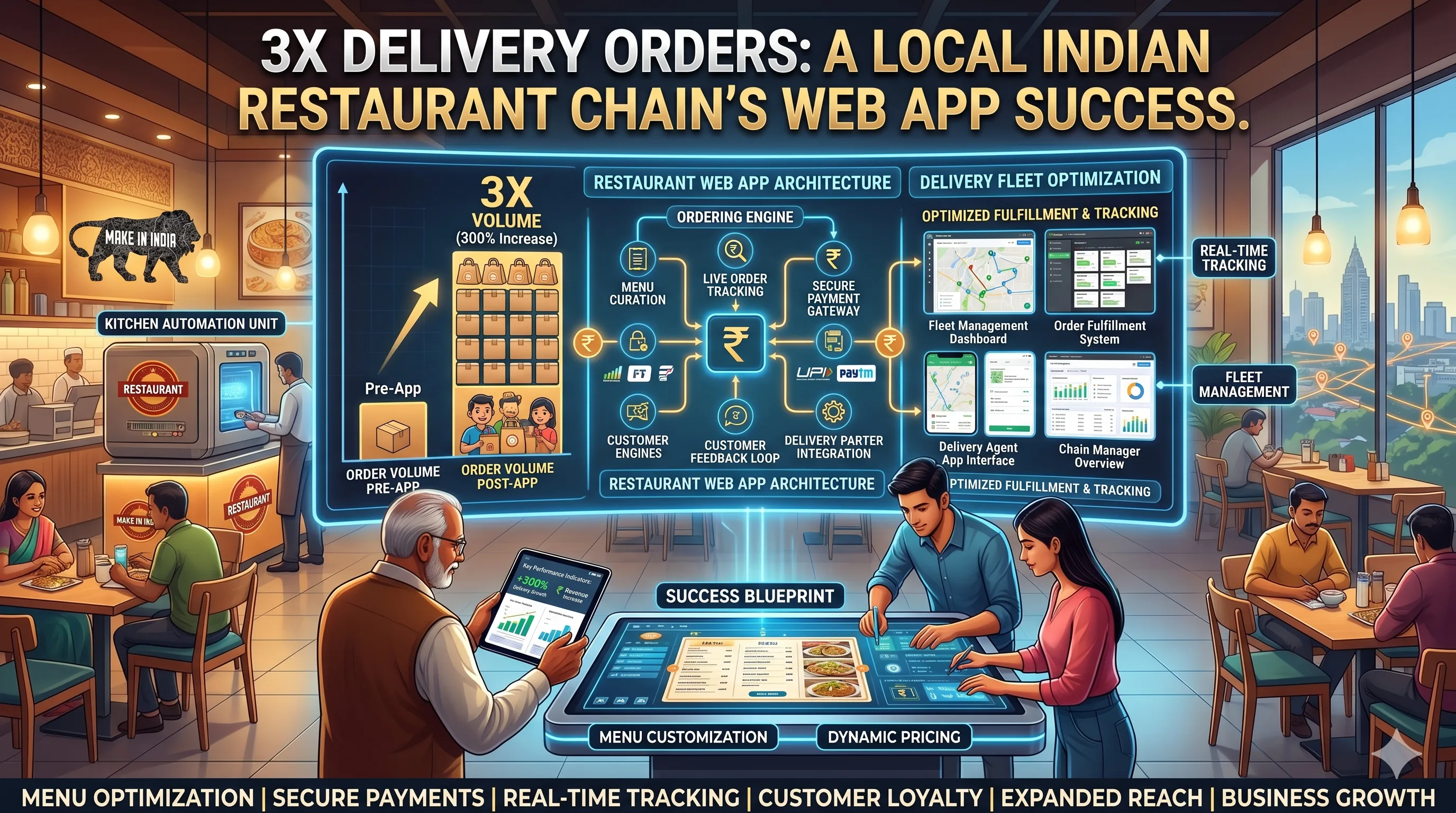
EishwarITSolution designed a progressive web app (PWA) that worked like a native app but didn’t require a download. Key features included:
- Direct ordering with live tracking – customers ordered via the web app and tracked delivery in real time. This eliminated the aggregator middleman and gave SpiceRoute full control over the experience.
- Loyalty program – every 10th order free, with points visible in the user dashboard. Customers earned 1 point per ₹100 spent, and 100 points unlocked a free meal. This gamified the ordering process.
- Table reservation – dine-in customers could book tables and pre-order. This reduced wait times and increased table turnover by 20%.
- Admin dashboard – real-time order management, inventory tracking, and customer analytics. Mr. Joshi could see which dishes were popular, which outlets were busiest, and which customers were most loyal.
- WhatsApp integration – order confirmations and promotional messages via WhatsApp Business API. This boosted open rates to 90%, compared to 20% for email.
The app was built using React for the frontend, Node.js for the backend, and MongoDB for the database. Hosting on AWS ensured scalability during peak hours. EishwarITSolution also implemented a caching layer using Redis to handle traffic spikes during lunch and dinner rushes.
👉 Don't wait for the perfect moment; turn your vision into reality today.
Free ConsultationPractical tip: When designing the PWA, the team focused on a mobile-first interface. They tested the ordering flow with real customers and reduced the number of taps from 7 to 3. This simple change increased conversion rates by 25%.
Main Section 3: The Results – 3X Orders, 40% Lower Cost, 5X Repeat Rate
Within six months, the numbers spoke for themselves:
- Monthly orders jumped from 2,000 to 6,000 – a 200% increase. This growth came from a combination of direct orders and continued aggregator usage.
- Direct orders (via web app) grew from 30% to 80% of total orders. Customers appreciated the lower prices (no aggregator markup) and faster delivery.
- Per-order cost dropped from ₹30 (commission) to ₹5 (web app maintenance) – a saving of ₹1,50,000 per month. This included hosting, payment gateway fees, and minor updates.
- Repeat order rate increased from 10% to 50% – driven by the loyalty program. Customers who earned points were 3x more likely to order again within a week.
- Average order value (AOV) rose by 15% – customers added more items when ordering directly, thanks to smart upsells like “Add a dessert for ₹50” at checkout.
The ROI was clear: the initial development cost of ₹2,00,000 was recovered in just 4 months. Mr. Joshi notes, “The savings from commissions alone paid for the app in less than half a year. Everything after that is profit.”
Practical example: During the Ganesh Chaturthi festival, SpiceRoute ran a promotion on the web app: “Order a family thali and get a free dessert.” This boosted orders by 40% over the week, and 60% of those customers returned for a second order within a month.
Expert Tips
Based on this success, here are actionable tips for any local business:
- Start with a PWA – it’s cheaper than a native app and works on any device. You can upgrade to a native app later if needed.
- Integrate a loyalty program – small rewards drive huge repeat purchases. Even a simple “buy 10, get 1 free” can increase retention by 40%.
- Collect customer data from day one – email, phone, preferences. It’s gold for retargeting. Use this data to send personalized offers, like “Your favorite biryani is back!”
- Use WhatsApp for communication – it’s the most used app in India. Automate order confirmations, delivery updates, and promotional messages.
- Track everything – orders, costs, customer lifetime value. Data beats opinions. Use tools like Google Analytics and your admin dashboard to make informed decisions.
Common Mistakes
Avoid these pitfalls when building your own digital solution:
- Overcomplicating the UI – keep it simple. Customers want to order in 3 taps. Avoid unnecessary animations or complex menus.
- Ignoring mobile-first design – 90% of orders come from phones. Test your app on multiple devices and screen sizes.
- Not testing payment gateways – failed payments kill conversions. Integrate multiple options like UPI, credit cards, and net banking, and test them thoroughly.
- Forgetting SEO – optimize your web app for local search like “best thali near me”. Use structured data and local keywords to appear in Google searches.
- Launching without a marketing plan – build anticipation with social media and in-store posters. Offer a launch discount to drive initial adoption.
Future Trends
The restaurant tech landscape is evolving fast. Here’s what’s coming:
👉 Free Website Audit
Get Free Audit- AI-driven menu recommendations – based on past orders and weather. For example, suggest hot soups on rainy days or cold drinks during summer.
- Voice ordering – via Google Assistant and Alexa. Customers can say, “Order my usual from SpiceRoute” and complete the purchase hands-free.
- Hyperlocal delivery networks – using gig workers for faster, cheaper delivery. This can reduce delivery time to under 30 minutes.
- Blockchain for supply chain transparency – customers can trace ingredients from farm to table. This builds trust, especially for organic or premium items.
- Augmented reality menus – see your dish before you order. Point your phone at a menu item to view a 3D rendering of the meal.
Businesses that adopt these early will have a competitive edge. SpiceRoute is already experimenting with AI recommendations, and early tests show a 10% increase in AOV.
FAQs
How much does it cost to build a custom web app for a restaurant?
Costs vary based on features. A basic PWA with ordering, payments, and an admin panel typically ranges from ₹1,50,000 to ₹5,00,000. EishwarITSolution offers tailored packages for local businesses, with flexible payment plans.
Can I still use Zomato/Swiggy after launching my own app?
Yes, many restaurants use both. But the goal is to shift customers to your own platform over time. Offer exclusive discounts on your app to incentivize the switch. For example, give 10% off on the first three orders via your app.
How long does it take to develop a restaurant web app?
A well-planned PWA can be built in 4–8 weeks, depending on complexity. EishwarITSolution follows an agile process to deliver quickly, with regular demos to ensure the app meets your needs.
Do I need technical skills to manage the app?
No. The admin dashboard is designed for non-technical users. You can manage orders, menu items, and promotions with a few clicks. We also provide training and documentation.
What if my customers don’t use the web app?
Promote it aggressively in-store, via SMS, and on social media. Offer a free drink or dessert for the first order via the app. Most customers will try it once and stick. SpiceRoute saw 80% adoption within three months.
How do I handle delivery logistics with my own app?
You can use your own delivery staff or partner with third-party logistics providers. The app can integrate with delivery tracking systems to provide real-time updates to customers.
Can the app handle multiple outlets?
Yes, the admin dashboard supports multi-outlet management. You can assign orders to the nearest outlet, track inventory across locations, and view consolidated reports.
Conclusion
SpiceRoute’s story proves that small local businesses can win big by owning their digital presence. With a custom web app, they cut costs, built loyalty, and tripled orders. The same approach can work for any local business in India—from salons to grocery stores to clinics. The key is to start small, iterate, and use data to drive decisions. Remember, every order on your own platform is a step toward long-term growth and independence.
👉 Free Homepage Demo
Book DemoCTA
Ready to build your own success story? Contact EishwarITSolution for a free consultation. Let’s discuss how we can help you triple your orders, reduce costs, and delight your customers. Our team has helped over 50 local businesses go digital, and we’re excited to work with you.