Interactive Storytelling in Web Design: Captivate Indian Audiences in
Published on: 06 Jul 2026
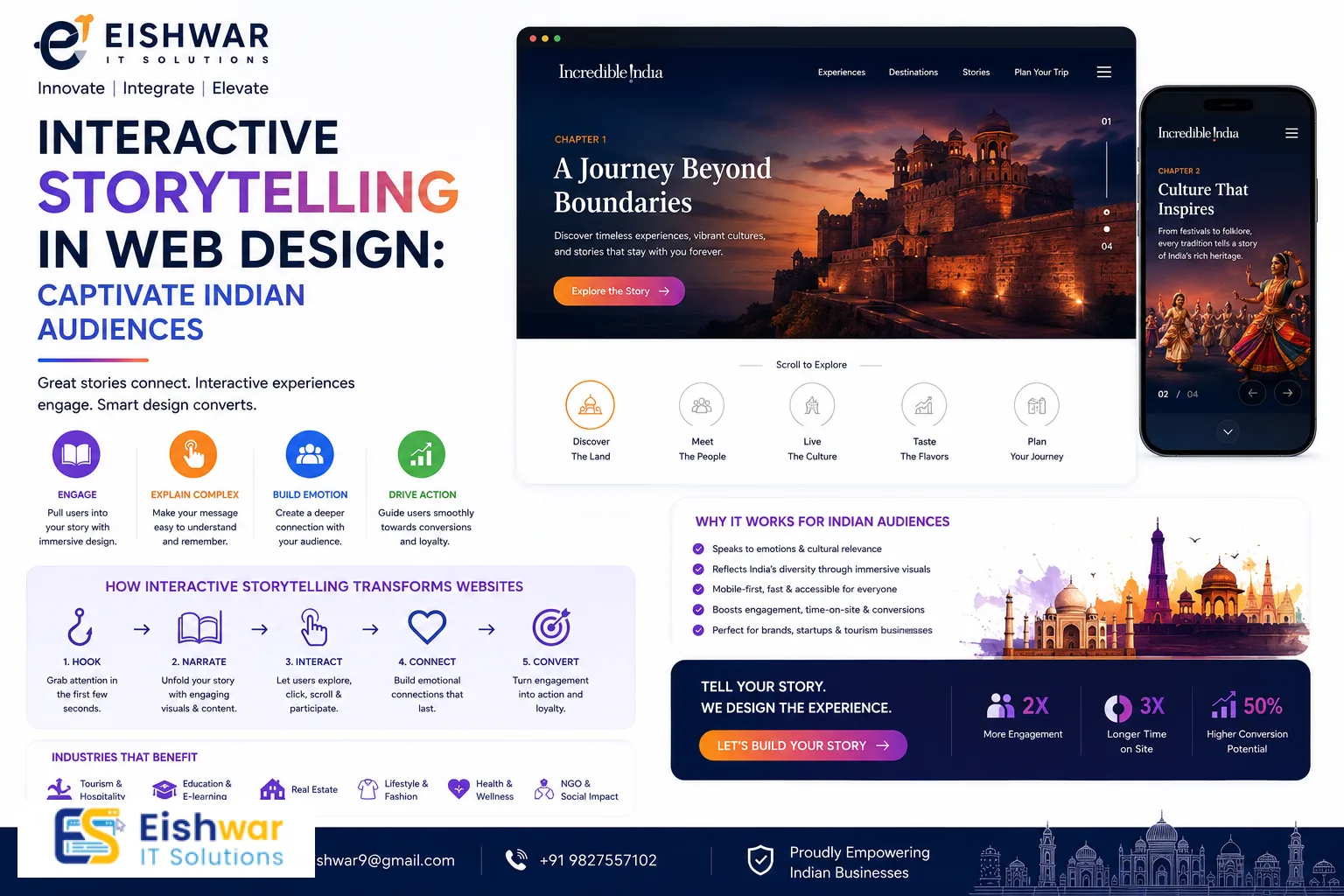
Interactive Storytelling in Web Design: Captivate Indian Audiences in 2026
Introduction
In 2026, Indian users expect more than just a functional website—they want an experience. With the explosion of digital content, standing out requires emotional engagement. Interactive storytelling blends narrative with interactivity, turning passive visitors into active participants. For business owners and marketers targeting India, this approach builds trust, increases time on site, and boosts conversions. In this guide, we’ll explore how to implement interactive storytelling effectively, with practical examples tailored for the Indian market. For instance, a travel website could let users click through a 'Monsoon in Kerala' story, choosing destinations and seeing real-time weather updates—this not only engages but also builds anticipation for a booking.
Learn more about our Website services
What is Interactive Storytelling in Web Design?
Interactive storytelling uses elements like clickable timelines, parallax scrolling, quizzes, and branching narratives to let users shape their journey. Unlike traditional static content, it invites exploration. For Indian audiences, who are increasingly mobile-first and value-rich experiences, this method can create a memorable brand impression. Think of it as a digital conversation rather than a monologue. A practical example: an educational platform could offer a 'Career Path Explorer' where students choose their stream (science, commerce, arts) and see interactive success stories of professionals in that field, complete with video snippets and salary graphs.
Why Interactive Storytelling Works for Indian Audiences
India’s diverse culture, languages, and preferences demand personalization. Interactive storytelling allows you to segment your message without extra pages. For example, a real estate website could let users choose their city (Mumbai, Bangalore, Delhi) and see tailored property stories. This relevance boosts engagement. Additionally, Indians love sharing unique experiences on social media—an interactive story is inherently shareable. Consider a food delivery app that creates a 'Flavor Journey' where users pick regional cuisines (Punjabi, South Indian, Bengali) and see interactive recipes with ordering options—this drives both engagement and sales.
Key Elements of Interactive Storytelling
1. Emotional Triggers
Use visuals and micro-copy that resonate with Indian values—family, festivals, and aspirations. A financial services site could tell a story of a young professional saving for Diwali, with interactive charts showing savings growth. For example, a bank could create a 'Festival Savings Calculator' where users input their goal (e.g., ₹50,000 for Diwali shopping) and see a personalized timeline with milestones like 'Save ₹5,000 by August'—this makes the abstract goal tangible and emotionally engaging.
2. Branching Paths
Let users choose their adventure. For an e-commerce brand, a 'Style Quiz' that recommends products based on preferences creates a personalized story. A clothing retailer could ask questions like 'What’s your preferred fabric? (Cotton, Silk, Linen)' and 'What occasion? (Wedding, Casual, Office)' to curate a lookbook. Each choice leads to a different narrative, making the user feel in control.
3. Gamification
Add points, badges, or progress bars to encourage completion. A health website could have a 'Fitness Journey' interactive timeline where users log milestones. For instance, a wellness app might offer a '7-Day Wellness Challenge' with daily tasks like 'Drink 8 glasses of water' and 'Walk 10,000 steps.' Users earn badges (e.g., 'Hydration Hero') and see a progress bar—this gamification increases retention and habit formation.
👉 Don't wait for the perfect moment; turn your vision into reality today.
Free Consultation4. Data Visualization
Turn statistics into interactive graphs. An NGO could show the impact of donations through a clickable map of India. For example, a charity focused on education might display a map where users click on states to see how many schools were built, with animated icons showing children attending classes. This transforms dry data into a compelling story of change.
How to Implement Interactive Storytelling on Your Website
Start with a clear narrative arc—beginning (problem), middle (exploration), end (solution). Use tools like Webflow, Adobe XD, or custom JavaScript. Keep load times under 3 seconds by optimizing media. For Indian users, ensure mobile responsiveness—most interactions happen on phones. Test with real users from your target region. For example, a travel agency could prototype a 'Destination Discovery' story using Webflow’s interactions panel, adding scroll-triggered animations for images of Goa beaches or Himalayan treks. Test on devices like a OnePlus 9 or Xiaomi Redmi to ensure touch gestures work smoothly.
Expert Tips
- Keep it simple: Don’t overwhelm users with too many choices. Limit branches to 2-3 paths. For instance, a real estate site could offer just 'Buy' or 'Rent' as initial choices, then narrow down by city and budget.
- Use local context: Reference Indian festivals, languages, or regional trends. A travel site could let users explore 'Monsoon in Kerala' or 'Winter in Manali.' Add regional language options (Hindi, Tamil, Bengali) via a toggle—this increases accessibility and trust.
- Measure engagement: Track completion rates, time spent, and social shares. A/B test different story arcs. For example, test a linear story vs. a branching one for a product launch—use Google Optimize to see which drives more conversions.
- Prioritize accessibility: Ensure keyboard navigation and screen reader support for inclusivity. Use ARIA labels for interactive elements, and provide transcripts for audio stories. A user with visual impairment should still be able to navigate a 'Career Path' story via keyboard.
Common Mistakes to Avoid
- Overcomplicating the interface: Too many interactive elements can confuse users. Stick to one core story per page. For example, a homepage should feature just one interactive story (e.g., 'Our Journey') rather than multiple quizzes and timelines.
- Ignoring mobile users: 70% of Indian web traffic is mobile. Test touch interactions thoroughly. Ensure buttons are at least 48px in size and avoid hover-only effects—use tap gestures instead.
- Forgetting SEO: Interactive content can be invisible to search engines. Use descriptive alt text and transcripts. For a video story, include a text summary below with keywords like 'interactive storytelling India 2026.'
- Lack of clear CTA: Every story should guide users to a desired action—sign up, buy, or share. For instance, a 'Style Quiz' should end with 'Shop Your Look' button, not just a 'Thanks for participating' message.
Future Trends in Interactive Storytelling (2026 and Beyond)
Artificial intelligence will enable real-time story personalization based on user behavior. Voice-activated storytelling will grow with smart speaker adoption in India. Augmented reality (AR) integration will let users interact with products in 3D—like trying on clothes virtually. Expect more data-driven narratives that adapt instantly. For example, a furniture retailer could use AR to let users place a virtual sofa in their living room via smartphone camera, with an interactive story about how the sofa was crafted—this merges storytelling with utility.
👉 Free Website Audit
Get Free AuditFAQs
1. Do I need a developer to add interactive storytelling?
Not necessarily. Tools like Storyly, Shorthand, or Webflow offer no-code solutions. For complex interactions, a developer can customize. For instance, a small business can use Storyly’s template for a 'Product Story' without coding.
2. How does interactive storytelling affect SEO?
If done right, it increases dwell time, which signals quality to Google. Ensure content is crawlable by adding text alternatives. For example, include a text transcript of a branching story that search engines can index.
3. Can interactive storytelling work for B2B websites?
Absolutely. B2B sites can use interactive case studies or product demos. For example, a SaaS company could let users click through a 'Day in the Life' story of a project manager using their tool, with interactive timelines showing time saved.
4. What’s the cost of implementing interactive storytelling?
It varies from free (simple quizzes) to ₹50,000+ for custom development. Start small with a single interactive element. A no-code quiz might cost ₹5,000 for design, while a custom AR story could be ₹1,00,000.
5. How do I measure success?
Track metrics like session duration, interaction rate, conversion rate, and social shares. Use tools like Google Analytics or Hotjar. For example, set up an event in GA4 to track when users complete a 'Style Quiz' and see if they proceed to checkout.
6. Is interactive storytelling suitable for all industries?
Yes, but it works best for industries where emotion drives decisions: travel, real estate, education, non-profits, and e-commerce. For example, a healthcare site could use a 'Symptom Checker' interactive story to guide users to relevant services.
7. How can I ensure my interactive story loads fast on slow connections?
Optimize images (use WebP format), lazy-load interactive elements, and minimize JavaScript. Test on 3G networks using Chrome DevTools. For instance, a travel story should load a low-res image first, then upgrade on interaction.
8. What are some examples of successful interactive storytelling in India?
Examples include Zomato’s 'Foodie Quiz' that recommends dishes, and MakeMyTrip’s 'Trip Planner' with interactive itineraries. These brands use local context (e.g., 'Monsoon Getaways') to engage users.
Conclusion
Interactive storytelling is not just a trend—it’s a powerful way to connect with Indian audiences on a deeper level. By blending narrative with interactivity, you create memorable experiences that drive engagement and conversions. Start small, test with your audience, and iterate. The future of web design is participatory, and your business can lead the way. Remember, the key is to make the user the hero of the story—whether they’re saving for a festival, planning a trip, or choosing a career path.
👉 Free Homepage Demo
Book DemoCTA
Ready to transform your website? Contact EishwarITSolution for a free consultation on interactive storytelling design tailored for Indian audiences. Let’s build something unforgettable. Our team specializes in no-code and custom solutions, ensuring your story resonates with your target market.