
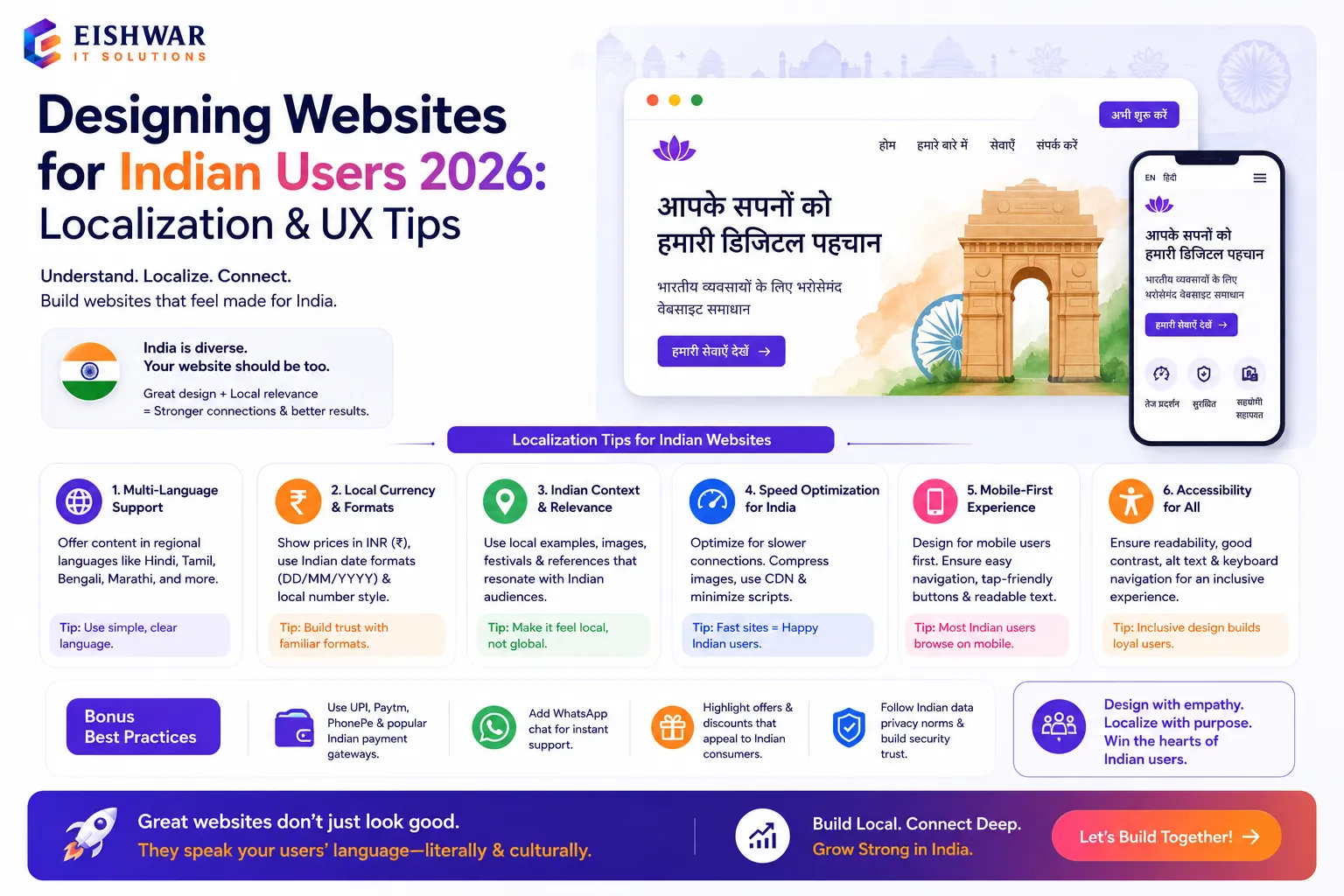
Designing Websites for Indian Users 2026: Localization & UX Tips
Published on: 14 Jun 2026
Designing Websites for Indian Users 2026: Localization & UX Tips
Introduction
India's digital landscape is evolving at an unprecedented pace. By 2026, over 900 million Indians will be online, with a majority accessing the internet via smartphones—often on 4G or 5G networks that can still be inconsistent in rural areas. For business owners, marketers, and professionals, designing a website that truly connects with Indian users is no longer optional—it's essential. This comprehensive guide covers the key principles of localization, user experience (UX), and conversion optimization tailored specifically for the Indian audience. Whether you're a startup or an established brand, these insights will help you build a website that drives engagement, builds trust, and boosts sales. We'll dive into practical examples, actionable tips, and real-world strategies that you can implement immediately.
Learn more about our Website services
Main Section 1: Understanding the Indian User Base
Indian users are incredibly diverse in language, culture, and digital behavior. To design effectively, you must understand their unique preferences and pain points. Here's a deeper look:
- Language Diversity: While English is widely used in urban areas, many users prefer regional languages. For instance, a user from Tamil Nadu might feel more comfortable reading product descriptions in Tamil. Offering content in Hindi, Tamil, Telugu, Bengali, Marathi, and other major languages can significantly build trust and reduce bounce rates. A practical tip: use a language switcher that remembers user preferences across sessions.
- Mobile-First Behavior: Over 70% of web traffic in India comes from mobile devices, and this number is expected to rise. Your website must be responsive and fast-loading on 4G/5G networks, but also optimized for slower 3G connections in rural areas. For example, a travel booking site should prioritize a thumb-friendly interface with large buttons and minimal text entry.
- Value-Conscious Mindset: Indian users are known for comparing prices, looking for discounts, and seeking clear value propositions. Highlight savings, free shipping, and guarantees prominently. For instance, an e-commerce site could display a "Price Match Guarantee" badge or a "Save ₹500" callout near the add-to-cart button.
- Trust Factors: Testimonials, secure payment badges, and clear contact information are crucial. Indian users are cautious about online fraud, so displaying SSL certificates, customer reviews with photos, and a physical address can make a huge difference. A fintech app, for example, should prominently feature its RBI registration number and customer support phone number.
Main Section 2: Localization Strategies for Indian Audiences
Localization goes beyond translation. It's about adapting your entire website to feel native and familiar. Here are actionable strategies with real-world examples:
- Regional Language Support: Use a language switcher prominently in the header or footer. Consider auto-detecting user location via IP to show the preferred language, but always allow manual override. For example, a news website could serve Hindi content to users in Uttar Pradesh and Tamil content to users in Tamil Nadu.
- Cultural Imagery: Use images that reflect Indian diversity—festivals like Diwali and Holi, traditional clothing such as sarees and kurtas, and local settings like bustling markets or serene villages. Avoid generic stock photos that feel disconnected. For instance, a food delivery app should show images of biryani, dosa, and paneer dishes rather than pizza and burgers.
- Payment Options: Integrate UPI (Google Pay, PhonePe, Paytm), net banking, and cash on delivery. These are non-negotiable for conversions. A practical tip: display payment icons near the checkout button to reassure users. For example, an online clothing store could show "Pay via UPI, Net Banking, or COD" with logos.
- Local Content: Include references to Indian festivals, holidays, and local events in your content and promotions. For instance, a travel site could create a blog post titled "Top 10 Destinations to Visit During Diwali 2026" or offer a "Holi Sale" discount code.
- Address & Contact: Use Indian address formats (e.g., city, state, pin code), include a local phone number with a +91 prefix, and show a physical address if possible. This builds credibility. For example, a SaaS company could list its office in Bengaluru with a map embed.
Main Section 3: UX Design Principles for Higher Conversions
Good UX is the backbone of conversion. For Indian users, simplicity and speed are paramount. Follow these principles with detailed examples:
👉 Don't wait for the perfect moment; turn your vision into reality today.
Free Consultation- Fast Loading Speed: Optimize images using WebP format, use a CDN with servers in India (e.g., Cloudflare or AWS Mumbai), and minimize JavaScript. Indian users on slower connections will abandon a site that takes more than 3 seconds to load. For instance, an e-commerce site could use lazy loading for product images and preload critical CSS.
- Clear Navigation: Use simple menus with no more than 5-7 items, breadcrumbs for easy backtracking, and a prominent search bar with autocomplete. Avoid clutter. For example, a job portal could have a top menu with "Jobs," "Companies," "Salaries," and "More."
- Mobile-First Design: Design for smaller screens first. Use large buttons (at least 48x48 pixels), readable fonts (minimum 16px for body text), and easy-to-tap links with ample spacing. For instance, a banking app should have a bottom navigation bar for one-handed use.
- Trust Signals: Display security certificates (e.g., Norton, McAfee), customer reviews with star ratings, and money-back guarantees near the call-to-action. For example, a subscription service could show "30-Day Money-Back Guarantee" next to the "Subscribe Now" button.
- Simplified Forms: Minimize required fields to name, phone, and email. Use autocomplete for addresses, dropdowns for states and cities, and clear error messages in red. Offer guest checkout to reduce friction. For instance, a food delivery site could allow ordering without creating an account.
Expert Tips
- Test on Real Devices: Use tools like BrowserStack or real device labs to test your site on popular Indian smartphones (e.g., Xiaomi Redmi Note, Samsung Galaxy M series, Vivo Y series). Emulators can miss real-world issues like touch sensitivity.
- Use Progressive Web Apps (PWAs): PWAs offer app-like experiences without downloads, perfect for low-storage phones. For example, a news site could become a PWA to deliver offline reading and push notifications.
- Leverage WhatsApp Integration: Add a WhatsApp chat button for instant support—Indians love using WhatsApp for business. Use a click-to-chat link with a pre-filled message like "Hi, I need help with..."
- Optimize for Voice Search: Many Indian users use voice assistants in regional languages (e.g., Google Assistant in Hindi). Include natural language keywords like "best phone under 15000" or "nearby restaurants."
- Personalize with Data: Use location, browsing history, and past purchases to recommend products or content. For instance, an e-commerce site could show "Popular in Your City" or "Based on Your Recent Views."
Common Mistakes
- Ignoring Regional Languages: English-only sites alienate a huge portion of the audience. For example, a government service portal without Hindi support may fail to reach rural users.
- Slow Loading Times: Heavy images and unoptimized code drive users away. A travel site with high-resolution photos could lose 50% of visitors if it takes more than 5 seconds to load.
- Poor Mobile Experience: Tiny buttons and unresponsive layouts frustrate mobile users. A checkout page with a 10px font size is a conversion killer.
- Lack of Trust Elements: No reviews, unclear return policies, or missing contact info reduces credibility. An online electronics store without a return policy will see high cart abandonment.
- Ignoring Local Payment Methods: Offering only credit cards limits conversions significantly. A fashion site without UPI or COD may lose 40% of potential sales.
Future Trends
By 2026, we expect these trends to shape Indian web design:
👉 Free Website Audit
Get Free Audit- AI-Powered Personalization: Chatbots and recommendation engines will become smarter, offering real-time support in multiple languages. For example, a banking site could use AI to suggest loan products based on user income.
- Voice-First Interfaces: More sites will integrate voice search and navigation, especially for regional languages. A recipe site could allow users to say "show me paneer recipes in Hindi."
- Hyperlocal Content: Websites will dynamically show content based on city or even neighborhood. A food delivery app could display restaurants within 2 km and offer local cuisine options.
- Augmented Reality (AR): E-commerce sites will use AR for virtual try-ons, popular in fashion and home decor. For instance, a furniture site could let users see how a sofa looks in their living room.
- Privacy-First Design: With data regulations like the Digital Personal Data Protection Act tightening, transparent data practices will be a competitive advantage. A healthcare site could clearly explain how user data is stored and used.
FAQs
1. Why is localization important for Indian websites?
Localization builds trust and improves user experience by catering to language, cultural, and behavioral preferences. For example, a site that offers Hindi content and UPI payments will see higher engagement and conversions compared to an English-only, credit-card-only site.
2. What are the best payment options for Indian users?
UPI (Google Pay, PhonePe, Paytm), net banking, and cash on delivery are the most preferred. Credit cards are used but less common, especially in smaller cities. A practical tip: offer at least three payment methods to cover all user segments.
3. How can I make my website load faster for Indian users?
Compress images using WebP, use a CDN with servers in India (e.g., Cloudflare, AWS Mumbai), enable lazy loading, and minimize JavaScript. Consider using AMP for mobile pages. For example, a news site could reduce load time from 5 seconds to 2 seconds by implementing these steps.
👉 Free Homepage Demo
Book Demo4. Should I use Hindi or English on my website?
Ideally, offer both. Use English as default but provide a language switcher for Hindi and other regional languages based on your target audience. For instance, a job portal targeting tier-2 cities should prioritize Hindi and local languages.
5. What is a PWA and why is it useful for Indian users?
A Progressive Web App (PWA) is a website that behaves like an app. It works offline, loads quickly, and saves data, making it ideal for users with limited storage or slow internet. For example, a recipe site as a PWA can be accessed offline in rural areas.
6. How do I build trust with Indian users?
Display customer testimonials with photos, secure payment badges (e.g., SSL, Norton), clear contact information (phone, email, address), and a physical address. Offer easy returns and money-back guarantees. For instance, a skincare brand could show before-after photos and a 15-day return policy.
7. What are the key metrics to track for Indian website performance?
Track page load time, mobile bounce rate, conversion rate by device, and regional traffic sources. Use Google Analytics and heatmaps. For example, if you see high bounce rates from Andhra Pradesh, consider adding Telugu content.
8. How can I optimize for voice search in Indian languages?
Use natural language keywords and phrases that users might speak, such as "best phone under 15000" or "nearby restaurants." Include long-tail keywords in Hindi and other regional languages. For example, a travel site could optimize for "Mumbai se Delhi flight ticket."
9. What are the best practices for mobile-first design in India?
Use large buttons (48x48px), readable fonts (16px+), and easy-to-tap links with ample spacing. Design for one-handed use with bottom navigation. Test on popular Indian devices like Xiaomi Redmi Note and Samsung Galaxy M series.
10. How can I use WhatsApp for customer support effectively?
Add a WhatsApp chat button with a click-to-chat link. Use a pre-filled message like "Hi, I need help with [product name]." Ensure quick response times (under 5 minutes) and consider using WhatsApp Business API for automation.
Conclusion
Designing a high-converting website for Indian users in 2026 requires a deep understanding of local preferences, a mobile-first approach, and a commitment to trust and speed. By implementing the strategies outlined above—localization, optimized UX, and future-ready trends—you can create a digital presence that resonates with India's diverse and growing online population. Start today, test continuously, and adapt to stay ahead. Remember, the key is to think local, act mobile, and build trust at every touchpoint.
CTA
Ready to transform your website for Indian users? Contact EishwarITSolution at eishwar.com for expert web design and localization services. Let's build a site that converts!