Psychology-Driven Website Design: Boost Conversions for Indian Busines
Published on: 16 Jun 2026
Psychology-Driven Website Design: Boost Conversions for Indian Businesses
Introduction
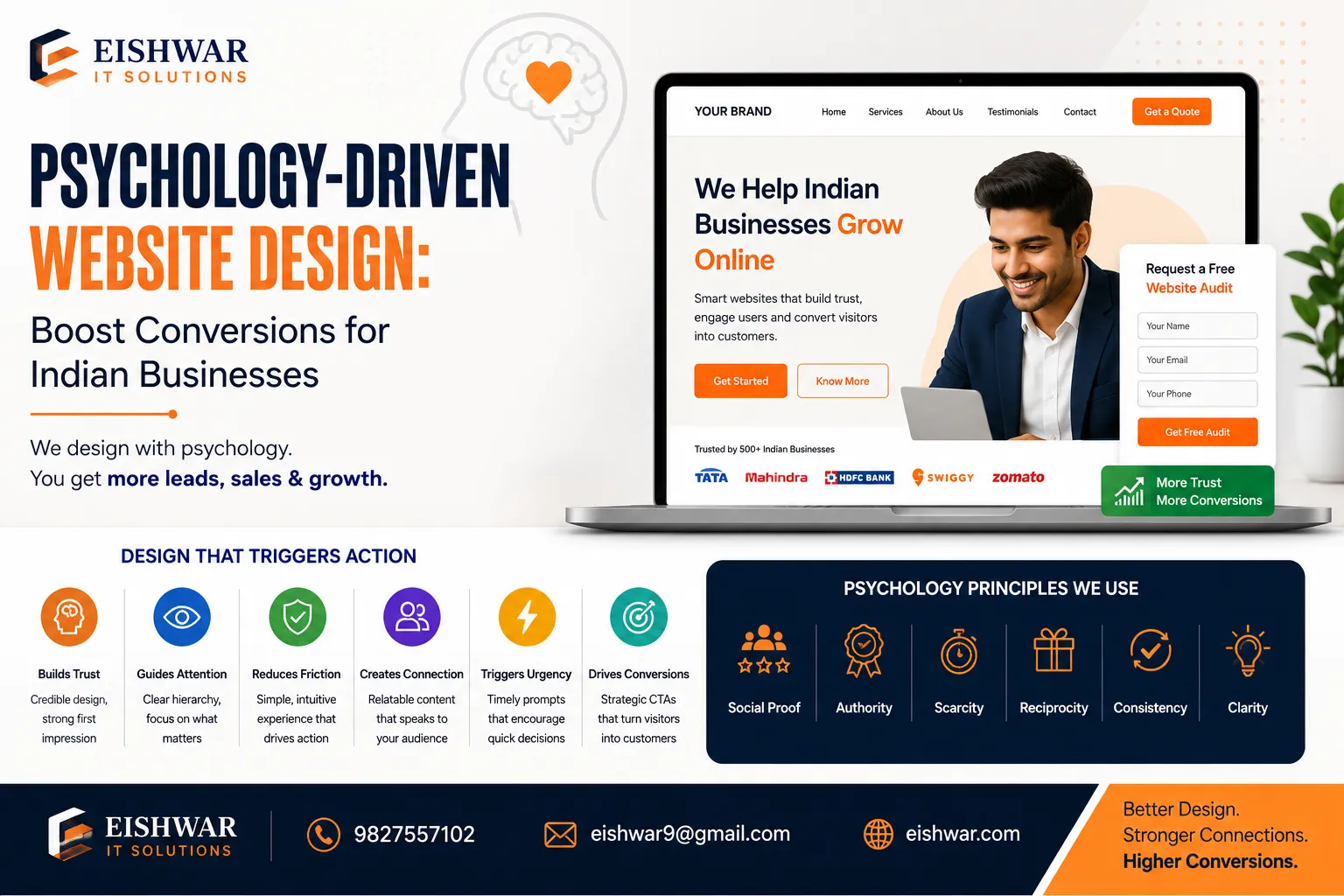
In today's digital landscape, a beautiful website isn't enough. For Indian businesses competing in a crowded market, the key to success lies in understanding the psychology behind user behavior. Psychology-driven website design combines visual aesthetics with behavioral science to guide visitors toward desired actions—whether that's making a purchase, filling out a form, or calling your business. This approach is especially powerful for Indian audiences, where trust, social proof, and cultural nuances play a major role in decision-making.
Learn more about our Website services
At EishwarITSolution, we've seen firsthand how small design changes—like button color, layout symmetry, or the placement of testimonials—can dramatically improve conversion rates. In this guide, we'll explore actionable strategies to design a website that not only looks great but also converts visitors into loyal customers. We'll dive deep into the psychology behind every element, from the first impression to the final click, and provide practical examples tailored to the Indian market.
Main Section 1: The Science of First Impressions
Users form an opinion about your website within 50 milliseconds. That's faster than a blink. This snap judgment determines whether they stay or bounce. For Indian businesses, where trust is paramount, making a positive first impression is non-negotiable. Think of your homepage as a digital handshake—it needs to be firm, confident, and reassuring.
Key Psychological Principles:
- Visual Hierarchy: Arrange elements so the most important information (like your value proposition) grabs attention first. Use size, color, and placement to guide the eye. For example, a bold headline like "Get 50% Off Your First Order" in a large font above a smaller subheadline draws immediate focus. In practice, a real estate website might place a prominent "Book a Free Site Visit" button above property listings to prioritize conversion.
- Color Psychology: Colors evoke emotions. For example, blue conveys trust (ideal for finance or healthcare), while orange creates urgency (great for e-commerce). Choose a palette that aligns with your brand and audience. An Indian e-commerce site selling festive wear might use gold and red to evoke celebration and urgency, while a fintech app could use blue and green to signal security and growth.
- Symmetry and Balance: Symmetrical layouts feel orderly and professional. Asymmetry can be creative but must be intentional to avoid confusion. For instance, a balanced grid of product images with equal spacing feels more trustworthy than a chaotic collage. A local restaurant website might use a symmetrical layout for its menu to make it easy to scan.
Actionable Tip: Test your homepage with a heatmap tool (like Hotjar) to see where users look first. Adjust your hero section to include a clear headline, subheadline, and a single call-to-action (CTA). For example, if heatmaps show users fixate on the top-left corner, place your primary CTA there. Also, ensure your hero image is relevant—using a photo of a happy Indian family using your service can instantly build rapport.
Main Section 2: Building Trust with Social Proof and Familiarity
Indian consumers rely heavily on recommendations and reviews. Integrating social proof into your design taps into the psychological principle of "liking" and "consensus." People are more likely to trust your business if others have had positive experiences. In a market where word-of-mouth is king, digital social proof is your best ally.
👉 Don't wait for the perfect moment; turn your vision into reality today.
Free ConsultationDesign Elements That Build Trust:
- Testimonials with Photos: Display real client testimonials with names and photos. This humanizes your brand. For example, a local salon could feature a testimonial from a regular customer with a before-and-after photo, along with a quote like "Best haircut in Mumbai!" Use authentic, unposed photos to increase credibility.
- Trust Badges: Include SSL certificates, payment security logos, and industry awards near checkout or contact forms. For an Indian audience, displaying "Verified by Paytm" or "Razorpay Secure" can reduce cart abandonment. Also, include a "100% Money-Back Guarantee" badge to lower risk perception.
- Case Studies: Showcase successful projects with before/after metrics. Use a clean, scannable layout with bullet points. For instance, a digital marketing agency might show "Increased leads by 150% in 3 months for a Jaipur-based startup" with a graph. Include specific numbers and client quotes to make it tangible.
- Familiar Patterns: Stick to common UI patterns (e.g., logo top-left, navigation top-right) to reduce cognitive load. Users should feel instantly at home. Avoid unconventional layouts like a hamburger menu on desktop, which can confuse older users. For Indian users, consider adding a "WhatsApp" button for instant queries, as it's a familiar communication channel.
Actionable Tip: Add a "Trust Bar" on your homepage—a horizontal strip featuring logos of clients, media mentions, or certifications. This builds credibility without taking up much space. For example, a B2B service provider could display logos of companies like Tata, Reliance, or Infosys (with permission) to instantly signal reliability. Also, include a live counter showing "Trusted by 5,000+ customers" to leverage social proof.
Main Section 3: Reducing Friction for Higher Conversions
Friction is anything that slows down or confuses a user. In the Indian context, factors like slow internet speeds, language barriers, and complex forms can kill conversions. Psychology-driven design minimizes friction by anticipating user needs and removing obstacles before they arise.
Common Friction Points and Solutions:
- Slow Load Times: Optimize images, use lazy loading, and leverage CDN. A 1-second delay can reduce conversions by 7%. For Indian users on 4G or slower connections, compress images to under 100KB and use next-gen formats like WebP. Tools like TinyPNG can help. Also, consider a lightweight theme if using WordPress.
- Long Forms: Only ask for essential fields. Use inline validation to prevent errors. For Indian users, offer options like WhatsApp or email sign-up. For example, a lead generation form could ask just for name and phone number, with a checkbox for "Contact me on WhatsApp." Reduce dropdowns and use autofill for city and state based on pincode.
- Unclear Navigation: Use descriptive labels and a simple menu structure. Include a search bar for larger sites. For example, instead of "Services," use "Our Services" or "What We Offer." For an Indian audience, add a "हिंदी" language toggle if relevant. Keep the menu to 5-7 items max to avoid overwhelm.
- Lack of Mobile Optimization: Over 70% of Indian users browse on mobile. Ensure your design is fully responsive with thumb-friendly buttons. Buttons should be at least 48x48 pixels, and forms should use large input fields. Test on devices like a OnePlus or Xiaomi to ensure compatibility. Also, avoid pop-ups that cover the screen on mobile.
Actionable Tip: Audit your checkout or contact form. Remove any non-essential fields. Add progress bars for multi-step processes to reduce anxiety. For example, a 3-step checkout (Cart → Shipping → Payment) with a progress bar can increase completion rates by 20%. Also, offer cash-on-delivery (COD) as an option, which is popular in India, and display it prominently.
👉 Free Website Audit
Get Free AuditExpert Tips
We asked top conversion designers for their best advice. Here's what they shared, with practical examples for Indian businesses:
- Use the "Decoy Effect": Offer three pricing tiers where the middle one is your target. The decoy (highest price) makes the middle seem reasonable. For example, a SaaS tool for Indian startups could price at ₹999/month (basic), ₹1,999/month (pro), and ₹4,999/month (enterprise). The pro option becomes the most attractive. This works because users compare options rather than absolute value.
- Leverage Scarcity: Show limited stock or time-limited offers. Use phrases like "Only 2 left" or "Offer ends in 24 hours." For an Indian e-commerce site selling Diwali specials, a countdown timer with "Sale ends tonight!" can create urgency. But be honest—false scarcity can damage trust. Use real inventory data if possible.
- Implement Micro-Interactions: Subtle animations on buttons or hover effects can delight users and encourage clicks. For example, a "Add to Cart" button that bounces slightly when hovered over, or a form field that glows green when filled correctly. These small touches make the experience feel responsive and premium.
- Personalize with Dynamic Content: Show different CTAs based on user location or behavior. For example, show "Book a Free Consultation" to new visitors and "Get a Quote" to returning ones. Use cookies to track past interactions. A travel site could show "Explore Kerala Packages" to users from South India and "Himalayan Treks" to those from the North.
- A/B Test Everything: Test headlines, button colors, and layouts. Even small changes can yield big lifts. For instance, test a green "Buy Now" button against a red one. In one case, changing the CTA from "Submit" to "Get My Free Guide" increased clicks by 30%. Use tools like Google Optimize for simple tests.
Common Mistakes
Even well-intentioned designs can hurt conversions. Avoid these pitfalls, especially in the Indian context:
- Too Many CTAs: A page with multiple competing actions confuses users. Stick to one primary CTA per page. For example, a landing page should have one main button like "Shop Now" rather than "Learn More," "Sign Up," and "Contact Us." This reduces decision paralysis.
- Ignoring Cultural Context: Using generic stock photos of non-Indian people can feel inauthentic. Use real images of your team and local customers. For instance, a wedding photography site should feature Indian weddings, not Western ones. Also, avoid using English-only content if your audience speaks Hindi or regional languages.
- Hidden Information: Don't bury pricing or contact details. Users should find key info within two clicks. For example, a service page that hides pricing behind a "Get Quote" form can frustrate users. Instead, display a price range or starting price upfront. Add a sticky phone number or WhatsApp button for instant access.
- Overcomplicating Design: Flashy animations or cluttered layouts distract from your message. Minimalism often converts better. For example, a cluttered homepage with multiple sliders, pop-ups, and auto-playing videos can slow load times and overwhelm users. Stick to a clean layout with ample white space.
- Neglecting Accessibility: Ensure your site is usable for people with disabilities. Use alt text, high contrast, and keyboard navigation. For Indian users, this includes supporting screen readers for visually impaired users. Also, consider font size—use at least 16px for body text to improve readability on small screens.
Future Trends
Looking ahead to 2026 and beyond, psychology-driven design will evolve with new technologies. Here's what to watch, with implications for Indian businesses:
👉 Free Homepage Demo
Book Demo- AI-Powered Personalization: AI will analyze user behavior in real-time to serve personalized layouts and content. For example, an e-commerce site might show different product recommendations based on browsing history. In India, AI could tailor offers based on regional festivals (e.g., Diwali vs. Pongal) or language preferences. This will require robust data collection and ethical use.
- Voice User Interfaces (VUI): As voice search grows, designing for voice interactions will become crucial. Think conversational CTAs like "Say 'Shop now' to explore." For Indian users, supporting multiple languages (Hindi, Tamil, Bengali) in voice commands will be key. A food delivery app could allow users to order via voice in their local language.
- Biometric Feedback: Using eye-tracking or facial expression analysis to adjust design elements dynamically. This is still emerging but promises deeper insights. For example, a website could detect user frustration (via facial cues) and simplify the layout. However, privacy concerns will need to be addressed, especially in India where data protection laws are evolving.
- Ethical Design: Users will demand transparency. Dark patterns (tricking users into actions) will backfire. Focus on ethical, user-first design. For instance, avoid pre-checked boxes for subscriptions or hidden cancellation fees. Indian regulators are increasingly cracking down on such practices, so ethical design is both a moral and legal imperative.
FAQs
What is psychology-driven website design?
Psychology-driven website design uses principles from behavioral science to influence user behavior. It focuses on how elements like color, layout, and social proof can guide visitors toward taking specific actions, such as making a purchase or filling out a form. It's about understanding the 'why' behind user actions to create a more intuitive and persuasive experience.
How can Indian businesses use psychology to improve conversions?
Indian businesses can leverage trust signals like testimonials, local imagery, and familiar UI patterns. Also, optimizing for mobile and reducing form friction addresses common user pain points in India. A/B testing culturally relevant CTAs can further boost conversions. For example, using phrases like "Book a Free Demo" instead of "Sign Up" can resonate better with Indian users who prefer low-commitment actions.
What are the most important design elements for conversion?
Key elements include a clear value proposition, strong visual hierarchy, prominent CTAs, social proof (testimonials, trust badges), and fast load times. Simplicity and mobile responsiveness are also critical. For Indian businesses, adding a WhatsApp chat button and offering COD can significantly boost conversions.
How do I test if my website design is converting well?
Use tools like Google Analytics to track conversion rates, heatmaps (Hotjar) to see user behavior, and A/B testing platforms (Optimizely) to compare versions. Pay attention to bounce rate and time on page as indirect indicators. For Indian sites, also monitor page load speed on 4G networks and user feedback via surveys.
Can small businesses afford psychology-driven design?
Absolutely. Many principles are low-cost to implement: simplifying forms, adding testimonials, or choosing the right color palette. Start with small changes and measure impact. Investing in a professional designer can offer high ROI if done strategically. For example, a local restaurant can add customer reviews and a simple reservation form without any design budget.
What is the role of color in website design for Indian audiences?
Color plays a significant role in evoking emotions and cultural associations. For Indian audiences, colors like saffron (associated with spirituality and courage), green (prosperity), and gold (wealth) can be powerful. However, avoid overusing red in financial contexts as it may signal loss. Test color combinations with your target demographic to ensure they align with brand values.
Conclusion
Psychology-driven website design isn't just a trend—it's a proven strategy to turn visitors into customers. By understanding how your audience thinks, you can create a site that feels intuitive, trustworthy, and persuasive. For Indian businesses, this means blending universal psychological principles with local cultural insights. Start with one change today: audit your homepage for trust signals and friction points. The results will speak for themselves. Remember, every element on your page—from the color of a button to the placement of a testimonial—can influence a decision. Embrace the science of design, and watch your conversions soar.
CTA
Ready to transform your website into a conversion machine? Contact EishwarITSolution today for a free consultation. Our team of experts will analyze your site and recommend psychology-driven improvements tailored to your Indian audience. Visit EishwarITSolution.com or call us to get started. Don't let your competitors win—make the first move toward higher conversions now.