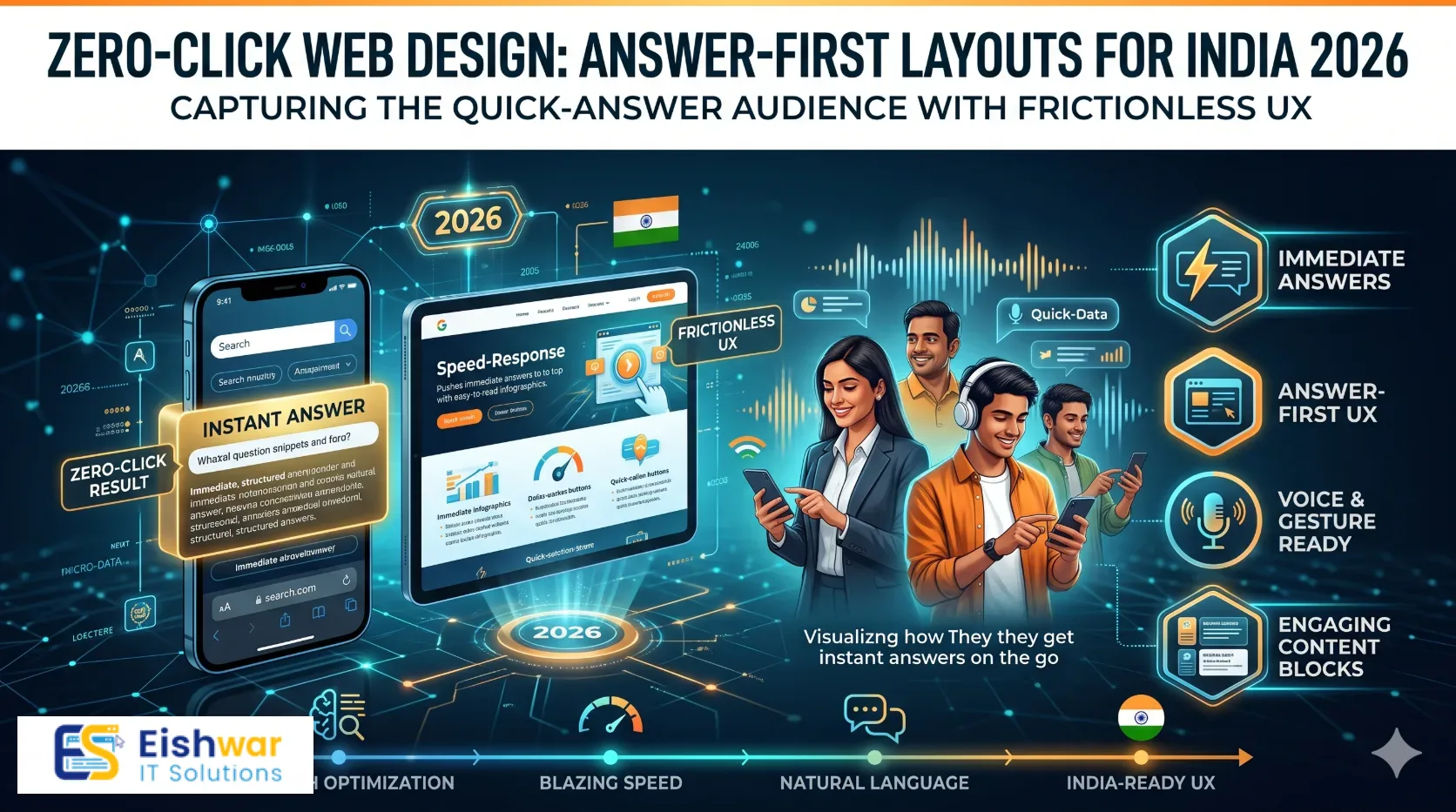
Zero-Click Web Design: Answer-First Layouts for India 2026
Indian buyers are asking more questions than ever before. They search on Google, tap an AI Overview, ask voice assistants, and check WhatsApp forwards before they visit a website. In 2026, a business website is no longer only a destination. It is a source of answers that search engines and AI tools can quote.
Zero-click web design is the practice of designing pages so users and machines can find the answer quickly, trust the source, and take action when ready.
This guide is for business owners, marketers, and professionals who want a practical website design strategy for India. You will learn what zero-click search means, how to structure answer-first layouts, and which technical details help your website appear in AI-powered results.
Main Section 1: Why Zero-Click Web Design Matters for Indian Businesses in 2026
Zero-click search means a user gets an answer directly on the search results page or inside an AI assistant without clicking through to a website. Think of a featured snippet, a Google AI Overview, a People Also Ask result, a voice reply, or a chatbot summary. The user may still visit later, but the first interaction often happens before the click.
For Indian businesses, this shift is important because search behavior is mobile-heavy, question-led, and increasingly local. A customer in Indore may search “best interior designer near me cost”. A marketing manager in Bengaluru may ask an AI tool “how much does a B2B website redesign cost in India?” A small business owner in Surat may compare GST-compliant invoice software using quick summaries. If your website does not provide clear, structured answers, someone else will.
The new discovery funnel: answer, trust, action
The old funnel was click, browse, enquire. The new funnel often starts with answer, trust, action. A user reads a short answer, notices your brand name, and later searches for your business directly. Or they click your link because your answer included a practical detail like a price range, a checklist, or a local example. Zero-click design is not about giving away everything. It is about being useful enough to earn attention.
This matters for conversion too. When a visitor lands on your website after seeing your answer, they arrive with context. They are not starting from zero. A well-designed page can confirm your expertise, show proof, and guide them toward a consultation or WhatsApp conversation.
What changes for website design in India
Design choices that worked in 2020 may not work in 2026. Long introductions, hidden pricing, vague service pages, and image-only content reduce your chances of being cited. Indian users also expect fast mobile pages, clear contact options, rupee pricing signals where possible, local trust markers, and simple language. Many users switch between English and Hinglish, so clarity matters more than decorative copy.
Consider a practical example. A Pune-based chartered accountant firm creates a page titled “GST Registration Documents Required for Small Business”. The page opens with a 50-word answer, lists documents in a table, adds a short video, and ends with a WhatsApp button. The page can win a featured snippet, get quoted in an AI summary, and still convert visitors who need help. That is zero-click web design in action.
Main Section 2: Designing Answer-First Layouts Indian Buyers Trust
Answer-first layout means the most useful information appears early and is easy to scan. It does not mean every page is a boring FAQ. It means you respect the user’s question before you pitch your service. Indian buyers are practical. They want to know cost, process, timeline, documents, service area, and proof. Design around those needs.
Start with a question architecture
Before redesigning a page, list the real questions your customers ask. Use sales calls, WhatsApp chats, Google Search Console queries, and on-site search data. Group them into themes such as pricing, process, eligibility, comparisons, local availability, and after-sales support. Then design page sections around those themes.
For example, a website design company in India could create sections like “How much does a business website cost in India?”, “What is included in a website redesign?”, “How long does it take?”, and “Do you provide hosting and support?” Each section should start with a direct answer in 40 to 60 words, followed by details.
Use a hero that answers, not just decorates
A large banner with a stock photo and “We Are The Best” does not answer anything. A stronger hero includes a clear value statement, a one-line explanation, and proof. For an IT solutions company, that could be: “Website design and SEO for Indian businesses that need more qualified enquiries. 12+ years of experience. Transparent pricing. Support in English and Hindi.” Add a visible primary CTA such as “Get a Free Website Audit”.
Keep the hero mobile-first. Many Indian users will see your page on a mid-range Android phone with a patchy connection. Use readable type, short lines, and buttons that are easy to tap. Avoid huge videos that slow down the first screen.
Build skimmable answer blocks
Answer blocks can include definitions, bullet lists, comparison tables, checklists, and step-by-step process cards. These formats are easy for users to scan and easy for search engines to understand. If you sell services, add practical details like starting price ranges, timelines, deliverables, and locations served. If you sell products, include specifications, warranty, delivery time, and return policy.
Use H2 and H3 headings as natural questions. For example:
What does a zero-click website design project include?
How much does a business website cost in India?
Which pages should answer common customer questions?
Do not hide the answer in the third paragraph. Put it first. Then support it with examples, screenshots, and proof.
Design for local trust
Indian buyers look for signals that a business is real, reachable, and accountable. Add a real office address, phone number, email, GST details where relevant, team photos, client testimonials, case studies, and service areas. If you serve multiple cities, create location-specific pages or sections instead of copying the same content everywhere.
Trust also comes from clarity. Show pricing bands if you can. Explain what happens after a form submission. Use simple refund, privacy, and support policies. These details reduce hesitation and improve conversion quality.
Make the next step obvious
Zero-click search may delay the click, but it should not delay conversion when the user is ready. Add contextual CTAs near answer blocks. A user reading about website costs may prefer “Get a Cost Estimate”. A user reading about SEO may prefer “Request a Free SEO Audit”. Use WhatsApp, call, and form options based on the page intent. Keep forms short and ask only for what you need to respond.
Main Section 3: Technical SEO and Design Checklist for AI Answer Visibility
Good design and good technical SEO now work together. If your content is helpful but crawlers cannot understand it, you lose visibility. Use this checklist as a practical starting point for your Indian business website.
1. Use semantic HTML and clear headings
Each page should have one H1 and a logical H2 and H3 structure. Use headings to describe topics, not to style text. Put key answers in text, not inside images. Avoid hiding important content behind JavaScript-only tabs if you want search engines to access it easily.
2. Add structured data where it fits
Schema markup helps search engines understand your business, services, locations, articles, and FAQs. Useful types include Organization, LocalBusiness, Service, Product, Article, FAQPage, and BreadcrumbList. Do not add schema that does not match the visible page content. Schema is a support signal, not a magic ranking button.
3. Optimize Core Web Vitals for Indian networks
Speed matters. Compress images, use modern formats, reduce third-party scripts, and test on mobile networks. A fast page improves user experience and helps crawlers process your content efficiently. Focus on loading speed, visual stability, and interaction responsiveness.
4. Write snippet-ready answers
For each key question, write a concise answer of 40 to 60 words, then expand. Use the question as a heading. Add examples, data, or local context to show first-hand expertise. Avoid generic AI-style filler that says the same thing as every competitor.
5. Strengthen internal linking
Link related answer pages to service pages and service pages to proof pages. For example, a blog post about zero-click web design can link to your website design services, SEO services, and case studies. Use descriptive anchor text. This helps users and search engines understand your site structure.
6. Show authorship and freshness
Add an author bio with relevant experience. Show the published and updated date. For businesses, mention the team or expert who reviewed the content. If you update pricing, policies, or processes, update the page too. Freshness builds trust, especially for topics like compliance, costs, and technology trends.
7. Track the right signals
Zero-click success is not only about clicks. Monitor impressions, average position, brand searches, direct traffic, assisted conversions, WhatsApp clicks, call clicks, and form starts. Use Google Search Console to see which queries trigger your pages. Combine that with analytics and CRM data to understand which answer pages contribute to enquiries.
A simple monthly review can reveal gaps. If you rank for “website design cost in India” but your page has no price context, add a pricing section. If users search for “website redesign checklist”, create a downloadable checklist page. Let search behavior guide your design updates.
Expert Tips
- Answer the money questions early. Pricing, timeline, process, and support are often the real reasons a user hesitates. Address them clearly.
- Write for humans first. Use simple sentences. Explain jargon. Indian buyers appreciate directness and practical examples.
- Use local proof. Mention cities, industries, client types, and case study results. A generic website feels less credible than a specific one.
- Design for mobile thumbs. Keep tap targets large, forms short, and contact options visible without endless scrolling.
- Create answer hubs. Group related questions into resource pages, such as “Website Design FAQs for Indian Businesses” or “SEO Checklist for Small Business Websites”.
- Add visual proof. Use screenshots, process diagrams, before-and-after examples, and real team photos. Optimize images with descriptive alt text.
- Review content quarterly. Update pricing, tools, regulations, and examples. AI search favors useful and current information.
- Measure assisted conversions. A user may see your answer today and enquire next week. Use UTM links, call tracking, and CRM notes to connect the journey.
Common Mistakes
Many businesses try to adopt zero-click design but make avoidable mistakes. Here are the ones to watch.
- Keyword stuffing. Repeating “best website design India” in every line makes content hard to read and less trustworthy.
- Hiding the answer. Long brand stories before the actual answer frustrate users and reduce snippet chances.
- Publishing generic AI content. AI-assisted drafts can help, but they need expert review, local examples, and original insights.
- Ignoring mobile speed. Heavy sliders, pop-ups, and uncompressed images can destroy the experience on Indian mobile networks.
- No conversion path. Answer pages should still guide users to a relevant service, quote, or consultation.
- Overusing schema. Incorrect or misleading structured data can harm trust and may not be displayed.
- Copying competitor pages. Duplicate content rarely wins. Add your own process, data, screenshots, and customer questions.
- Forgetting local language and context. English-only pages may miss users who think in Hinglish or prefer regional languages. Use clear language and consider translation for high-intent pages.
Future Trends
Zero-click web design will keep evolving as AI search becomes more common in India. Here are trends worth watching.
AI agents that compare businesses
Users may ask AI agents to compare vendors, estimate costs, or shortlist service providers. Your website should make comparison easy with structured service details, pricing ranges, proof, and clear differentiators.
Answer analytics
Businesses will track not only clicks but also citations, brand mentions, and AI-generated referrals. Search Console and analytics will remain important, but teams will also monitor answer visibility across platforms.
Multilingual answer layers
India’s language diversity makes multilingual answer design a major opportunity. High-intent pages in Hindi, Marathi, Tamil, Gujarati, or Hinglish can capture users who prefer local-language explanations.
Interactive cost and eligibility tools
Calculators, checklists, and self-assessment tools can answer questions while capturing intent. For example, a website cost calculator or SEO audit checklist can be both helpful and conversion-friendly.
Trust-first design
As AI-generated content grows, human proof becomes more valuable. Real photos, expert bios, client stories, audits, and transparent policies will differentiate credible Indian businesses.
FAQs
What is zero-click web design?
Zero-click web design is the practice of structuring website content and layouts so users and AI search tools can quickly find clear answers. It focuses on direct answers, scannable sections, trust signals, and easy conversion paths.
Does zero-click search reduce website traffic?
It can reduce clicks for simple informational queries, but it can also build brand awareness and improve traffic quality. Users who visit after seeing your answer are often better informed and closer to action.
How do I optimize my website for AI Overviews in India?
Use clear question-based headings, concise answers, structured data, fast mobile pages, original examples, and strong trust signals. Also keep content updated and link related pages together.
Which pages should be answer-first?
Prioritize service pages, pricing pages, FAQs, how-to guides, comparison pages, local landing pages, and product pages. Any page that answers a common pre-purchase question is a good candidate.
Is schema markup enough to appear in AI answers?
No. Schema helps machines understand your content, but it does not guarantee visibility. The visible content must be useful, accurate, well-structured, and trustworthy.
How can I measure zero-click success?
Track impressions, branded searches, direct traffic, assisted conversions, call clicks, WhatsApp clicks, and form starts. Combine search data with CRM notes to see which answer pages influence enquiries.
Conclusion
Zero-click web design is not a shortcut or a trick. It is a shift toward clarity. Indian users want fast answers, local proof, and a simple next step. When your website is built around real questions, useful details, and trustworthy design, it can perform better in both traditional search and AI-powered search.
Start small. Pick one high-intent service page. Add a direct answer, a pricing range, a short FAQ, local proof, and a clear CTA. Then measure what changes. Over time, these answer-first improvements can make your website more useful, more credible, and more competitive.
CTA
Want to make your Indian business website ready for zero-click and AI search in 2026? EishwarITSolution can audit your current website, identify answer gaps, and redesign key pages for clarity and conversions. Visit http://eishwar.com or book a free website audit today.