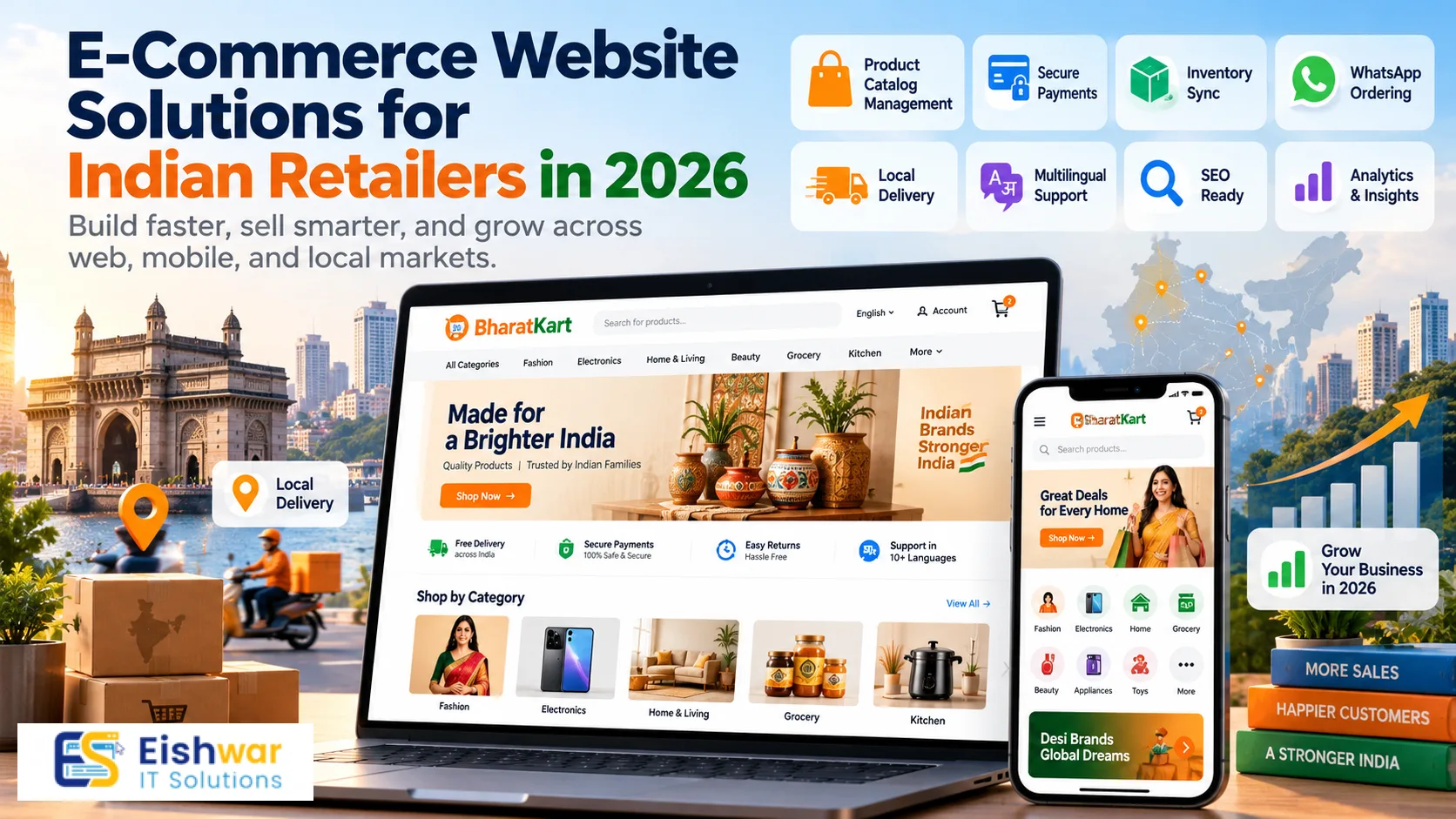
E-Commerce Website Solutions for Indian Retailers in 2026
Introduction
Indian retail is no longer split neatly into online and offline. Customers discover products on Instagram, compare prices on Google, ask for recommendations on WhatsApp, and then buy from the store that feels easiest to trust. For Indian retailers, an e-commerce website is not just a digital catalogue. It is the salesperson, cashier, and customer service desk that never closes.
Yet many retailers still rely on generic websites or social media pages. They get likes, but not enough orders. They get traffic, but not repeat buyers. That is where specialized e-commerce website solutions for Indian retailers make a difference. A well-built store understands local payment habits, delivery expectations, mobile usage, language preferences, and festive buying behaviour.
At EishwarITSolution, we help retail businesses build industry-specific websites that do more than look good. They turn visitors into customers and customers into loyal fans. In this guide, you will learn what makes an e-commerce website work in India, which features matter most, and how to avoid costly mistakes in 2026.
Why Indian Retailers Need Specialized E-Commerce Websites in 2026
India's e-commerce market is growing beyond metros. Shoppers in Tier 2 and Tier 3 cities are buying fashion, electronics, home decor, groceries, and wellness products online. Many of them use only mobile phones. Many expect UPI, Cash on Delivery, and easy returns. A generic template website often fails to meet these expectations.
Online Buying Has Changed Permanently
Customers today compare products across multiple tabs. They check reviews, delivery timelines, and return policies before adding items to the cart. If your website loads slowly or hides key information, they leave. If it asks for too many form fields, they abandon the purchase.
For example, a saree retailer in Jaipur may attract thousands of visitors during a festive season. But if the website does not show real product videos, accurate fabric details, and pin code delivery dates, users hesitate. A specialized e-commerce solution can show all of this without overwhelming the shopper.
The Cost of a Generic Website
A generic website may look modern, but it is not built for retail. It might lack inventory sync, GST invoicing, coupon management, or abandoned cart recovery. These gaps cost money every day. Retailers often spend on ads to bring traffic, then lose sales at checkout because the foundation is weak.
Industry-specific e-commerce website solutions solve this by focusing on the retail journey. They connect product discovery, payment, delivery, and retention in one system. That is how a small store competes with large marketplaces.
Core Features of High-Performing E-Commerce Website Solutions
The best e-commerce websites in India share certain features. They are fast, mobile-friendly, trustworthy, and built around local buying habits. Here are the core elements Indian retailers should prioritize in 2026.
1. Fast, Mobile-First Storefronts
Most Indian shoppers browse on mobile phones, often on 4G or inconsistent Wi-Fi. Every extra second of load time reduces conversions. A mobile-first storefront should load product pages quickly, compress images, and keep navigation simple.
Use thumb-friendly buttons, sticky add-to-cart bars, and clear product images. Avoid pop-ups that block the screen immediately. Instead, guide users with smart recommendations. A fast website also improves SEO, which lowers your dependence on paid ads.
2. Localized Payment and Checkout Options
India has one of the most diverse payment ecosystems in the world. Your checkout should support UPI, credit and debit cards, net banking, wallets, and Cash on Delivery where suitable. Popular gateways like Razorpay, PayU, and Cashfree offer smooth integration.
Also consider EMI options for higher-ticket products. For a furniture retailer in Pune, EMI can turn a hesitant buyer into a confirmed customer. For a grocery store in Chennai, one-click UPI reorder can increase repeat purchases.
3. Smart Product Discovery
Shoppers should find what they want in seconds. Use filters for size, colour, price, brand, material, and occasion. Add semantic search that understands natural language, such as 'cotton kurti under 1500 for office'. This is especially useful in fashion and lifestyle retail.
Product recommendations should be relevant. 'Frequently bought together' and 'Customers also viewed' can increase average order value. But do not overload the page. Keep suggestions helpful, not pushy.
4. Trust Signals for Indian Shoppers
Trust is the biggest currency in Indian e-commerce. Display GST registration, business address, contact number, return policy, and secure payment badges. Add customer reviews with photos and videos. Show delivery and return timelines clearly.
For first-time buyers, Cash on Delivery can reduce risk. For repeat buyers, loyalty points and referral rewards can build habit. A legal website solution for a law firm builds trust differently, but the principle is the same: remove doubt before asking for payment.
5. Post-Purchase Retention Tools
Getting a first order is good. Getting a second and third order is better. Use order tracking, WhatsApp updates, email receipts, and feedback requests. Send personalized offers based on past purchases.
For example, a pet supplies retailer can remind a customer to reorder dog food after 30 days. A skincare brand can suggest a complementary product after a moisturizer purchase. These small automations increase lifetime value without extra ad spend.
How to Choose the Right E-Commerce Website Solution for Your Retail Business
There is no single best platform for every Indian retailer. The right choice depends on your products, order volume, budget, and growth plans. Use this practical framework to decide.
Map Your Business Model First
Are you a D2C brand, a local store with online delivery, a wholesaler, or a marketplace seller? Each model needs different features. A D2C fashion brand may need lookbooks and size guides. A wholesaler may need bulk pricing, minimum order quantities, and GST invoice downloads.
Write down your top five customer actions. For a grocery retailer, actions might be search, add to cart, choose delivery slot, pay, and reorder. For an electronics retailer, they might be compare, check warranty, finance, add to cart, and schedule installation.
Evaluate Platform Flexibility
Platforms like Shopify, WooCommerce, and custom solutions each have strengths. Shopify is fast to launch. WooCommerce offers flexibility. Custom development gives full control but needs more maintenance. The key is to avoid locking yourself into a system that cannot support Indian payment, shipping, and tax requirements.
Check whether you can customize checkout fields, add regional languages, and integrate with ERP or inventory software. If you sell on Amazon or Flipkart, inventory sync is essential to avoid overselling.
Check India-Specific Integrations
Your website should integrate with Indian courier partners such as Delhivery, Blue Dart, Shiprocket, and India Post. It should calculate shipping by pin code and weight. It should support GST-compliant invoices and HSN codes.
Also consider ONDC opportunities. As India's open network for digital commerce expands, retailers who have structured product catalogues can reach more buyers. A flexible website makes it easier to connect with new channels.
Plan for SEO and Content
An e-commerce website without SEO is like a shop in a hidden lane. Optimize category pages, product titles, descriptions, and images. Create buying guides, size charts, and comparison articles. Use schema markup for products, reviews, and FAQs.
Local SEO matters too. If you have a physical store, add your address, Google Business Profile, and local keywords. A customer searching for 'best organic store in Indiranagar' should find you.
Expert Tips
- Start with speed: Compress images, use a CDN, and remove unnecessary plugins. Aim for under three seconds on mobile.
- Show delivery dates, not just delivery charges: Shoppers in India care about when the product will arrive, especially during festivals.
- Use WhatsApp for support and reorders: It is familiar, fast, and trusted. Add a click-to-chat option on product pages.
- Build trust with user-generated content: Encourage customers to share photos and videos. Real proof beats polished claims.
- Track the right metrics: Monitor cart abandonment, conversion rate, average order value, and repeat purchase rate.
- Prepare for festive spikes: Test your server, payment gateways, and shipping integrations before Diwali, Raksha Bandhan, and Big Billion Days.
- Offer regional language options: Hindi, Tamil, Telugu, Marathi, and Bengali can improve comfort for non-English shoppers.
- Keep checkout short: Guest checkout, address autofill, and UPI intent flows reduce friction.
Common Mistakes
Many Indian retailers lose sales because of avoidable errors. Here are the most common ones and how to fix them.
- Designing for desktop first: Most traffic is mobile. Design for small screens, then adapt to desktop.
- Hiding shipping costs: Surprise charges at checkout cause abandonment. Show estimated shipping early.
- Ignoring product content: Thin descriptions and poor images reduce trust. Add details, dimensions, materials, and usage tips.
- No return or refund clarity: Customers need to know what happens if the product does not fit or work.
- Overloading the homepage: Too many banners and pop-ups confuse visitors. Focus on one primary action.
- Neglecting post-purchase communication: Silence after payment creates anxiety. Send order confirmation, dispatch, and delivery updates.
- Not testing payment flows: A failed UPI transaction can lose a customer forever. Test all payment methods regularly.
- Copying marketplace tactics: Your own website should build brand relationships, not just discount battles.
Future Trends
E-commerce in India is changing quickly. Retailers who adapt early will have an advantage. Here are the trends to watch in 2026 and beyond.
AI-Assisted Shopping
AI chatbots and product recommendation engines will become more common. They can answer questions, suggest sizes, and guide shoppers in local languages. This reduces returns and improves satisfaction.
Voice and Vernacular Search
More Indians are searching using voice in Hindi, Marathi, Tamil, and other languages. Websites with clean structure, natural language content, and FAQ schema will benefit.
Quick Commerce Expectations
Quick commerce has trained customers to expect fast delivery. Retailers may not promise 10-minute delivery, but they can offer same-day delivery in select pin codes and real-time tracking.
Composable Commerce
Instead of one bulky platform, retailers will use modular tools for checkout, search, CMS, and analytics. This allows faster innovation and better customer experiences.
Sustainability and Local Sourcing
Shoppers are paying attention to sustainable packaging, local artisans, and ethical sourcing. Websites that tell these stories authentically can charge a premium and build loyalty.
FAQs
What are e-commerce website solutions for Indian retailers?
They are website design and development solutions built specifically for retail businesses in India. They include mobile-first design, Indian payment gateways, GST invoicing, courier integrations, local SEO, and retention tools.
How much does an e-commerce website cost in India?
Costs vary widely. A basic Shopify or WooCommerce store may start from a few thousand rupees, while a custom solution with advanced integrations can cost more. Focus on total value, not just initial price.
Can a small retail store compete with Amazon and Flipkart?
Yes, by focusing on niche products, personalized service, local delivery, and community trust. A strong e-commerce website lets you own the customer relationship instead of renting it from a marketplace.
Which payment gateway is best for Indian retailers?
Razorpay, PayU, Cashfree, and Instamojo are popular choices. The best gateway depends on your transaction volume, settlement time, and supported payment methods. Always test UPI, cards, and net banking.
How do I improve repeat purchases for my online store?
Use post-purchase emails, WhatsApp updates, loyalty points, referral offers, and personalized recommendations. Make reordering easy and reward customers for coming back.
Is SEO important for e-commerce websites in India?
Absolutely. SEO brings free, high-intent traffic. Optimize product pages, category pages, images, and schema. Create buying guides and local content to attract shoppers at different stages.
Conclusion
Indian retailers have a huge opportunity in 2026. Customers are ready to buy online, but they are also quick to leave when a website feels slow, confusing, or untrustworthy. E-commerce website solutions for Indian retailers bridge that gap. They combine speed, local payment options, smart discovery, trust signals, and retention tools.
The right website does not just display products. It understands how Indians shop. It supports UPI and Cash on Delivery. It speaks to mobile-first users. It makes delivery clear. It follows up after purchase. And it grows with your business through SEO, analytics, and integrations.
Whether you run a boutique, electronics store, grocery chain, or D2C brand, the goal is the same: make buying easy and make returning even easier. With a specialized e-commerce website, you can compete beyond discounts and build a brand customers remember.
CTA
Ready to turn your retail website into a sales engine? EishwarITSolution builds e-commerce website solutions for Indian retailers that are fast, mobile-friendly, and built for local customers. Visit eishwar.com or contact our team to discuss your project. Let us help you attract more shoppers, increase conversions, and grow repeat sales in 2026.