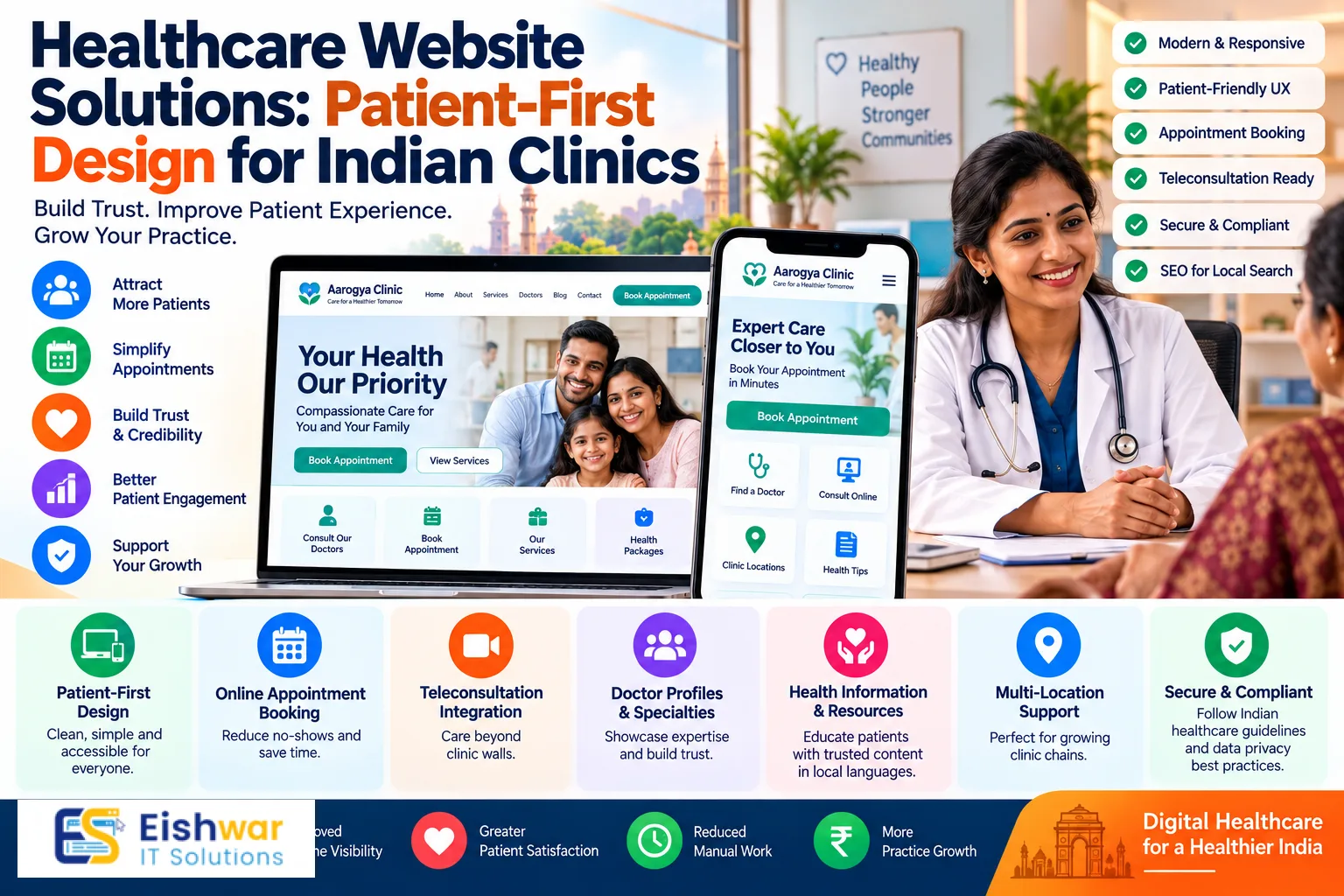
Healthcare Website Solutions: Patient-First Design for Indian Clinics
Introduction
In India, a patient often meets your clinic online before they meet your doctors offline. They search for symptoms, compare specialities, read reviews, check timings, look for directions, and ask for appointment options on WhatsApp. If your website feels like a generic business template, you lose that first impression.
Healthcare website solutions in India are not just about a homepage, a contact form, and a gallery. They must reduce anxiety, answer urgent questions, respect privacy, and make booking simple on a mobile phone. That is where patient-first design and industry-specific features matter.
This guide from EishwarITSolution explains what Indian clinics, hospitals, diagnostic centres, dental practices, and physiotherapy studios need from a healthcare website in 2026. You will learn the must-have features, local SEO tactics, compliance basics, common mistakes, and future trends that turn website visitors into patients.
Main Section 1: Why Healthcare Website Solutions in India Need a Patient-First Approach
Patients do not browse healthcare websites like shoppers browse fashion. They arrive with a problem, a worry, or a deadline. A parent searching for a paediatrician at 10 PM, a senior looking for a cardiologist nearby, or a traveller needing a dentist in an unfamiliar city all want speed and clarity.
The patient decides before they call
By the time a patient calls your front desk, they have already formed an opinion. They have seen your Google Business Profile, scanned your website, checked doctor profiles, and compared two or three clinics. If your site hides the phone number, uses small text, or has no online booking, they move to the next option.
Patient-first design means answering the most common questions before they are asked: Who is the doctor? What are the timings? Where is the clinic? How much will a consultation cost? Do you accept insurance? Can I book online? Is there parking? What should I bring?
Generic websites create friction
A template built for a coaching centre or a retail store rarely fits healthcare. It may lack department pages, doctor schedules, emergency contact bars, patient testimonials, treatment explanations, and secure forms. It may also use language that sounds promotional rather than reassuring.
Industry-specific website solutions solve this by mapping the patient journey. The homepage, service pages, doctor pages, and appointment flow are designed around real healthcare tasks. Instead of forcing patients to adapt, the website adapts to them.
Trust, privacy, and speed decide conversions
Indian patients are becoming more aware of data privacy. They expect their health information to be handled carefully. The Digital Personal Data Protection Act, 2023, has raised the bar for consent, data use, and storage. A healthcare website should clearly explain what data is collected, why it is needed, and how it is protected.
Speed also matters. Many patients browse on mobile networks that fluctuate. If your appointment page takes ten seconds to load, you lose them. A fast, mobile-first healthcare website is not a luxury. It is a basic patient service.
Main Section 2: Must-Have Features in Healthcare Website Solutions for Indian Clinics
The right features depend on your speciality and size. A single-doctor dental clinic needs different tools from a multi-speciality hospital. However, most successful healthcare websites in India share a core set of capabilities.
1. Appointment booking that works on mobile
Online appointment booking should be visible on every page. Patients should be able to choose a doctor, see available slots, select a date and time, enter basic details, and receive confirmation by SMS, email, or WhatsApp. For smaller clinics, a simple request form with a quick callback promise can work. For larger clinics, real-time slot management is better.
Also include click-to-call and WhatsApp buttons. Many Indian patients prefer to confirm by phone or chat. Do not force them into a single channel.
2. Doctor and department pages
Each doctor should have a dedicated page with qualifications, specialisation, experience, languages spoken, registration details, consultation timings, and a professional photo. Department pages should explain conditions treated, diagnostic services, technology, and preparation instructions.
This helps patients self-select and reduces repetitive calls. It also gives search engines clear, structured information about your services.
3. Patient resources and health hub
A health blog or resource centre can attract patients who are searching for answers. Write about common conditions, treatment options, recovery tips, preventive care, and cost expectations. Keep the tone medically responsible. Add a disclaimer that content is for information only and not a substitute for consultation.
For local SEO, combine general health topics with local intent. For example, a dental clinic in Pune can publish pages about teeth whitening costs in Pune, emergency dental care in Baner, and kid-friendly dentists near Aundh.
4. Local discovery and multi-clinic support
Most patients choose clinics based on proximity and convenience. Add location pages for each branch with embedded maps, directions, parking notes, landmark descriptions, timings, and contact numbers. Use local schema markup so search engines understand your clinic locations.
If you operate in multiple cities, avoid duplicating the same content everywhere. Each location page should have unique details, staff names, services, and patient reviews.
5. Communication and follow-up
Healthcare is a relationship, not a one-time transaction. After a visit, automated reminders, prescription refill prompts, feedback requests, and follow-up appointment suggestions can improve retention. WhatsApp Business API can be especially effective in India when used with consent and clear opt-out options.
For diagnostic centres, report delivery notifications and secure report access via a patient portal can reduce phone calls and improve satisfaction.
6. Compliance, security, and integrations
Use HTTPS, secure forms, role-based access, and encrypted storage. Collect only the data you need. Add a privacy policy, terms of use, and cookie consent where applicable. If you use telemedicine, follow the Telemedicine Practice Guidelines and provide clear consent steps.
Larger clinics may need integrations with EMR, HIS, payment gateways, SMS gateways, and ABDM/ABHA workflows. A good healthcare website solution plans for these integrations from the start instead of adding them as afterthoughts.
Main Section 3: Local SEO, Trust, and Compliance for Indian Healthcare Websites
A beautiful healthcare website is not enough. Patients must find it when they search for care near them. That requires local SEO, credible content, and visible trust signals.
Local SEO for clinics
Start with Google Business Profile. Choose the right categories, add high-quality photos, list accurate timings, enable messaging, and respond to reviews. Post updates about health camps, new doctors, and vaccination drives. Ensure your website name, address, and phone number match your Google profile exactly.
Create location-specific pages for each area you serve. If you are a physiotherapy clinic in Bengaluru, pages like physiotherapy in Indiranagar, sports injury rehab in Koramangala, and post-surgery physiotherapy in HSR Layout can capture local searches. Do not stuff keywords. Write helpful content for each area.
Use structured data for MedicalClinic, Physician, LocalBusiness, and FAQ. This helps search engines display richer results and can improve click-through rates.
Content that answers patient questions
Patients search with questions. Your website should answer them clearly. Build content clusters around specialities. For a dermatology clinic, create pages for acne treatment, hair fall solutions, laser therapy, and skin allergy testing. Each page should explain the condition, treatment process, expected timeline, cost factors, and aftercare.
Include real patient testimonials with consent. Video testimonials can be powerful, especially when they show the clinic environment and doctor-patient interaction. Always avoid exaggerated claims and guaranteed cure language.
Compliance essentials
India's healthcare and data landscape is evolving. The DPDP Act, 2023, requires clear consent and purpose limitation for personal data. ABDM aims to make health records interoperable through ABHA. NABH accreditation signals quality for hospitals and clinics. Your website should reflect these standards where relevant.
Add disclaimers for telemedicine, health content, and testimonials. Do not publish patient images without written consent. Train staff on how to handle online enquiries and medical data. A compliance-aware website builds long-term trust.
Conversion tracking that matters
Track calls, WhatsApp clicks, appointment form submissions, direction requests, and chat starts. For clinics, a form fill is not enough. You need to know how many become confirmed appointments and how many actually visit. Use call tracking numbers, UTM parameters, and CRM notes to connect website activity to revenue.
Review this data monthly. If a page gets traffic but no bookings, improve the CTA, simplify the form, or add clearer pricing and insurance information.
Expert Tips
- Map the patient journey first. Write down the steps a patient takes from search to visit. Design your website around those steps, not around your internal departments.
- Use one primary action per page. A doctor page should focus on booking. A location page should focus on directions and calling. A blog post should guide to a relevant service.
- Show real people and places. Use authentic photos of your clinic, team, and facilities. Stock photos can make a healthcare website feel impersonal.
- Keep forms short. Ask only for name, phone, preferred date, and reason for visit. You can collect more details later.
- Make emergency information obvious. Put emergency contact numbers and ambulance details above the fold for hospitals and urgent care centres.
- Speak your patient's language. Add Hindi and regional language options where your patient base needs them. Even simple language toggles can improve trust.
- Train the front desk to respond fast. A website booking is only as good as the confirmation call or message that follows.
- Review compliance with a professional. Data protection and medical advertising rules vary. Get legal and medical review before publishing claims.
Common Mistakes
- Using a generic business template. It may look modern but lacks healthcare-specific navigation and patient workflows.
- Hiding the phone number. Patients should not have to hunt for a way to call you.
- Ignoring mobile users. Most local health searches happen on phones. Test every page on a small screen.
- Skipping local SEO. If you are not visible in Google Maps and local results, you are invisible to nearby patients.
- No appointment confirmation. Patients want to know their request was received. Send an instant confirmation and a reminder.
- Using too much medical jargon. Explain conditions in plain language. Patients are anxious, not looking for a textbook.
- Neglecting data privacy. Do not collect medical details through unsecured forms or share them without consent.
- Buying fake reviews. Fake reviews damage trust and can lead to penalties. Ask happy patients for honest feedback instead.
- No follow-up system. Post-visit messages, recall reminders, and feedback requests keep patients connected.
- Not tracking conversions. Without tracking, you cannot tell which pages bring appointments and which need improvement.
Future Trends
Healthcare websites in India are becoming more intelligent, more connected, and more patient-centric. Here are trends to watch.
- AI-assisted triage and chatbots. Clinics will use AI to answer basic questions, suggest specialities, and book appointments. These tools must include disclaimers and clear limits.
- Deeper ABDM integration. Websites will connect with ABHA and health record systems to offer secure report access and consent-based data sharing.
- WhatsApp-first patient journeys. From appointment booking to report delivery, WhatsApp will become a primary communication channel.
- Voice search optimisation. Patients will ask voice assistants for doctors near me and best clinics in my area. Clear location content and FAQs will matter.
- Telemedicine built into the website. Video consultations, e-prescriptions, and payment links will be standard for many specialities.
- Privacy-first analytics. Clinics will adopt tools that respect patient data while still measuring website performance.
- Hyperlocal content. Area-specific pages and local health guides will help clinics stand out in crowded cities.
- Accessibility and multilingual AI. Websites will support screen readers, larger text, and real-time translation for diverse Indian patients.
FAQs
What are healthcare website solutions in India?
Healthcare website solutions are industry-specific websites built for clinics, hospitals, doctors, diagnostic centres, and other medical practices. They include appointment booking, doctor profiles, local SEO, patient resources, secure forms, and compliance features tailored to Indian healthcare.
How much does a healthcare website cost in India?
Costs vary by size and features. A basic doctor or clinic website may start from a modest one-time fee, while multi-speciality hospital websites with custom booking, integrations, and multilingual content cost more. Focus on return on investment: a website that brings ten extra patients a month often pays for itself quickly.
Do Indian clinics need DPDP Act compliance on their websites?
Yes, if you collect personal data such as names, phone numbers, health concerns, or appointment details, you should follow DPDP Act principles. This includes clear consent, purpose limitation, secure storage, and a privacy policy. Consult a legal expert for your specific situation.
Can a healthcare website integrate appointment booking and payments?
Yes. Modern healthcare websites can integrate real-time appointment scheduling, SMS or WhatsApp confirmations, online payments, and calendar syncing. The right setup depends on your clinic size, speciality, and existing software.
How does local SEO help clinics attract patients?
Local SEO helps your clinic appear in Google Maps, local search results, and near-me queries. By optimising your Google Business Profile, location pages, reviews, and schema markup, you make it easier for nearby patients to find and choose you.
Is a website useful for small clinics and individual doctors?
Absolutely. Even a single-doctor clinic benefits from a professional website. It establishes credibility, answers common questions, collects appointment requests, and reduces time spent on repetitive phone calls. It also gives you a platform you control, unlike social media alone.
How long does it take to build a healthcare website?
A focused clinic website can take a few weeks. Larger hospital websites with custom features, content, and integrations may take two to four months. The timeline depends on how quickly content, photos, and approvals are provided.
Conclusion
Healthcare website solutions in India must do more than look professional. They must guide anxious patients, build trust, protect data, and make appointment booking effortless. A patient-first website with industry-specific features helps your clinic stand out in local search, reduce front-desk friction, and improve patient retention.
Whether you run a dental clinic in Mumbai, a physiotherapy centre in Hyderabad, a diagnostic lab in Delhi, or a multi-speciality hospital in Chennai, the principles are the same. Understand the patient journey, remove barriers, and make every page useful. When your website feels like a helpful member of your care team, patients notice.
CTA
Ready to turn your clinic website into a patient acquisition and retention engine? EishwarITSolution builds industry-specific website solutions for Indian healthcare providers. From patient-first design and appointment booking to local SEO and DPDP-aware forms, we create websites that work for your staff and your patients.
Visit EishwarITSolution or contact our team for a website audit and a custom healthcare website plan. Let us help you create a digital front desk that patients trust.