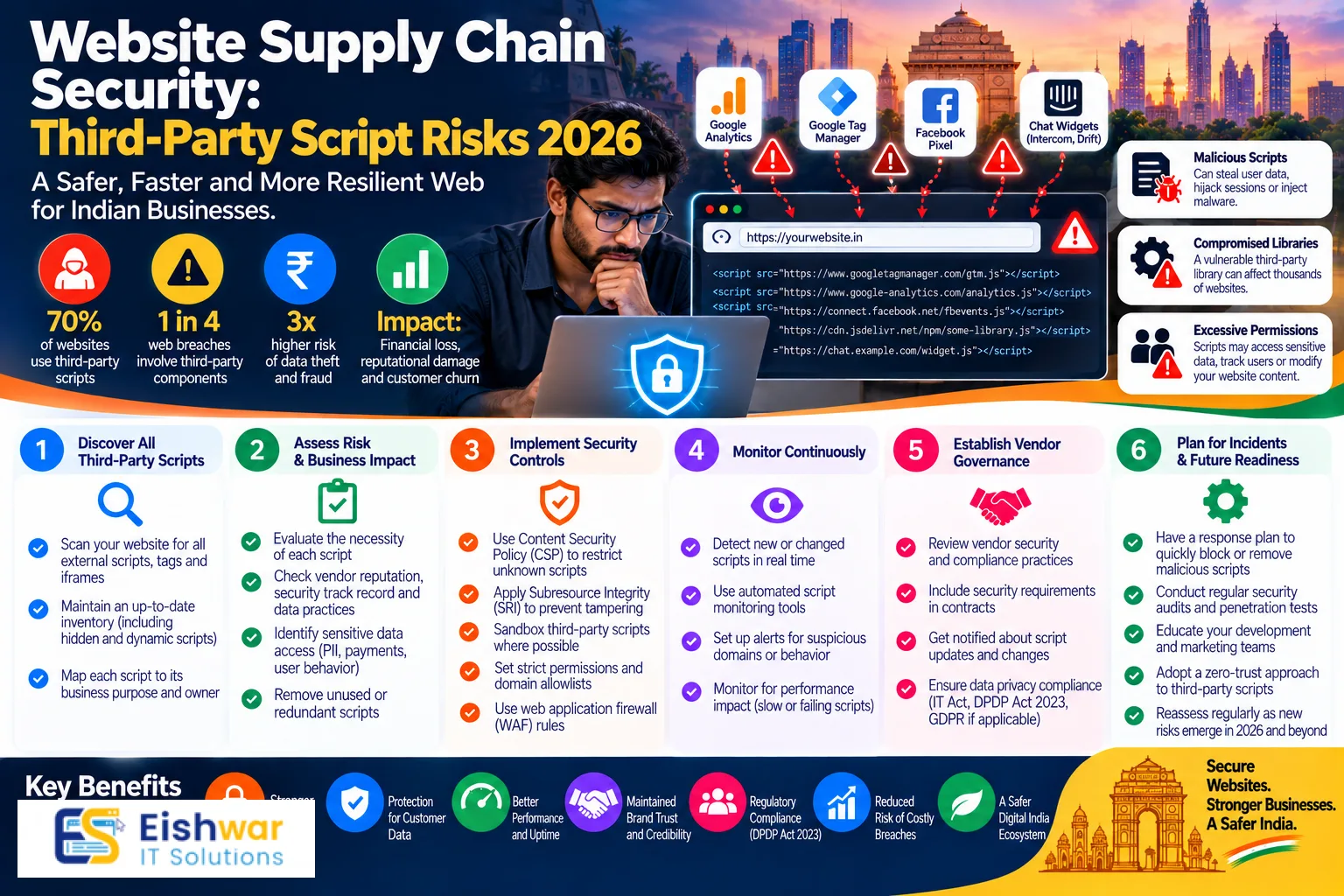
Website Supply Chain Security: Third-Party Script Risks 2026
Introduction
Most Indian businesses today run websites that depend on code they did not build. Analytics tags, chat widgets, payment gateways, ad pixels, CDN scripts, booking tools, and marketing automation all connect to your site. They make work easier. They also expand your attack surface.
This is the new reality of website supply chain security. A weakness in a vendor's script can become your breach. A compromised plugin can steal customer data on your checkout page. A third-party chat tool can redirect visitors to a phishing page. The risk is not theoretical. It is already happening across Indian e-commerce, SaaS, healthcare, education, and professional services websites.
In this guide, you will learn what website supply chain security means, why third-party scripts are a growing risk in 2026, and how to build a practical defence without slowing down your business.
Main Section 1: What Website Supply Chain Security Means for Indian Businesses
Website supply chain security is the practice of managing every external component, script, service, plugin, API, and vendor that touches your website. It covers the full chain: the code you install, the agencies you hire, the SaaS tools you embed, and the infrastructure partners you rely on.
Your website is a connected ecosystem
A typical business website in India may load scripts from 10 to 30 different domains. Some are essential, like payment gateways. Others are helpful, like analytics and CRM tools. A few may be forgotten test scripts left by a former developer.
Each connection is a trust decision. If you do not review that decision regularly, you are trusting a vendor forever, even after ownership, security practices, or business priorities change.
Why Indian businesses are especially exposed
India's digital growth has been fast. Many businesses moved online quickly, often with lean teams and limited security budgets. Marketing teams add tags without developer review. Sales teams adopt chat tools. Founders approve plugins for speed.
At the same time, regulations like the Digital Personal Data Protection Act are raising the bar for data protection. Customers expect secure payments, safe login flows, and transparent data handling. A third-party breach can damage all three.
A simple example
Imagine an Indian online store that adds a discount pop-up tool. The tool loads a script on every page, including checkout. If that vendor is compromised, attackers can quietly capture card details or personal information. Your store looks normal. Your customers see no warning. But your reputation and legal exposure grow by the minute.
That is why supply chain security is no longer an IT-only topic. It is a business continuity topic.
Main Section 2: The Hidden Risks of Third-Party Scripts and Vendor Access
Third-party scripts are powerful because they run in your customers' browsers. That position gives them access to page content, form fields, cookies, and sometimes payment data. When they are poorly managed, the results can be severe.
1. Client-side attacks and formjacking
Formjacking happens when malicious code skims data from forms. Attackers often inject it through compromised third-party scripts or plugins. The checkout page still works, so nobody notices. This is one of the most dangerous client-side attacks because it bypasses many server-side protections.
2. Vendor account takeovers
If a vendor's admin account is compromised, attackers can push malicious updates to every customer. This is a web supply chain attack at scale. Small vendors may have weaker security than your own team. Ask how they protect their admin access, code releases, and customer scripts.
3. Outdated plugins and libraries
Plugins and JavaScript libraries age quickly. A library that was safe last year may have a known vulnerability today. If your website maintenance process does not include third-party components, those gaps stay open for months.
4. Excessive permissions and data sharing
Some scripts ask for more access than they need. A chat widget may not need to read every form field. An analytics tool may not need to collect personal data. Over-permissioned tools increase both security risk and privacy risk.
5. Orphaned scripts and forgotten vendors
Campaigns end. Agencies change. Developers leave. But the script tags remain. These orphaned scripts are easy targets because no one is watching them. They also slow down your site and confuse your data collection.
6. Weak vendor contracts
Many Indian businesses sign vendor agreements that focus on features and pricing. Security requirements are missing. There may be no breach notification clause, no data handling terms, no right to audit, and no exit plan. When something goes wrong, you are left negotiating in a crisis.
Business impact you cannot ignore
A supply chain incident can lead to stolen customer data, payment fraud, regulatory penalties, SEO ranking loss, browser warnings, and lost trust. For Indian businesses, the cost often goes beyond cleanup. It can affect partnerships, funding, and customer retention.
Main Section 3: A Practical Website Supply Chain Security Framework for 2026
You do not need an enterprise budget to reduce third-party risk. You need a repeatable process. Use this framework to protect your website without blocking marketing or product speed.
Step 1: Create a third-party inventory
List every script, plugin, API, iframe, pixel, and vendor connected to your website. Include the business owner, purpose, data accessed, and last review date. Update it every quarter. If a tool cannot justify its place, remove it.
Step 2: Tier vendors by risk
Not all vendors are equal. Treat payment, login, health, and customer data tools as high risk. Treat simple fonts or public analytics as lower risk. High-risk vendors need stronger contracts, tighter access, and more frequent reviews.
Step 3: Enforce script integrity
Use Subresource Integrity where possible. SRI lets the browser verify that a script file has not been changed. Combine it with a strict Content Security Policy to control which domains can load code on your site.
Also consider self-hosting critical scripts when the vendor allows it. This reduces dependence on external domains and gives you more control over updates.
Step 4: Limit vendor access
Give vendors the minimum access they need. Use named accounts, not shared logins. Enable multi-factor authentication. Review access every quarter and remove it immediately when a project ends.
Step 5: Monitor for changes
Set up alerts for unexpected file changes, new script domains, admin logins, and permission changes. File integrity monitoring and website activity logs help you spot supply chain issues early. For Indian businesses without a security team, a managed website maintenance partner can handle this monitoring.
Step 6: Build security into vendor contracts
Ask for breach notification within 24 to 72 hours. Require encryption, access controls, and secure development practices. Define data ownership and deletion. Include the right to audit or request security reports. Make security a commercial requirement, not an afterthought.
Step 7: Prepare an incident response plan
Know who to call if a vendor is breached. Have a plan to disable scripts, rotate credentials, notify customers, and work with legal and PR teams. Test the plan once a year with a tabletop exercise.
Step 8: Schedule regular maintenance
Website supply chain security is ongoing. Patch plugins, review scripts, update libraries, and test backups. A monthly maintenance window prevents small issues from becoming emergencies.
Expert Tips
- Ask vendors for a security page and recent report. If they cannot share basic security information, treat them as high risk.
- Use a tag manager with governance. Tag managers are useful, but without approval workflows they become a dumping ground for scripts.
- Test your checkout page monthly. Look for unexpected domains, new iframes, or changes in form behaviour.
- Keep a kill switch. Know how to disable each third-party script within minutes. Document the exact steps.
- Review agency access after every project. Former developers and agencies should not retain admin rights.
- Train marketing and sales teams. They often add tools. Teach them to route new scripts through a security review.
- Use a website security partner for quarterly reviews. Fresh eyes catch forgotten scripts and permission creep.
Common Mistakes
- Trusting a vendor because it is popular. Popular tools get attacked too. Popularity is not a security control.
- Adding scripts without documentation. If no one knows why a script exists, no one will remove it when it becomes risky.
- Ignoring plugins after installation. Unpatched plugins are a common entry point for website supply chain attacks.
- Using shared vendor logins. Shared credentials make it impossible to trace who did what.
- Assuming HTTPS is enough. HTTPS protects data in transit, but malicious scripts can still run in the browser.
- Waiting for a breach to review contracts. Security terms are easier to negotiate before an incident, not during one.
- Letting marketing bypass security. Speed matters, but unmanaged scripts can create legal and financial risk.
Future Trends
Website supply chain security will become more automated and more regulated. Here is what Indian businesses should watch.
- Browser-level script controls: Browsers are adding stronger controls for third-party scripts, including better isolation and permission prompts.
- AI-assisted vendor risk scoring: Security platforms will use AI to score vendors based on breaches, code changes, and public threat data.
- DPDP Act enforcement: India's data protection rules will push businesses to document data flows and vendor responsibilities more clearly.
- Provenance and signing: Software supply chain provenance will move from enterprise DevOps into mainstream website tooling.
- Privacy-first analytics: As third-party cookies decline, businesses will rely more on first-party data and privacy-focused tools, which changes the risk profile.
- Managed security for SMEs: More Indian SMBs will outsource monitoring and maintenance because hiring full-time security teams is not practical.
FAQs
What is website supply chain security?
Website supply chain security is the process of managing and securing all external code, plugins, scripts, APIs, vendors, and partners that connect to your website. It focuses on reducing risk from third-party components.
Why are third-party scripts risky?
Third-party scripts run in your visitors' browsers and can access page content, form data, and cookies. If a vendor is compromised or a script is malicious, attackers can steal data or redirect users without changing your own server.
How often should Indian businesses review third-party scripts?
Review high-risk scripts quarterly and all scripts at least twice a year. Also review immediately after a campaign ends, a vendor changes ownership, or a security incident is reported.
Can a Content Security Policy stop all third-party script attacks?
No single control stops everything. CSP is powerful when combined with Subresource Integrity, vendor reviews, access controls, monitoring, and incident response. It reduces risk but does not replace a full programme.
Do small Indian businesses need supply chain security?
Yes. Small businesses often use many third-party tools and have fewer resources to detect problems. A simple inventory, quarterly review, and managed monitoring can reduce significant risk.
What should be included in a vendor security contract?
Include breach notification timelines, data protection requirements, encryption, access controls, secure development commitments, data ownership, deletion terms, and the right to request security reports or audits.
How can EishwarITSolution help?
EishwarITSolution can help Indian businesses inventory third-party scripts, review vendor access, implement CSP and monitoring, and maintain a practical website security programme throughout 2026.
Conclusion
Your website is only as secure as the weakest vendor connected to it. Third-party scripts bring speed, insight, and convenience, but they also bring hidden risk. Indian businesses that treat supply chain security as a one-time project will fall behind. Those that build it into maintenance will protect revenue, customer trust, and compliance.
Start small. Create an inventory. Review high-risk vendors. Limit access. Monitor changes. Put security terms in contracts. Then repeat. This is not about fear. It is about control.
In 2026, website supply chain security should be part of every business maintenance plan, just like backups, updates, and performance checks.
CTA
Ready to secure your website supply chain? Contact EishwarITSolution for a third-party script review and a practical website security maintenance plan for your Indian business. Visit eishwar.com to get started.