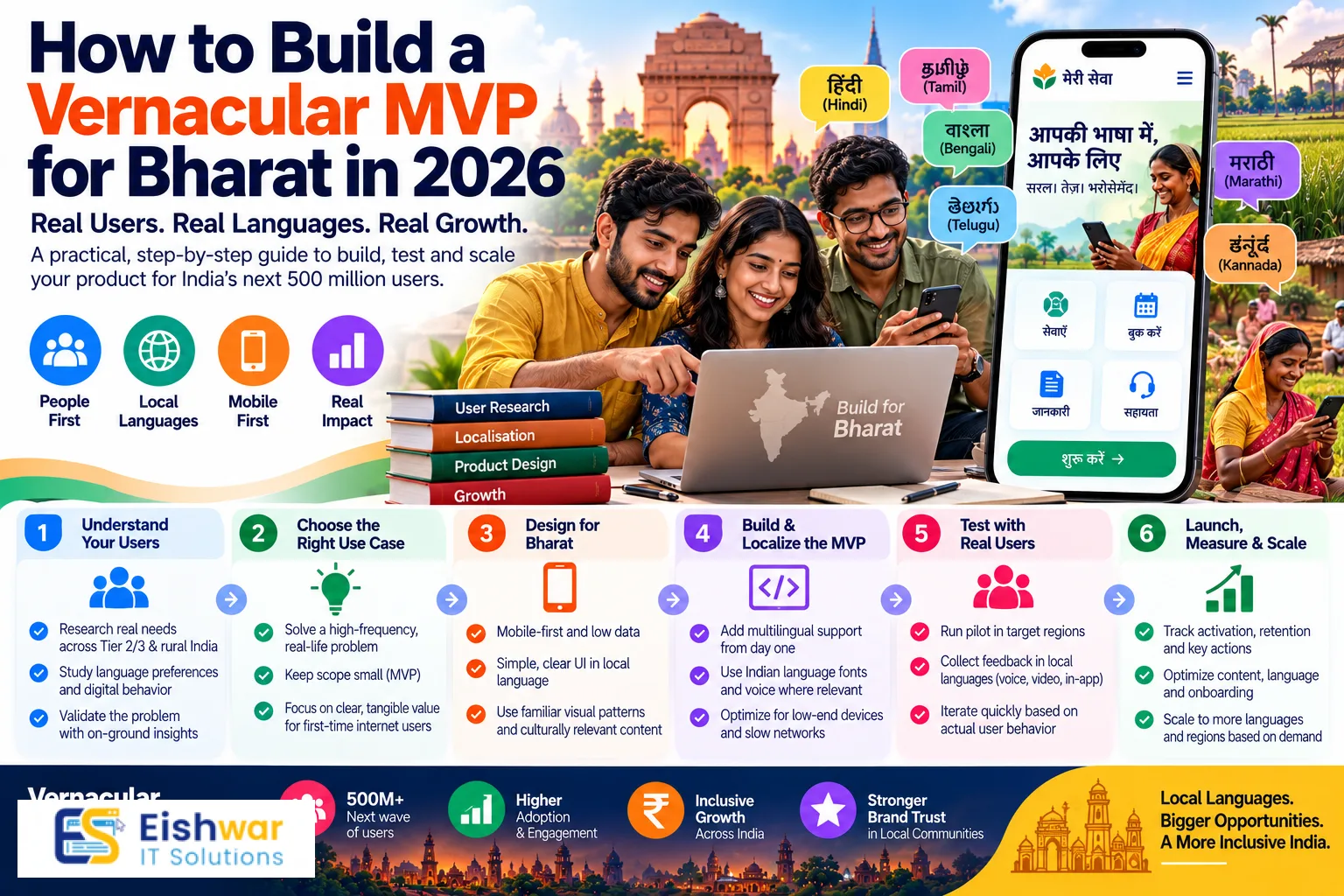
How to Build a Vernacular MVP for Bharat in 2026
Introduction
India’s internet story is no longer only about English-speaking metro users. The next wave of digital adopters — often called Bharat — prefers Hindi, Tamil, Telugu, Bengali, Marathi, Gujarati, Kannada, Malayalam, and other Indian languages. For startups, this is not a niche. It is a massive market signal. If your MVP speaks only English, you may be invisible to millions of users who are ready to pay, transact, and stay loyal — but only when the product feels familiar.
A vernacular MVP for Bharat is not just an English product with a language toggle. It is a product built from the ground up for how real users think, speak, search, trust, and buy. That means multilingual onboarding, voice support, regional content, lightweight performance, UPI payments, WhatsApp-first communication, and support in the user’s language.
In this guide, you will learn how to plan, build, launch, and grow a vernacular MVP in India. Whether you run a D2C brand, SaaS tool, marketplace, fintech product, or service business, these practical steps will help you move faster without wasting budget.
Main Section 1: What a Vernacular MVP Really Means for Indian Startups
Language is the first layer of trust
For a user in Patna, Coimbatore, Indore, or Guwahati, language is not a feature. It is the difference between feeling invited and feeling excluded. When a user sees their own language in the first 10 seconds, trust increases. They are more likely to complete sign-up, share details, and try a paid plan.
But vernacular does not mean only translating menus. It means writing error messages, notifications, invoices, and help content in the same language. It means using words people actually use in daily life, not formal textbook language.
Beyond translation: voice, visuals, and context
Many Bharat users are comfortable with voice and video but less comfortable with dense English text. A vernacular MVP should include voice search, audio instructions, WhatsApp support, and simple icons. Visual cues matter too. A farmer may understand a crop image faster than a paragraph. A small business owner may prefer a video walkthrough over a help document.
Context also matters. Payment trust, delivery expectations, return policies, and customer support hours vary across regions. A vernacular MVP respects those differences instead of forcing one urban, English-first template on everyone.
Why this is a business opportunity, not a charity project
Vernacular users are not low-value users. They are often underserved. When you solve their problem in their language, you can build deep loyalty with lower acquisition costs. Regional language users may have fewer competing apps, stronger word-of-mouth networks, and higher trust in local recommendations.
For startups, the smart move is to pick one language and one user segment first. Prove the model. Then expand. That is exactly how a lean MVP should work.
Main Section 2: How to Design and Build a Vernacular MVP Step by Step
Step 1: Choose one language and one high-pain problem
Do not start with 12 languages. Start with one. If your target users are textile traders in Surat, Gujarati may be your first language. If they are small pharmacies in Tamil Nadu, Tamil may lead. If they are gig workers in Delhi NCR, Hindi may be the fastest route.
Next, define the problem in one sentence. For example: 'Help kirana stores order stock in Gujarati and receive delivery updates on WhatsApp.' That clarity will shape every product decision.
Step 2: Validate with real conversations, not assumptions
Talk to at least 20 to 30 potential users. Visit their shops, join their WhatsApp groups, and ask how they currently solve the problem. Listen for the exact words they use. Those words become your app copy, landing page headline, and ad creatives.
Ask questions like: What language do you use on your phone? Which apps do you use daily? What makes you distrust a new app? Would you pay ₹99, ₹199, or ₹499 per month for this? Their answers will save you months of guessing.
Step 3: Design a language-first user experience
Put language selection on the first screen. Let users choose their preferred language without creating an account. Use large buttons, clear icons, and minimal text. Avoid long forms. Use progressive profiling — ask only what you need now.
Write copy in the user’s dialect. 'Sign up' may become 'Start using' or a local phrase that feels natural. Error messages should explain the fix, not blame the user. If a payment fails, say what happened and what to do next in simple language.
Step 4: Add voice and assisted onboarding
Voice is a game-changer for users who are not comfortable typing in English or any script. Add a microphone button for search, form filling, and support. For complex onboarding, offer a WhatsApp voice note option or a call-back request.
Assisted onboarding can be powerful. A field agent, retailer, or local partner can help the first 100 users sign up. Once they experience value, they can invite others. This model works well for agritech, fintech, healthtech, and B2B commerce.
Step 5: Make the technology lightweight and reliable
Use Unicode-compliant fonts for Indic scripts. Test on low-end Android phones with 2GB or 3GB RAM. Optimize images and avoid auto-playing heavy videos. Support offline or low-network modes where possible. Cache key screens so the app remains usable when the network drops.
If you are building a web MVP, consider a progressive web app or a lightweight responsive site. It can reduce friction and avoid app-store dependency. But if your users need push notifications, offline access, or device features, a native app may be better.
Step 6: Integrate payments and trust signals
UPI is the default payment expectation in India. Support UPI apps, QR codes, and simple checkout. If you offer subscriptions, explore UPI Autopay. For many users, cash on delivery or partial payment may still matter. Do not force a credit card.
Trust signals include a local support number, clear refund policy, GST invoice, data privacy note in simple language, and visible customer reviews. If you work with a known local brand or partner, highlight it.
Step 7: Measure the vernacular funnel
Track language-specific metrics: install-to-signup rate, first transaction rate, drop-off points, support tickets by language, and retention after 7 and 30 days. Compare Hindi vs Tamil vs Gujarati cohorts. You may discover that one language converts far better than another.
Use session recordings and heatmaps carefully. Also read support chats. The words users type in their language reveal friction points that analytics alone may miss.
Main Section 3: Go-to-Market and Growth for Vernacular MVPs
Distribution: meet users where they already are
What brings vernacular users to your MVP?
WhatsApp: Share catalogs, updates, and support.
YouTube: Regional-language tutorials, testimonials, and product demos.
Local influencers: Micro-influencers in tier-2 and tier-3 cities often drive more trust than national celebrities.
Partner networks: Retailers, distributors, cooperatives, and local service providers can introduce your product.
Regional SEO: Create content in the user’s language for searches like 'GST invoice app in Tamil' or 'stock management app in Gujarati.'
Onboarding and activation
The first session should deliver value in under five minutes. Show one clear action: create a product, place an order, book a service, or generate an invoice. Use a short video or voice guide. If possible, offer a WhatsApp onboarding flow where users reply with simple numbers or voice notes.
For B2B users, offer a demo in their language. For D2C users, make the first purchase easy with COD or UPI. Remove unnecessary fields. Every extra step costs you users.
Retention and monetization
Send notifications in the user’s chosen language. Use voice notes for important updates. Celebrate local festivals and events relevant to the user’s region. Build a community where users can ask questions in their language.
Monetization can include subscriptions, transaction fees, lead fees, SaaS plans, or a marketplace commission. Test pricing in small cohorts. A ₹149 monthly plan may work for a micro-business, while a ₹999 plan may suit a growing retailer. Always show value before asking for payment.
Expert Tips
- Build a language layer from day one. Do not hard-code English text across the product. Use localization files so you can add languages without rebuilding.
- Hire native copywriters, not just translators. A translator converts words. A native copywriter converts meaning, emotion, and trust.
- Test on real devices. Borrow or buy popular budget phones. Test on slow networks. Your office Wi-Fi is not the real world.
- Use the user’s dialect. Formal Hindi may feel distant to a user in Bihar. Colloquial language builds connection.
- Keep an English fallback. Some users prefer English. Let them switch anytime.
- Measure language-level analytics. What gets measured gets improved. Track conversion by language.
- Respect privacy and consent. Explain data usage in simple language. Follow India’s data protection rules.
Common Mistakes
- Direct translation. Google Translate cannot capture tone, culture, or local idioms. It often creates confusion.
- Launching too many languages. Spreading thin across 10 languages reduces quality. Dominate one first.
- Ignoring voice. Many users prefer speaking over typing. Voice is not a bonus; it is a core interface.
- English-first design. If English text appears before language selection, users may drop off immediately.
- Heavy media. Large images and videos frustrate users with limited data and slower phones.
- No local support. If users cannot get help in their language, they will not trust payments or subscriptions.
- Assuming Bharat users will not pay. They pay when the value is clear and the experience feels safe.
Future Trends
Vernacular MVPs are becoming easier and smarter to build. Here are trends to watch in 2026 and beyond:
- AI voice models for Indian languages. Real-time speech-to-text and text-to-speech in Hindi, Tamil, Bengali, and other languages will improve rapidly.
- Indic LLMs and translation APIs. Better language models will help startups create content faster, but human review will still matter.
- Voice-first commerce. Users may search, compare, and order using voice notes on WhatsApp or in-app assistants.
- ONDC and vernacular storefronts. Small businesses will use open networks to reach more buyers without heavy technical know-how.
- UPI Autopay and credit on UPI. Subscription and lending models will become smoother for micro-businesses and consumers.
- Vernacular SEO and answer engines. Content in regional languages will become more discoverable through search and AI assistants.
- Privacy and consent in local languages. Trust will grow when data practices are explained simply, not buried in legal English.
FAQs
1. What is a vernacular MVP for Bharat?
A vernacular MVP is a minimum viable product designed primarily for users who prefer Indian languages. It includes multilingual UX, voice support, local content, and payment or support flows that feel familiar to non-English-first users.
2. Which Indian language should I choose first?
Choose the language spoken by your highest-pain, easiest-to-reach user segment. If your first 100 customers are in Gujarat, start with Gujarati. If they are in Tamil Nadu, start with Tamil. Validate demand before adding more languages.
3. How much does it cost to build a vernacular MVP?
Costs vary by complexity. A simple web MVP with one language, basic onboarding, and UPI payment may cost less than a multi-language app with voice and offline features. Start lean, validate, and reinvest. EishwarITSolution can help you scope a realistic budget.
4. Can I use Google Translate for my MVP?
You can use machine translation for internal drafts, but not for user-facing copy. Poor translations damage trust. Use native speakers or professional copywriters to review every screen, notification, and error message.
5. Do I need a mobile app or a PWA?
It depends on your use case. A PWA is faster and cheaper to launch, works across devices, and is easy to update. A native app is better if you need push notifications, offline access, camera, or Bluetooth features. Many startups launch a PWA first and build an app later.
6. How do I test a vernacular MVP before a full launch?
Run a pilot with 30 to 50 users in one region. Use WhatsApp groups, local partners, and field agents. Measure activation, first transaction, and support requests. Fix the biggest friction points before scaling.
7. How do I measure success for a vernacular MVP?
Track language-specific activation, conversion, retention, and referral rates. Also monitor support tickets by language. A successful MVP shows that users can complete the core action without English and are willing to return or pay.
Conclusion
Building a vernacular MVP for Bharat is one of the smartest ways Indian startups can stand out in 2026. The market is huge, but it is not homogenous. Users want products that speak their language, respect their context, and solve real problems quickly. By starting with one language, validating deeply, designing for voice and low-bandwidth reality, and integrating UPI and WhatsApp-first support, you can launch a product that feels local and scales nationally.
Do not wait for a perfect multilingual platform. Build a focused vernacular MVP, learn from real users, and expand only when the data supports it. That is how you turn India’s language diversity from a challenge into your competitive advantage.
CTA
Ready to build a vernacular MVP for Bharat? EishwarITSolution helps startups design, develop, and launch multilingual web solutions that convert. Visit eishwar.com or contact us for a free MVP consultation. Let’s build a product your users understand — and trust.