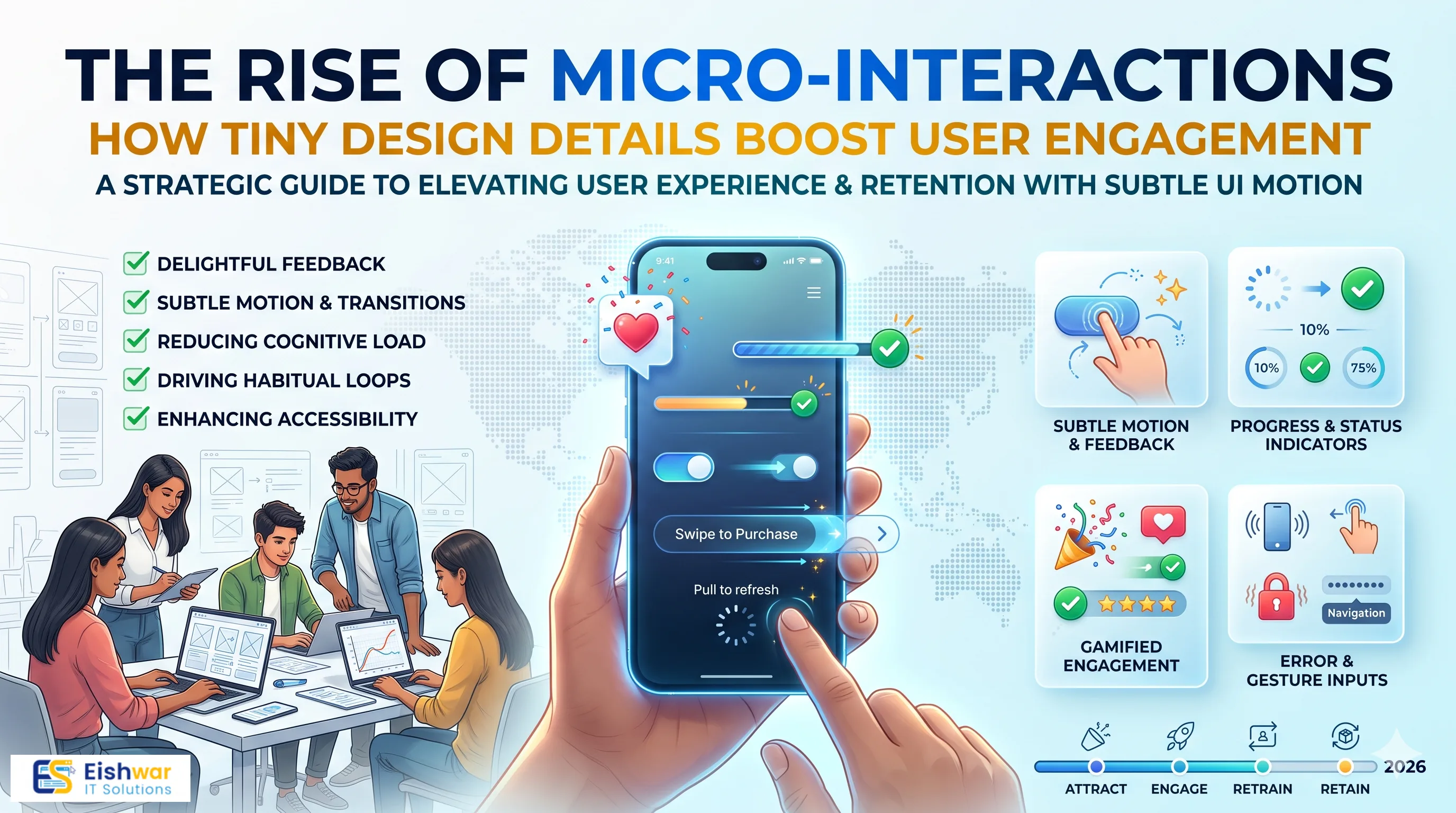
The Rise of Micro-Interactions: How Tiny Design Details Boost User Engagement in 2026
Introduction
In the fast-paced digital world of 2026, capturing and retaining user attention is harder than ever. With an overwhelming number of apps, websites, and digital services vying for a slice of the user's day, the challenge isn't just to attract users—it's to keep them engaged, satisfied, and loyal. While grand features and flashy graphics may draw users in, it's often the subtle, tiny details that keep them coming back. These are micro-interactions—the small, purposeful moments of feedback that occur when a user interacts with a digital product. From the satisfying 'ding' when a message is sent to the playful animation when a heart icon is tapped, micro-interactions shape how users feel about a brand. For businesses in India, where mobile-first usage is rampant and user expectations are soaring, mastering micro-interactions can be a game-changer. In this article, we'll explore how micro-interactions are transforming UX design in 2026, why they matter for user engagement, and how you can implement them effectively using behaviour analytics.
Main Section 1: What Are Micro-Interactions and Why Do They Matter?
Micro-interactions are the subtle, often overlooked moments of interaction within a product. They consist of four parts: trigger, rules, feedback, and loops/modes. A trigger initiates the interaction—like a user tapping a button. The rules determine what happens next. Feedback is the visual, auditory, or haptic response that tells the user the action was successful. Loops and modes define what happens over time or under different conditions. These tiny elements serve critical functions: they provide immediate feedback, guide users, prevent errors, and create emotional connections. In 2026, as attention spans dwindle, micro-interactions are not just nice-to-have; they are essential for reducing friction and enhancing user satisfaction. For businesses, this translates into higher engagement, better retention, and ultimately, more conversions.
Consider the ubiquitous 'like' button on social media platforms. When you tap it, the heart or thumbs-up icon doesn't just change color—it often animates with a burst or a bounce. This micro-interaction serves multiple purposes: it confirms your action, provides a moment of delight, and encourages you to engage more. Without it, the action would feel flat and uncertain. Similarly, in e-commerce, when you add an item to your cart, a small animation might show the item flying into the cart icon, accompanied by a subtle sound or vibration. This reassures you that the action was successful and creates a satisfying connection between your intent and the system's response.
Why do these tiny details matter so much? The answer lies in human psychology. Micro-interactions tap into our innate need for feedback and reward. They reduce cognitive load by making the system's state clear, and they create a sense of control and predictability. In a world where users are bombarded with information, these moments of clarity and delight stand out, fostering a positive emotional bond with the product. For businesses, this translates into tangible benefits: increased user engagement, higher retention rates, and improved conversion metrics. In the competitive Indian market, where users have countless alternatives, these small touches can be the differentiator that makes your product the preferred choice.
Main Section 2: How Micro-Interactions Drive User Engagement
Micro-interactions directly influence user engagement by making experiences more intuitive, enjoyable, and rewarding. Here’s how:
- Immediate Feedback: When a user likes a post or adds an item to the cart, a micro-interaction confirms the action instantly, reducing uncertainty and anxiety. This immediate response assures the user that their action has been registered, which is crucial in fast-paced digital environments.
- Guidance and Orientation: Subtle animations can guide users through a multi-step process, such as a form or checkout, making it feel seamless. For example, a progress bar that fills up as the user completes steps provides a visual cue of how much is left, reducing the feeling of being lost.
- Emotional Connection: A playful animation when a user achieves a milestone can evoke delight, fostering a positive emotional bond with the brand. For instance, a fitness app might celebrate a new personal record with confetti and a cheerful sound, making the achievement feel special.
- Error Prevention: Shaking a text field when the input is invalid is a micro-interaction that helps users correct mistakes quickly. This not only prevents frustration but also teaches users the correct format without the need for lengthy error messages.
- Gamification: Progress bars, badges, and celebratory animations tap into users' desire for achievement, encouraging continued use. By turning mundane tasks into a game, micro-interactions can significantly boost user engagement and loyalty.
For example, a fintech app in India could use a micro-interaction to animate a coin dropping into a savings pot when a user saves money. This simple gesture can make the act of saving feel more rewarding and encourage repeat behaviour. Similarly, a language learning app might use a streak counter with a flame animation that grows each day the user practices, motivating them to maintain their streak. These micro-interactions transform routine actions into memorable experiences, driving user engagement and retention.
Another powerful example is the pull-to-refresh gesture. When you pull down on a feed and see a spinner or a custom animation, it provides immediate feedback that the app is working. This micro-interaction not only makes the wait feel shorter but also adds a touch of personality to the app. In 2026, with the rise of 5G and faster networks, users expect instant responses, and micro-interactions help bridge the gap between action and result, making the experience feel snappy and responsive.
Main Section 3: Implementing Micro-Interactions with Behaviour Analytics
To create effective micro-interactions, it's crucial to understand how users actually behave. This is where behaviour analytics comes in. By tracking user actions, heatmaps, session recordings, and event data, you can identify which interactions are most meaningful and where users face friction. Here’s a step-by-step approach:
- Identify Key User Actions: Determine the most important actions users take in your product—signing up, completing a purchase, sharing content, etc. These are the actions that drive value for your business, and optimizing them with micro-interactions can have a significant impact.
- Analyze Friction Points: Use analytics to find where users drop off or hesitate. These are prime spots for micro-interactions to ease the process. For example, if you notice a high abandonment rate on a particular form field, a micro-interaction that provides real-time validation could help.
- Design Micro-Interactions for Those Moments: Create subtle animations or feedback that directly address the user's need at that moment. The key is to make the interaction feel natural and helpful, not intrusive.
- A/B Test and Iterate: Use A/B testing to measure the impact of your micro-interactions on engagement metrics. Iterate based on data. What works for one audience may not work for another, so continuous testing is essential.
For instance, an e-commerce site might notice that users abandon the checkout page when asked to enter OTP. A micro-interaction like a gentle pulse on the OTP field, combined with a clear success animation once verified, could reduce anxiety and improve completion rates. By analyzing session recordings, you might discover that users are hesitating before clicking the 'Place Order' button. A micro-interaction that highlights the button and provides a reassuring message like 'Almost there!' could nudge them to complete the purchase.
Behaviour analytics also allows you to personalize micro-interactions based on user segments. For example, new users might benefit from more explanatory micro-interactions, while returning users might prefer faster, more subtle feedback. By leveraging data, you can create a tailored experience that feels intuitive and responsive to each user's needs.
Expert Tips
To make the most of micro-interactions, follow these expert tips:
- Keep it subtle: Micro-interactions should not distract or overwhelm. They should enhance, not compete with, the main content. A good rule of thumb is to use them sparingly and only where they add value.
- Be consistent: Use the same style of micro-interactions across your product to build familiarity and brand identity. Consistency helps users learn the system faster and reduces cognitive load.
- Prioritize performance: Ensure animations are smooth and don't slow down page load times, especially on lower-end devices common in India. Optimize animations by using CSS transforms and avoiding heavy JavaScript libraries.
- Use haptics on mobile: On mobile devices, haptic feedback (vibration) can make interactions feel more tangible and satisfying. For example, a light vibration when a button is pressed can provide a sense of physicality.
- Align with your brand personality: Playful micro-interactions work for consumer apps, but for B2B or financial services, keep them more subdued and professional. The tone should match your brand's voice and values.
Another tip is to involve your users in the design process. Conduct usability tests to see how users react to your micro-interactions. Do they notice them? Do they find them helpful or annoying? This feedback is invaluable for refining your designs. Additionally, consider the cultural context. In India, where users come from diverse backgrounds, micro-interactions should be universally understandable. Avoid relying solely on color to convey meaning, as color perception can vary.
Common Mistakes
Avoid these pitfalls when implementing micro-interactions:
- Overdoing it: Too many animations can cause cognitive overload and slow down the experience. Use them sparingly. Every micro-interaction should have a clear purpose, and if it doesn't, cut it.
- Ignoring accessibility: Ensure micro-interactions are perceivable by users with disabilities. Provide alternative feedback like sound or text. For example, if you use a color change to indicate success, also include a checkmark icon.
- Not testing on real devices: What looks good on a high-end phone might lag on a budget device. Always test on a variety of devices and network speeds. In India, where device diversity is huge, this is especially important.
- Using them without purpose: Every micro-interaction should serve a functional purpose, not just decoration. If a micro-interaction doesn't help the user, it's just noise.
- Forgetting the 'loop' phase: Micro-interactions should have a clear endpoint. For example, a loading animation should stop once the action is complete. An endless animation can frustrate users and make them think the app is stuck.
Another common mistake is ignoring the impact of micro-interactions on performance. Heavy animations can drain battery life and cause janky scrolling, which is a major turn-off for users. Always profile your animations and ensure they run at 60 frames per second. Additionally, don't forget to consider the context of use. A micro-interaction that works well in a quiet office might be annoying in a noisy environment. Provide options to disable or reduce animations for users who prefer a simpler experience.
Future Trends
Looking ahead, micro-interactions will evolve with emerging technologies. In 2026 and beyond, we can expect:
- Voice-activated micro-interactions: As voice interfaces become more prevalent, micro-interactions will include auditory feedback and voice prompts. For example, a smart speaker might respond with a subtle chime when a command is successfully executed.
- AR/VR interactions: In augmented and virtual reality, micro-interactions will be spatial and gesture-based, creating immersive feedback loops. Imagine a virtual button that responds to your hand gesture with a ripple effect.
- AI-driven personalization: Behaviour analytics powered by AI will enable micro-interactions to adapt in real-time to individual user preferences and moods. For instance, if a user is frustrated (detected through rapid clicks), the system might slow down and provide more reassuring feedback.
- Gesture control: With the rise of foldables and wearables, micro-interactions will respond to subtle gestures like tilting or shaking. A smartwatch might vibrate differently for different notifications, providing a richer feedback experience.
Another trend is the integration of micro-interactions with biometric data. Wearables can detect heart rate or stress levels, and micro-interactions could adapt to calm the user or provide encouragement. For example, a meditation app might use a gentle breathing animation that syncs with the user's heart rate to promote relaxation. As these technologies mature, the possibilities for micro-interactions are limitless, and businesses that stay ahead of the curve will reap the benefits.
FAQs
1. What are micro-interactions in UX design?
Micro-interactions are small, purposeful moments of interaction between a user and a product, such as a button animation, a notification sound, or a progress indicator. They provide feedback and guide users through tasks, making the experience more intuitive and enjoyable.
2. How do micro-interactions improve user engagement?
They improve engagement by making interactions feel responsive and rewarding, reducing uncertainty, and creating positive emotional associations. This encourages users to continue using the product and fosters loyalty.
3. What are some examples of micro-interactions?
Common examples include the 'like' button animation on social media, the pull-to-refresh spinner, the haptic vibration when typing on a smartphone, and the checkmark animation when a form is submitted successfully. These small details make interactions feel alive.
4. How can behaviour analytics help in designing micro-interactions?
Behaviour analytics provides data on how users interact with your product, revealing which actions are most frequent, where users drop off, and what frustrates them. This data helps you design micro-interactions that target specific pain points, ensuring they are effective and relevant.
5. Are micro-interactions important for Indian businesses?
Absolutely. With a mobile-first audience and diverse user base, micro-interactions can significantly enhance usability and user satisfaction, leading to higher retention and conversions, which are critical for business growth in India. They help your product stand out in a crowded market.
6. What are the key components of a micro-interaction?
The four key components are the trigger (what initiates the interaction), the rules (what happens next), the feedback (how the system responds), and loops/modes (how the interaction behaves over time or under different conditions). Understanding these helps in designing effective micro-interactions.
7. How can I ensure my micro-interactions are accessible?
Ensure that micro-interactions are perceivable by providing alternative feedback such as sound, text, or haptics. Also, consider users with motion sensitivity by offering a 'reduce motion' option in settings. Always test with diverse user groups.
Conclusion
In 2026, micro-interactions are no longer just a design trend—they are a necessity for creating engaging, user-friendly digital experiences. By paying attention to the tiny details, you can make your product stand out, reduce friction, and build lasting relationships with your users. Combined with behaviour analytics, micro-interactions become a powerful tool for continuous improvement and personalization. So, whether you're a startup or an established enterprise in India, start investing in micro-interactions today to stay ahead of the curve. The future of UX design is in the details, and those details are what will set your product apart.
CTA
Ready to elevate your UX design and boost user engagement? Contact EishwarITSolution today for expert UX/UI design and behaviour analytics services tailored to your business needs. Let’s create digital experiences that delight and convert!