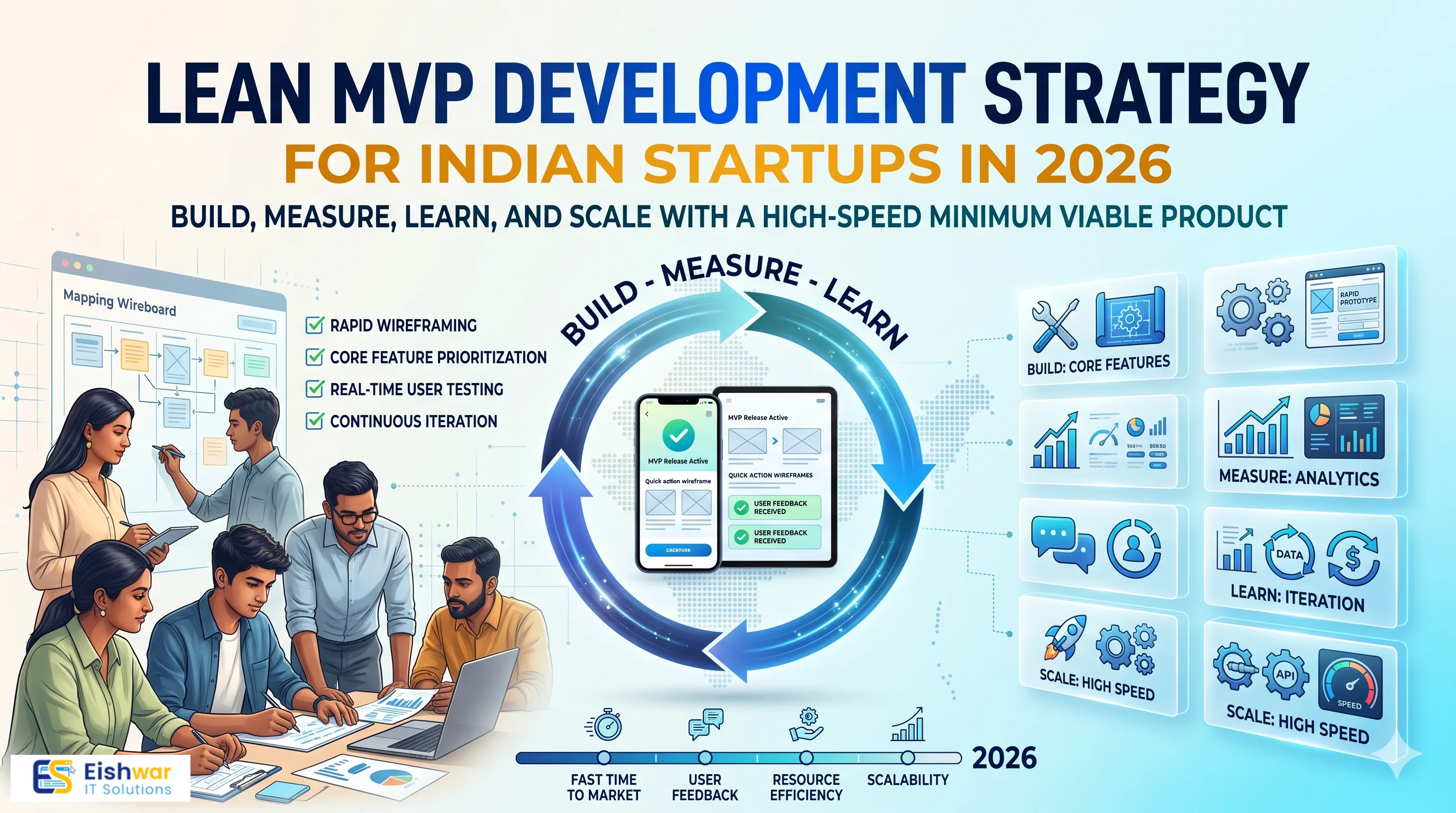
Lean MVP Development Strategy for Indian Startups in 2026
Introduction
In the fast-paced Indian startup ecosystem, speed and efficiency are the new currencies. The traditional approach of building a full-featured product before launching is not only expensive but also risky. Enter the Lean MVP (Minimum Viable Product) approach—a methodology that helps startups test their core hypothesis with minimal resources, gather real user feedback, and iterate quickly. In 2026, Indian startups are increasingly adopting this lean mindset to cut costs and launch faster, avoiding the pitfalls of overbuilding and market misfit.
Consider this: a recent NASSCOM report highlighted that over 60% of Indian startups fail within the first three years, often due to building products that don't meet market needs. The lean MVP approach directly addresses this by ensuring you build only what's necessary to validate your idea. This guide will walk you through the principles of lean MVP, practical steps to implement it, expert tips, common mistakes to avoid, and future trends that will shape MVP development in India. Whether you're a first-time founder or a seasoned entrepreneur, this playbook will empower you to build smarter, not harder.
Main Section 1: Understanding the Lean MVP Approach
What is a Lean MVP?
A Lean MVP is the smallest version of your product that delivers value to early adopters while providing maximum learning about your target market. Unlike a prototype or a proof-of-concept, an MVP is a functional product that solves a real problem for a specific audience. The 'lean' part emphasizes eliminating waste—be it time, money, or features—and focusing on what truly matters: validating your business idea.
For example, when Zomato first launched, it didn't start with a full-fledged food delivery app. Instead, it began as a simple website listing restaurant menus and reviews. This MVP validated the demand for restaurant discovery before they expanded into delivery, payments, and more. That's the essence of lean: start small, learn fast, and scale only when you have evidence.
Why Lean MVP is Critical for Indian Startups
India's startup landscape is unique. With a diverse population, varying price sensitivities, and rapid digital adoption, the need for localized solutions is immense. However, funding is competitive, and the margin for error is thin. A lean MVP allows startups to:
- Test product-market fit without burning through capital. For instance, instead of spending ₹50 lakh on a full product, you can validate with ₹5 lakh.
- Gather actionable insights from real users in different regions. India's cultural and linguistic diversity means what works in Bengaluru may not work in Jaipur. An MVP lets you test across these markets early.
- Pivot quickly based on feedback, reducing the risk of building something nobody wants. A classic example is how Ola started as a cab aggregator but pivoted to include auto-rickshaws and food delivery based on user demand.
- Attract investors by showing traction and a validated business model. Investors in 2026 are more likely to fund startups with a working MVP and real user data than those with just a pitch deck.
Lean vs. Traditional MVP: Key Differences
Traditional MVP development often involves building a comprehensive product with many features, assuming that 'more is better.' The lean approach flips this: it starts with a single core feature that solves a critical pain point. For example, instead of building a full-fledged e-commerce platform, a lean MVP might focus on a simple product listing and checkout process. This not only speeds up development but also reduces initial costs significantly.
Let's break it down with a comparison:
- Scope: Traditional MVP includes 10-15 features; Lean MVP includes 1-3 core features.
- Time to launch: Traditional takes 6-9 months; Lean takes 2-3 months or even weeks with no-code.
- Cost: Traditional can cost ₹20-30 lakhs; Lean can be done for ₹1-5 lakhs.
- Risk: Traditional has high risk of building unwanted features; Lean minimizes risk by focusing on the core hypothesis.
Main Section 2: How to Implement a Lean MVP Strategy
Step 1: Identify the Core Problem
Begin by clearly defining the problem your product solves. Conduct interviews, surveys, and market research to understand your target audience's pain points. In India, this might involve field research in multiple cities to account for cultural and linguistic differences. The goal is to pinpoint a single, urgent problem that your MVP will address.
For instance, if you're building a healthcare app, don't try to solve all health issues. Focus on one problem, like booking doctor appointments, and validate that first. Use tools like Google Forms, Typeform, or even on-ground surveys in local languages to gather insights. Remember, the problem should be so painful that users are willing to pay for a solution.
Step 2: Define Your Value Proposition
What unique value does your product offer? This should be a concise statement that differentiates you from competitors. For Indian startups, this could include localized features, vernacular language support, or affordable pricing. Your MVP should deliver this value proposition in the simplest way possible.
For example, a fintech startup might offer a value proposition like "Instant microloans for small merchants with zero paperwork." This is specific, addresses a pain point, and can be tested with a simple loan application form as an MVP. Avoid vague statements like "We provide the best financial services." Instead, focus on the tangible benefit your user gets.
Step 3: Choose the Right Feature Set
List all potential features and prioritize them based on the 'must-have' versus 'nice-to-have' criteria. Use the MoSCoW method (Must, Should, Could, Won't) to decide what goes into the MVP. For instance, if you're building a food delivery app, the must-haves are restaurant listings, ordering, and payment. Reviews and loyalty programs can wait.
To make this practical, create a simple table:
- Must have: Core functionality that solves the problem (e.g., search, order, pay).
- Should have: Important but not critical for launch (e.g., order tracking).
- Could have: Nice to have if time permits (e.g., recommendations).
- Won't have: Features that can be deferred (e.g., social login).
Stick to the 'Must' list for your MVP. This discipline will save you from scope creep.
Step 4: Select the Fastest Development Approach
In 2026, no-code and low-code platforms are a game-changer. They allow you to build a functional MVP in days, not months, without a large development team. For more complex products, consider using agile development methodologies and cloud-based infrastructure to reduce overheads. Partnering with a reliable development agency in India can also help you navigate technical challenges.
Here are some options:
- No-code platforms: Tools like Bubble, Glide, or FlutterFlow let you build web and mobile apps visually. For example, a local services marketplace could be built in a week using Glide, integrating with Google Sheets for data.
- Low-code platforms: If you need more customization, platforms like OutSystems or Mendix offer pre-built components and faster development.
- Custom development with agile: For complex products, hire a small team (2-3 developers) and use agile sprints. This allows you to launch in 2-3 months with regular feedback loops.
Remember, the goal is speed, not perfection. Choose the approach that gets you to market fastest while maintaining quality.
Step 5: Launch Early and Iterate
Don't wait for perfection. Launch your MVP to a small group of early adopters as soon as it's functional. Collect feedback rigorously—use analytics, user interviews, and surveys. Then iterate based on what you learn. This cycle of build-measure-learn is the essence of the lean approach.
For instance, if you launch a food delivery MVP and notice users abandon the app at the payment step, you can quickly test different payment gateways or offer cash on delivery. This iterative process helps you refine your product based on real user behavior, not assumptions.
Main Section 3: Real-World Examples and Case Studies
Case Study 1: A Local Services Marketplace
A startup in Bengaluru wanted to connect users with local plumbers and electricians. Instead of building a full platform with multiple service categories, they launched a simple website with a WhatsApp integration where users could request a service. This MVP validated demand and allowed them to refine their operations before scaling.
They started by manually assigning service providers to requests, which gave them insights into pricing, response times, and customer satisfaction. After three months, they had enough data to build a more automated system, but the initial MVP cost them only ₹2 lakhs and took 3 weeks to launch. This approach also helped them build a loyal user base who felt involved in the product's evolution.
Case Study 2: Fintech for Small Businesses
A fintech startup targeting small merchants in Mumbai started with a basic invoice generation tool as their MVP. This solved a critical pain point and attracted users quickly. Over time, they added payment processing and credit services based on user feedback. Their lean approach helped them secure funding by demonstrating strong traction.
The initial MVP was a simple web app where merchants could create and send invoices via WhatsApp. It took 6 weeks to build using a low-code platform and cost ₹4 lakhs. Within two months, they had 1,000 merchants using the tool, which gave them the credibility to raise a seed round. The key was focusing on one pain point—invoicing—and doing it exceptionally well.
Case Study 3: EdTech for Vernacular Learning
An edtech startup wanted to offer online courses in regional languages. Their MVP was a simple library of recorded video lessons with a quiz feature. This allowed them to test engagement and content quality without building a complex learning management system. The insights gained guided their expansion into live classes and interactive features.
They started with 20 videos in Hindi and Kannada, hosted on YouTube with a simple website for quizzes. The MVP cost ₹1.5 lakhs and took 2 weeks to set up. By tracking watch time and quiz completion rates, they learned which topics were most popular and which formats worked best. This data-driven approach helped them prioritize future development and attract partnerships with educational institutions.
Expert Tips
- Focus on One Metric: Choose a single key performance indicator (KPI) that reflects success, such as user activation rate or daily active users. Avoid getting lost in multiple metrics. For example, if your MVP is a food delivery app, focus on the percentage of users who complete an order within the first week.
- Embrace Manual Processes: In the early stages, you can manually handle tasks that would normally require automation. For example, instead of building an automated notification system, you can send emails manually. This saves development time and costs. A good example is how many startups manually onboard early users to understand their needs better.
- Use Lean Analytics: Implement simple analytics tools to track user behavior. In India, where internet speeds vary, ensure your MVP is lightweight and loads quickly on low-bandwidth connections. Tools like Google Analytics or Mixpanel can give you insights without heavy implementation.
- Build a Feedback Loop: Create a systematic way to collect and analyze user feedback. Use tools like Google Forms, Typeform, or even direct phone calls to understand user needs. For instance, schedule weekly calls with your first 10 users to get qualitative insights that surveys might miss.
- Leverage Indian Tech Communities: Platforms like Product Hunt India, YourStory, and LinkedIn groups can provide valuable early adopters and feedback. Join these communities to share your MVP and get constructive criticism. Many successful Indian startups have found their first users through these channels.
Common Mistakes
- Overbuilding: Including too many features in the MVP is the most common mistake. Remember, the goal is to test a hypothesis, not to launch a full product. A classic example is a startup that spent 8 months building a comprehensive app with 20 features, only to find that users only used 2 of them. Stick to the core.
- Ignoring User Feedback: Some startups launch an MVP but fail to act on feedback. This defeats the purpose of building an MVP. Always be ready to pivot or make changes. For instance, if users are consistently asking for a feature you didn't include, consider adding it in the next iteration.
- Choosing the Wrong Metrics: Vanity metrics like total downloads or page views can be misleading. Focus on engagement and retention metrics that indicate real value. For example, a high download count but low daily active users suggests your product isn't sticky.
- Scaling Prematurely: Once you see some traction, it's tempting to scale quickly. However, premature scaling can drain resources. Ensure you have a validated, repeatable business model before expanding. A common mistake is hiring a large sales team before you've proven the product-market fit.
- Neglecting Legal and Compliance: In India, startups must comply with data protection laws and other regulations. Ensure your MVP is compliant from day one to avoid legal issues later. For example, if you're handling user data, make sure you have a privacy policy and follow the Digital Personal Data Protection Act (DPDP) 2023.
Future Trends
As we move further into 2026, several trends are shaping lean MVP development in India:
- AI-Powered MVPs: Artificial intelligence is becoming more accessible, allowing startups to build smart features like chatbots and personalized recommendations with minimal coding. For example, an MVP for a customer support tool could use AI to answer common queries, reducing the need for human agents.
- No-Code/Low-Code Dominance: These platforms are becoming more sophisticated, enabling non-technical founders to create MVPs without hiring developers. In 2026, we expect to see even more powerful tools that can handle complex logic and integrations.
- Rise of Micro-SaaS: Niche, cloud-based solutions for specific industries are gaining traction, and lean MVPs are the perfect starting point for these ventures. For instance, a micro-SaaS for managing WhatsApp business messages could be built as an MVP and then scaled.
- Focus on Bharat: With the government's push for digital inclusion, there's a growing focus on building MVPs for Tier 2 and Tier 3 cities, with features like voice support and vernacular languages. Startups that cater to these markets have a huge untapped potential.
- Sustainability and Social Impact: Indian startups are increasingly incorporating sustainability and social responsibility into their MVPs, which resonates well with modern consumers. For example, an MVP for a sustainable fashion brand might focus on eco-friendly materials and transparent supply chains.
FAQs
1. What is the difference between a prototype and a lean MVP?
A prototype is a visual representation of your product, often non-functional, used to test design concepts. A lean MVP is a functional product with just enough features to solve a core problem and gather real user feedback. Prototypes are for internal validation; MVPs are for external validation with real users.
2. How much does it cost to build a lean MVP in India?
The cost varies widely depending on complexity, but a basic lean MVP can be built for ₹1-5 lakhs using no-code tools or a small development team. More complex MVPs may cost ₹10-20 lakhs. For example, a simple booking app might cost ₹2-3 lakhs, while a fintech MVP with payment integration could go up to ₹15 lakhs.
3. How long does it take to launch a lean MVP?
With no-code platforms, you can launch a simple MVP in 2-4 weeks. For custom development, it may take 2-3 months. The key is to prioritize speed and learning over perfection. A good rule of thumb is to set a deadline and stick to it, even if it means cutting features.
4. Can I use a lean MVP to attract investors?
Absolutely. Investors are more likely to fund a startup that has validated its idea with a working MVP and shown traction. A lean MVP demonstrates your ability to execute and iterate efficiently. In fact, many Indian venture capitalists now expect to see an MVP before considering a seed investment.
5. What if my MVP fails?
Failure is a learning opportunity. The lean approach is designed to help you fail fast and cheaply. Use the insights gained to pivot your idea or refine your strategy before investing more resources. For example, if your MVP for a food delivery app fails because users prefer dining out, you might pivot to a restaurant reservation platform.
6. How do I choose the right features for my MVP?
Focus on features that directly address the core problem and provide the most value to users. Use the MoSCoW method to prioritize and avoid scope creep. Start by listing all features, then categorize them as Must, Should, Could, and Won't. Only include the 'Must' features in your MVP.
7. What are the best no-code tools for building an MVP in India?
Popular no-code tools include Bubble for web apps, Glide for mobile apps, and FlutterFlow for more complex mobile apps. These tools are widely used in India and support local payment gateways and integrations. For example, you can integrate Razorpay for payments in a Bubble app easily.
8. How do I get early users for my MVP?
Leverage your network, social media, and online communities. Platforms like Product Hunt India, YourStory, and LinkedIn groups are great places to find early adopters. You can also run targeted ads on Facebook or Instagram to reach your target audience. Offering incentives like free trials or discounts can also attract initial users.
Conclusion
The lean MVP approach is not just a cost-cutting measure; it's a strategic mindset that empowers Indian startups to make data-driven decisions, adapt quickly, and achieve product-market fit with minimal waste. By focusing on the core problem, building a simple yet functional product, and iterating based on real feedback, you can significantly increase your chances of success in the competitive Indian market.
CTA
Ready to launch your lean MVP and outpace the competition? Contact EishwarITSolution today for a free consultation and let our experts help you build a cost-effective, high-impact MVP that resonates with Indian users. Visit eishwar.com to get started!