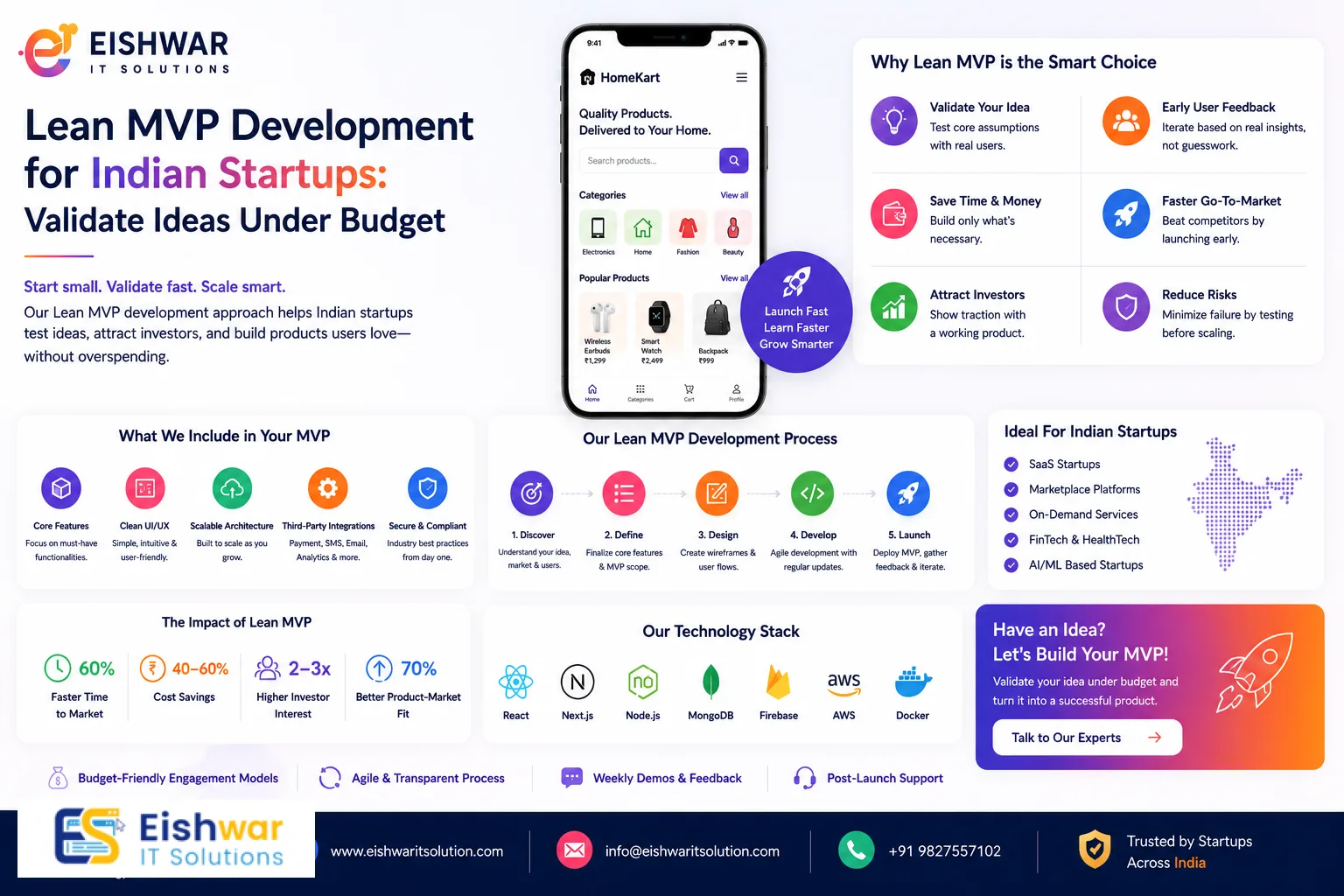
Lean MVP Development for Indian Startups: Validate Ideas Under Budget in 2026
Introduction
Building a startup in India is exciting—but also risky. Many founders spend months and lakhs developing a full product, only to find no one wants it. That’s why lean MVP development is the smartest path forward in 2026. A Minimum Viable Product (MVP) lets you test your core idea with real users using minimal resources. The Indian startup ecosystem is booming, with over 100,000 startups registered, but the failure rate remains high—often due to building products without market validation. By adopting a lean approach, you can avoid these pitfalls and make every rupee count.
At EishwarITSolution, we have helped dozens of Indian startups launch lean MVPs that validated ideas under Rs. 2 lakhs. In this guide, you’ll learn exactly how to do the same—step by step. We’ll cover everything from identifying the right problem to launching and iterating, with practical examples and tips tailored for the Indian context.
Main Section 1: What is a Lean MVP and Why It Matters for Indian Startups?
A lean MVP is the simplest version of your product that solves one core problem for early adopters. It is not a half-baked app—it is a focused solution that collects maximum learning with minimum effort. The term 'lean' comes from the Lean Startup methodology by Eric Ries, which emphasizes build-measure-learn cycles. For Indian startups, this approach is not just a luxury; it’s a necessity.
For Indian startups, lean MVP is crucial because:
- Budget constraints: Most founders are bootstrapped with limited funds. According to a 2025 report, 70% of Indian startups operate with less than Rs. 10 lakhs in initial capital. A lean MVP ensures you don’t burn through savings on unvalidated features.
- Market diversity: India has many languages, regions, and user behaviors—you need validation before scaling. What works in Mumbai may fail in Meerut. A lean MVP lets you test in a specific city or demographic first.
- Speed matters: Competitors move fast. A lean MVP helps you launch in weeks, not months. In 2026, with the rise of AI and no-code tools, the window for first-mover advantage is shrinking. Speed is your biggest asset.
For example, consider a startup aiming to provide affordable healthcare in rural India. Instead of building a full telemedicine platform, they could start with a simple WhatsApp bot that connects patients to doctors. This lean MVP would validate demand, user behavior, and payment willingness before any significant investment.
Main Section 2: Step-by-Step Process to Build a Lean MVP Under Budget
Follow these five steps to create your lean MVP without overspending. Each step is designed to minimize risk and maximize learning.
Step 1: Identify the Core Problem
Talk to at least 20 potential users. Ask about their pain points. For example, if you are building a local grocery delivery app, the core problem might be ‘I want fresh vegetables delivered in 30 minutes’. But don’t stop there—dig deeper. Ask questions like: 'What do you do when you run out of vegetables at 7 PM?' or 'How much are you currently paying for delivery?'. Use tools like Google Forms or Typeform to collect responses, but prioritize in-person or phone interviews for richer insights.
Practical tip: Create a problem statement canvas. Write down the user, their need, and the current workaround. For instance: 'Busy working parents in Bangalore need fresh groceries delivered quickly because they don’t have time to visit the market. Current workaround: They ask neighbors or order from expensive platforms.' This clarity will guide your MVP.
Step 2: Define Your Unique Value Proposition (UVP)
Your UVP should be one sentence. Example: ‘Get farm-fresh vegetables in 30 minutes, no minimum order’. Make sure it’s specific and measurable. A good UVP answers: What do you offer? Who is it for? Why is it better? For instance, instead of 'We deliver groceries,' say 'We deliver organic vegetables from local farms to your doorstep in under 30 minutes, with zero delivery fee for orders above Rs. 200.'
Test your UVP with a simple landing page. Use tools like Carrd or Unbounce to create a page with your UVP and a signup button. Run a small Facebook ad campaign (budget: Rs. 5,000) targeting your ideal users. If you get 50 signups in a week, your UVP resonates.
Step 3: Choose the Right MVP Type
Not all MVPs are apps. Consider:
- Landing page MVP: A simple page explaining your offer with a signup button. Use tools like Carrd or Unbounce. This is great for testing demand before building anything. Example: A startup for personalized fitness plans created a landing page offering 'Customized workout plans for Rs. 499/month.' They got 200 signups in two weeks, validating the idea.
- Concierge MVP: Manually deliver the service to a few users. For example, you personally deliver groceries to test demand. This is labor-intensive but provides deep insights. One of our clients, a laundry service, started by personally picking up and delivering clothes for 10 families in their apartment complex. They learned about pricing, turnaround time, and common complaints.
- Wizard of Oz MVP: Fake the backend. Let users think it’s automated, but you do the work manually. For instance, a startup building an AI-based resume analyzer could manually review resumes and send feedback, pretending it’s automated. This tests if users value the service without building the AI.
- Single-feature app: Build only the core function using no-code tools like Bubble, Adalo, or FlutterFlow. For example, a food delivery app might only have a menu display and order placement feature—no payments, no tracking. This keeps development time under two weeks.
Step 4: Set Success Metrics
Define what ‘validated’ means. Common metrics:
- Number of signups (e.g., 100 in 2 weeks)
- Conversion rate (e.g., 10% of visitors sign up)
- Retention rate (e.g., 40% return after first use)
- User feedback score (e.g., 4/5 satisfaction)
- Revenue (e.g., Rs. 10,000 in first month)
Set a minimum threshold for each metric. For example, 'If we get 50 paying users in 30 days, we proceed to build a full product.' This prevents you from endlessly iterating. Use tools like Google Analytics, Mixpanel, or even a simple spreadsheet to track these metrics.
Step 5: Launch and Iterate
Launch on platforms like Product Hunt India, local startup Facebook groups, or WhatsApp communities. Collect feedback and improve rapidly. For example, if users complain about slow delivery, prioritize that in the next iteration. Use a feedback loop: collect feedback, prioritize changes, implement, and test again.
Practical tip: Set a 2-week iteration cycle. After launch, spend the first week collecting feedback and the second week implementing the top 3 changes. This keeps your MVP evolving without getting stuck in perfectionism.
Main Section 3: Real-World Examples of Lean MVPs in India
Example 1: Zomato’s MVP
Zomato started as a simple PDF menu listing on a website. They manually collected menus from restaurants and shared them online. That lean MVP proved demand before building the full app. Founders Deepinder Goyal and Pankaj Chaddah personally visited restaurants to gather menus. This manual approach cost them virtually nothing but validated that people wanted restaurant information online. Today, Zomato is a multi-billion dollar company.
Example 2: Urban Company (formerly UrbanClap)
They launched with just one service—home cleaning—in one city (Delhi-NCR). They used a simple website and manual coordination. Customers would call, and the team would manually assign cleaners. After validating demand, they expanded to other services and cities. This lean approach allowed them to refine their operations and pricing before scaling.
Example 3: A local edtech startup
One of our clients, a tutoring platform, used a WhatsApp group as their MVP. They posted lesson timings and collected payments manually. Within a month, they had 50 paying students. Then they built a basic booking system using Google Forms and a shared calendar. This cost them less than Rs. 5,000 in setup. Today, they have over 1,000 students and a custom app.
Example 4: A hyperlocal delivery service
A startup in Jaipur wanted to deliver fresh milk and dairy products. Instead of building an app, they created a simple Google Sheet with product lists and shared it via WhatsApp. Customers would message their orders, and the founder would manually coordinate deliveries. Within three months, they had 200 regular customers. Only then did they invest in a basic ordering system using Shopify.
Expert Tips
- Start with a problem, not a solution. Many founders fall in love with their idea. Validate the problem first. Use the 'Five Whys' technique to get to the root cause.
- Use no-code tools aggressively. Platforms like Bubble, Glide, and Airtable can build functional MVPs in days. For example, Glide can turn a Google Sheet into a mobile app in hours.
- Charge from day one. Even a small fee (Rs. 99) shows real commitment from users. Free users often don’t provide genuine feedback. A nominal fee filters out casual interest.
- Talk to 5 users every week. Direct feedback is gold. Schedule 15-minute calls or send personalized emails. Ask: 'What’s the one thing we should improve?'
- Keep your team lean. Two co-founders and a freelancer are enough for an MVP. Use platforms like Upwork or Fiverr for specific tasks like design or development.
- Focus on one platform. Don’t try to be everywhere. If your target users are on WhatsApp, build there. If they use Instagram, use that. This reduces complexity and cost.
Common Mistakes
- Building too many features. The biggest mistake. Stick to one core feature. Remember the 80/20 rule: 80% of value comes from 20% of features.
- Ignoring user feedback. If users say the problem is not real, pivot. Don’t fall in love with your solution. Be ready to change direction.
- Over-engineering the backend. Use existing tools. Don’t build custom code unless necessary. For example, use Stripe for payments, Twilio for SMS, and Firebase for database.
- Not defining success criteria. Without clear metrics, you won’t know if the idea is validated. Set specific, measurable goals before launch.
- Spending on marketing too early. Focus on organic reach and personal networks first. Use word-of-mouth, social media posts, and community groups. Paid ads can come later.
- Scaling too fast. If your MVP shows early signs of success, resist the urge to scale immediately. Validate the model thoroughly before investing in infrastructure.
Future Trends
In 2026, lean MVP development will be shaped by:
- AI-assisted prototyping: Tools like ChatGPT and DALL·E can help generate copy and design ideas instantly. For example, you can use ChatGPT to write landing page copy and DALL·E to create mockups. This reduces the time from idea to prototype to days.
- Low-code/no-code explosion: More Indian founders will use platforms like FlutterFlow and Retool. FlutterFlow allows you to build native mobile apps without coding, while Retool is great for internal tools. This democratizes development, allowing non-technical founders to build MVPs.
- Hyperlocal validation: Startups will test MVPs in specific Indian cities (e.g., tier-2 towns like Lucknow or Coimbatore) before scaling. This reduces risk and allows for localized marketing. For instance, a food delivery startup might test in a single locality before expanding city-wide.
- Voice-first MVPs: With voice search growing, some startups will validate ideas using voice bots on WhatsApp. For example, a healthcare startup could build a voice bot that answers common health queries, testing if users prefer voice over text.
- Integration with UPI: With UPI payments being ubiquitous, MVPs can easily integrate payment gateways like Razorpay or PhonePe. This makes it simple to charge users from day one.
FAQs
Q1: How much does a lean MVP cost in India?
A: A lean MVP can cost anywhere from Rs. 50,000 to Rs. 3 lakhs depending on complexity. Using no-code tools can keep it under Rs. 1 lakh. For example, a landing page MVP might cost just Rs. 10,000 (domain + hosting + tool subscription), while a single-feature app might cost Rs. 50,000 to Rs. 1 lakh if you hire a freelancer.
Q2: How long does it take to build an MVP?
A: With no-code tools, 2-4 weeks. With custom code, 6-12 weeks. The timeline also depends on how quickly you can gather user feedback. For a concierge MVP, you can start in a day.
Q3: What if my MVP fails?
A: Failure is learning. You will know what doesn’t work, saving you from bigger losses later. Many successful startups pivoted after their initial MVP failed. For example, Slack started as a gaming company. Use the insights to refine your idea or try a different problem.
Q4: Do I need a technical co-founder?
A: Not necessarily. No-code tools let you build without coding. But a technical co-founder helps for complex products or when you need to scale. If you’re non-technical, consider partnering with a freelancer or agency for the MVP phase.
Q5: Can I use the MVP for fundraising?
A: Yes. Investors love seeing real user traction. Even 100 active users can be powerful. A lean MVP with positive metrics (e.g., 20% week-over-week growth) can help you raise a seed round. Be prepared to show your learning and iteration process.
Q6: Should I launch on Google Play or App Store?
A: Only if your MVP needs native features. Otherwise, a web app or PWA (Progressive Web App) is faster and cheaper. PWAs work on both Android and iOS and can be shared via a link. They also don’t require app store approval, saving time.
Q7: How do I find early users for my MVP?
A: Start with your personal network—friends, family, and colleagues. Then expand to relevant online communities (e.g., Facebook groups, Reddit, LinkedIn groups). Offer incentives like discounts or free trials. For example, a fitness app could offer the first month free for early adopters.
Q8: What tools are best for building a no-code MVP?
A: For web apps, use Bubble or Adalo. For mobile apps, use FlutterFlow or Glide. For landing pages, use Carrd or Unbounce. For databases, use Airtable or Google Sheets. For payments, use Razorpay or Stripe. These tools are affordable and have free tiers.
Conclusion
Lean MVP development is the smartest way for Indian startups to validate ideas without wasting time and money. By focusing on a single problem, using no-code tools, and listening to users, you can launch in weeks and iterate fast. The key is to start small, learn quickly, and scale only when validated. Remember, every successful startup began with a simple experiment. Your MVP is not the end product—it’s the beginning of a journey. Embrace the process, stay flexible, and keep your users at the center.
Ready to build your lean MVP? EishwarITSolution specializes in helping Indian startups create cost-effective MVPs. Contact us today for a free consultation.
CTA
Ready to turn your idea into a validated MVP? Get in touch with EishwarITSolution for a free 30-minute strategy session. Let’s build something lean and smart.